BART
BART on July 11 presented its annual Sustainability Report (download below) to the Board of Directors, detailing its accomplishments of 2023.
“BART’s sustainability efforts were all about innovation in 2023,” said BART Board President Bevan Dufty. “We are dedicated to integrating creative solutions that not only improve the rider experience, our immediate priority, but also emphasize long-term sustainability.”
Established more than 50 years ago with a vision to “alleviate regional traffic congestion through eco-friendly transit options,” BART says it has continually evolved its practices to reflect contemporary environmental standards. Notably, engineers initially opted to power trains with electricity rather than fuel, “a decision that laid the foundation for ongoing sustainability achievements,” the agency noted.
BART hosted a memorable “retirement party” in February 2024, marking the culmination of efforts to retire older vehicles. Thousands of attendees gathered to bid farewell to the trains that had served millions of passengers over the years. The decommissioned cars are being repurposed for various projects, including a BART car short-term rental in the Sierra Nevada and a youth bike shop and clubhouse in East Oakland, demonstrating BART’s commitment to sustainability beyond transit operations.
According to the agency, the introduction of new, energy-efficient train cars has furthered BART’s sustainability goals, boasting a 7% reduction in energy consumption compared to previous train car models. By running shorter trains during off-peak hours, BART says it has achieved significant energy savings: 88% of BART’s electricity comes from greenhouse gas-free sources like solar, wind, and hydropower.
“Our shorter trains not only save energy and reduce costs but also enhance safety and efficiency in maintenance,” BART General Manager Bob Powers added. “These innovations underscore our holistic approach to sustainability across all facets of our operations.”
In addition to transit improvements, BART expanded its Transit-Oriented Development (TOD) program, constructing 531 new housing units near BART stations. Projects like the Gateway at Millbrae Station and the Upper Yard at Balboa Park Station “not only address regional housing needs but also promote sustainable urban development and economic revitalization,” the agency noted.
Highlighting unique environmental initiatives, BART’s Sheep and Goat Fire Mitigation program has grown substantially, utilizing more than 500 grazers to mitigate fire risks across its properties. Meanwhile, the Falconry-Based Nuisance Bird Control program, now implemented at 12 stations, effectively manages pigeon populations through pesticide-free methods.
More information is available here.
PANYNJ
PANYNJ on July 12 announced that more than half of PATH riders are now using the commuter rail’s new tap-and-go fare payment system, with the percentage of PATH riders using TAPP consistently surpassing 50% of all riders each week. In the seven months since its introduction, PATH has recorded more than 7.6 million TAPP entries.
According to PANYNJ, TAPP (Total Access PATH Payment) allows passengers to pay their fare at select turnstiles with the tap of a contactless debit/credit card, smartphone or wearable device, instead of the PATH-issued SmartLink cards or pay-per-ride MetroCards that have been traditionally used.
More than 51% of PATH customers used TAPP to pay their fare during the week of July 1, which was consistent with the two weeks prior. Over this three-week span, an average of about 83,000 riders used TAPP each weekday. The figure was about 58,000 riders on weekends.
The speedy adoption of TAPP among PATH’s ridership has coincided with a steady growth in the number of system turnstiles equipped with TAPP readers, according to the agency. Of the system’s 318 standard gates, 172 now accept the new fare option. TAPP-enabled fare gates are available at all PATH stations in both New York and New Jersey.
The TAPP pilot launched in December 2023, part of the first phase in replacing PATH’s legacy Smartlink and MetroCard fare payment system installed in 2008. As TAPP is phased in throughout the system, equipment supporting SmartLink and MetroCard will remain operational as more customers become familiar with the new fare payment alternative. Existing PATH discounts for SmartLink users remain in effect and will be available when PATH issues a TAPP fare card.
The new system has received wide praise from customers and industry stakeholders alike. TAPP was recently recognized by the Intelligent Transportation Society-New York for innovation, winning the group’s 2024 “Project of the Year Award” for outstanding transportation initiatives.
“We’re thrilled to see record numbers of PATH riders TAPPing into the most convenient way to pay their fare,” said PANYNJ Chairman Kevin O’Toole. “A majority of PATH customers are now seeing firsthand the efficiency and peace of mind that comes with simply tapping your card, phone or watch and breezing onto your train.”
“As PATH customers have now found out more than 7.6 million times, there is no easier or quicker way to pay your fare than with a simple tap,” said PANYNJ Executive Director Rick Cotton. “TAPP is one of many investments customers are seeing as we deliver on our commitment to continue to improve the PATH travel experience.”
“The success of TAPP is measured through these key milestones as we modernize fare payment for our customers,” said PATH General Manager and Director Clarelle DeGraffe. “We’ve turned a corner, with more than half of our ridership consistently opting for the new fare system, making their ride more accessible and convenient.”
MTA Metro-North
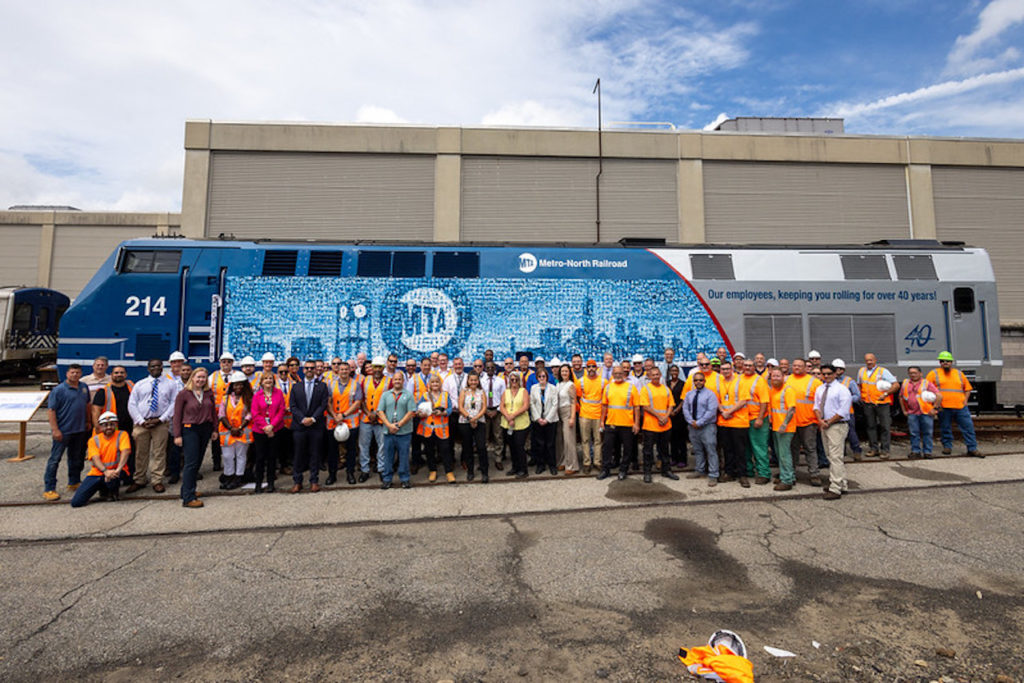
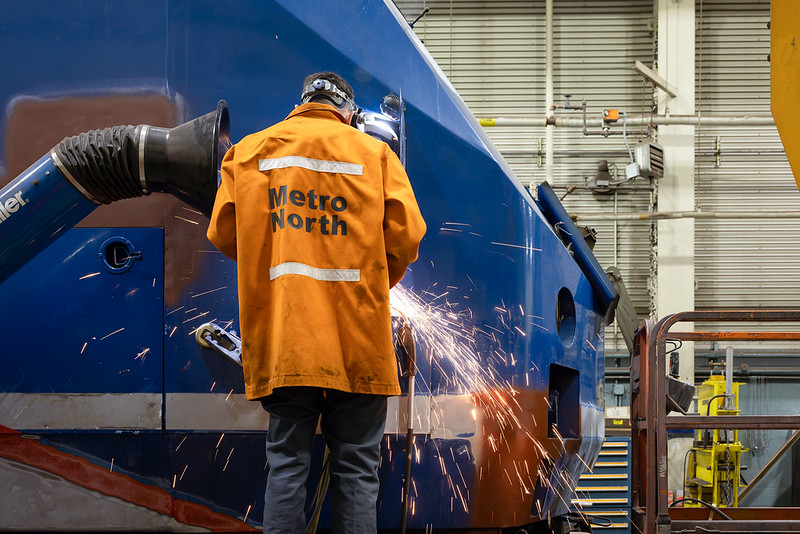
MTA’s Metro-North Railroad has rebranded a fifth locomotive with special colors and designs as part of a Heritage Series to highlight the railroad’s 40 years of service to the public. Unlike the previous four rebrands, the rebranding of locomotive No. 214 pays tribute to the Metro-North workforce. Skilled craft workers at Metro-North’s North White Plains Shop restored locomotive No. 214, and a wrap was applied featuring pictures of past and present Metro-North workers.
The full-size mosaic images, created from the individual employee photographs, on each side of the locomotive are representative of Metro-North’s East of Hudson lines, with the clock tower at White Plains station representing the Harlem Line, a New York Cityscape representing the Grand Central, a view of the Hudson River from the Bear Mountain Bridge for the Hudson Line and Bridgeport’s Black Rock Harbor Lighthouse for the New Haven Line. As a historical nod, one side of the locomotive uses the old two-toned “M” logo of the MTA, and the other side uses the modern MTA logo.
“All the progress Metro-North has made since 1983 can be credited to the faces you see on this train,” said Metro-North Railroad President Catherine Rinaldi. “When customers and rail enthusiasts see this employee tribute locomotive on the rails, I hope they use it as a reminder to thank Metro-North employees for the work they do every day to keep our system safe and our trains on the move.”
The employee tribute rebrand will make its way to employee facilities following a special ceremony held on July 12 at North White Plains.
The last rebranded locomotive hit the rails in March, and paid tribute to Penn Central, one of Metro-North’s predecessor railroads. In the spring of 1970, the MTA signed an agreement with the Penn Central Railroad Corporation to subsidize the operations of the Hudson, Harlem and New Haven commuter rail lines, which would later become the core rail lines that would make up Metro-North Railroad in 1983.
The third rebranded locomotive paid tribute to New York Central, the predecessor railroad that operated on the Hudson and Harlem lines. Metro-North’s locomotive No. 211, made its debut run on the Hudson Line, Tuesday, Nov. 14, 2023.
The second rebranded locomotive paid tribute to Conrail, the railroad which is Metro-North’s immediate predecessor. The train made its debut on the Hudson Line Monday, Aug. 14, 2023. The design of the wrap mimics the paint scheme applied to older FL9 locomotives that Conrail operated for the MTA over the Hudson, Harlem, and New Haven Lines from 1976 to 1982. Metro-North’s locomotive No. 201 is one of 31 P32ACDM models the railroad uses to provide service on the northern Hudson and Harlem Lines and the New Haven Line’s Danbury and Waterbury Branches.
The first rebrand in the series was locomotive No. 208, which made its debut in May 2023 with a vinyl wrap of silver, blue, and red to pay homage to Metro-North’s original design. The design was created upon the railroad’s founding in 1983 for the railroad’s historic FL9 locomotives and worn by them until the last was retired in April 2007.
The wrapped locomotives will remain in service for the foreseeable future.