Transit Briefs: BART, MBTA, Hill International/SCVTA, CTA, ACE
BART
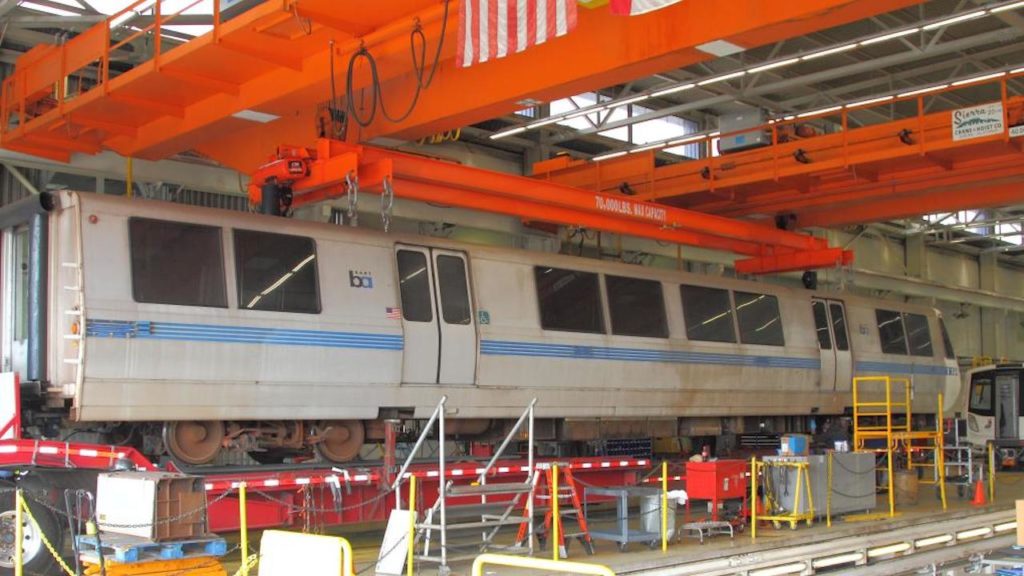
On Aug. 9, WRM received the first of three decommissioned legacy BART cars for its forthcoming Rapid Transit History Center.
The museum was awarded the three retired cars—an A, B, and C car—following a call for proposals in 2021 that selected eight recipients to receive decommissioned cars (two recipients later declined). BART officially retired its legacy fleet, which carried passengers for more than 50 years since the opening of the system, at a ceremony and final ride in April 2024. All 55 trains in service are now made up of new cars.
“BART’s legacy cars have a tremendous sentimental value with passengers in the greater San Francisco Bay Area, and we wanted to ensure the historic vehicles would have a second life, or more accurately, second lives,” the agency stated. The chosen six groups will reuse their cars for a multitude of purposes, including a short-term rental in the Sierras, a bike shop and clubhouse for Oakland youth, a dining car with retro arcade games, and more. The Hayward Fire Department picked up their car earlier this year for its new Regional Fire Training Center.
There was one major catch the recipients had to agree to: BART would give the cars to the groups for free, but they had to transport the cars from their temporary home at BART’s Hayward shops to their final destinations.
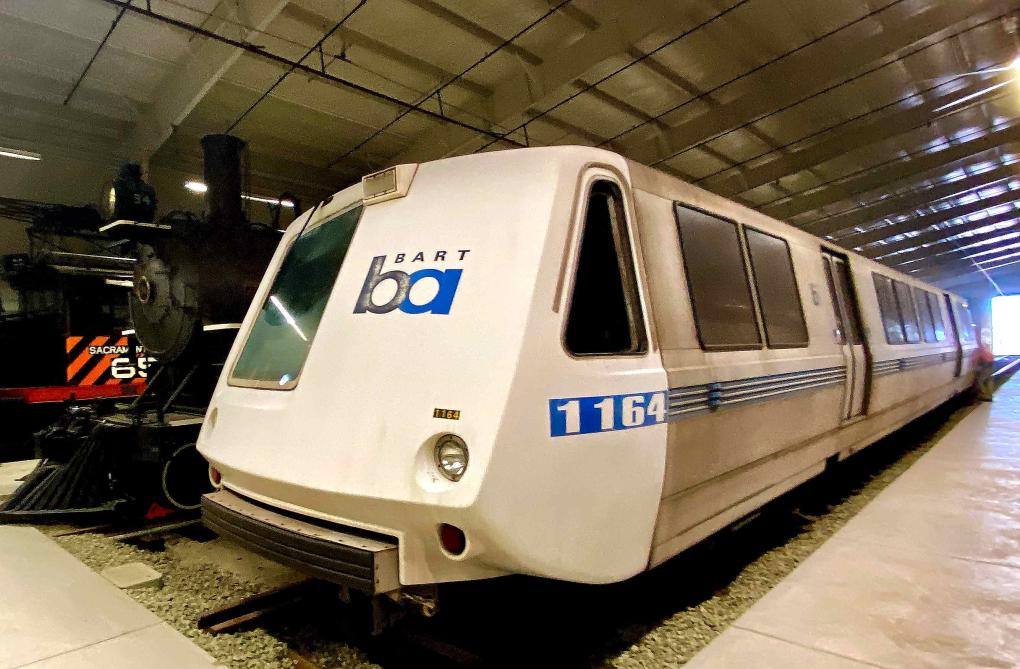
WRM raised money to make sure they could get the cars to their new temporary home in Car House 3 until their proposed Rapid Transit History Center is completed. The history center will educate the public about BART and its history of innovation. In addition to the three cars, which the public will be able to enter and explore, the center will include displays, videos, a set of wheels from the front of a cab car, third rail equipment, and the antennas that enable the train to pick up power and communicate with train control. In all, the history center will celebrate the “amazing technology of the ‘world’s first’ automated rapid transit system,” said Bob Simon, a retired BART Engineering and Operations Manager who sits on WRM’s Board of Directors.
“The creation and implementation of cutting-edge technologies began with BART’s visionaries understanding the great challenge to design a new transit concept. They were not unlike the visionaries who went on to build Silicon Valley,” he continued, offering his thanks for the support and enthusiasm of BART General Manager Bob Powers, the BART Board of Directors, and the museum’s dedicated volunteers and staff.
So, what does it take to move a BART car? WRM staff found out firsthand on Aug. 9 when they showed up to the Hayward shops with a flatbed truck and helping hands. BART employees prepared for their visit by transferring car #1164 from its holding track (where the soon-to-be-decommissioned legacy cars are held) to the shop bay with a crane.
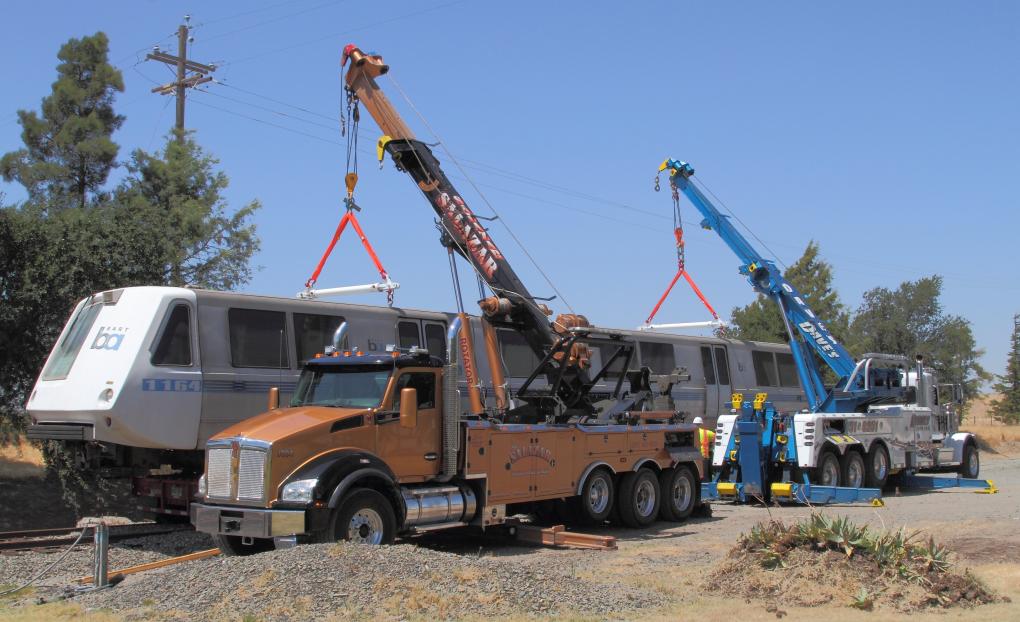
When the truck arrived from Salazar Heavy Haul—the same company that delivered BART’s Fleet of the Future cars—BART staff hooked the car up to the crane and attempted to load it on the bed. There was an unforeseen problem: The undercar equipment was just a few inches too big for the truck bed, so BART staff had to improvise by removing the battery box and HVAC underneath it. Most decommissioned cars won’t have this problem as they’ll be picked up with the wheels and mounts removed. That wouldn’t do for WRM, however.
“They want everything on the cars, so they are as authentic as possible,” explained Brian Tsukamoto, BART Manager of Special Projects – Decommissioning. “They’ll be coming back to pick up the battery box and HVAC.”
Once the temporarily modified car was loaded and secured by the highly skilled driver, it was on its way from Hayward to Suisun City up north. A sign in its front window read: “I’m going to the Western Railway Museum.”
At the museum, the team unloaded the car from the truck using a rented crane and used conversion dollies to allow the car, built for BART’s wide gauge, to be maneuvered on their standard-gauge track. Then, using a former Muni work train locomotive, they zig-zagged the car to Car House 3 and unloaded it onto the BART gauge track they built for it. To save on cutting concrete and rebar, a steel rail strap bridge was fabricated to get the car over the car house door foundation and the public walkway to its platform.
The process will soon be repeated with the B and C cars, which the museum is working to schedule with BART staff and Salazar Heavy Haul.
MBTA
MBTA on Aug. 14 announced that it is expanding access to reduced fares for income-eligible riders beginning Wednesday, Sept.4, 2024.
The online application is simple and can be completed in English, Spanish, Portuguese, simplified Chinese, Haitian-Creole, or Vietnamese. The launch will also include the availability of in-person support at five locations around the MBTA service area in partnership with Action for Boston Community Development (ABCD) and the Massachusetts Association for Community Action (MASSCAP) network. An additional 31 locations will become available for service over fall 2024. Following input from critical stakeholder groups, a pool of “early adopters” of the program will be able to apply online beginning Tuesday, Aug. 20, 2024. More information is available here.
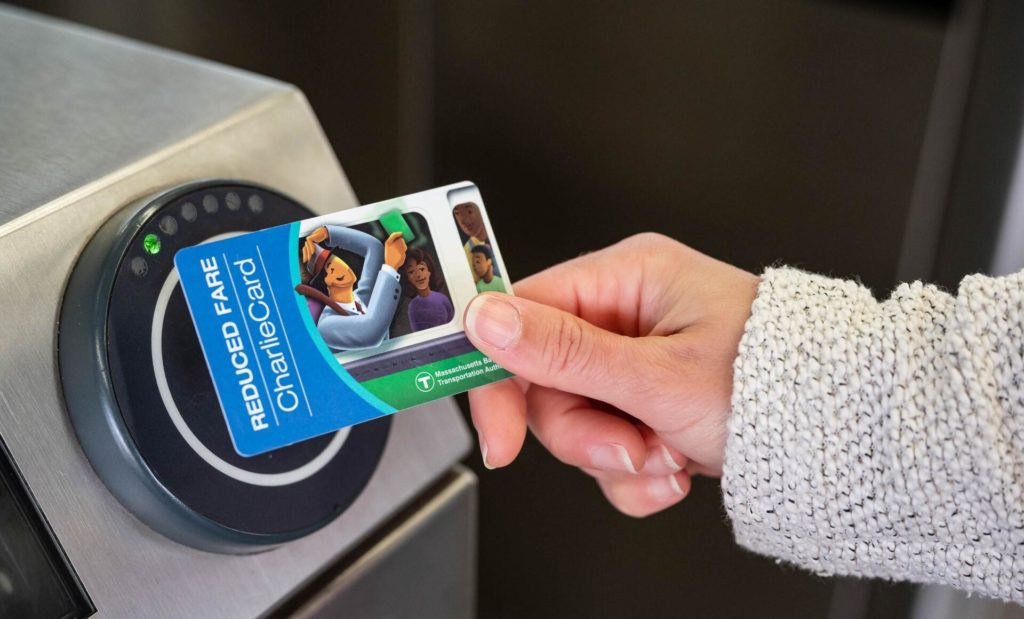
A “meaningful improvement for fare equity,” the new program provides riders who are aged 18-64 and have low income with reduced one-way fares of approximately 50% off on all MBTA buses, subway, Commuter Rail, and paratransit (The RIDE) travel. This, the agency says, “unlocks affordability for residents across the MBTA service area, including in the Gateway Cities.” This expansion will be the first reduced fare program to include The RIDE. As part of this change, Senior users of The RIDE will also be eligible for half-priced fares on both Standard and Premium RIDE trips.
Riders with low income will be able to apply in multiple languages online at mbta.com/income-eligible and at five in-person locations provided by ABCD and MASSCAP around the MBTA service area. Program participants can demonstrate eligibility via existing enrollment in programs with a cutoff of 200% of the federal poverty level (or lower), including Supplemental Nutrition Assistance Program (SNAP), Transitional Assistance for Families and Dependent Children (TAFDC), Emergency Aid to the Elderly, Disabled & Children (EAEDC), MassHealth CarePlus, MassHealth Family Assistance, MassHealth Limited, MassHealth Standard, and MASSGrant.
As part of the program launch on Sept. 4, RIDE customers enrolled in the Senior or income-eligible reduced fare programs will also be able to use an online form to link their reduced fare eligibility to their RIDE accounts and receive a discounted rate on Standard or Premium RIDE trips. Additionally, young people with low income already enrolled in the Youth Pass will be guided to enroll in the new program beginning on Sep. 4 with the Youth Pass program discontinued on Oct. 31.
According to prior research, riders with low income are expected to take 30% more trips with a reduced fare, significantly increasing mobility while saving on transportation costs, MBTA noted. More than 60,000 riders are expected to qualify for and enroll in the program, which is expected to result in up to eight million more trips per year.
The initiative is thanks to the collaboration of multiple partners across the Commonwealth with the MBTA, including the Commonwealth’s Executive Office of Health and Human Services (EOHHS) in allowing riders to demonstrate eligibility through existing EOHHS programs; the Registry of Motor Vehicles (RMV) in allowing riders to offer proof of identity through an RMV ID; ABCD and the MASSCAP Network in providing in-person support; and Omicron Technology Solutions in providing additional application reviews.
“This is a critical step in making transit more affordable for those that need it the most,” said MBTA General Manager and CEO Phillip Eng. “I thank Secretary Tibbits-Nutt for her advocacy of this initiative, the Governor and the Legislature for their foresight to include funds in our FY24 and FY25 budgets to enable us to develop this program, our numerous partners at the EOHHS, the RMV, ABCD, MASSCAP, and Omicron Technology Solutions who were instrumental in helping us launch this program, and the many advocates who have for years championed this initiative, which will benefit so many across all modes. This is a meaningful step that allows all of the public that rely on mass transportation to use it, improving quality of life, boosting economic mobility, and connecting people and communities.”
Hill International/SCVTA
Hill International, Inc. announced Aug. 14 that it has been selected SCVTA to continue to provide PMSS and staff augmentation services to deliver capital improvements (from planning through operations on an as needed basis), including highway, roadway, pedestrian/bicycle, transit and facility projects. Hill has served as SCVTA’s PMSS partner since 2017, and this new award extends Hill’s work with the agency through 2029.
SCVTA acts as an independent special district responsible for bus and light rail operations, congestion management, specific highway improvement projects, and countywide transportation planning. The agency’s currently approved capital program is approximately $2.6 billion and encompasses projects in support of a bus fleet of 435 buses serving a 346-square mile urbanized service area, a 42.2-mile light rail system served by 98 rail cars and 5 historic trolley cars, and associated road, bridge, and highway improvements and maintenance.
Hill’s services will entail as-need project management, construction management, resident engineering, inspection, project controls, and other support in such specialty areas as procurement, safety and security, outreach, and materials testing.
“I’ve lived and worked in the Santa Clara Valley for nearly 30 years and know the good work VTA is doing first-hand,” said Hill First Vice President, Northern California Operations Andy Kreck, PE, CCM. “I’m proud we’ve assembled such a strong team to continue our work with VTA, and I’m excited to move forward into the next phase of VTA’s capital program.”
“U.S. infrastructure will always be a focus for Hill,” added Hill CEO Raouf S. Ghali. “Our work over the years with VTA showcases the value we add at all levels to our clients, and with the commitment of leaders like Andy, I know VTA will continue to enjoy the best PM/CM talent and innovations our industry has to offer.”
CTA
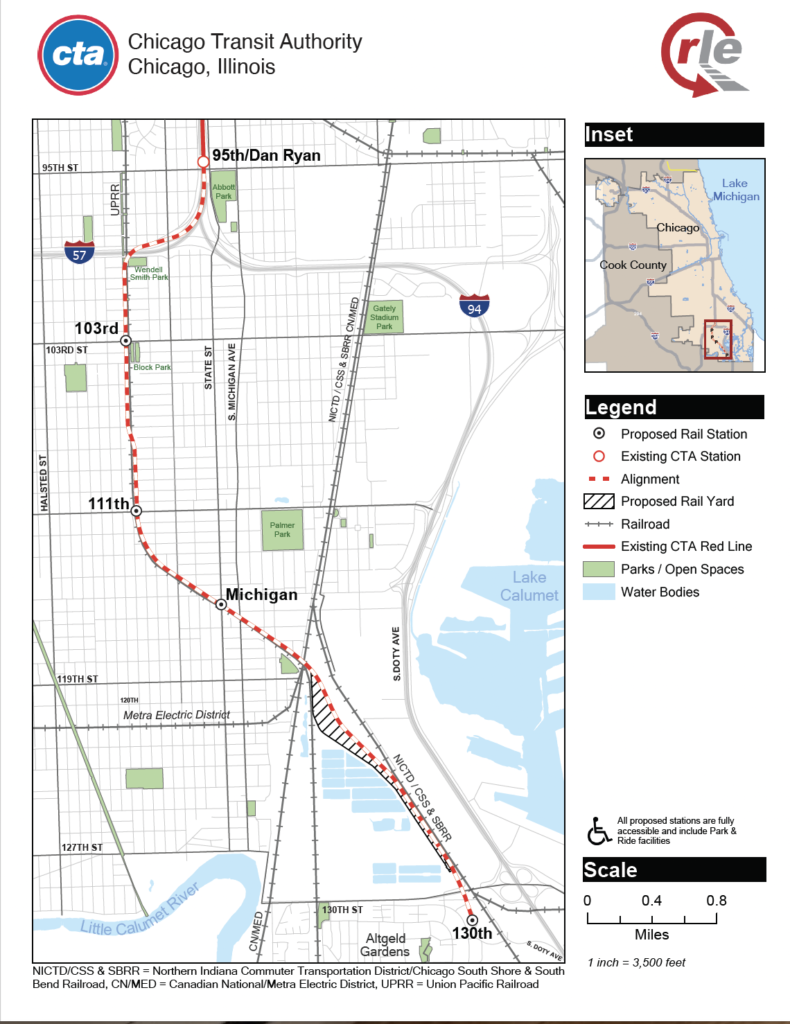
CTA announced Aug. 14 that it has taken the next major step in the RLE Project by selecting Walsh-VINCI Transit Community Partners to design and build the 5.6-mile extension of the Red Line from 95th Street to 130th Street, including four new Red Line stations.
The Chicago Transit Board approved the award of a $2.9 billion contract to Walsh-VINCI Transit Community Partners following a comprehensive, two-year procurement process.
RLE is the largest project in CTA history and will provide faster connections from the Far South Side to the rest of the city while serving as an “economic catalyst to one of the most disinvested parts of Chicago,” the agency noted. “The RLE is a transit equity project that fulfills a commitment to the Far South Side by significantly improving transportation to this part of the city with 5.6 miles of new track and four new fully accessible rail stations at 103rd, 111th, Michigan near 116th and 130th Street,” CTA said.
By selecting the team that provided the best value to design and build the RLE Mainline Project, the CTA has reached yet another significant milestone for this historic project.
According to CTA, RLE is a critical project for Chicago because:
- “The Far South Side is the only area where CTA’s rail rapid transit service stops short of the city border.
- “Communities here are largely populated with low-income, minority residents.
- “For more than 50 years residents have been promised the line would be extended.”
“The Red Line Extension corrects past transit inequity and increases access to the most affordable transportation in the city. Hiring the contracting team that can provide the best value to the CTA to construct the RLE is a consequential step that demonstrates our vow to build this project,” said CTA President Dorval R. Carter, Jr. “The CTA’s Red Line Extension Project is an example of how transportation dollars can be distributed to have lasting impact on the Far South Side including workforce and small business opportunities that create jobs and support families.”
Construction is expected to start in late 2025 and be completed by 2030.
According to CTA, the project’s budget has increased to $5.3 billion, which includes financing expenses, to cover cost increases for construction materials, labor and financing. The prior project budget was $3.6 billion before finance charges and $4.1 billion including financing costs. CTA is moving forward with the project to fulfill the long-ago promise to the Far South Side that the RLE would be built. “Delaying the project would potentially increase the budget by several billions of dollars,” the agency noted. Factors affecting the RLE project budget change include:
- “A more than 60% increase in construction labor and materials costs 2020-2023, according to the Federal Highway Administration’s National Highway Construction Cost Index.
- “Higher interest rates.
- “Continued uncertainty and predictability around material delivery.
- “Large pipeline of projects, particularly for civil infrastructure projects.”
CTA says it intends to secure funding for the budget increase with CTA-issued bonds.
ACE
Levi’s® Stadium and the San Joaquin Regional Rail Commission (SJRRC) announced Aug. 14 that they will be renewing their partnership to encourage visitors to take public transportation to select events hosted at the stadium.
The goal, SJRRC says, is to make sure that attendees from the Central Valley and Tri-Valley have a convenient, car-free option to reach the stadium with special train service provided by ACE, which serves the Santa Clara Great America Station, just steps away from the stadium.
ACE plans to run service to and from Levi’s® Stadium for seven, regular season home games for the San Francisco 49ers. Beginning with the 49ers vs. the Patriots on Sunday, Sept. 29, 2024. This initiative is designed to offer fans a seamless journey to and from the stadium.
“Over the past 10 years, we have cultivated an award-winning fan experience that serves to provide safe and memorable experiences for all fans. Having multiple transportation options is a big part of that,” said Francine Melendez Hughes, Executive Vice President & General Manager, Stadium Operations. “ACE is an important part of our game day experience, and we are grateful to have them as a community partner.”
Special Event Train tickets will be required to travel on ACE for these special trains. For fans that plan to attend games throughout the season, for a limited time, ACE will be offering its own season pass train ticket, which will cover the cost of the seven home games for the price of six. “First time riders of ACE can expect a comfortable ride with cozy seats, free-Wi-Fi, restrooms, charging outlets, and more, making travel easy for all travelers including families, seniors, and individuals with disabilities,” according to SJRRC.
“As a commuter train service, we value the importance and ease of connectivity for work, and are delighted to, once again, partner with Levi’s® Stadium in an effort to provide a safe and enjoyable transportation option for leisure travel,” said Nancy Young, SJRRC Board Chair. “We want fans to be able to cheer on their team, allowing them to focus entirely on enjoying the game-day experience.”