BART
BART ridership growth is starting the new year on a positive note, with January counts showing continued growth, including several weekdays that surpassed 200,000 trips, the agency recently reported. While ridership continues to bounce back, BART says it is “still far off from its pre-pandemic ridership, largely due to hybrid work patterns.”
The January 2026 Monthly Ridership Snapshot (download below) reports nearly 4.6 million paid exits, a 10.7% increase compared with January 2025. Average weekday ridership reached 182,487 trips, “reflecting consistent demand and building on the gradual recovery seen over the past years.”
BART also saw significant ridership increases during major events, including on Jan. 17 for the Bob Weir public memorial at Civic Center and the TWICE concert at the Oakland Arena, for which BART ran longer trains.
January Highlights
- Total exits: 4.6 million
- Average weekday: 182,487
- Year-over-year growth: +10.7%
- Busiest day: Jan. 28 with 207,343 trips
Tap and Ride and Clipper START Usage Increase
Tap and Ride usage grew 15.5% in January compared to December, as more riders used contactless bank cards or mobile wallets to pay at the fare gates. In all, 14% of total BART trips were taken using Tap and Ride in January.
Usage of Clipper START, the 50% fare discount for low-income riders, rose 32.6% year over year in January.
Even with encouraging ridership gains, fare revenue is not enough on its own to stabilize BART’s finances, the agency noted. “Like many transit agencies nationwide, BART faces a structural budget deficit as remote and hybrid work patterns reduce weekday commute trips, which is historically the system’s largest source of fare revenue. While individual riders have returned to BART, they are riding less frequently.”
MBTA
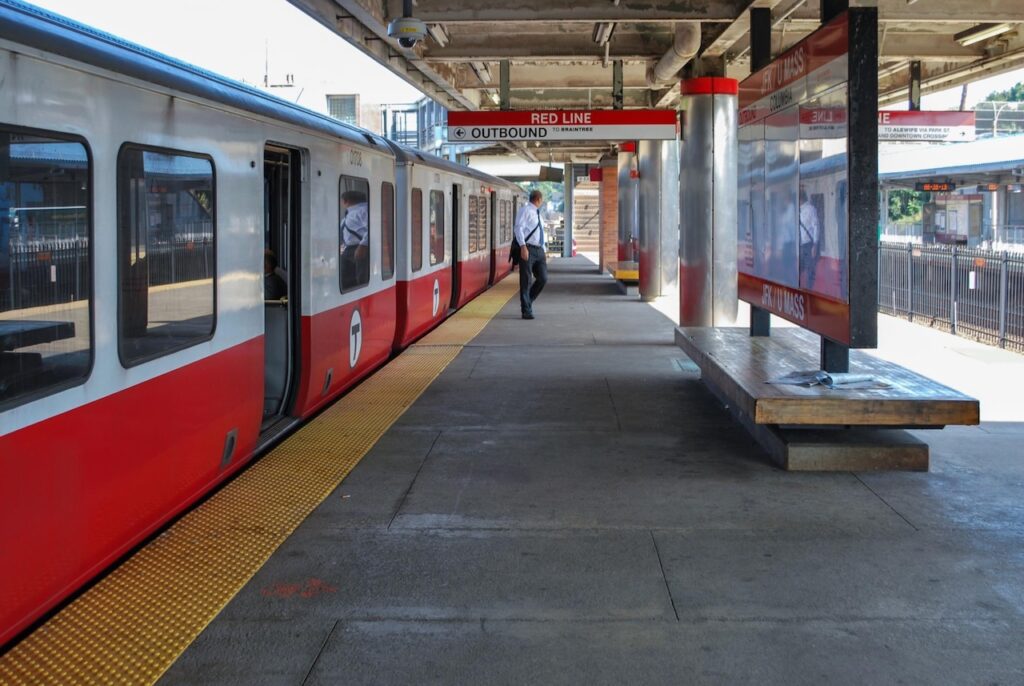
The MBTA on Feb. 24 announced that critical signal modernization work is taking place on the Red Line at Columbia Junction near JFK/UMass station while crews complete testing and cutover to the new, digital signaling system in this area.
This work, the MBTA says, “will bring important upgrades that will strengthen Red Line service reliability for riders, providing the ability to route trains more quickly, turn trains around faster, and recover from unplanned disruptions more efficiently.” To accomplish this work, four phases of temporary evening service changes will begin on Feb. 28 and continue through April.
“The long-overdue work at Columbia Junction completes signal updates that should have been accomplished after the 2019 Red Line derailment. We’re taking the time now to do the work correctly, modernize the system, and improve the Red Line’s reliability long-term,” said Interim MassDOT Secretary and MBTA General Manager Phillip Eng. “By doing this work in a phased evening approach instead of a full shutdown, we’re also delivering essential improvements while minimizing disruption for riders. I thank riders for their patience while we accomplish this critical work.”
Columbia Junction is the complex area of track just north of JFK/UMass that merges the Ashmont and Braintree branches and connects the Red Line’s main passenger track to the Cabot Yard Maintenance Facility where the majority of the Red Line fleet is stored and maintained.
The signal system in this area was significantly damaged following the major derailment of a Red Line train in 2019. Initial repairs restored service at that time, but signal and switch operations have continued to be limited, according to the MBTA. The work taking place beginning Feb. 28, which could have been completed in 2019, fully corrects these issues, restoring full system functionality. “Operations will have the ability to quickly reroute trains as needed, turn trains around faster, and quickly recover after unplanned service changes, ultimately providing a better transit experience for riders, the agency said. The work also follows through on the MBTA’s commitment to complete major signal upgrades on the Orange and Red lines prior to the FIFA World Cup matches this summer.
Testing of the new system began in mid-February. More than 100 track circuits are within the Columbia Junction area, and most track circuits have 12 tests that need to be performed. With more than 1,200 tests to complete during this phase of the project, the MBTA says it is “closely monitoring, analyzing, and documenting the results of each test, understanding that adjustments will need to be made as the work progresses.”