Transit Briefs: BART, LACMTA, SacRT, Sound Transit, Valley Metro
![“It’s remarkable how much the new [Fleet of the Future] cars have changed the look and feel of BART for the better,” BART President Bevan Dufty said July 23. “These cars are delivering on the promise of being more reliable, more modern and easier to enter and exit.” (BART Photograph)](https://www.v2.railwayage.com/wp-content/uploads/2024/07/bart-1-1024x576.png)
BART
BART’s final rapid transit car, No. 775, from the original Fleet of the Future contract has been officially certified for passenger service, the transit agency reported July 23. BART said it is now accepting cars from the second Core Capacity contract at its Hayward Test Track.
The transit agency placed its first order with Bombardier in 2012, for 410 cars, and exercised an option for an additional 365 in 2013, to replace legacy cars. The new cars have been built by Alstom, which acquired Bombardier on Jan. 29, 2021.
“In the six years since the first Fleet of the Future train first went into service, the new trains have gone from a surprising sight for riders to an everyday part of their trip,” BART said. “The legacy fleet was officially retired in April with a fond send off, but the fact is the new trains took over the system by replacing the old [trains] for all scheduled runs in September 2023.”
According to BART, the Fleet of the Future project is expected to come in $394 million under budget, due to the increased pace in production and delivery of the new fleet and BART’s decision to have its own experienced staff do more of the engineering work in house.
With all 775 of the rapid transit cars from the original contract now on board, BART said it is renewing its focus on the delivery and certification of an additional 306 cars for the Transbay Corridor Core Capacity Program (CCP), which is described as “a package of strategic investments that will allow BART to operate up to 30 ten-car trains per hour in each direction through the Transbay Tube.”
An additional 48 cars, which will follow the 306 CCP cars, will serve Phase II of BART to Silicon Valley (BSVII) in the coming decades, according to the transit agency. The CCP cars and BSVII cars will bring the BART’s total fleet to 1,129 rapid transit cars.
BART reported that Alstom is delivering 20 cars per month, almost twice as many as the 11 cars per month stipulated in the original delivery schedule.
“Getting to this transition point has been a true team effort,” BART General Manager Bob Powers said. “We’ve not only worked closely with the car maker to ensure the quality and reliability of the new cars, but we’ve created partnerships to make sure we have the funding to pay for these important investments.”
BART funded the 775-car Fleet of the Future project in partnership with the Federal Transit Administration (FTA), Metropolitan Transportation Commission (MTC), California High Speed Rail Authority, Strategic Growth Council/California Dept of Housing & Community Development, California Department of Transportation (Caltrans), and Santa Clara Valley Transportation Authority (VTA). The Core Capacity (306) Rail Car Project is likewise supported by a coalition of funding partners, including FTA, MTC, California State Transportation Agency (CalSTA), Caltrans, San Francisco County Transportation Authority, and Alameda County Transportation Commission. The 48 BSVII rapid transit cars are fully funded by VTA.
LACMTA
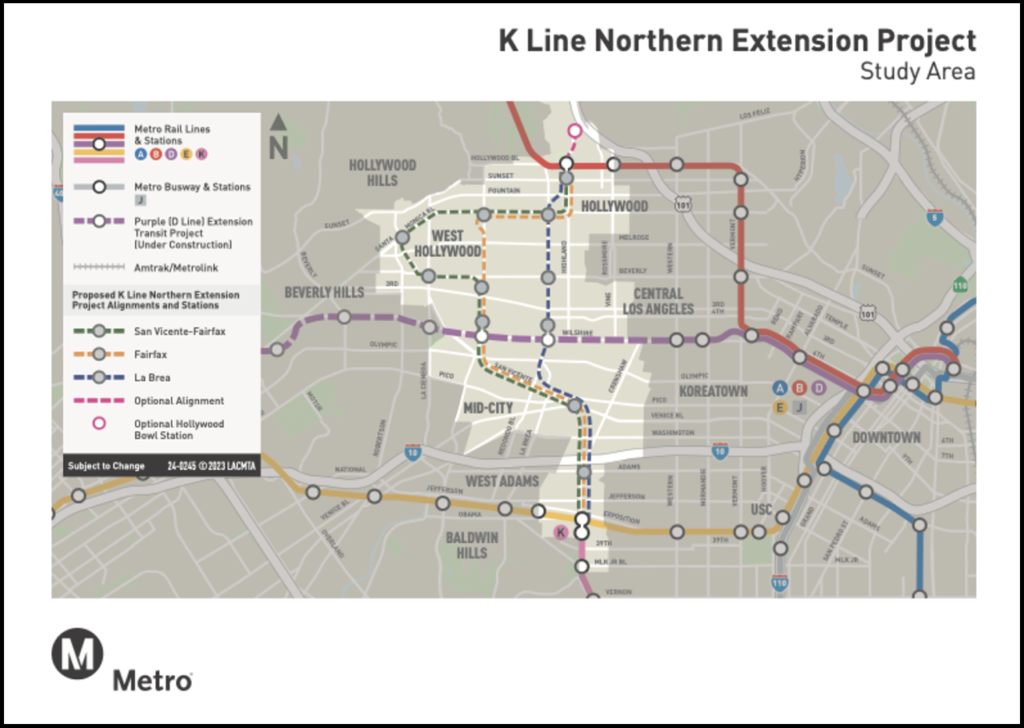
LACMTA is seeking public comment by Sept. 5 on its newly released Draft EIR for the K Line Northern Extension Project (see map above). This Measure M-funded light rail project is slated to close a gap in the regional rail network, connecting communities from the South Bay up to Hollywood, including the LAX area, South Los Angeles, Inglewood, the Crenshaw Corridor, West Adams, Mid City/Central Los Angeles, Mid City West, West Hollywood, and Hollywood. The project would expand access to transit and employment opportunities for many Equity-Focused Communities (EFC), LACMTA said.
The K Line currently terminates at the E Line Crenshaw/Expo Station. This project would extend LACMTA’s K Line north to its D Line at Wilshire Boulevard in Miracle Mile and its B Line at Hollywood and Highland, and includes a design option to extend the line further north with a potential station at the Hollywood Bowl. If approved and when completed, LACMTA said the K Line would connect to its C, E, D and B Lines and six of the 10 busiest bus lines in Los Angeles County.
According to LACMTA, the Draft EIR analyzes three potential underground light rail alignments, discloses potential impacts to environmental resources, and identifies mitigation measures to reduce or avoid significant impacts. All three options begin at the transit agency’s Expo/Crenshaw Station and end at the Hollywood/Highland Station.
In 2045, it is estimated that the project would serve between 47,000 and 60,000 daily trips, reported LACMTA. It added that with increased mobility options, the project would help to reduce auto dependence in the region, air pollution, greenhouse gas emissions, and energy use.
The transit agency has also published a series of summaries on the project website including project benefits, ridership projections, community engagement, construction cost estimates, and responses to Frequently Asked Questions.
Since the public scoping period for the project began in spring 2021, LACMTA said it has hosted several rounds of community meetings, pop-up events and stakeholder briefings. Click here to read what the transit agency learned from these events.
SacRT
Caltrans has awarded three sustainable community planning grants to SacRT. Totaling nearly $1 million, they are slated to help the transit agency improve safety and transit connections for riders and meet the mobility needs of a growing region.
The projects are:
- Reimagining Roseville Road Light Rail Station for Equitable Access Project, $177,060: According to SacRT, the project seeks to reopen and improve access to the Roseville Road light rail station via the Grand Avenue bridge, which is currently closed due to safety risks. This project aims to redefine the bridge as a community asset through access improvements identified through community engagement. Proposed enhancements include lighting upgrades, cameras, traffic control devices, bike/pedestrian facilities, urban greening elements, artwork, and signage. “These improvements aim to foster a safer, more accessible environment for the community north of the station, transforming it into a neighborhood amenity,” the transit agency reported.
- Safe Routes to Transit Plan, $442,650: SacRT, in partnership with Civic Thread and Sacramento Area Bicycle Advocates (SABA), will conduct a comprehensive review of active transportation plans, including SacRT’s Bus Stop Improvement Plan. “This project aims to analyze current conditions, prioritize locations, and develop recommendations for safe routes to transit,” the agency said. “Through extensive community engagement, the plan will focus on transforming car-centric environments into safer and more comfortable spaces for cyclists and pedestrians. This initiative ensures equitable transportation by addressing obstacles faced by transit riders of all ages and abilities, ultimately supporting SacRT in securing future funding and aligning with other development projects.”
- Folsom Connections to Healthcare, $218,472: In partnership with the City of Folsom and local medical facilities, SacRT said it will “proactively plan for sustainable transit connections supporting Folsom’s rapid growth.” This project is expected to help reduce greenhouse gas emissions; alleviate traffic congestion; provide alternative regional transportation modes; and improve access to jobs, services, and healthcare facilities. The study will include route design, ridership forecasts, station area planning, public engagement, and a multi-party sponsorship agreement, according to SacRT.
“We are honored to receive these grants, which will significantly enhance our ability to provide safe, sustainable and accessible transit options for the Sacramento community,” SacRT General Manager/CEO Henry Li said. “Each of these projects reflects our commitment to improving the quality of life for our residents by connecting them more effectively to essential services, employment opportunities and healthcare. Through strong partnerships and innovative planning, we are transforming our transit system to meet the growing needs of our region.”
Each of the projects is expected to start in early 2025.
Sound Transit
Along with opening 1 Line service to Lynnwood City Center, Sound Transit has reported three changes to Link light rail service starting Aug. 30. It will:
- Offer a new $3 adult one-way Link light rail fare. This change is designed to simplify fare structure, according to the transit agency. Sound Transit’s last fare change for Link light rail happened in 2015. While the agency said it planned to adjust fares in 2020, the pandemic led to a postponement. “Link light rail fares are a crucial source of revenue for Sound Transit, helping us expand our transit services and maintain high-quality operations,” the agency reported. “Alongside fare revenue, we also rely on sales tax, government grants, property taxes, and motor vehicle excise taxes (MVET) to support our projects. Since it’s been eight years since our last fare increase and the economic landscape keeps evolving, we need to adjust fares to meet our current financial needs and keep our commitments to the region.” In response to input from Board members and the community, Sound Transit said it is now exploring a flat fare structure. “Beginning Aug. 30, there will be one $3 flat fare for all adult riders, making it simpler for passengers to understand and budget for their trips,” the agency reported. “This structure will only require passengers to tap on when they board, eliminating the need to tap off. Additionally, a flat fare could simplify future transitions to fare capping, where there is a maximum amount a rider can be charged in a given period, promoting fairness and ease of use.”
- Rename University Street Station as Symphony Station. “This new name celebrates the nearby Seattle Symphony and reduces confusion, since riders often (understandably) confused University Street Station with University of Washington Station and U District Station,” Sound Transit reported. In 2019, the agency asked the public to weigh in on the renaming. It received more than 14,000 responses on a systemwide survey, including 13,300-plus online responses and 800-plus in-person survey responses. Symphony Station received the highest number of votes compared with “Benaroya Hall Station,” “Seneca Street Station,” “Midtown Station,” “Downtown Arts District Station,” and “Arts District Station.” In October 2021, the Sound Transit Board authorized the renaming of the station.
- Introduce three-digit station codes for wayfinding. Sound Transit is replacing its Link station pictograms with three-digit station codes. “Washington state law requires us to have station identifiers not based on the Roman alphabet to better assist Limited English Proficiency (LEP) passengers, visitors, and riders with disabilities,” the agency reported. “For many years, our Link stations have been accompanied by small pictograms—graphical symbols representing nearby landmarks or neighborhood identifiers. For example, Capitol Hill Station had a Pride flag and SODO Station had an anvil. While these pictograms have served us well, they have become increasingly difficult to adapt as we prepare for more Link expansions in the coming years. Furthermore, they were not widely used—less than 20% of surveyed riders used them for navigation. To address this challenge, we recognized the need for an upgrade that would better support our growing transit system.” Sound Transit said it chose station codes because they are an international best practice. “Urban metro systems in cities like Tokyo, Seoul, and Singapore have successfully implemented three-digit codes as an alternate station ID system,” the agency said. “Station codes transcend language barriers in transit system navigation. Arabic numerals, unlike pictograms, are more globally recognized and widely used, making them more accessible to a diverse population of residents and tourists alike. The new three-digit station codes ensure improved assistance for LEP populations and visitors; by using a numerical system, we can offer clearer and more straightforward wayfinding for those who may struggle with language barriers. The focus of the new codes is on wayfinding over local branding; while the old pictograms emphasized local landmarks or symbols, the new codes prioritize easy navigation and understanding of our transit network. The station codes also offer a clear indication of station locations, showing the number of stops at each station, which makes it easier for some riders to plan their journeys. Lastly, the new system allows for easy upgrades as our Link light rail system continues to grow, ensuring consistency across both current and future Link extensions.”
Valley Metro
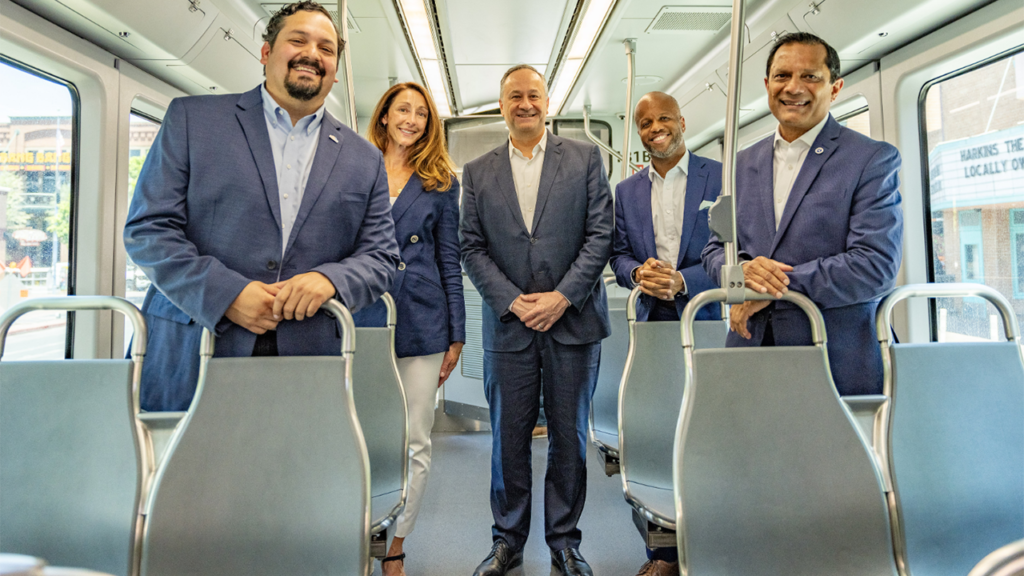
Following the recent $15.9 million USDOT RAISE grant award for Valley Metro’s Rio East-Dobson Streetcar Extension, U.S. Second Gentleman Douglas Emhoff joined local and federal officials on July 19 for an event and a ride on the streetcar system in Arizona.
“President Biden and Vice President Harris understand how important it is that everyone has access to reliable public transportation,” said Emhoff, a lawyer who is married to the 49th vice president of the United States, Kamala Harris. “This [RAISE] grant will improve transportation access for low-income, underrepresented, and transit-dependent populations in both Tempe and Mesa. It will enhance the quality of life for residents by providing a more convenient, frequent, one-seat ride across the Valley Metro streetcar corridor.”
The 4.4-mile extension—from Rio Salado Parkway and Marina Heights in Tempe to Dobson Road in Mesa and south on Dobson Road to Main Street—would build on the success of the Tempe Streetcar system, which has served more than 1.4 million rides since opening in 2022.
Valley Metro will use the RAISE grant to study how the streetcar would most effectively operate along the new 4.4-mile route. The study will determine traffic configuration and stop location areas.
“The potential of this streetcar extension is immense,” Mesa Vice Mayor and Valley Metro Rail Board Chair Francisco Heredia said. “It will link key destinations such as Tempe Marketplace, Marina Heights, ASU, Novus Innovation District with Mesa Riverview Mall, Sloan Park, and the Asian District. By connecting these vibrant areas, we make it easier for residents to travel, stimulate economic growth, attract businesses, and create jobs.”
“We are immensely grateful to the Administration, USDOT and our federal elected leaders for their advocacy and continued investments in public transit,” Valley Metro CEO Jessica Mefford-Miller said. “This RAISE grant for the Rio East-Dobson Streetcar Extension is a testament to the power of federal partnerships in enhancing regional mobility.”
In a related development, STV last fall signed a contract with Valley Metro, in partnership with the cities of Tempe and Mesa, to serve as the lead planner and designer of the extension.