Transit Briefs: Amtrak/USRC, Transit Tech Lab, CTA, NJT, Sound Transit, NCTD

Amtrak / USRC
The U.S. Department of Transportation on Sept. 18 reported that Amtrak and the USRC Boards of Directors unanimously agreed to approve the terms of a renegotiated cooperative agreement restoring federal control of the facility. The new agreement among USRC, Amtrak, and the Federal Railroad Administration (FRA) “will fast track restoration efforts, improve security, and attract new economic development,” according to the government.
It said the terms of the cooperative agreement “will enable the management changes necessary to:
- “Address state-of-good-repair projects,
- “Increase revenue through first-class retail, office, and event space,
- “Improve security,
- “Enhance multi-modal transportation uses,
- “Set the stage for increased private investment,
- “Create a family-friendly environment,
- “And provide a gateway to the nation’s capital worthy of this great country.”
USDOT said that under its leadership, Amtrak and USRC will “collaborate to move toward a new formal governance structure.”
As the owner of Washington Union Station, USDOT said it will:
- “Bring a ‘one building’ approach to station management,
- “Demand improved security,
- “Focus short-term work on addressing a backlog of capital projects, and
- “Promote a long-term vision of Union Station that leverages private investment and expertise and minimizes costs to the federal government.”
Under USDOT’s direction, USRC will:
- “Operate the retail, office, and event space, along with parking, to maximize revenue for reinvestment,
- “Provide Amtrak with new passenger areas as part of a world-class rail travel experience, complemented by the new Acela trainsets,
- “Provide enhanced security to establish a family-friendly station, in cooperation with federal law enforcement agencies and Amtrak,
- “Restore the station to a state of good repair, and
- “Position this unique asset for a more reasonable expansion plan that can draw private investment and limit taxpayer risk.”
Amtrak will:
- “Return its D.C. offices to Washington Union Station, through a lease with USRC that allows Amtrak’s taxpayer-funded office expenses to be reinvested in a federal asset rather than being spent on private realty,
- “Continue to provide a police presence, in coordination with USRC and Federal agencies,
- “Leverage new space to create modern and attractive waiting areas, and
- “Refocus on its operations in a ‘back to basics’ approach to railroading, featuring its state-of-the-art Acela II trainsets.”
“This revitalization will not only beautify and secure the station but also provide additional space to Amtrak that improves the passenger experience,” FRA Acting Administrator Drew Feeley said. “Reasserting control of the facility will free up Amtrak to focus on its core mission of providing rail transportation.”
“In partnership with DOT and USRC, we’re committed to delivering a safer, cleaner, and more seamless travel experience for every passenger,” said Roger Harris, President of Amtrak. “We’ve already made significant strides—welcoming over a dozen new retailers, bolstering Amtrak Police presence, rolling out station refresh and deep-clean initiatives, and streamlining operations—and this new agreement accelerates that momentum.”
“We appreciate this strategic decision from the Department of Transportation to designate Union Station Redevelopment Corporation with direct oversight of the station,” said Doug Carr, USRC CEO. “USRC is well prepared to deliver benefits for the station, our passengers, the public, and our partners. We look forward to ongoing collaboration with the FRA and Amtrak to identify and implement capital improvements related to the station, including its retail operations, as we continue to enhance the Union Station experience for all users.”
Further Reading:
- Report: Amtrak to Control Washington Union Station Leasehold
- “Amtrak as Bully”
- “Amtrak Bullying Now Targets SEPTA”
Transit Tech Lab

The Transit Tech Lab—a public-private initiative created by the Metropolitan Transportation Authority (MTA) and the Partnership Fund for New York City to facilitate advancements through technology in public transportation—has published a report on its 2025 proof-of-concept phase results.
Over the course of this eight-week phase that began in May 2025, 12 companies worked with the MTA, Port Authority of New York and New Jersey, and the NYC Department of Transportation (NYC DOT) to test their technology for improving the ridership experience, and optimizing inspection and maintenance processes.
The two challenge areas—Ridership Improvement and Inspection & Maintenance—were announced in January and generated 112 applications from around the world.
The Ridership Improvement Challenge sought technology that would help agencies accurately measure, capture and improve paid ridership and travel demand data to optimize transit schedules and communicate effectively.
Finalists include Jawnt, Libelium Comunicaciones, and Matawan. The companies worked with agency partners to:
- “Redesign paper-based workflows to accelerate contactless fare payment adoption.
- “Use real-time sensors to monitor crowding and inform train schedules
- “Integrate large-scale fare data to optimize transit planning.”
The Inspection and Maintenance Challenge sought technology that would help agencies digitize manual inspections and optimize maintenance processes.
Finalists include Censys Technologies, FlipAI, Kinexio, Previsico, Routora, SafetyCulture, SahayAI, Tomorrow.io, and TwinKnowledge. The companies worked with agency partners to:
- “Utilize AI-powered tools to accelerate inspections, data analysis, and document review.
- “Digitize user-friendly workflows that reduce manual labor, drive time for [what], and administrative overhead.
- “Produce predictive systems that improve weather forecasting and operations response.”
This is the seventh annual program of the Transit Tech Lab. Previous challenges focused on improving subway signaling, transit accessibility, resiliency, and customer experience. Since the program’s inception in 2018, more than 1,000 companies have applied to participate in the program, 81 companies have tested their technologies, and 29 solutions have commercially scaled or informed commercial procurements.
Join Stacey Matlen, Senior Vice President of Innovation for The Partnership for New York City, at the Railway Age / RT&S Women in Rail Conference, to be held Oct. 15-16, 2025. She will discuss the latest technologies stemming from the Transit Tech Lab challenges.
Further Reading:
- NYC Transit Tech Lab Announces 2025 Project Partners
- TTL Selects 13 Companies to Continue Partnering With Transit Agencies
CTA

CTA on Sept. 15 officially launched a pilot featuring new vending machines that dispense free naloxone at five rail stations. The move follows a June partnership agreement with Cook County Health (CCH).
According to the transit authority, these stations were chosen based on community input and data that “zeroed in on areas with higher opioid-related emergencies”:
- 47th Street (Red Line)
- Wilson (Red/Purple Line)
- Jefferson Park (Blue Line)
- Harlem/Lake (Green Line)
- Central Park (Pink Line)
CCH has invested $100,000 to cover the costs of procurement, installation, and maintenance of the machines as part of the six-month pilot, with the option to expand based on community impact, according to CTA. This investment is supported by funds from the U.S. Department of Treasury, under the American Rescue Plan Act (ARPA) allocated to CCH by Cook County Government.
“Naloxone, an FDA-approved nasal spray, can rapidly reverse the effects of an opioid overdose,” CTA said. “Public health leaders emphasized at today’s event that the medication is safe, easy to use, and empowers anyone to act in an emergency.”
“By placing naloxone vending machines at five key CTA stations, we are meeting people where they are and breaking down barriers to provide lifesaving tools within reach,” Cook County Board President Toni Preckwinkle said. “Public transit hubs are vital arteries of our city and county, and making this life-saving medication available in these locations removes a significant barrier to access. This initiative is about harm reduction and saving lives.”
“Our partnership with Cook County Health is a powerful and innovative way for public transit to support the communities we serve,” CTA Acting President Nora Leerhsen said. “CTA rail stations are often hubs in Chicago communities, and we believe that these vending machines have the potential to help save lives and support the health and well-being of those in need of Naloxone.”
CTA said this effort builds upon its existing efforts to aid those suffering from substance abuse on the system, which include dedicated social service outreach teams deployed on the system each night to offer assistance and resources. CTA said its other “harm-reduction” initiatives include a pilot with the Chicago Department of Public Health to offer a public health machine that dispenses “free health and hygiene products, as well as other harm-reduction supplies” at the 95th/Dan Ryan terminal. This program launched in 2023 and will soon expand to include three additional locations, according to the transit authority.
Further Reading:
- Report: RTA Redirects Funds From Metra, Pace to Prevent CTA Service Reductions
- CTA Launches Innovation Studio Challenges

NJT
NJT’s “FARE-PAY” card is now available to riders of the Newark Light Rail, Hudson-Bergen Light Rail and River LINE systems, as well as buses statewide. The reusable cards are said to allow riders to purchase and store monthly passes, 10-trip bus tickets or cash value for a “tap-and-go” experience.
The FARE-PAY card was piloted on a limited scale in April at four bus park & rides—Willowbrook Mall (Wayne), Mothers (Wayne), Wayne Transit Center (Wayne), and Allwood Road (Clifton)—and on the Newark Light Rail system.
Since Sept. 19, riders have been able to purchase fare cards loaded with bus or light rail monthly passes at ticket vending machines (TVMs) or at the following Bus ticket offices: Port Authority Bus Terminal, Old Bridge, Lakewood, Atlantic City Bus Terminal, Wildwood, and Walter Rand Transportation Center. Beginning Oct. 1, they will be able to purchase new fare cards loaded with 10-trip bus tickets. Riders can tap their “FARE-PAY” cards at the onboard validator while boarding their bus or at platform validating stations on the light rail systems. Select retail outlets will also carry the FARE-PAY card so riders can purchase the card and add cash value.
According to NJT, riders can register their card to protect their stored fare from loss, manage their accounts online, view fare-card activity and current value, auto-reload, and perform other options. A credit/debit card is not required. Riders who use the mobile app to purchase tickets and passes may continue to do so, NJT said. Purchasing a FARE-PAY card is optional. The FARE-PAY cards are not yet available for use on NJT’s commuter rail system.
“With the expansion of FARE-PAY, we’re making it easier for customers to purchase tickets and passes with greater flexibility,” NJT President and CEO Kris Kolluri said. “It’s part of our ongoing commitment to modernize and enhance the everyday experience for those who rely on NJ Transit.”
Further Reading:
- NJT Exercises MLIII, ALP45-DP Alstom Options
- NJT Brings River LINE Operation, Maintenance In-House
- NJT Releases RFQ for Northern Rail MOW Facility
- NJT Sets FY26 Ops Budget, Authorizes Capex Funding
Sound Transit

Sounder commuter rail service began 25 years ago with four stations: Seattle’s King Street Station, Auburn, Sumner (with only half its platform ready), and a temporary Tacoma stop near the old Amtrak station on Puyallup Avenue.
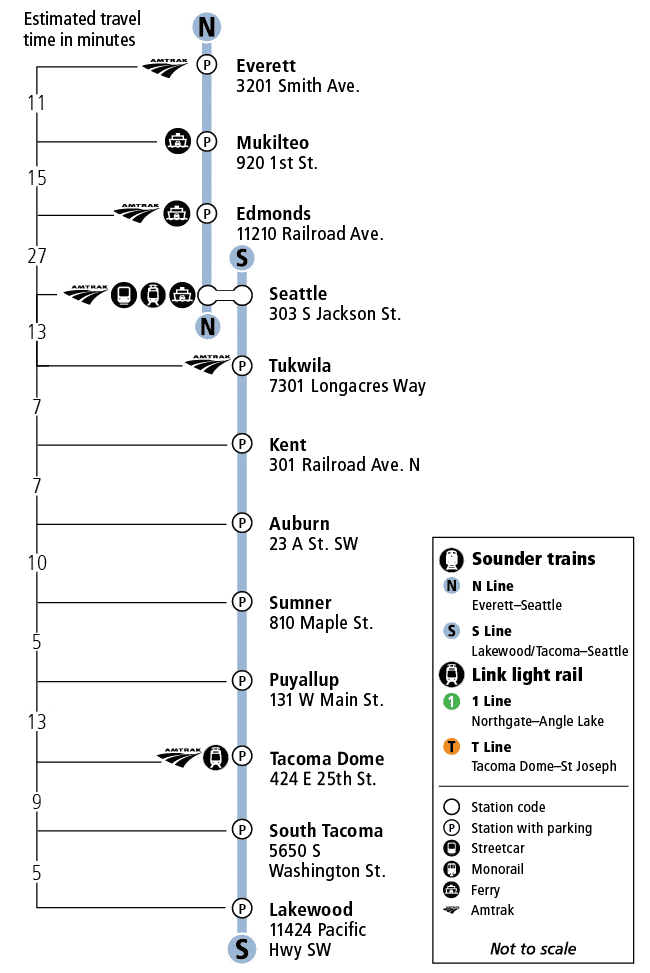
Fast forward to 2025 and Sounder now serves 12 stations across the N Line and S Line, connecting thousands of riders each weekday (see map, right). To celebrate the 25th anniversary, Sound Transit rounded up 25 fun facts you may not know about Sounder:
1. Opening Day
Sounder’s first official day of service was Sept. 18, 2000, with King Street, Auburn, Sumner, and Tacoma stations in operation.
2. First Trips = Only Two
For the first two years, Sounder ran just two round trips per weekday.
3. Mariners Came First
Sounder actually ran trains before daily service began — carrying fans to Mariners games in April 2000.
4. Tiny Sumner Platform
On opening day, Sumner’s station had only 300 feet of platform and limited parking.
5. Temporary Tacoma
The original Tacoma stop wasn’t at Freighthouse Square—it was a temporary platform off Puyallup Avenue near the BNSF tracks.
6. First Year Boardings
Sounder carried 25,742 passenger boardings in its first full year.
7. N Line Debut
The N Line launched on December 21, 2003, with a special Seahawks game train. Regular commuter service on the N Line began December 22, 2003.

8. Mukilteo Joins Later
Mukilteo Station opened on May 31, 2008, adding a third stop to the N Line. A second platform and pedestrian bridge at Mukilteo opened on April 11, 2016.
9. Lakewood-to-Tacoma
Service expanded south in October 2012, connecting Lakewood to Tacoma Dome Station.
10. Today’s Network
Sounder now covers 82.9 miles of track — 48.7 miles on the S Line and 34.2 miles on the N Line.
11. 1 Million Riders
Sounder reached its 1 millionth rider in 2004, just four years after opening.
12. King Street Rules
The busiest weekday boarding station is Seattle’s King Street Station, followed by Kent and Puyallup.

13. Maximum Speed
Sounder trains can reach 79 miles per hour.
14. Heavy Hardware
A full 7-car trainset with locomotive weighs about 600 tons. Each locomotive weighs about 285,000 pounds, while each passenger car weighs around 120,000 pounds.
15. Push-Pull Power
Sounder trains don’t “turn around” in Tacoma—they’re push-pull trains with a locomotive on one end and a cab car on the other.
16. Two Crew Members
Just two people—an engineer and a conductor—operate each train.
17. Scenic Views
On the N Line, riders get stunning views of Puget Sound, often with eagles, ospreys, or seals spotted along the way. On clear days, S Line riders enjoy postcard views of Mount Rainier.

18. Point Defiance Bypass
In 2017, S Line service shifted to the Point Defiance Bypass, making trips into Tacoma faster and more direct.
19. Bi-Level Cars
Sounder uses double-deck passenger cars, giving upstairs riders the best seats in the house.
20. Long Platforms
Tacoma Dome Station features one of the longest platforms in the system.
21. Game Day Tradition
Sounder has carried tens of thousands of fans to Seahawks, Sounders FC, and Mariners games.

22. Line Names
In 2020, Sounder officially became the N Line and S Line, joining Sound Transit’s systemwide naming convention.
23. APTA 2001
Sound Transit hosted the APTA Commuter Rail Conference in Seattle from March 31 to April 4, 2001.
24. Future at 50
Sound Transit is planning for longer trains, more trips, and expanded stations — setting Sounder up for another 25 years of growth.
25. ST Shop
Sound Transit has launched a limited-edition Sounder 25 collection at the Sound Transit Shop.
“Whether you’ve been riding since that tiny Sumner platform or just hopped aboard recently, thank you for being part of Sounder’s first 25 years,” Sound Transit said. “Here’s to the next 25!”
NCTD

To celebrate its golden anniversary, NCTD will be hosting pop-up events at stations with free limited-edition giveaways (while supplies last) for riders from Sept. 23 through Sept. 25. NCTD will also host a press conference and public anniversary celebration on Sept. 27 at 10 a.m.
The North County Transit Development Board was established on Sept. 20, 1975, by California Senate Bill No. 802, to plan, construct, and operate public transit in North San Diego County. The new transit agency’s jurisdiction would include Oceanside, Carlsbad, San Marcos, Vista, Escondido, Fallbrook, Pauma, Valley Center, San Dieguito, and Ramona. The Board would serve as the operator of bus service within the North County area, absorbing the municipal bus systems of Escondido and Oceanside.

Since then, the North County Transit Development Board evolved into the North County Transit District, adopting the acronym NCTD, and is now operating as North County Transit – San Diego Railroad. NCTD expanded its service and established the COASTER commuter rail in 1995, SPRINTER hybrid rail in 2008, FLEX deviated fixed route service, LIFT paratransit service, and NCTD+ on-demand (see timeline above).
Earlier this year, NCTD placed new COASTER cab and coach cars into service and celebrated 30 years of the commuter rail service. NCTD will also redesign its SPRINTER vehicles, the first of which will be launched as part of its 50th Anniversary. NCTD also unveiled a new logo this year (above).