Transit Briefs: Amtrak, DART, LA Metro, TriMet, Jacobs, Denver RTD

Amtrak
Amtrak and Google have joined forces to help travelers choose more sustainable transportation options when searching for intercity travel.
Thanks to a newly launched, direct data integration, travelers using Google can now view the most up-to-date Amtrak departure times, trip durations and fares directly on the Google Search results page. Amtrak’s new integration with Google also means that once customers select a train, they can click through to Amtrak.com to complete the booking for their chosen itinerary without needing to re-enter their trip details.

Amtrak information will appear in Google search results when a user indicates they are considering rail travel between two Amtrak destinations. As part of this integration, Google will also show train suggestions when travelers look for flights on Google Search or Google Flights, helping people consider more sustainable options when deciding how to get from A to B. More information is available here.
Each time a customer chooses Amtrak instead of flying, they can reduce their carbon footprint by up to 72%, the company noted. “As Amtrak looks to the future, the U.S. has an opportunity to make use of an unparalleled asset—the railway infrastructure, the world’s largest by mileage—to support an expanded network of low-carbon, high-capacity intercity passenger rail routes that can materially enhance the economy, improve communities, and create opportunities for travelers and workers alike,” the company stated.

Amtrak says it has set ambitious new targets, including a goal to achieve net-zero greenhouse gas (GHG) emissions across its network by 2045. This net-zero emissions target focuses on expanding efforts across Amtrak’s entire carbon footprint to reduce environmental impacts from operations while safely moving people.
“One of the biggest impacts we can make towards climate change is shifting the way people get around,” said Amtrak President Roger Harris. “As we continue offering services that motivate people to shift out of cars and planes into trains, we are thrilled that this integration makes it even easier for users to find rail options for their travel needs while also potentially lowering their carbon emissions.”
DART
DART was recently named Transit Agency of the Year by LIT at the association’s annual leadership summit held earlier this month in Portland, Oreg.
Founded in 2016, LIT was created to “promote the advancement and development of Latinos and other minorities in transportation.” Membership is comprised of public and private transportation professionals from across the nation.

LIT’s Transit Agency of the Year award has several selection criteria, including an agency’s “ability to champion access, diversity equity and inclusion, customer service, sustainability, a strong workforce, and multicultural marketing, as well as community relations.”
In its submission DART outlined several key initiatives from 2023 that help underscore the agency’s commitment to the ever-growing Hispanic community in North Texas including:
- “Partnering with Univision to promote job opportunities at DART.
- “Collaborating with the region’s Hispanic MBA Association, Prospanica DFW to host their annual conference at DART Headquarters in Downtown Dallas.
- “Offering comprehensive training and development programs aimed at enhancing the skills and career advancement opportunities for all employees, including supporting the growth of minority employees.
- “Prioritizing customer service accessibility for customers with limited English proficiency and non-English speakers.
- “Increasing food access in underserved areas by establishing Farmers Markets in collaboration with Restorative Farms.
- “Increasing job access through transit by 33% in Hispanic communities with the launch of DART’s redesigned bus network and via the on-demand Go Link service.
- “Engaging with minority-owned small businesses (MWBE) through our procurement processes with more than 50% of awardees identifying as an MWBE in 2023.
- “Investing in the development of minority-owned vendors via DART’s annual Small Business Academy.
- “Collaborating with local chambers of commerce and minority business councils to expand outreach and support for minority-owned enterprises.”
DART’s recently published Strategic Plan, Point B outlines the agency’s overarching goal: “to move DART from being a service that people sometimes use, to being a valued regional economic and mobility asset.” To achieve this goal, DART says it has committed to “fostering an inclusive and diverse workforce that reflects the composition of the service areas where the agency operates.”
“It is an immense honor to represent DART and join the other storied organizations who have been recognized by Latinos In Transit,” said DART Executive Vice President and Chief Communications Officer Jeamy Molina, who accepted the award on behalf of the agency. “To receive this award, especially during Hispanic Heritage Month, is incredibly humbling. I can’t help but to reflect on the incredible strides the DART team has made to ensure our organization is delivering on our mission of creating best-in-class mobility experiences that help people and communities connect and flourish.”
LA Metro
LA Metro recently shared a 35-slide presentation titled “Metro 2028 Games Mobility Concept Plan,” giving a capsule view of the agency’s public transit plan, according to a report by The Sports Examiner.
According to the report, the plan, which was shared by Metro document watcher Numble, identifies an 80-day operations period, beginning on June 13, 2028, with Olympic operations beginning at the venues and ending on Sept. 1, 2028, as the Paralympians return home. The “Supplemental Bus System” for spectators is scoped at 30 days, only during the competitions of the Olympic and Paralympic Games (July 15-30 and August 15-27).
The “Games Route Network” would be in operation for only 60 days, from the Olympic Village opening on June 30, 2028, through the end of the Paralympic departure cycle on Aug. 30, 2028, according to The Sports Examiner report.
According to the report, special attention is being made to light rail improvements to the A Line, which connects downtown Los Angeles to Long Beach, and the E Line, connecting downtown L.A. to Santa Monica, with stops at Exposition Park and the Coliseum.
There is a long list of things that LA Metro would like to do, The Sports Examiner reports, and some funding has been allocated, including $151 million in Federal funds so far. But $520 million in requests did not get awarded and $187 million in new requests have been submitted. None of this is Games-specific, according to the report, but if awarded, will be used to create longer-term programs, which will also help in 2028.
TriMet
The TriMet Board of Directors on Sept. 25 approved a new Working and Wage Agreement with union employees represented by ATU Local 757. The new agreement, which was ratified in August, will take effect on Dec. 1, 2024,.
The ATU represents the vast majority of TriMet employees—more than 2,700 people, including bus and MAX operators, dispatchers, mechanics, maintenance service workers and others.
TriMet and ATU leadership negotiated a four-year term for the new contract, instead of the usual three, to “provide greater stability for everyone involved,” the agency noted. That includes riders, as well as people who may be considering a career with TriMet.
According to TriMet, the agreement boosts union employees’ wages by 4% in December 2024, followed by a 3% increase each year after that. That comes out to a 13.64% wage increase over four years. Hourly pay will also increase for maintenance shifts between 6 p.m. and 6 a.m.

TriMet says it will also increase the employer contribution to union employees’ 401(a) retirement plan by 1% now and another 1% in the final year of the contract, bringing TriMet’s contribution for union employees to 10%.
The agreement includes several other benefits for new and existing TriMet union employees, including:
- A new tuition reimbursement of up to $5,250 per year, intended to support employees who are taking higher and continuing education courses.
- A new childcare subsidy of up to $150 per month, helping to allay the increased cost of childcare.
- Two additional floating holidays, plus more vacation time for employees who have spent at least 15 years with TriMet.
Under the agreement, TriMet says it will also rework some schedules and add new cleaning positions. These changes, the agency adds, should mean more regular cleaning at TriMet facilities and fewer canceled trips.
Jacobs
Jacobs announced Sept. 25 that it has been selected by NYMTA as the program management consultant for the LIRR Station Improvements Project.
“Focused on keeping passengers safe and supporting MTA’s on-time service commitments,” Jacobs will provide program management services, overseeing construction and commercial management, design compliance and risk identification.

The design-build contract includes updating LIRR’s Babylon, Forest Hills and Hollis stations to bring them into Americans with Disabilities Act (ADA) compliance—increasing the population that can access and enjoy this public amenity.
“As the busiest commuter rail system in North America, Long Island Rail Road provides essential mobility to Long Island and the wider New York City metropolitan area,” said Jacobs Senior Vice President Chrissy Thom. “Leveraging our integrated approach to complex delivery on similar global programs, we’ll work with the MTA to tackle its aging infrastructure, improve access and bring three crucial pieces of their system into ADA compliance and a state of good repair —connecting New York City commuters to their destinations smoothly into the future.”
LIRR serves nearly 260,000 customers daily. Improvements are expected to include installation and rehabilitation of ADA compliant elevators, escalators, ramps, platform and canopy replacements, as well as architectural and wayfinding upgrades that improve functionality and provide a more comfortable customer experience.
NYMTA estimates the total contract value for this project at $227.5 million and final completion is anticipated in 2026.
Denver RTD
RTD will mark 30 years of light rail in Denver with a public celebration on Saturday, Oct. 5. The community is invited to join RTD and other civic leaders at the anniversary celebration. Local leaders will kick off the celebratory events at 10 a.m.
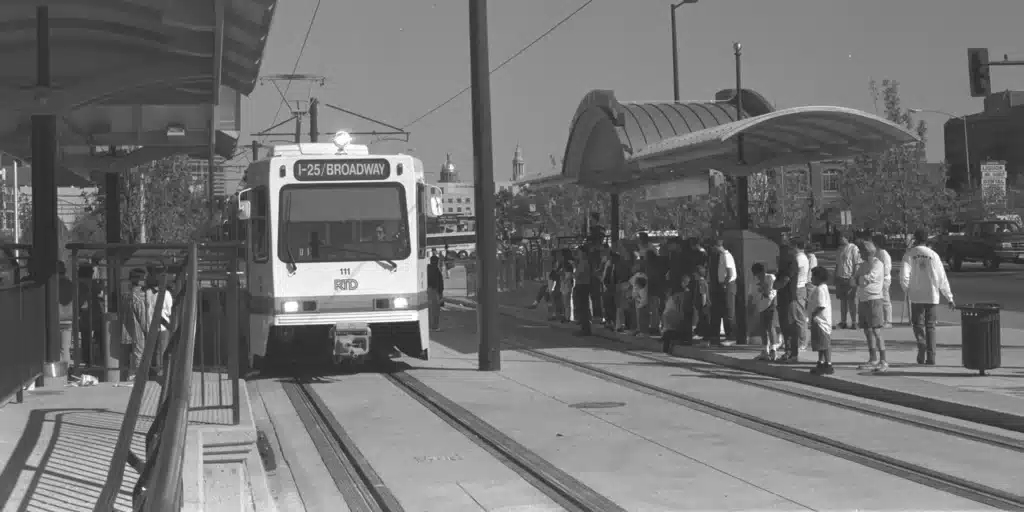
On October 7, 1994, RTD’s first light rail line opened for service, connecting downtown Denver to I-25. Since that time, RTD’s rail operations have now expanded to include six light rail lines and four commuter rail lines.
October’s 30th anniversary event will also celebrate the agency’s completion of the first phase of its Downtown Rail Reconstruction Project. The multi-phased project, the agency says, “will ensure RTD’s oldest light rail lines are maintained well into the future.”
More information is available here.