

Amtrak
Amtrak on Feb. 20 announced the extension of the expanded temporary Empire Service through Sunday, April 27.
On Monday, April 28, the new spring schedule will take effect to allow Amtrak to rehabilitate the East River Tunnel in New York City, which was damaged in Superstorm Sandy. This schedule, Amtrak says, will provide 10 round trips between the Capital Region and New York City, and a fifth train car will be added to 28 trains per week, for certain trains traveling between New York City and Albany and between New York City and Niagara Falls, to provide more seating capacity.
Recognizing the popularity of Empire Service trains, Amtrak says it continues to collaborate with its state and commuter partners to evaluate the service plan, including the creation of additional seating capacity, and restoration or modification of service as construction progresses on the East River Tunnel project, if possible. According to Amtrak, the state-supported Empire Service carried more than two-million passengers in federal fiscal year 2024 and set all-time records for ridership and revenue.
The tunnel project, a roughly three-year “essential” infrastructure improvement project and $1.6 billion investment for New York State, will improve train service reliability both within New York State and throughout the Northeast Corridor, according to Amtrak. It is a “vital project” that will restore two of the four tubes of the ERT that were badly damaged during Superstorm Sandy in 2012. When complete, this project, as well as several others throughout the Northeast and nation, “will benefit travelers and fortify Amtrak’s rail network for the first time in 100 years to last for the next 100 years,” according to the company.
Beginning Monday, April 28, Empire Service schedule changes will include:
- 10 Daily Southbound Trains between Albany and New York City available.
- 10 Daily Northbound Trains between New York City and Albany available.
- Trains 238 & 235 will be suspended during construction.
- A fifth train car will be added to 28 trains per week to certain trains between New York City and Albany and between New York City and Niagara Falls to provide more seating capacity.
- Adirondack and Maple Leaf trains will combine into one train between New York City and Albany with an extended dwell time in Albany.
- Empire Service, Adirondack and Maple Leaf schedule times may adjust up to 30 minutes earlier or later, which will benefit riders seeking an earlier departure headed south to New York City and a later departure for the last northbound train.
“Amtrak is committed to providing the best possible service to our Empire Service customers while we begin our critical work on the East River Tunnel used in this service,” said Amtrak President Roger Harris. “These significant upgrades will modernize critical infrastructure and ensure long-term improvements to the Empire Service and other Amtrak and commuter services for a better customer experience and more reliable trip.”
CTA
After an 18-month planning process centered on “robust community engagement,” the CTA on Feb. 21 announced the adoption of the 95th Street Corridor Plan for ETOD, one of the agency’s “most ambitious planning efforts to date.”
The Chicago Plan Commission has adopted the Plan, a community-informed blueprint by the CTA and the City of Chicago Department of Planning and Development (DPD) for a two-mile stretch of 95th Street between Halsted Street on the west and Cottage Grove Avenue on the east.

According to CTA, the Plan, which was funded through a grant from the Federal Transit Administration’s (FTA) Pilot Program for Transit-Oriented Development Planning, was initiated as a result of community advocacy and in recognition of numerous major public transit improvements coming soon to the area. The Plan, the agency says, “will leverage the opportunity provided by these public transit improvements for sustainable and inclusive community growth in the form of ETOD,” a planning approach that promotes walkable, mixed-use development near train stations and major bus lines that provide amenities for nearby residents to live, work and play in the community without needing a car, while prioritizing investment in disinvested communities and preventing displacement.
Throughout the planning process, the CTA and DPD engaged with hundreds of community stakeholders through many in-person and virtual events and meetings. These engagements, the agency says, directly informed the content of the final Corridor Plan, which outlines the community’s vision for ETOD along 95th Street, including illustrative ETOD development concepts and recommendations to address needs identified from community feedback and technical analysis.
With the adoption of the 95th Street Corridor Plan, CTA says the city now has an “overarching guide for future community and economic development in the area.” The Plan’s Implementation Guide provides community goals and strategies across six key focus areas: Empowering Community Voices, Mobility and Safety, Community Wealth Building, Equitable Development, Environment, and Health and Wellness. Additionally, for the first time in a CTA or DPD comprehensive planning effort, the Plan utilized a Health and Racial Equity Impact Assessment lens to “thoughtfully consider the lived experiences of current community members and consider nuanced tradeoffs of proposed Plan recommendations.”
Many community organizations and local stakeholders contributed to the planning and advocacy for equitable growth along the 95th Street Corridor. Project community partners The Endeleo Institute, and the Far South Community Development Corporation were “invaluable in leading the robust engagement efforts conducted and will continue to play a key role in the Plan’s implementation,” according to CTA.
The major transit investments that will benefit the 95th Street Corridor include the CTA’s 95th/Dan Ryan Red Line Station & Terminal Improvements completed in 2019, CTA’s Red Line Extension (RLE) from 95th/Dan Ryan to 130th Street, Metra’s rehabilitation of the 95th Street/Chicago State University Metra Electric station, the CTA/Pace South Halsted Bus Corridor Enhancement Project and Pace Pulse South Halsted Line, and the Pace Pulse 95th Street Line. Collectively, the improved regional mobility resulting from these projects offers the potential for the 95th Street Corridor to serve as a residential, commercial, and institutional hub for the entire Far South Side, the agency noted.
An electronic copy of the Final 95th Street Corridor Plan will be available here. The Final Plan reflects many public and stakeholder comments submitted during the Draft Plan public comment period between November 16, 2024, and January 17, 2025.
The 95th Street Corridor Plan, the agency says, follows the success of CTA’s Red Line Extension (RLE) Transit-Supportive Development Plan, a guide for the future development of the long-disinvested communities located near the RLE project, which was similarly adopted by the Chicago Plan Commission in May 2023 and was another successful collaboration with the Chicago DPD.
“This plan underscores the CTA’s shared commitment with the City that every Chicagoan, regardless of their background, should be able to live in a healthy, walkable, vibrant community connected to transit,” said CTA Acting President Nora Leerhsen. “This engagement process has been invaluable to creating a plan that is reflective of the community.”
MBTA
The MBTA plans to issue an RFP this fall, with proposals due the following fall, for a new operator of its Commuter Rail system, according to a CommonWealth Beacon report.
According to the report, a contract with Keolis Commuter Services, a subsidiary of the Paris-based transportation company, which has operated and maintained the MBTA’s Commuter Rail system since 2014, is set to expire in June 2027.
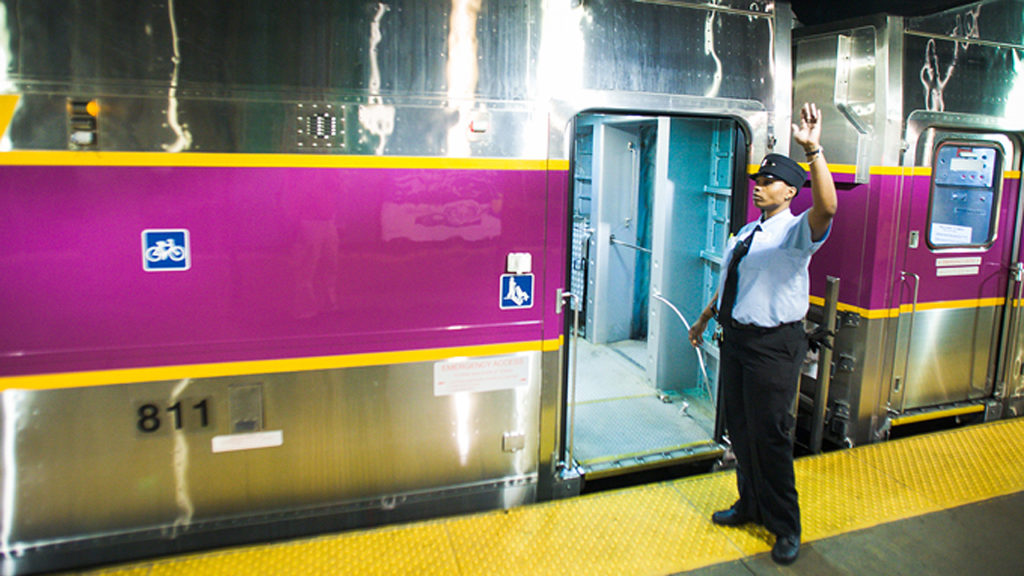
The new contract would be awarded by the end of 2026 or early 2027, leaving roughly six months of transition time if it’s a new operator other than Keolis.
According to the CommonWealth Beacon report, “several companies appear to be already interested in what’s happening with the potential contract, and their lobbyists have been spotted over the last several months at events discussing the future of the commuter rail.”
According to the report, “Keolis has hired Patrick Moynihan, a former Massachusetts transportation secretary, and Joe Boncore, a former lawmaker who chaired the state Senate’s transportation committee, while Transdev, another company based in France, has retained Kris Erickson, a former MBTA chief of staff, to lobby for them. Alstom, the third firm with French roots, has the high-powered O’Neill and Associates on its payroll. Industry insiders also expect Alternate Concepts Inc., a company run by a former MBTA chief who lost the current contract to Keolis, to bid.”
Before issuing the RFP later this year, MBTA officials “expect to make a crucial call this spring—by June at the latest—in determining the structure of the contract, which could be worth up to $20 billion,” according to the report.
“They could ‘bundle’ the contract, meaning one operator, or a consortium, handles everything, similar to the current structure, or they could ‘unbundle’ the contract, meaning one company will handle the infrastructure that doesn’t move, like the rails, while another company will handle the day-to-day operation of the train vehicles and pay the drivers and conductors,” according to the CommonWealth Beacon report.
“It’s one of the most important decisions I think the T is going to make in the next five years, what the structure of this contract is,” said Jim Rooney, the CEO of the Greater Boston Chamber of Commerce who laid tracks for the MBTA in his younger days and later served as a top agency official. “There’s some very good operators out there.”
According to the report, MBTA officials asked companies last year about a different contract structure, and met privately with some of them to get a sense of what they would like to see emerge from the agency. Most were in favor of an “unbundled” contract, since it might “attract more bidders and increase competition.”
MBTA Advisory Board Executive Director Brian Kane said he “isn’t convinced yet that ‘unbundling’ is the way to go in order for the T to achieve its vision for the commuter rail, which includes seeing higher numbers than the system’s current 550,000 weekly passengers. But he remains open-minded, according to the report.
“’Unbundling’ works well in Italy, where there is competition for use of the rails, leading to discount rail operators and cheap fares, according to Kane. But that’s not the same situation here, with the T essentially having a monopoly on operations.”
Rooney, according to the CommonWealth Beacon report, was glad the MBTA asked the industry what it would like to see before putting together the contract. But he was also skeptical about “unbundling” the contract and handing over the system to multiple companies.
“Personally, I would need to be convinced that’s a good idea to do because it sets up a finger-pointing dynamic when something goes wrong,” he said. “Giving someone the ability to control their destiny as an operator would probably be a prevailing criterion for me.”
The current contract structure, where Keolis is just a service operator and the MBTA handles the rest, is one of the “worst” in the world, according to Rooney, the CommonWealth Beacon reported. “Keolis, which is a world-class commuter rail operator, is only asked to run the trains and maintain things. They don’t buy anything, they don’t get to be involved in a lot of the key decisions that get made,” he said.
The contract with Keolis, valued at $4 billion, has already been extended several times, and the timeline to get a new contract in place is “aggressive,” according to the report. MBTA Executive Director of Commuter Rail Mike Muller insisted this week that the agency is “not behind schedule and remains on track for getting the contract out to bidders later this year.”
“I would characterize it as tight, not late,” Muller said.




