Amtrak
Amtrak is investing $155 million in Fiscal Year (FY) 2024 in station accessibility upgrades and improvement projects across the National Network to “ensure a safe, efficient, and comfortable travel experience for customers with disabilities as part of the company’s program to achieve compliance with the Americans with Disability Act (ADA).”
Amtrak marks the anniversary of the landmark ADA, signed into law on July 26, 1990, by highlighting the company’s “robust accessibility program and integrated approach to improve the travel experience—from trip planning, to purchasing tickets and the experience at stations, to equipment and on-board services.”
“Investing to improve accessibility is a core responsibility for Amtrak and key priority for the entire company,” said Amtrak President Roger Harris. “The execution of all the work on assets and at stations depends on the strong collaboration and shared commitment from many, from the community, national disability organizations, leaders in Congress, the Department of Transportation, local governments, freight railroads, and other partners. We thank these partners and stakeholders for their help, guidance, and advocacy.”
Amtrak is advancing projects in the following areas:
Stations
- Amtrak brought 17 stations into ADA compliance this year by improving elements including parking lots, station buildings and platforms.
- A total of 43 station accessibility improvement construction projects are in progress and 144 design projects are under way.
- Amtrak designed and deployed assistive boarding equipment, including bridge plates and ramps, to help customers with reduced mobility board and depart from the train.
- Passenger Information Display Systems (PIDS), audio and visual train status and boarding information, are now available at 87 stations, up from 76 a year ago.
- Induction hearing loops, an assistive listening system that sends clear sound directly to a user’s hearing aid or cochlear implant, are now available at ticket counters at 85 stations.
Equipment
- Amtrak’s new Acela trains, now in testing and in service soon, will offer enhancements for passengers with spacious accessible restrooms with 60-inch clear turning space, touchless features, and ample grab bars for stability; accessible café cars; and Braille seat numbers. The new trains will offer customers an improved Public Address Customer Information System (PACIS), which will provide real-time information such as location, train speed and conductor announcements in both audio and visual formats.
- Amtrak’s new Airo trains will offer spacious accessible restrooms, vestibules, and café cars.
- Accessibility improvements across all fleets include adding handrails to Superliner accessible bedrooms, folding tray tables at accessible seating areas, slip-resistant vestibule flooring, and compliant service counters in café cars.
“Amtrak’s ADA Stations Program is delivering accessibility-related station improvement projects to ensure customers with disabilities can successfully navigate the rail network,” the company said. Amtrak estimates completion of another 39 stations for this fiscal year at a forecasted investment of $140 million. To date Amtrak has invested more than $880 million since 2011 dedicated to advancing accessibility at all levels.
The federal funds provided by the Infrastructure Investment & Jobs Act (IIJA), the company says, have allowed Amtrak to make accessibility improvements at 40 stations in 19 states, to date. IIJA continues to fund a comprehensive improvement program to “ensure a safe, efficient and comfortable travel experience with a focus on accessibility and inclusion at Amtrak.”
Chicago RTA
Ridership across Chicago’s transit system has continued to increase, with May 2024 seeing the highest ridership levels since 2019 for CTA, Metra and Pace, according to Chicago’s RTA.
The figures, RTA says, represent nearly 14% year-over-year growth for all fixed routes on three Service Boards combined. The three operators provided more than 32 million rides in May, bringing the system to 64% recovery compared to 2019 levels. Since January, more than 144 million rides have been taken, an increase of 18 million rides compared to 2023.
According to CTA, active Ventra accounts are at 97% of pre-pandemic levels, showing that the number of people who ride transit have largely returned, but they are riding less “due to flexible work arrangements and other travel pattern changes since the pandemic.” All three transit operators, RTA says, continue to work to adapt their services to meet the changing needs of riders—one of the action items from the agency’s regional transit strategic plan, Transit is the Answer.
Chicago Transit Authority (CTA)
CTA rail recovery in May was 59% of 2019 levels, RTA reports. In April, CTA announced new spring rail service timetables and plans for increasing rail service throughout summer as new rail operators complete training and are added into service. The agency is on track to train up to 200 new operators, double the number trained in 2023, and plans to return rail service to pre-pandemic levels this year.
CTA’s 2024 budget set a ridership recovery goal of 64% of 2019 levels for the year. At 67% overall year-to-date ridership recovery, this goal is expected to be surpassed at year’s end.
Metra
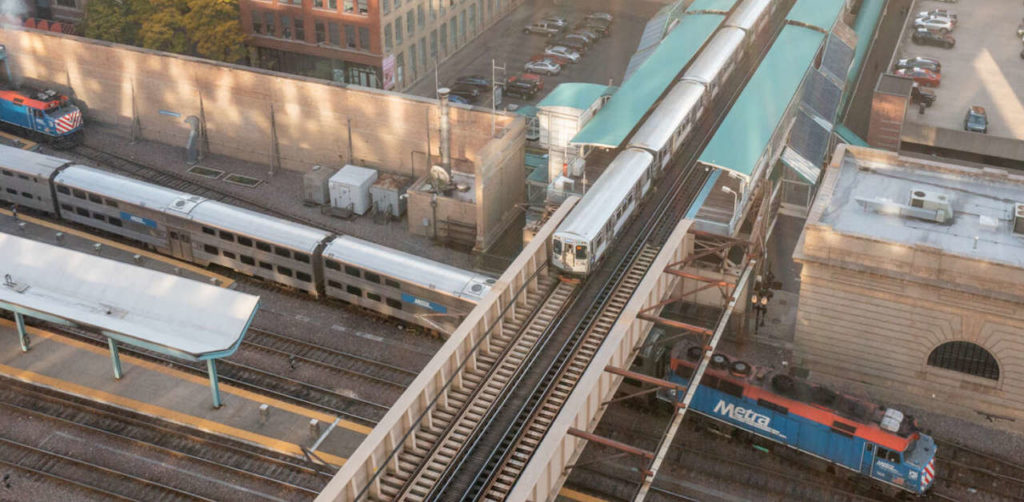
Metra weekday ridership recovery in May crossed 58% of 2019 levels, according to RTA. May 21 set a record for post‐pandemic Metra ridership with 197,520 riders, surpassing even the previous high set Aug. 2, 2023, for Lollapalooza. Metra also carried more than 31,000 bicycles in May, nearly twice as many as in May 2019. In April, Metra sold more than 50,000 monthly passes, breaking its own post-pandemic record for the second month in a row.
Metra added service to the Union Pacific North Line and opened the new Peterson/Ridge Station in May and added late evening service on the Milwaukee District North Line in June. The agency also added weekend service to the BNSF line in April. In February, Metra unveiled a new, simpler fare structure, reducing 10 fare zones to four and setting cost at or below pre-pandemic levels.
Public transit, RTA says, “plays an essential role in the lives of millions of riders across the Chicago region and has the potential to reach even more people. But the rise of remote and hybrid work and its staying power post-COVID have resulted in significant losses in fare revenue and exacerbated the issue that most systems nationally have been experiencing for decades: drastic underfunding of public transportation. Increasing investment in transit is key to advancing equity, growing our economy and combating climate change.”
According to the agency, the RTA system is facing a $730 million annual operating shortfall starting in 2026, which is expected to grow with the cost of providing service in future years. “Increasing funding to fill this gap would prevent severe service cuts and fare increases and help the region’s transit operators improve service, grow ridership and create a more equitable system,” RTA noted.
“Today, ridership across CTA, Metra and Pace is growing as we see increased service levels, enhanced schedules with more midday and weekend service, new fare products and other changes to meet the needs of today’s riders,” said RTA Executive Director Leanne Redden. “This has only been possible because of flexible COVID relief funding. And while we’re thrilled to see these major ridership gains, this alone will not fill the gap. We are on the right track, and the region cannot afford to have this momentum interrupted by service cuts that will come if a funding solution to the coming fiscal cliff is not found.”
“No single revenue source will solve the fiscal cliff on its own,” noted RTA, which is working with partners and local, state and federal officials to “explore a range of options for new revenue while implementing a strategic plan focused on building a safer, more reliable and more accessible system.”
TTC
Beginning Sunday, July 28, the TTC is enhancing streetcar service along Dundas St. with the introduction of a new 305 Dundas all-night service. This extension of the popular 505 Dundas route “will provide customers with a convenient transit option between Broadview Station and Dundas West Station during the late-night and early-morning hours.” From Sunday, customers can ride 305 Dundas streetcars from 2 a.m. to 5 a.m. daily, with vehicles arriving every 30 minutes.
To accommodate the new service, adjustments will be made to the existing 306 Carlton all-night streetcar route. From Sunday, 306 Carlton streetcars will operate between Main St. at Danforth Ave. and High Park Loop.
During the operating hours of 305 Dundas, subway stations will be closed, and streetcar boarding will take place outside Broadview and Dundas West stations.