Alto

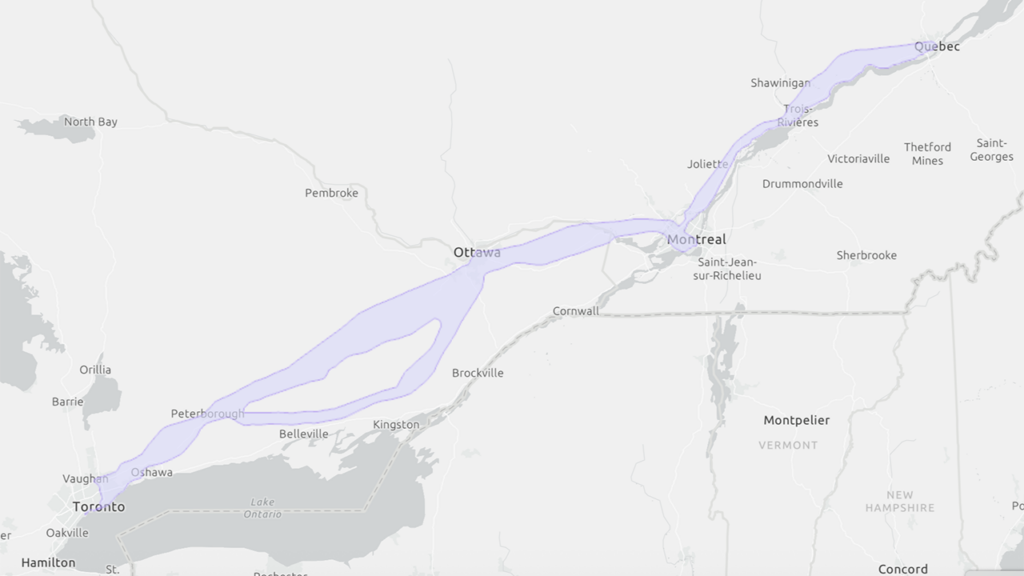
Canadian Crown corporation Alto and Cadence on March 23 reported the start of environmental data collection “to deepen our understanding of local conditions, to support the impact assessment process, and to guide planning, engineering, and environmental analyses” of the planned HSR network.
In March 2025, the partners signed a development agreement that includes detailed design work, land acquisition, environmental assessments, and consultations with nearby residents, including Indigenous communities.
Instead of VIA Rail Canada’s HFR (High-Frequency Rail) service revealed first by Railway Age Canadian Contributing Editor David Thomas in 2016, outgoing Canadian Prime Minister Justin Trudeau in early 2025 said Alto would be dedicated electrified HSR, with trains running up to 186 mph (300 kph); it would be implemented as a DBFOM (design-build-finance-operate-maintain) project, with stations planned in Toronto, Peterborough, Ottawa, Montréal, Laval, Trois-Rivières, and Québec City.
The project is slated to create more than 50,000 jobs during construction, “generate productivity gains that could reach up to C$35 billion annually,” and contribute to cutting greenhouse gas emissions, according to Alto and Cadence, the consortium of Quebec pension fund’s CDPQ Infra, AtkinsRéalis (formerly SNC Lavalin), Keolis, SYSTRA Canada, Air Canada, and SNCF Voyageurs.
On Nov. 18, Alto and Cadence reported that outreach to the steel industry was expected in 2025. The goal: “to shape a procurement approach that prioritizes Canadian suppliers.” Guided by the government’s intent to Buy Canadian, the partners said that key components of the future rail network—including “several hundred thousand tons of steel for high-speed [track], structures, facilities and electric infrastructure”—will be sourced from Canadian suppliers “to the greatest extent possible.”
Field Studies
According to Alto and Cadence, the 2026 program builds on preliminary work conducted in previous years, with data collection taking place within the first segment of the study corridor between Ottawa and Montréal. Field studies may include wildlife and flora observations, soil sampling, sound-level measurements, and the analysis of waterways and wetlands. “These activities, which are designed to be as non-invasive as possible, are carried out by qualified professionals using recognized methodologies and in compliance with applicable regulatory requirements,” the partners said. “The sites identified for field studies represent rural, urban and suburban environments. They do not indicate the project’s final route, which has not yet been determined. Properties selected for the field studies program were chosen based on the quality of data that can be collected, on the ease of access, and to ensure staff safety.”
Field studies, Alto and Cadence said, will help establish “baseline environmental conditions within the study corridor prior to the project, anticipate potential impacts, and identify measures to avoid, minimize, or compensate for adverse effects, while maximizing benefits for communities.”
They noted that “Indigenous knowledge plays a fundamental role in understanding the territory” and “helps build a deeper understanding of site-specific conditions and traditional land use, thereby enriching scientific analysis.”
“Alto collaborates with Indigenous communities to identify their areas of interest related to field studies and to organize their participation in the program,” the partners reported. “This integrated approach supports more comprehensive, inclusive, and locally grounded field studies and impact assessments, while also facilitating regulatory processes and permitting requirements.”
According to Alto and Cadence, field studies conducted by Alto so far have taken place on public lands and existing rail corridors. In 2026, they are “broadening field study work within the corridor so as to include certain private properties, which will allow us to capture more comprehensive environmental data.” As part of this work, they said, “agents will contact selected property owners within the study corridor to seek permission to enter (PTE) their property.” Participation is voluntary and participants will receive financial compensation, reported Alto and Cadence, which noted that no field studies will be conducted on private properties without consent from their owners.
“Receiving a PTE request does not necessarily mean that a property will need to be acquired for the project or that the future train will run near it, as the alignment has not yet been determined,” they continued. “Alto is committed to maintaining clear and structured communication with property owners. Each property owner will receive a comprehensive information package and, when required, will receive personalized support and efficient communications by a dedicated Alto representative throughout the process.”
“The environment is at the heart of every decision we make, reflecting our commitment to minimizing impacts on communities along the corridor,” Alto Vice President, Environment Anne-Marie Gaudet said. “To gain a comprehensive understanding of the territory, our teams will need to access a variety of public and private sites scientifically selected to showcase the corridor’s unique characteristics and diversity. These studies will enable us to make responsible, evidence-based decisions in order to protect both the ecosystems and the people living near the corridor.”
Further Reading:
- Alto HSR Could Include Tunnels in Montreal, Toronto (part of Transit Briefs)
- Alto Launches Public Consultations (part of Transit Briefs)
- Alto HSR Project Advances
- Canada Dumps VIA Rail Brand for Private ‘Alto’ HSR
- VIA HFR: How Viable? How Close?
- Red-Over-Green for VIA Rail’s High-Frequency Corridor
- Canadian HFR: From Proposal to Project
Caltrain


Caltrain on March 23 reported paying tribute to Rep. Nancy Pelosi (D-Calif) with a trainset named in her honor. Pelosi, who served as House Speaker from 2007-2011 and 2019-2023, announced late last year that she will retire at the end of her current term in January 2027.
“Made during Women’s History Month, this dedication recognizes Pelosi for her outsized role in advocating for Caltrain and other public transit agencies throughout her career as she nears the end of her final term in Congress after serving for 38 years,” said the operator that provides rail service from San Francisco to San Jose, with commute service to Gilroy. “Pelosi was instrumental in obtaining federal funding for Caltrain’s $2.4 billion Electrification Project that was completed in 2024, modernizing the 160-year-old railroad.” It now runs 23 new Stadler Rail-built KISS bilevel EMUs (electric multiple-units).
Caltrain noted that through the Infrastructure Investment and Jobs Act of 2021, Pelosi helped secure $10.3 billion to expand public transit and more than $4 billion in emergency COVID-19 relief for Bay Area transit, “strengthening essential infrastructure and connecting communities.”
This is the second electric trainset Caltrain has dedicated; it dedicated a trainset in honor of Rep. Anna Eshoo (D-Calif.) on the first day of electrified service in September 2024.
“Speaker Emerita Pelosi didn’t just represent the Bay Area—she built it, strengthened it, and connected the Golden State to the world,” California Gov. Gavin Newsom said. “She has driven the biggest wins for infrastructure and clean transportation this state has achieved in a generation, and Caltrain’s transformation from an aging diesel railroad into one of the fastest-growing electric transit systems in America is proof of what fearless, relentless leadership looks like. Naming this train in her honor is a tribute as enduring as her legacy, and every Californian who rides these rails will travel in the future she fought to build.”
“Few leaders have done more for San Francisco than Speaker Emerita Nancy Pelosi,” noted San Francisco Mayor Daniel Lurie. “Naming this Caltrain in her honor is a fitting tribute to her decades of service to this city and her record of delivering results for our residents and our future. On behalf of San Francisco, we thank her for her 38 years of service and for always fighting to keep our city moving.”
“For as long as Caltrain has existed, Speaker Emerita Nancy Pelosi has been in Congress advocating for it,” added Caltrain Board Chair and San Bruno Mayor Rico E. Medina. “While we are sad to see her go, we are proud to continue to celebrate her legacy and everything she has achieved both for our rail agency and for the people we serve every day.”
“Speaker Emerita Nancy Pelosi has been a steadfast champion for public transportation and for the communities Caltrain serves,” Caltrain Executive Director Michelle Bouchard commented. “We are deeply grateful for her leadership and efforts to secure critical investments that have been transformative to this corridor and pivotal to strengthening transit systems across the Bay Area. The people of the Bay Area will benefit from electric Caltrain service for decades to come, and by naming this train in her honor, we ensure that her role in making this project a reality will be celebrated for just as long.”