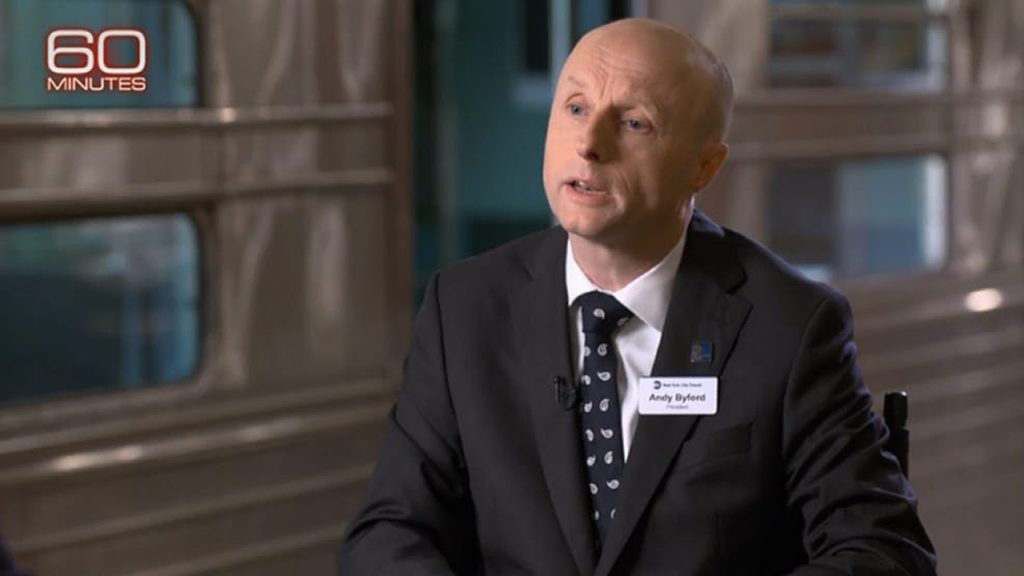
Andy Byford is coming back to New York, where he has been tapped to oversee development in and around the city’s Penn Station. New Yorkers bestowed the moniker “Train Daddy” on Byford during his tenure as President of New York City Transit from the winter of 2018 to the winter of 2020. An Englishman, Byford literally earned a “world class” reputation for transit leadership for his efforts in Sydney, Toronto, and New York, in addition to London, where he got his start. He left New York and continued his career in London after facing difficulties dealing with then-Gov. Andrew Cuomo at the time. Similarly to the way he returned to London five years ago, Byford is returning to New York now.
Triumphal Return, Apparently
The Metropolitan Transportation Authority (MTA), the state-controlled agency that owns and operates NYCT, Metro-North, the Long Island Rail Road and other transit properties and roads, seems happy with the choice. John J. McCarthy, MTA Chief or Policy and External Relations, said in a statement: “This is good news. Governor [Kathy] Hochul has welcomed the Administration’s decision to step up and make good on its commitment to advance and finance this project. We look forward to working with Andy Byford, who understands the importance of mass transit and was a strong supporter throughout our battle to implement congestion pricing in New York.”
Andrew Albert, Chair of the NYC Transit Riders’ Council and a rider-representative at the MTA Board, told Railway Age: “He’s looking forward to returning to New York, which he loves. Because of all the transit improvements he made here, he was remembered as ‘Train Daddy.’ Because of that, he is familiar with Penn Station and all of its shortcomings, and he’s looking forward to making it a world-class terminal, like he has helped create on other continents.”
Mike Oreskes broke the story on Saturday with a comprehensive report in the West Side Spirit, a community-oriented publication: “Andy Byford, who has run rail agencies on three continents, has agreed to take over the renovation and possible expansion of Penn Station, New York’s most tangled transportation, real estate and political conundrum … Byford sealed the deal after a meeting at the White House with [POTUS 47], the onetime New York developer who has taken a special interest in both the future of Penn Station and other Manhattan transit issues, such as congestion pricing, which he opposes.”
Transportation reporter Stephen Nessen and political reporter Jon Campbell observed in Gothamist, the news website affiliated with local NPR station WNYC: “The project will put Byford at the center of one of the most high-profile construction projects in the country. MTA Chair Janno Lieber had previously planned to run the overhaul of the station, which is owned by Amtrak. But he was kicked off the project last month by U.S. Transportation Secretary Sean Duffy, who said Amtrak would take control of the work.” The story bore the headline Daddy’s Home: Andy Byford to Make NYC Return for Penn Station Remake, White House Says, and began: “Train Daddy is on the express route back to New York City.”
An Unusual Appointment
After his COVID-era stint in London at Transport for London Commissioner, overseeing the new Elizabeth Line’s completion and opening, Byford came back to the U.S.and worked for Amtrak as EVP for High-Speed Rail Development. Two years ago, he was promoting the Texas Central High-Speed Rail proposal that would run between downtown Dallas and its other endpoint several miles from downtown Houston. Amtrak’s most recent statement that mentioned him in connection with that project was issued on Aug. 9, 2023. Byford did not move the Texas project to fruition at that time, but he is still with Amtrak, although it was USDOT that announced his new position on Tuesday
The federal agency’s statement said: “In this role, Byford will report directly to the Amtrak directors and coordinate closely with USDOT as he oversees the Penn Station project through a master developer public-private partnership,” although no such “master developer” was identified. Without further clarification, Byford’s appointment appears to beg the question of where he will fit into Amtrak’s organizational structure, and with which managers he will be expected to work. Amtrak management itself is in a state of flux, due to the recent announcement that “America’s Railroad” is eliminating 450 management jobs. I called Amtrak for a statement, but were referred instead to USDOT, whose statement we quoted.
It Won’t Be Easy
Byford is taking on the task of developing an improved Penn Station at a particularly difficult time, and fraught with controversy. A headline on Aaron Short’s article in Streetsblog NYC on May 27: ‘Train Daddy’ Takes Over Penn Station Project But Amtrak Still Has Major Issues, while the subhead: Looking beyond the hiring of Andy Byford, Amtrak still has a lot of red signals ahead, seems to tell the story. Short noted: “Now the White House has sent Byford back to manage the complex redesign of a transportation project that has bedeviled governors, the heads of transit agencies, architects, engineers and commercial real estate developers … Fortunately he has plenty of familiarity with the railroad hub. During the Biden Administration, Byford opposed Amtrak’s initial proposal to acquire and demolish a Midtown block to expand the capacity of the railroad station as New York, New Jersey and the railroad work to build two [new] rail tunnels under the Hudson River (the Hudson Tunnel Project, part of the Gateway Program). He also supports through-running commuter trains between the New Jersey and Long Island suburbs—an idea that has mixed criticism from transit experts.”
Through-Running and Block 780
There are two issues that are currently controversial regarding any plans for the future of Penn Station. One is through-running of trains between New Jersey and Long Island in the future, even though equipment currently running on New Jersey Transit (NJT) and the Long Island Rail Road (LIRR) are not compatible—even though some tracks at Penn Station serve both railroads. NJT uses overhead catenary in its electrified territory with either 12kv, 12.5kv or 25kv at 25Hz or 60Hz for its power combinations, while the LIRR uses third-rail DC with over-running pickup shoes at 750 volts. Metro-North is making improvements that will allow service to four new stations in the Bronx on the Hell Gate Bridge route currently used by Amtrak trains going through Connecticut to Massachusetts on the New Haven Line and beyond. Metro-North owns the track as far as New Haven and also runs 750 VDC, but with under-running third-rail pickup shoes.
With the Empire Connection from Penn Station, which is used by Amtrak’s Empire Service trains to Upstate New York and beyond, it is not beyond the realm of possibility that trains could run through between New Jersey and Metro-North’s Hudson Line. About 30 years ago, Amtrak experimented briefly with running the Adirondack train from Montreal through Penn Station to Washington, D.C.. As far as I know, that is the only time there was a through operation between the Empire Line and the Northeast Corridor (NEC), but that short-lived schedule demonstrated the feasibility of such an operation. No similar proof is required for Metro-North’s New Haven Line, because Amtrak runs most of its NEC trains thorough Penn Station to serve stations on both sides of it. There are also issues with track configuration in the Penn Station area, and there are logistical issues, too, especially during peak commuting periods. At those times, many more trains now run in the prevailing direction than in the reverse direction.
Still, many (but not all) advocates favor the concept of through-running, if those difficulties could be resolved. They believe that through-running between New Jersey and Long Island or between the Garden State and points on Metro-North would make significantly better use of existing capacity at Penn Station, because trains could follow each other in rapid succession, rather than having to back out of a station track and proceed to an appropriate waiting area before the next train can use the same station track—a necessary process for operations at stub-end terminals.
In a comment on Short’s article in Streetsblog, Sam Turvey, President of ReThinkNYC, which favors through-running and a redesign of Penn Station in a style reminiscent of its original 1910 design, said: “Andy Byford can be expected to make sure that the through-running issue, which could have tremendous upside for the region, is fully and fairly evaluated, including seeing that industry standard RTC [Rail Traffic Controller] calculations are performed. Byford will also look to see if options other than demolishing the neighborhood to the south exist as New York’s Governor and local elected officials have called the neighborhood off limits.”
Block 780 is also controversial. It is located immediately south of Penn Station, between West 30th and 31st Streets, and between Seventh and Eighth Avenues. Part of the Gateway Program, which proposes several projects in and near Penn Station and in New Jersey on the other side of the Hudson River, calls for demolishing the block to make room for Penn South, a new stub-end station that would contain seven tracks, located under the structures currently on Block 780. The rationale for the demolition is that Penn South would be needed for additional Penn Station capacity, and that it can’t be built unless the existing buildings are demolished. Gov. Hochul and local elected officials and civic organizations have come out against demolishing the block, as have neighborhood residents and business owners, along with some rider-advocacy organizations. ReThinkNYC is among the opponents who say that through-running could offer sufficient new capacity that Penn South will not be needed.
Oreskes reported in the West Side Spirit article quoted above: “Byford spoke supportively of such a plan two years ago at a forum by the advocacy group ReTHINK NYC, which has lobbied since to bring Byford in to at least resolve whether ‘through running’ is a viable alternative to tearing down the block south of Penn Station.”
Doing More with Less?
There are financial issues, too. As I reported, the POTUS 47 Administration revoked a grant awarded to the MTA for Penn Station redevelopment and reduced Amtrak’s grant, while at the same time gave the railroad more responsibility for the project. It seems possible, as things look from here, that there will not be enough money to build Penn South as proposed. Oreskes reported: “Much of the neighborhood around Penn Station remains under a state redevelopment plan that originally called for 10 supertall office towers, many of them on property owned by Vornado Realty Trust, the area’s largest property owner. But with office use in flux and interest rates high, that plan has been stalled.” Part of the rent that would be collected from tenants in those buildings would help pay for construction related to Penn Station. The story continued: “But Governor Hochul said she was ‘decoupling’ the development project from funding Penn Station, and after the federal government took over Penn reconstruction from the MTA, she said she was grateful they would pay the whole cost, which they say they never said.”
Politics Prevail—As Usual
In the current game of Empire State Politics, we have Gov. Kathy Hochul (who hails from the Buffalo area but has taken an interest in the transit in and around New York City) and many City elected officials sparring with the POTUS 47 Administration over transit-related issues. The most contentious is the recently enacted Congestion Pricing toll, which charges a base rate of $9.00 for passenger automobiles to enter Manhattan south of 60th Street (with different rates at different times and for different classes of vehicles). Transportation Secretary Sean Duffy wants to kill it, while the MTA is fighting USDOT in court, and has just won a round: a preliminary injunction against Duffy and other federal defendants that will last until June 9. There is also the controversy about the need to shut one of the tubes (“lines”) of the East River Tunnels down for the duration of the project to accommodate rehabilitation in the wake of Superstorm Sandy almost 13 years ago. Hochul and other New York officials are calling for all construction to take place on nights and weekends, as was done in 2020 with NYCT’s L-train (Canarsie Line) tunnel under the East River.
Former Gov. Andrew Cuomo pushed for the L-train project to proceed with only nighttime and weekend construction and, as Railway Age reported, the project was a success. A 15-month total shutdown was averted, while service was only reduced (but not eliminated) on weekends and for a few hours on weekday evenings. It has also been reported that the disagreement between Cuomo and Byford was a factor in Byford’s decision to leave the MTA and return to London. Cuomo faced major problems later that forced him out of office (sexual harassment allegations most prominent), but he might return, this time to a different office. He is running for Mayor of New York City and appears to be leading other Democrats in the primary contest coming up in June. While Democrats usually win the office, that is not always the case. If Cuomo wins, though, he and Byford will face each other again. This time, Cuomo will not have direct authority over Byford, as he did when he was Governor. (Editor’s Comment: Cuomo will probably do his best to intervene and micromanage everything. That’s his style. – William C. Vantuono)
Given Byford’s popularity with New York’s Straphangers (as many of them call themselves), coupled with the approval of the Washington brass who usually don’t like transit, the big question is whether he can steer between these two apparently implacable foes and get the needed improvements made at and around Penn Station. Given the recent controversies, it looks like if anyone can do it, Andy Byford can.