
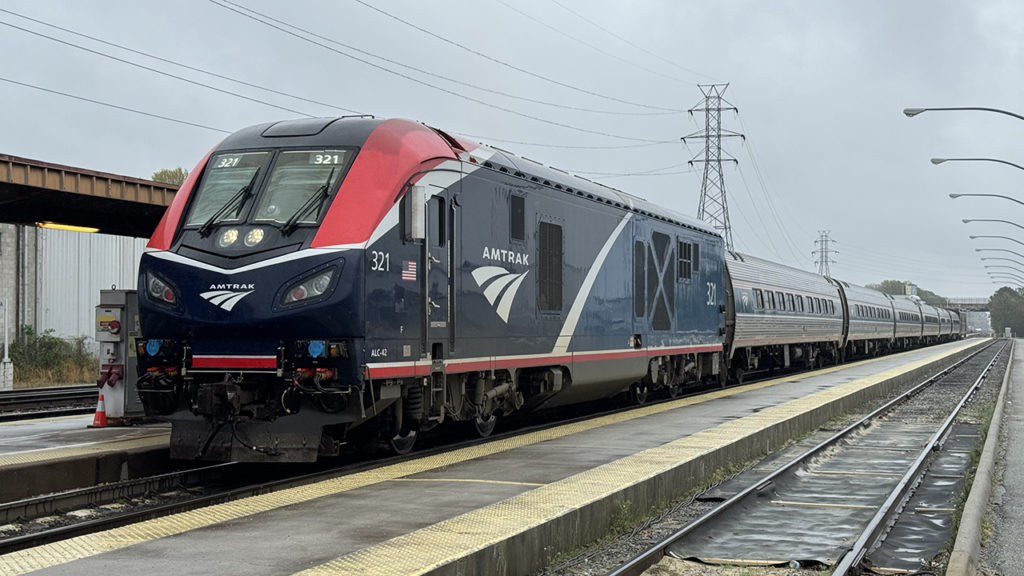
On Nov. 15, the Rail Users’ Network (RUN) held its Fall mini-conference. The online event bore the title “F.R.A. Corridor Grants – Boosting Economic Activity – the Rail Way!” It did not focus on the activity that passenger rail corridors bring to the areas they serve, that is a situation well-known in the rider-advocacy community. Instead, the conference featured a presentation about the program from FRA officials, along with several presentations from advocates and civic officials who are applying for grants to develop new corridors in the regions where they live.
About 85 attendees, mostly rider-advocates but including some managers and elected officials, attended the event, according to RUN Chair Richard Rudolph. They represented New England, the South, the Midwest, and the West. Rudolph introduced the conference with some remarks about RUN. It has advocated for all modes of rail transportation for passengers in the United States and Canada since 2002: long-distance trains and corridors on Amtrak and VIA Rail, emerging private-sector operators like Brightline, regional railroads operated by local transit authorities, and subway/elevated lines, light rail and streetcars that help comprise local transit. RUN is a not-for-profit §501(c)(3) entity, and its Board members are experienced advocates from around the United States.
Last spring’s RUN conference focused on a different FRA program: the initiative to suggest new routes which would eventually expand the skeletal network of long-distance trains that Amtrak currently operates. The Corridor Identification and Development Program (“Corridor ID”) is different, and Rudolph commented briefly on the program before turning the floor over to the agency’s presenters. He said: “It’s great that there are 69 corridor grants, but we must keep in mind that this is the first step. States will need to pony up 10% for a Service Development Plan (SDP) and 20% for Phase 3 of the program. So, we advocates need to work hard at the state level.”
FRA Overview
Two FRA officials who help manage the Corridor ID Program kicked off the conference with a description of it. They are Barbara Moreno, CID Program Lead, and Lyle Leitelt, Chief of the Project Planning Division at the FRA. Both had also conducted on-line presentations about the program for applicants, which included more detail than the RUN conference presentation, although many of the slides in their presentation were also included in the more-detailed sessions.
Moreno led off with an overview of the program and described why it’s important, with an emphasis of the need for state support. The three phases are Scoping (Step 1), Project Planning (developing the SDP, Step 2), and Project Development (Step 3). When Step 3 is completed, a project can enter the pipeline for additional grants. Leitelt then described the evolution of the program. It was part of the Bipartisan Infrastructure Law (BIL) as an initiative to promote planning for passenger-rail corridors. A major goal was outreach to eligible entities, other stakeholders, and the industry. The program started quickly, because it had to be established within 180 days of the passage of the BIL on May 13, 2022. Moreno continued with the more-recent history of the program, noting that $800 million is available for Steps 1 and 2, with an additional $1 billion for Step 3. Initial grants were $500,000 for each route to get the process started. She also described the four categories of projects eligible for grants. They are high-speed rail corridors, new conventional rail routes where there is currently no corridor-length passenger service, extensions to existing routes, and upgrades to existing routes that are now running their entire length. Leitelt completed the FRA presentation with some recent changes to the program, especially concerning SDP variations. They include adding new projects to existing corridors and combining multiple planning efforts for a phased implementation.
While the FRA program is not connected directly to Amtrak’s ConnectsUS plan for developing state-supported corridors between now and 2035, Leitelt acknowledged a relationship between the two programs. He noted that “Amtrak has the vision” and that many of the corridors proposed under §209 of the Passenger Rail Improvement and Investment Act (PRIIA) are also included in the list of corridors in the FRA study. “We’re not intending to copy Amtrak, and they’re one of our applicants” he said. We found that 34 of the projects mentioned in Amtrak’s plan are also recipients of the initial FRA grants. Amtrak is applying for funding for the former Texas Central high-speed-rail project between Dallas and a location in Houston’s outskirts, Amtrak service to Ronkonkoma, Long Island, and daily service on the Sunset Limited and Cardinal routes, proposals that are also part of the FRA long-distance study.
There are several detailed presentations, along with other information about the program, that can be found on the FRA website, www.railroads.gov. The slides that were featured in the presentation at the conference were also used for other presentations and can be found at several places on the site.
Advocacy Under the Corridor ID Program
Following the FRA presentation came the longest portion of the conference: ten presentations about advocacy efforts centered around applications for grants to help develop new corridors in different parts of the country. The presenters were equally divided between advocates who are either connected with “official” NGOs that can be project sponsors and leaders of advocacy organizations that do not possess such status, and current or former elected officials or state-level transportation officers.
Carl Fowler of the Vermont Rail Advisory Council was the first advocate to present. He gave a history of passenger rail in the state, with its decline to only the present Vermonter and Ethan Allen Express trains operated by Amtrak. He noted that ridership on the two trains has increased to almost 200,000 riders per year, and highlighted three proposals: improving service on the two existing lines, extending service to Montreal, and adding a new route between Albany and Rutland, through Bennington and Manchester, in the southwestern part of the state. He also called for a second train on the part of the Vermonter route between White River Junction and New York, through Springfield.
The next presenter came from a neighboring state. He was Andy Koziol, West-East Rail Director for the Massachusetts Department of Transportation (MassDOT). He noted that plans to connect Boston and Western Massachusetts are entering Step 2 of the FRA program, and that the agency is introducing a new brand: Compass Rail, signifying that trains serve Springfield to and from all four cardinal directions. In accord with that, Koziol described proposals to run through service between Boston and Albany, add a new station at Palmer (between Worcester and Springfield), and add two daily round trips between Boston and New York on the Inland Route through Springfield. He also explained the local outreach that MassDOT is conducting about these projects.
Two presenters from North Carolina were next, and they described long-standing projects that advocates and planners in their state have wanted for decades, which are now part of the FRA program. The first was Ray Rapp, a former state legislator and now Co-Chair of the Western North Carolina Rail Committee, which was founded in 2017. He is pushing for service between Asheville and Salisbury, a stop for the all trains between Charlotte and Greensboro, including the Amtrak Crescent. He noted that the last scheduled Asheville train ran on July 15, 1975, on the old Southern Railway. He described the historic rail network in the Tarheel State, as well as prior studies aimed at bringing trains to Asheville again. He said the biggest challenge the mountainous terrain in the region, with an 1100-foot elevation difference on 11 miles of railroad to cover only 3.1 miles of comparable distance on a straight, flat line.
Rapp said that multipurpose use of stations adds an extra benefit in addition to passenger trains. He supports a plan that expands freight service, allows tourist railroads, and brings passenger trains back to Asheville. He said that three daily round trips with a 3:25 schedule would bring 290,000 yearly riders.
Another project that has been eyed for decades would run between Raleigh and Wilmington, the one-time headquarters of the Atlantic Coast Line, for the first time since 1968. Gene Merritt, Co-Chair of Eastern Carolina Rail, talked about the latest effort. He described the history of railroading in the area back to 1840, including the Wilmington & Weldon RR, which was founded in 1866. He called for a depot in each county for intermediate stops, with a major station at Goldsboro, adding that running at a track speed of 80 mph would allow a running time of slightly less than three hours, with five stops.
Robert Reichert, former mayor of Macon, Georgia and a member of the I-75 Coalition, described the effort to restore passenger service between Atlanta and Savannah, which went through Macon, near the center of the route. The previous service was the Nancy Hanks (not named after Abraham Lincoln’s mother, but after a racehorse who was named after her) on the Central of Georgia Railroad. It was discontinued in 1971, when Amtrak began. He criticized “independence and protectionism” among Georgia’s 159 counties and called for Georgia’s DOT to help connect those counties by rail. He praised Sen. Jon Ossoff for getting an $8 million grant for an Environmental Impact Statement (EIS) to restore trains between Atlanta and Savannah, which he said allowed the project to enter the FRA program at Step 2. He added: “When you do an EIS, you’ve got to take off the blinders.” As its name implies, a major purpose of his organization is to relieve highway congestion between Macon and Atlanta with trains. He concluded by calling for Atlanta to become a hub for other passenger lines serving Georgia, such as services to Chattanooga, Tennessee and Meridian, Mississippi, both also currently proposed.
John Esterly, Executive Director of All Aboard Ohio (AAO), also represents labor, through the Legislative Board of the Brotherhood of Locomotive Engineers and Trainmen (BLET). He described AAO’s efforts to restore service on the 3C+D, a proposed line that would serve Cleveland, Columbus, Dayton, and Cincinnati. He said that AAO is pushing for more transit in the Buckeye State, as well as for more passenger trains. The previous 3C+D proposal was rejected in 2010 by then-Gov. John Kasich. Easterly hopes to do better with current Gov. Mike DeWine, also a Republican. He called on the Ohio DOT (ODOT) and the Ohio Rail Development Commission (ORDC) to establish an Office of Passenger Rail. He noted that ODOT’s policy calls for protecting freight service, making travel times on trains competitive with auto trips on the highway, and phasing in the implementation of passenger service. He also noted that Oxford, a town in the Cincinnati suburbs that is home to Miami University, is building a station for Amtrak’s Cardinal train “whether Amtrak likes it or not.”
Peter LeCody, President of the Texas Rail Advocates, was the next presenter. He titled his presentation “Making Tracks in Texas” and started by describing the proposed high-speed-rail line between Dallas and the Houston area that was promoted by Texas Central as an independent line, and now backed by Amtrak’s Andy Byford, the former and beloved “Train Daddy” of the New York subways. He also described previous proposals to connect major Texas cities with passenger trains, which were beaten back by Southwest Airlines and highway interests. He mentioned that Texas Central was given eminent domain authority, that financial manager Michael Booey is running it now, and that Amtrak is currently deciding whether to proceed with the project or eliminate it. He expects a decision sometime next year.
LeCody also mentioned a companion project: a 40-mile high-speed rail link between Dallas and Fort Worth, which would also connect that city to the proposed station on the outskirts of Houston and to the other proposed station at Rome’s Prairie in the Brazos Valley. The Fort Worth study is funded by a grant to the North Texas Council of Governments (NTCOG). LeCody also said that his organization is calling for service on the Texas Triangle (three lines with endpoints at Dallas, Houston, and San Antonio and other stops including Fort Worth and Austin), and he referred to potential service between Austin and San Antonio as “low-hanging fruit.” He also called for a statewide multi-modal rail plan, a “Fair Share for Rail” in state funding, both freight and passenger rail, and funds for transit in the state.
John Spain, Vice Chair of the Southern Rail Commission (SRC), was up next. He started by saying that it will be necessary “to re-educate governors and senior staff” about the benefits of passenger trains. He reported that the new service between New Orleans and Mobile, which the SRC has been sponsoring, should be running next year, and he expressed his hope that there would be a demonstration run for next February’s Super Bowl game in New Orleans. He mentioned that all governors are now on board with the Mobile service, including Alabama’s Kay Ivey, who had strenuously opposed the project throughout the time when we reported extensively about it. Spain mentioned the proposal to run trains between New Orleans and the state capital at Baton Rouge: that a station is needed, Amtrak would run it, CPKC is on board, the track is rated for 50 mph and he would prefer a faster track speed, and that it would be useful to have such a train for evacuation purposes in the event of a flood. He also reported that the I-20 Project for a new line between Meridian and Dallas through Shreveport and elsewhere in northern Louisiana can move forward quickly, because no new infrastructure would be needed for it.
Todd Liebman, President of All Aboard Arizona, called for “an integrated vision for passenger rail in Arizona” with a train network connecting urban, rural, and tribal communities with cities like Phoenix and Tucson, including the proposed Sun Corridor between those cities. Regarding further highway expansion, he asked rhetorically: “Is this the best investment when one third of people don’t drive?” and called for several new lines and for daily operation of Amtrak’s Sunset Limited, which now runs on a tri-weekly schedule. He said: “Our tracks go to all the right places” and called for more rail transit, saying that the Tucson Streetcar has resulted in $5 billion worth of investment downtown.
The final presenter before the concluding panel was Kyle Gradinger, Chief of Rail and Mass Transit for the California Department of Transportation (Caltrans). His job concentrates on three areas concerned with passenger trains: rail planning, the Intercity Passenger Rail Program, and the passenger car fleet. He has been growing the state’s existing corridors with goals of safety, equity, concern about climate, and economic prosperity. He called for an integrated network that would cooperate well with airlines and the California High Speed Rail line now under construction. He concluded by mentioning a Transit Transformation Task Force to expand transit in the state, to provide 20% of passenger miles by 2040.
State Level Advocacy
Following the individual speaker presentations, the conference continued with a panel on “Legislative Strategies for Funding Passenger Rail Projects at the State Level.” RUN Vice-Chair Andrew Albert, who is also Chair of the New York City Transit Riders Council and a rider-representative at the New York MTA Board, was moderator. The panel included advocates from a “red” state, a “purple” state, and a “blue” state. Peter LeCody of Texas returned for the panel. The other members were Steve Roberts, President of the Rail Passenger Association of California and Nevada, and Danny Plaugher, Executive Director of Virginians for High-Speed Rail.
Albert opened the panel by stressing the importance of strong advocacy at the state level. In accordance with the conference theme, he said: “Rail is the economic engine that really pays states back, big time!”
Roberts concentrated on California’s State Rail Plan for 2040. It mentioned plans for several lines, including California High-Speed Rail (CHSR). He described the complex governmental structure that governs trains and transit in his state. He also stressed the importance of advocates keeping up with the situation and mentioned some necessary activities. They included campaigning in Sacramento, meeting with staffers in the capital, and fighting off rail’s opponents, specifically mentioning interests promoting a “rail trail” in Orange County, south of Los Angeles.
Plaugher started by mentioning his organization’s “Transforming Rail in Virginia” initiative. His advice was: “Get your vision, meet with legislators, and campaign.” He noted that his organization started with $1 million when it was founded in 2007, which has grown to about $500 million today. He urged advocates to “find out what needs to be done”, even small changes at the local level. He mentioned the example of getting a traffic light installed at the entrance to Amtrak’s Staples Mill Road station in the Richmond suburbs. He also said that an important part of his organization’s campaign was to get more money for passenger trains and local rail transit into Virginia’s Transportation Trust Fund (TTF) pot.
LeCody mentioned many of the same advocacy themes as the other panelists, even though he lives and advocates for trains and rail transit in a “red” state, where politics are often presumed to operate differently than in the “blue” or “purple” states. He said that advocates need “to be able to support the State Department of Transportation (DOT) and build relationships.”
Richard Rudolph announced that RUN’s Annual Meeting, which will be held on Dec. 7, both on line and in person at MTA headquarters in New York City. The event will include elections for new RUN Board members and officers for next year, along with advocates who will describe their successes. Details are on the RUN website, www.railusers.net.
I delivered the closing remarks. A commentary that summarizes them follows:
FRA Corridor ID Program and the Future of Corridors
At its conference this past spring, RUN focused on the FRA’s long-distance route study and efforts by advocates to enlarge the skeletal long-distance network that Amtrak has operated since its inception in 1971. While the FRA’s maps and plans look great at first glance, the program also had a 2060 planning frontier, so any routes restored under it would not have run for at least 81 years, and most for 89 years or more. The Corridor Identification and Development (Corridor ID) Program is different, at least in terms of time. Step 1 has been completed, Step 2 is underway, and Step 3 is coming soon. Money will soon be available to generate Service Development Plans and take early steps toward implementation.
FRA Program Helpful But Limited
The initial grants of $500,000 per project are minuscule, barely enough for a study. There is more money available as applicants move forward (advocacy organizations are not eligible), but the end product will be a document, and nobody can ride a document. It’s still a long way from that stage to putting passenger trains on the rails and running them. Yet, the FRA deserves credit for establishing a procedure for planning service on new corridor-length routes, or for upgrading or expanding existing corridors. The fact that there is now a relatively standardized set of rules, policies and templates for getting new plans implemented, with some seed money to start the process, is a notable improvement from where State DOTs and other organizations stood before the FRA program was established.
After that comes the hard part: raising the money to pay for the capital improvements, mostly for the benefit of the host railroads, but required to accommodate the new trains. After the capital improvements come the operating costs, which several states used as their justification to reject grants for new routes during the early days of the Obama Administration. However formally or informally Amtrak and the FRA work together, it is clear that the relationship between Amtrak’s Connects US plan that was unveiled in 2021, and the FRA Corridor ID Program is close and will continue to be close, unless changes during the upcoming Administration severely limit those programs or derail them altogether. Nearly all the proposed routes in Amtrak’s plan are receiving grants from the FRA program, too. Amtrak’s plan calls for significant funding from the states later, and it is difficult to tell whether the states that want new routes will be able to afford the contributions that Amtrak will require.
Of the projects mentioned by the ten presenters, eight were first proposed decades ago, and only the California high-speed rail project is under construction. Whether or not the Golden State will have the money to complete it remains to be seen, but none of the others have gotten even that far. The best result that the FRA Corridor ID Program can produce is that it starts the momentum going toward building and someday operating as many of the 69 potential routes now under consideration as possible. At this juncture, the states and other entities proposing lines are motivated to work on their service development plans (SDPs). That is a step in the right direction. Still, we don’t know if there will be enough money available over time to implement the SDPs and run. That is where political will and innovative funding practices at the state level come in. Will they result in new routes? Time will tell.
Presenters and Projects
The FRA managers presented an overview of a sophisticated set of rules and policies that could help to standardize and accelerate the application process, along with grants to help pay for the planning stages in the hope that new routes will eventually be added to the nation’s passenger train network, while other routes will be extended or upgraded. Other presenters at the conference seemed excited about that.
Carl Fowler of Vermont presented an honest and rigorous analysis of the situation in his home state, from the first restored Montrealer run in 1972 (which I also rode), to the present. He also explained the policy considerations involved in advocating for more trains in Vermont. By doing so, he demonstrated a level of knowledge common among RUN members and others in the advocacy community. The task for advocates now is to convince decision-makers that they are knowledgeable and can help the cause.
Andy Koziol described some good proposals for Massachusetts but, in doing so, he also demonstrated some limitations in the process that appear to lie beyond his control. He had to limit his presentation to certain MassDOT projects, without official standing to discuss others, such as the proposed service between Boston and Greenfield on the historic route of the Boston & Maine’s Minute Man. He touted the seasonal Berkshire Flyer weekend train through Albany to Pittsfield. It ran on a schedule like the existing Massachusetts section of the Lake Shore Limited last summer, and it was useless for non-motorists (as many New Yorkers are), because there are no local buses on Berkshire Transit to or from Pittsfield in the evening or on Sundays that could connect with the train. The old Housatonic Railroad, which runs north from Danbury, Connecticut, serves those other towns. Also, the proposed Springfield service improvements are slated to start in 20 years, a long time to wait!
Both North Carolina projects have been discussed for 30 years, and service remains years off. Ray Rapp gave a good example of politics getting in the way of mobility, when politics in North Carolina killed funding for a bus that would have taken Amtrak passengers to Asheville. So, as a practical matter, non-motorists had no access to that city before Hurricane Helene damaged it, and still do not. There is a Greyhound bus from Charlotte that connects with a local Asheville bus, but leaving the city is impractical for non-motorists. The only bus leaves at 4:30 AM from a gas station located more than four miles from downtown Asheville, when the gas station is closed and the local bus does not run.
It is not impossible to get to Wilmington without a private vehicle, but it’s difficult. Greyhound buses go to a transit center roughly a half-hour ride from downtown on a local bus, which is better than nothing. Gene Merritt is the latest official to push for service to Wilmington, and support along the line for new trains is strong, at least if the level of support that local officials in Selma expressed to me during my visit in August is any indication. Still, eight years is a long time to wait before the trains run.
It is ironic and probably a grim sign of the times that an organization that advocates for trains is named after a highway. Yet the I-75 Central Corridor Coalition lists passenger trains among its goals. Like many other places, Macon, Georgia is hard to reach without a private vehicle, and Robert Reichert seems aware of that. Like his counterparts in North Carolina and elsewhere, he knows about the sort of obstacles to improving non-automobile mobility that local politicians will continue to raise. It was the controversy over the 1971 discontinuance of the Nancy Hanks train between Savannah and Atlanta that caused the National Association of Railroad Passengers (NARP, now RPA) to sue Amtrak, claiming that, since the Southern Railway continued running trains after Amtrak started, the Central of Georgia, its subsidiary, should have been required to run its trains, too. In National Railroad Passenger Corp. v. National Association of Railroad Passengers, 414 U.S. 453 (1974), the Supreme Court held that no private organization could sue to challenge the discontinuance, that only the federal government could.
John Esterly in Ohio mentioned several potential corridors that sound like good additions to the region’s sparse passenger-rail network, but he continues to fight a battle that his predecessors have fought for decades: getting trains on the 3C+D corridor. In 2010, Gov. John Kasich was offered federal money to get it started, but he turned it down. Now, 15 years later, will Gov. Mike DeWine, also a Republican, do the same? Esterly expressed his hope that, with the FRA program in effect, passenger trains and rail transit in Ohio might do better, but that sounds like a tall order from here.
Peter LeCody and his colleagues at the Texas Rail Advocates know how to make the case for trains and rail transit, but Texas is a hard sell, especially when it comes to the high-speed-rail project that Amtrak’s Andy Byford is now promoting. We have covered the saga of that project since the Texas Central days, and probably long before I came on board at Railway Age. Yet local opposition remains strong. Can it be overcome, especially in the wake of the recent election results? Again, time will tell.
Despite John Spain’s hopeful talk about the proposed I-20 route between Meridian and Dallas through Shreveport, it seems unlikely that Louisiana Gov. Jeff Landry will become a supporter of passenger trains. John Robert Smith, who was Chair of the Amtrak Board at the time, told me about that route and other suggestions he had for Amtrak expansion nearly 25 years ago. He had good ideas, but none of them have been implemented. As with other suggestions that the conference heard, it appears unlikely.
The same can be said of Todd Liebman’s suggestions for Arizona, although the Arizona polity might be more amenable to a few more trains and a bit more rail transit than other states, particularly with Valley Metro Rail and the Tempe Streetcar doing well in Phoenix and nearby towns. Liebman also deserves a special compliment for mentioning the plight of non-motorists during his presentation.
Ending that section of the conference on a high note, California’s Kyle Gradinger mentioned several new projects in his state, and they also sound useful. California remains a stronghold for Democrats, despite Republican victories in the recent election. The Republican gains probably mean that the states will have to pay more toward running more trains and enhanced transit than they do now. California’s deficit is getting worse, so it remains to be seen whether the state can afford all of these projects, and it is not out of the question that its financial woes could affect rail projects and operations there. Also, will hydrogen-powered units perform well and help the environment, too? That remains to be seen.
Regarding the panel on state-level advocacy, Andrew Albert is correct about the economic benefits that result from more trains and better rail transit, but it requires strong and constant advocacy to convince elected officials and other persons with influence, almost all of whom rely entirely on their automobiles to get around. Still, without such campaigning, there could be no opportunity for improvement. Even though the three other members of the panel come from states whose politics and transportation needs are different, they agree on the need to interact regularly with elected officials, develop a reputation for knowledge and reliability, and cultivate relationships with opinion leaders, whose suggestions are taken seriously by legislators and other officials who have a say about policy. That applies especially in places like Virginia, where advocates can work with elected officials to implement programs like the state’s purchase of parts of the rights-of-way from CSX and NS, which would guarantee room for expanded passenger train capacity for the future, while still protecting existing freight operations.
Looking Toward the Future
It appears that hard times are coming for both passenger trains and rail transit, even though riders tend to like both and to remain loyal to them. Transit everywhere in the country is facing a fiscal cliff, as the COVID-19 relief money that Congress authorized in 2020 and 2021 runs out. Amtrak’s long-distance network is in trouble, too, as most of the equipment running on those trains is 40 years old or more, and too much of it waits to be repaired and returned to service. The former Silver Star route no longer goes to New York, but has been cut back to Washington, DC, where the same consist then proceeds to Chicago on the former Capitol Limited route. That could be an isolated instance, or it could be the first in a series of service reductions that will devastate the long-distance network. That remains to be seen.
Corridor-length trains have served as Amtrak’s success story, particularly in states like California and Illinois, where state support for those routes has consistently been strong. The FRA Corridor ID Program can help with service development plans and other early planning, but funding to prepare the host railroad’s right-of-way for more passenger trains and then run those trains is not included in that program. The Amtrak Connects US program, which could serve to pick up where the FRA program leaves off, places a relatively heavy funding burden on the states where the new trains would run, at least after operations begin. That limits the number of new routes that are established.
In a nutshell, “red states” are generally not interested in running more passenger trains, “blue states” are more likely to want them but mounting deficits in some of those states might prevent officials from finding the money needed to run the trains, and “purple states” seem unsure about new passenger train routes. Virginia seems to be the exception in the “purple” category, with its ambitious plans to purchase infrastructure from CSX and NS and run additional trains on it.
With the incoming Administration, we also don’t know how federal agencies will fare, although the picture does not look good. Vivek Ramaswamy has been quoted as saying up to 75% of federal workers are unnecessary. Elon Musk has not shown a positive attitude toward trains or transit, preferring tunnels for electrically powered automobiles. If the President-elect calls on those men to lead the charge to reduce the size of the government, what will happen to the FRA and the FTA? It doesn’t look good. Even if those agencies survive, it is unclear how much they will be able to expand passenger rail.
In short, advocates will have a hard fight just to minimize the losses of service that can be expected to occur during the next four years, and possibly beyond that. All is not yet lost, though. Passenger trains between New Orleans and Mobile should be coming next year. One of the biggest boosters of the new service is Republican Sen. Roger Wicker of Mississippi, and it took a long fight to get those trains. Was that an exceptional victory, or could there be more such hard-won victories coming? Time will tell.
David Peter Alan is one of North America’s most experienced transit users and advocates, having ridden every rail transit line in the U.S., and most Canadian systems. He has also ridden the entire Amtrak and VIA Rail network. His advocacy on the national scene focuses on the Rail Users’ Network (RUN), where he has been a Board member since 2005. Locally in New Jersey, he served as Chair of the Lackawanna Coalition for 21 years and remains a member. He is also a member of NJ Transit’s Senior Citizens and Disabled Residents Transportation Advisory Committee (SCDRTAC). When not writing or traveling, he practices law in the fields of Intellectual Property (Patents, Trademarks and Copyright) and business law. Opinions expressed here are his own.




