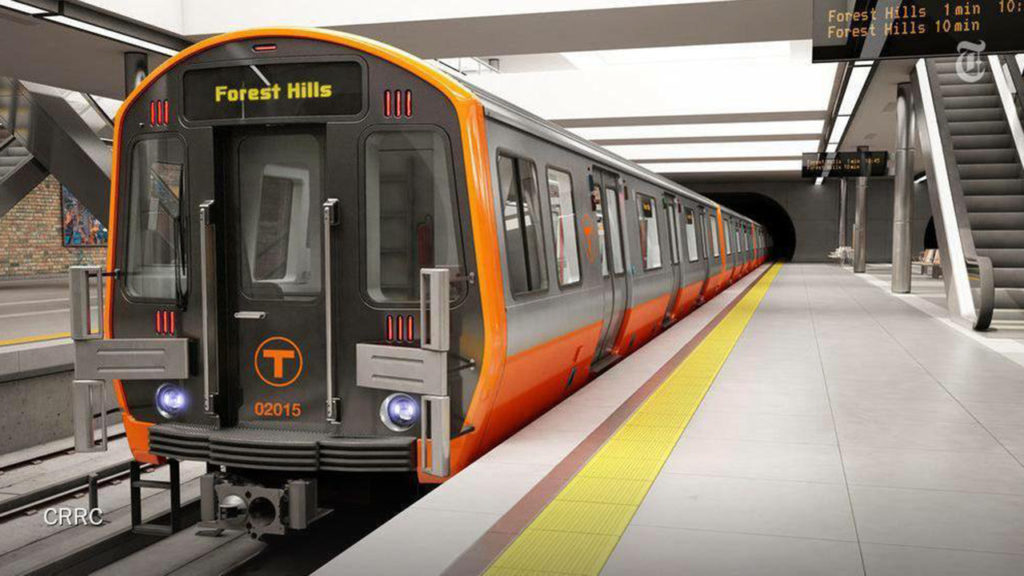
The POTUS 47 Administration has detained new railcar shells and other equipment manufactured for the Massachusetts Bay Transportation Authority (MBTA) Orange and Red Lines by Chinese SOE (state-owned enterprise) CRRC (China Railway Railway Rolling Stock Corp.), “threatening to derail a more than $1 billion effort to upgrade the transit agency’s aging subway cars,” Boston’s WGBH reported June 30.
“According to the [MBTA], last month U.S. Customs and Border Protection agents confiscated several shells and associated components that had been shipped from China by Beijing-based CRRC Corp.,” wrote WGBH reporter Jeremey Siegel. “If the components aren’t released, the holdup could slow or even shut down production at the Chinese company’s plant in Springfield, Mass. CBP did not immediately provide comment on the situation. MBTA spokesman Joe Pesaturo said in a statement that the T is ‘aware of the situation and is closely monitoring communications’ between the company and Customs and Border Protection.”
According to WGBH, online news site Contrarian Boston first reported on the holdup last week, “citing a letter by CRRC President Zhaofu Wang claiming that the company ‘responded promptly, to officials’ concerns over potential violations of the Uyghur Forced Labor Prevention Act (UFLPA), a 2021 U.S. law aimed at preventing American companies from funding forced labor among ethnic minorities in China’s Xinjiang region. In an email to GBH News, CRRC pushed back against allegations of forced labor, writing that it has ‘maintained rigorous compliance reviews of all suppliers and confirms that no entity involved in these shipments is linked to any violation of the UFLPA or use of forced labor.’ ‘We take this request very seriously and have responded promptly with providing documentation to CBP to demonstrate full compliance,’ the company wrote.”
Erik Olson, Executive Director of the U.S.-based Rail Security Alliance “praised the Administration for ‘holding Chinese state-owned and controlled CRRC accountable to ethical and honest trade and manufacturing practices,” Siegel reported. “‘CRRC’s use of forced Uyghur and child labor for train shells and railcar components has been widely reported going back years,’ he said in a statement. ‘This is an obvious violation of the Uyghur Forced Labor Prevention Act, which prohibits the import of products and materials that may have been manufactured by forced or slave labor.’”
The MBTA signed a contract with CRRC in 2014 to build new railcars for the Orange and Red lines at a new facility in Springfield, where final assembly occurs. CRRC manufactures carshells and some subassemblies in China and then ships them to the U.S.
“Over the past 11 years, the project has been riddled with delays and a swelling price tag,” WGBH reported. “Hundreds of new cars that were promised by 2023 still haven’t been delivered. Since 2014, the cost of the deal has grown from $567 million to more than $1 billion total. While U.S. Customs and Border Protection’s confiscation of materials threatens to further derail the plagued partnership, MBTA leaders are confident production will continue in Springfield at least through the end of the year using shells and related components already housed at the plant.
“‘What—if any—impacts this current issue has on the future delivery schedule is not immediately clear,’ the T’s Pesaturo said. ‘But the MBTA and its contractor are committed to finding a resolution that allows production to continue well past this year.’ Even if production at CRRC’s Springfield facility isn’t immediately affected, the Administration’s China policy will likely have major implications for the T’s effort to upgrade its subway cars.
“CRRC has said that any tariffs imposed on Chinese imports will increase costs and ‘negatively impact railcar construction.’ It’s unclear who would be responsible for covering any costs associated with tariffs, but in a March appearance on GBH’s Boston Public Radio, MBTA General Manager Phil Eng implied that the T would be off the hook. ‘Right now, that impacts CRRC themselves,’ he said. ‘It doesn’t impact us.’”