First TransLink Mark V SkyTrain Enters Service (UPDATED 7/29)

Several of the sets are slated to be running on TransLink’s Expo and Millennium lines by the end of 2025, a major milestone in the modernization of the agency’s rapid transit system.
According to Alstom, these driverless light metros are the “longest and highest” capacity trains on the SkyTrain network to date. With the additional order from TransLink to supply six five-car Mark V trains for the SkyTrain network in 2024, TransLink has ordered a total of 235 Mark V cars (47 trains), which will be delivered by 2029. Each five-car Mark V, which is built to support the incoming Broadway Subway and Surrey-Langley SkyTrain projects, can carry 672 passengers, a 25% increase in capacity over the current four-car Mark III trains. Offering more comfort for passengers, the new cars feature improved interior designs, interconnected wagons, new seating and standing configuration, indigenous artwork, improved HVAC and large digital displays showing station information.
These “Made-in-Canada” trains are designed, manufactured, and tested at Alstom facilities in Kingston, Ontario, and La Pocatière and Saint-Bruno-de-Montarville, in Quebec. The trains are then delivered to Metro Vancouver on flatbed trucks across the Trans-Canada Highway, spanning a 4,600-kilometer (2,858-mile) cross-country trek. At peak production, 282 people were working directly on this project, not including the jobs and economic benefits created through the company’s local supply chain, Alstom noted.
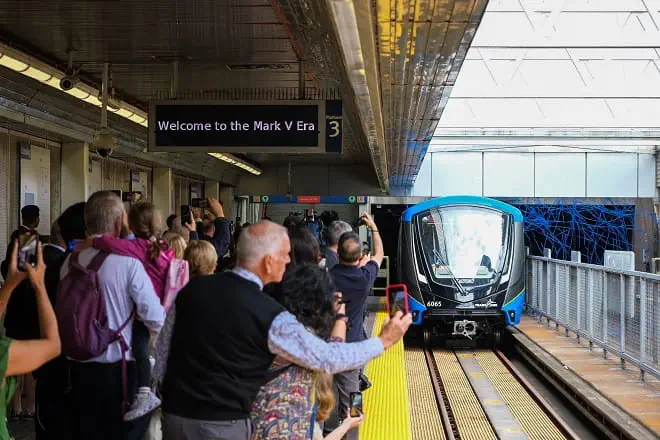
Delivery of the Mark V, TransLink says, arrives at a “crucial time,” as over the next five years, the agency is expecting a 20% increase in ridership on the Expo Line, and a 50% increase on the Millenium Line during peak hours. The Mark V will help to address that growing ridership demand in the region, TransLink noted.
This project was approved by the Mayors’ Council as part of its 10-Year Vision and is funded in part through the Investing in Canada Infrastructure Program (ICIP), in partnership with the Government of Canada, the Province of British Columbia, and TransLink.
“The entry into service of the state-of-the-art Mark V light metro fleet marks a new chapter in sustainable urban mobility,” said Michael Keroullé, President of Alstom Americas. “Alstom is proud to deliver ‘Made-in-Canada,’ best-in-class technology that enhances reliability, optimizes performance, supports TransLink’s long-term vision for a smarter, greener transit network and makes travelling by transit better and easier for the people of Vancouver.”
“The SkyTrain is more than just transportation—it’s part of the identity of Metro Vancouver,” added TransLink CEO Kevin Quinn, CEO. “The Mark V trains represent a bold new chapter, with more space, improved accessibility, and cutting-edge features that will enhance every ride. These trains are designed to meet the needs of a growing region, and I am excited to see them deliver a better experience for every customer.”
“The successful deployment of two VOBCs on the first of the 47 new Mark V trains enabled it to seamlessly enter service as part of a major expansion of the SkyTrain network,” Hitachi Rail reported July 29. The company said its SelTrac™ Communications-Based Train Control (CBTC) provides the “operational backbone of the SkyTrain network.” The technology now installed on the first new train ”communicates with the existing signaling system from Hitachi Rail,” it said, and provides real-time information on train locations that allows trains “to run safely, increase service reliability and provide improved passenger experience.”
According to Hitachi Rail, this fleet expansion “is a cornerstone of Metro Vancouver’s 10-Year Transportation Vision, enabling increased service frequency and supporting future extensions that comprise a 28% increase in the length of the SkyTrain network.” The system expansion, it noted, encompasses the Broadway Subway and Surrey Langley SkyTrain projects, both to be equipped with Hitachi Rail’s SelTrac™ CBTC technology.
“Hitachi Rail’s 40-plus year partnership with Metro Vancouver’s transit system is testament to our onboard technology developed right here in Canada,” said Ziad Rizk, Managing Director of Urban Rail Signaling at Hitachi Rail. “This milestone signifies the next significant stride in our shared journey that commenced in 1986 with the groundbreaking introduction of SkyTrain, the world’s first driverless train system. Our innovative technology seamlessly integrates new vehicles into service, reflecting the collaborative efforts of TransLink, Hitachi Rail, and our valued partners. Together, we enhance the passenger experience across one of Canada’s busiest transit networks.”
Separately, Hitachi Rail GTS USA is supplying the CBTC system for the Muni Metro system Train Control Upgrade Project.
Railway Age Executive Editor Marybeth Luczak contributed to this report.