

It’s about time, right? After all, many major airports around the world are connected by rail to their local transit systems. In the United States, which has generally lagged behind Asia and Europe, there are rail connections to airports in Atlanta, Chicago, Dallas, Denver, Minneapolis, New York, Philadelphia, Phoenix, Portland, San Francisco, Washington D.C. (both Reagan and Dulles) among others.[1] Even our own Hollywood-Burbank Airport is served by Amtrak and two Metrolink stations.
But LAX isn’t like any other airport.
Not only is it the busiest airport in Southern California (by a huge margin), it’s also one of the busiest in the country. In 2024, LAX handled over 513,000 flights carrying more than 76 million passengers. That shakes out to approximately 1,400 daily flights carrying more than 208,000 passengers each day.
Those numbers don’t make LAX the busiest airport in the United States –– that honor goes to the Hartsfield-Jackson in Atlanta –– but traffic congestion doesn’t necessarily correlate with passenger volumes. Hartsfield-Jackson is a major hub. Many of its flights are connecting flights in which passengers never leave the airport. LAX, by contrast, is the biggest origin and destination airport in the United States. That means more people from all over the region coming and going –– and the vast majority of them are doing that by car.
Which brings me to the roadway around the LAX central terminal area, colloquially known as the “horseshoe.” The brave souls who have willingly offered to drive you there must have really liked you or lost a bet. The U-shaped roadway was built as part of a master plan approved by city voters in 1956 (the same plan that brought you architect William Pereira’s beloved jet-age Theme Building) and inaugurated to great fanfare in 1961. The roadway configuration was intended to provide fluid access to all six terminals arranged like spokes around the edges.
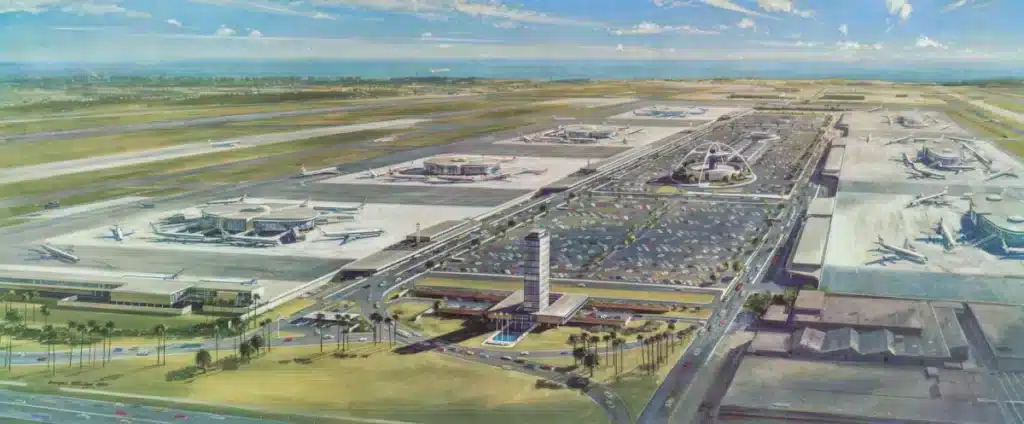
In 1967 –– only six years after the big airport makeover –– the Los Angeles Department of Airports (precursor to Los Angeles World Airports, or LAWA) developed a new master plan, in large part provoked by a huge spike in air travel. William Pereira, still very much involved in the airport design, observed that while the airport welcomed about three million passengers in 1956, the number had jumped to 20 million by 1967.[2]
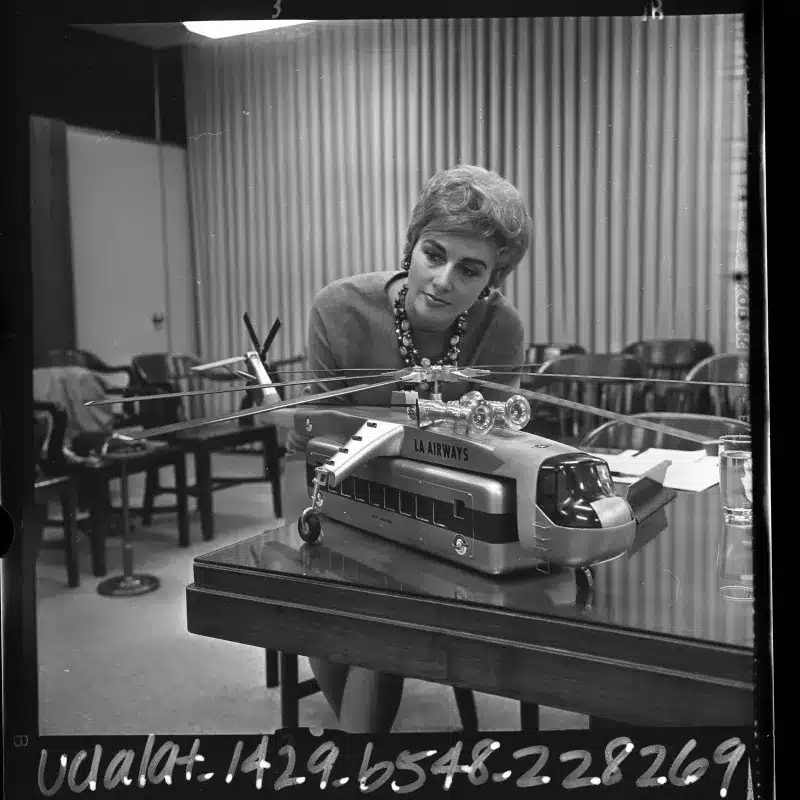
This was accompanied by massive automobile congestion, especially within the horseshoe, which couldn’t be easily modified to accommodate new levels of traffic. This time, planners put everything on the table. Gondolas whisking people from terminal to terminal. People movers (although they didn’t call them that –– one official described the concept to the Los Angeles Times as “something like a horizontal elevator”). An offshore airport, or “seadrome.” And (my favorite) an army of helicopters outfitted with giant metal jaws designed to carry buses through the air and ferry them around to various “metroports” throughout L.A. County (check out the photo below for a visual).
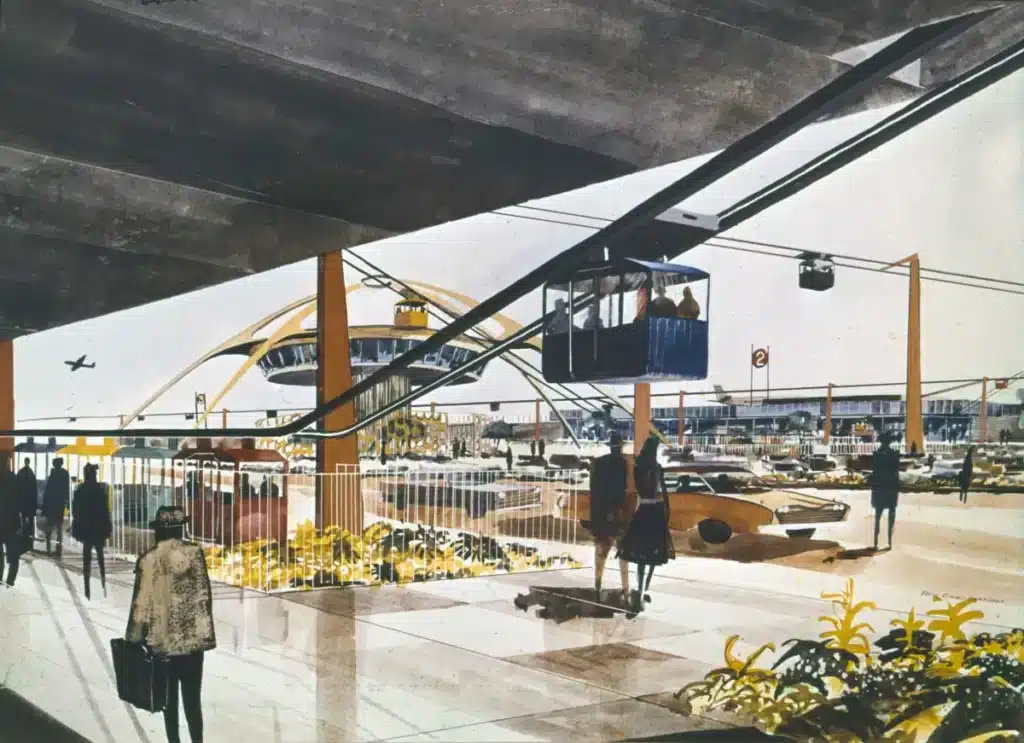
The oil crises and a surge in airplane hijackings in the 1970s squelched these ambitious plans, and congestion continued to worsen. LAWA did add a second level to the horseshoe during the 1980s in anticipation of the 1984 Olympic Games. This doubled the road’s capacity, but traffic quickly caught up. In 2024, an average of 95,000 vehicles passed through the horseshoe each day.
The LAX/Metro Transit Center Station will provide an alternative to this decades-long congestion problem. The new station, which closes a gap in our expanding transit network and completes the K Line, will serve two light rail lines –– the C and K Lines –– as well as several Metro and municipal bus lines, thereby adding new options for residents, employees, and visitors to move around the entire region. A huge addition and time-saver will be the opening of LAWA’s Automated People Mover scheduled for next year, which will replace the temporary bus shuttles between the new station and airport terminals. Our projections suggest that the LAX/Metro Transit Center will become one of our system’s busiest stations.
We’re thrilled to open the station in a few short days, especially as the journey to design and build the MTC has been a long uphill road speckled with false starts, creative re-imaginings, conspiracy theories and financing issues. Here’s how it came to pass.
The early days of LAX and its jet-age transit ambitions
Mines Field Airport, the forerunner to LAX, opened in 1928, a time when our local streetcar system had already peaked and was beginning its slow and steady decline. The 640-acre barley field first turned up in planning documents as the “Inglewood site” but it didn’t start out as a passenger airport. Rather, it was a remote, rough-and-tumble destination for joyrides and air shows. In 1928, Mines Field hosted national air races, prompting an article in the Los Angeles Evening Express to explain that both the city and county “are going to be using their full force in developing the new boulevards in the vicinity … to accommodate the large crowds that will attend the air races there.”
Buses started running to Mines Field as early as the 1920s. By the time that the airport opened for passenger service in 1946 and was renamed Los Angeles International three years later, rail had nearly vanished from Los Angeles. Small wonder, then, that the airport didn’t receive its first rail proposal until the early 1960s.[3]
Monorail proposals, that is! In 1961, a subsidiary of Alweg, the same company that built the well-known monorails at Disneyland and in Seattle, approached the Los Angeles Metropolitan Transit Authority (LAMTA) with a plan to build a system for LA. Shortly afterward, another monorail company, Goodell Monorail, offered to build the city a 17-mile monorail from downtown Los Angeles to LAX. The ride was projected to take 12 minutes (compared to the 30-to-90-minute car commute) and would cost $40 million.
Goodell promised that the project would be privately financed and wouldn’t cost taxpayers a dime.[4] All LAMTA would have to do was obtain the right-of-way, but that wasn’t an easy task. Many elected officials decried it as “merely a tube,” or refused to support it unless it added stops in their districts. Stymied by political squabbles and LAMTA’s lack of authority to levy taxes, both plans collapsed.
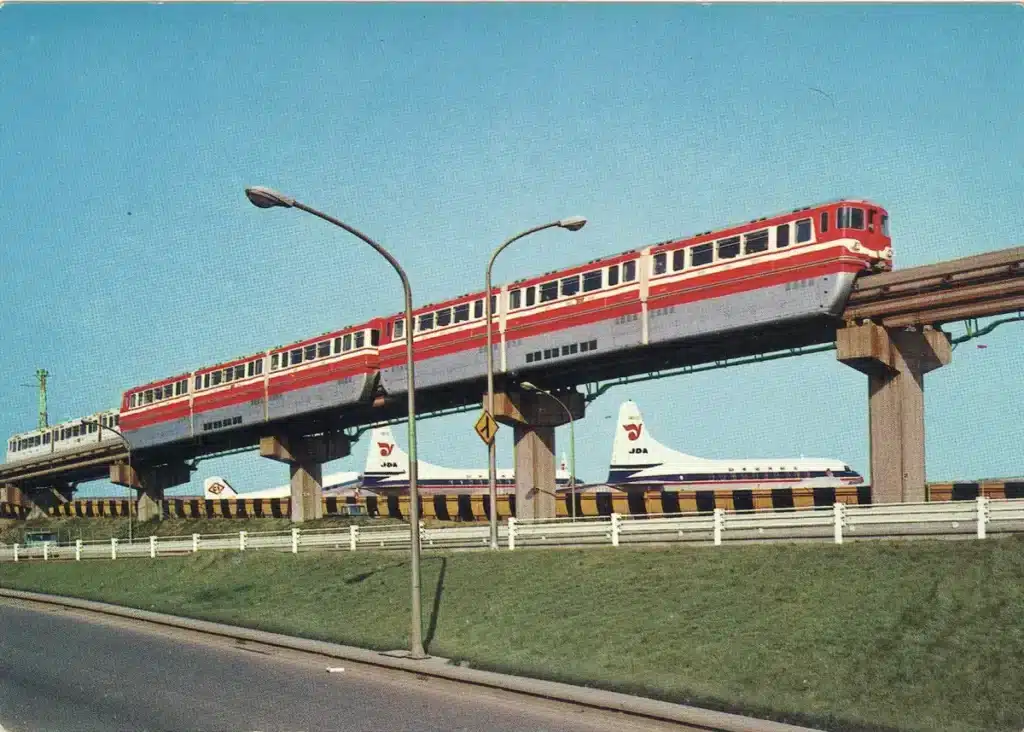
Several plans for a rail connection to the airport were kicked around after that. It shows up in the RTD’s “Five-Corridor Plan” of 1968 as well as additional ballot measures to fund a rail system proposed in 1974 and 1976. None of them passed muster with voters.
For a long time, then, the most reliable way to take transit to the airport was with the tried-and-true mode that had ferried Angelenos around since the 1920s: the bus. Metro’s predecessor, the RTD, ran a couple lines to LAX and took over Greyhound’s LAX bus lines.

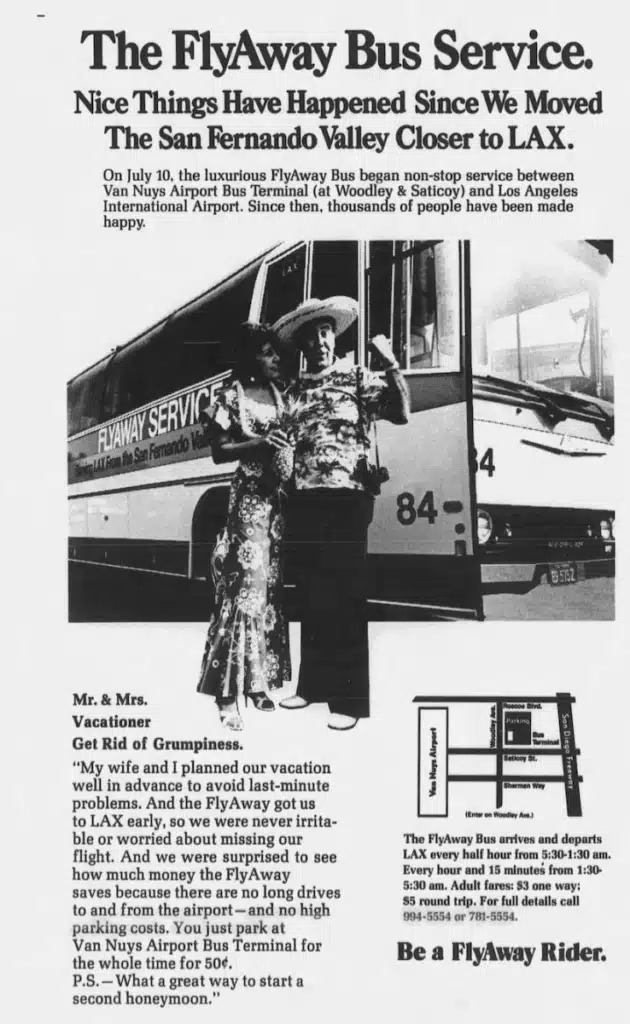
The LAX Flyaway started out as a pilot project in 1975. While FlyAway shuttles ran from various locations, most of them eventually folded due to low ridership. Today, you can only catch them at Van Nuys Airport and Union Station.
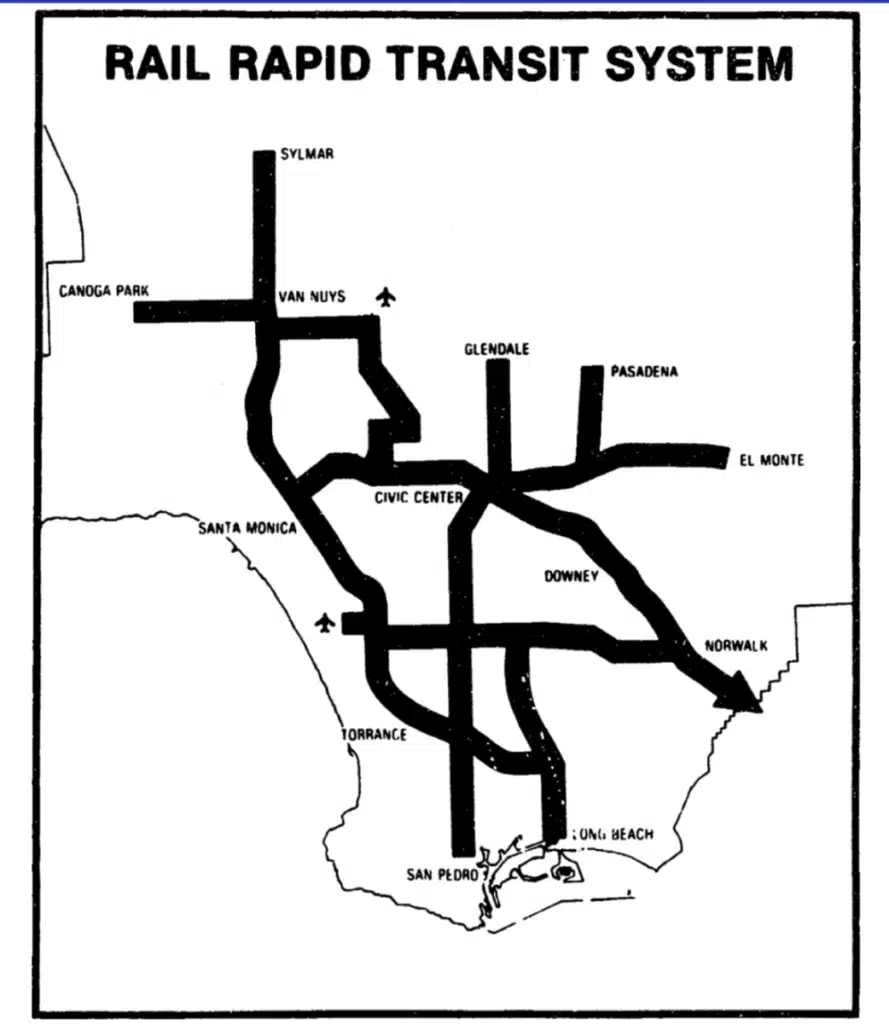
The mood changed with Proposition A (1980) –– a half-cent sales tax measure approved by voters designed to fund rail, bolster buses, and facilitate road improvements. And yet, when the Blue Line (now the A Line) opened in 1990, restoring rail to Los Angeles after a 39-year hiatus, it didn’t come close to the airport but instead traveled from Downtown LA to Long Beach. This was followed by Metrolink regional rail, which opened in 1992, and the first nub of the B and D Lines, which opened in 1993. For the first time in almost three decades, L.A. had a fledgling rail transit system.
The Green Line’s missed connection to LAX
The next rail line on deck: the C Line, which was to run in the middle of the new Century Freeway as a court-required consent decree mitigation for the demolition of thousands of homes. But there was a decision to be made: when the new rail line reached the western terminus of the Century Freeway, would the train turn north toward the airport or south to the South Bay and the major aerospace companies then based in the area? There wasn’t enough funding for both.
In what has been bemoaned as everything from an “epic failure” to “a psychological black eye” planners decided to route what became the Green Line (now the C Line) away from the airport, expecting higher ridership potential from the people living and working in South Bay cities.[5] Many planners argued that no one would want to load luggage on a light rail train (the horror!).
The connection to LAX wasn’t abandoned; rather, it went into planning the future Green Line Northern Extension. Those conversations began in earnest in 1988, gaining steam after the passage of Proposition C (1990), another half-cent sales tax increase narrowly approved by voters to support transportation projects.
Several alternatives for the Green Line Northern Extension were studied, including light rail straight into the terminals and a light rail stop that would connect to a future people mover that LAWA was planning at the time.Even though the Metro Board of Directors certified the final environmental impact report for the project in 1994, a myriad of reasons kept the project from moving forward.
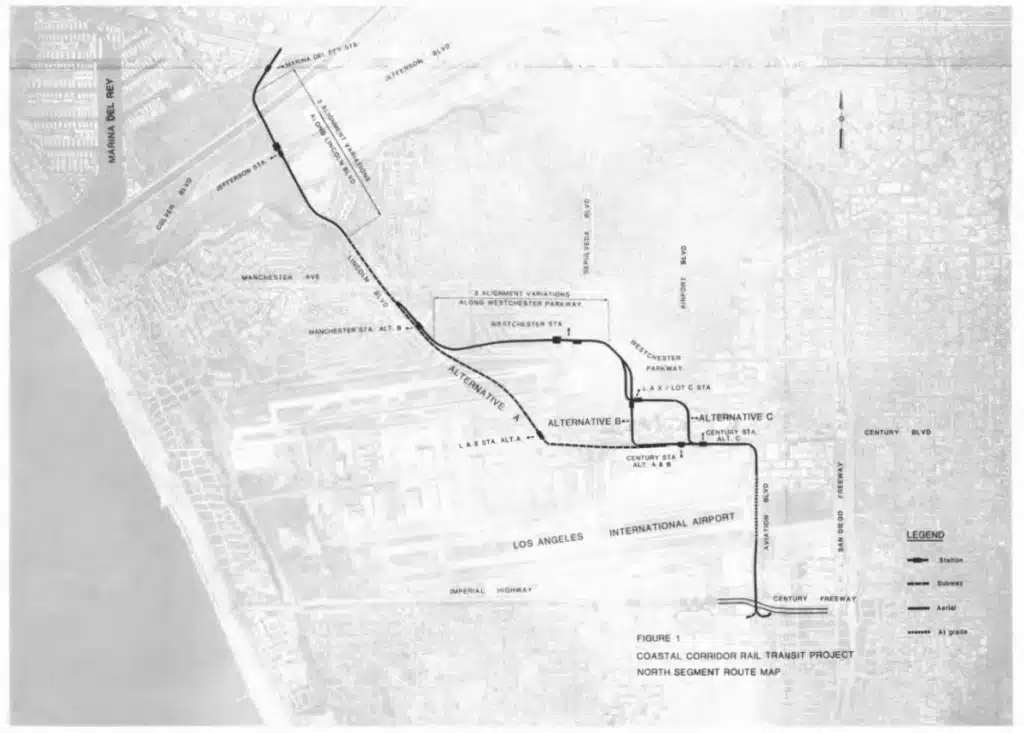
The Federal Aviation Administration expressed concerns that the overhead lines that powered the trains might disrupt flight navigation. The airport pointed to federal restrictions on what kind of improvements it was authorized to fund. Reasons aside, the airport connector’s failure to get off the ground has been marred by conspiracy theories. I’ve read juicy claims that the project was killed by the parking lot owners, car rental agencies, and the taxi industry, but none of have substantive evidence. “A taxi lobby so powerful it could prevent a train to LAX, but not Uber?” Metro’s head librarian laughed when I asked. A good point indeed.
When the Green Line (now the C Line) opened in 1995, the closest you could get to the airport was Aviation/LAX Station, about two miles south of LAX. The rail line was criticized as a “road to nowhere” and “an elephant with no tail and no trunk.” Launch of the LAX Shuttle that same year –– a bus from Aviation/LAX to the terminals –– wasn’t much consolation. You still had to walk down the platform and wait with your luggage at the curb for a bus to the terminals that came every 15 minutes. In time, both the Green Line and the shuttle bus built ridership, but neither ever got much traction as a great way to reach LAX. (Please note: this shuttle will be discontinued at 5 p.m. on June 6; instead, stay on the C Line to LAX/Metro Transit Center Station and take the new bus shuttle, operated by LAWA, to the terminals.)
The airport connector gets its second wind
When plans for the Crenshaw Line (now the K Line) were announced in early 2008, it seemed like plans for an airport connector were finally moving. The new line, which had been discussed since the early 1990s, would establish a north-south connection between two east-west running lines, the E Line and the C Line, and would travel just west of LAX along Aviation Boulevard. But bringing the actual connection to LAX depended on securing funding.
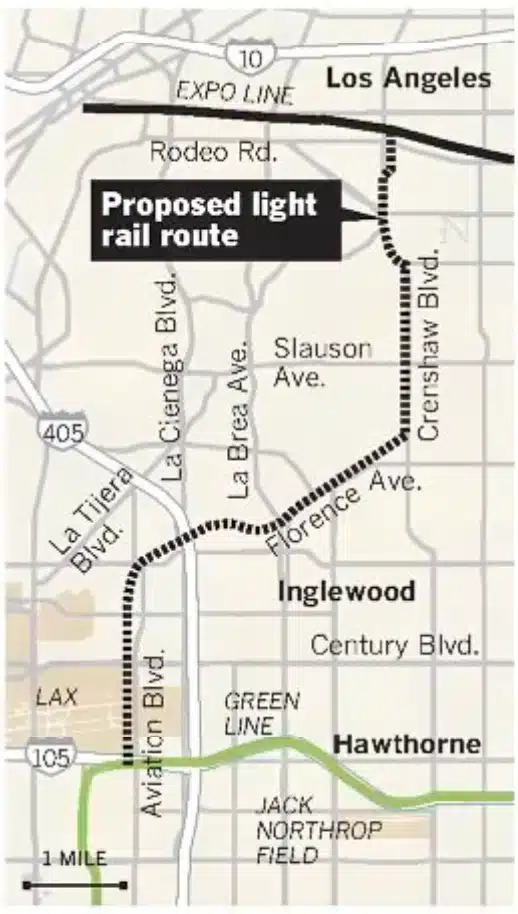
By the end of 2008, Metro’s fortunes had changed. Despite getting caught in the throes of the Great Recession, LA County voters overwhelmingly approved Measure R, a half-cent tax increase designed to fund a number of transit projects in Los Angeles. Among them was funding for the future K Line that would include a stop at or near LAX.
Still, plans for this airport connector station remained unresolved as officials debated the best way to get rail to the airport. Among ideas presented: a direct rail line straight into the central terminal area (shelved thanks to the $3 billion price tag, among other concerns) and connections to LAX’s people mover at different spots east of the airport.
In 2014, the Metro Board of Directors approved building a new station at 96th Street and Aviation as the best approach, where rail transit links to a people mover. Two rail lines would converge at the new station, while the LAX people mover would provide access to each airport terminal. Meanwhile, the new Aviation/Century Station would help connect riders to the hotels and airport-related businesses along Century Boulevard.
The project hit a tipping point when voters approved Measure M, a permanent sales-tax increase that supplied the new airport connector station with critical funding. While Measure R had primarily funded rail projects, Measure M was more expansive and multimodal with a greater emphasis on equity and accessibility. The LAX/Metro Transit Center is the first Measure M funded project to be completed, and in many ways reflects its ethos. For example, the large-scale open station concept is designed with accessibility at its forefront and adheres to the internationally recognized principles of “universal design.” It also has modern amenities such as public restrooms, rest areas, a bike hub, plenty of shade, and digital wayfinding –– and all before Los Angeles hosts the FIFA World Cup 2026, the Super Bowl in 2027, and the 2028 Olympic and Paralympic Games.
The project broke ground in 2021. Now, four years later, it’s complete.
Setting the tone for the most ambitious transit expansion of our time
Fun fact: LAX serves more passengers than every other airport in our region combined (including San Diego). It’s that busy. Building a rail line to LAX has always been seen as such a glaring necessity that the challenges associated with actually building it haven’t gotten as much attention. There were more security and safety considerations. More environmental clearances. More plans that must be approved by multitude of agencies. Higher costs, both financially and psychologically. LAX is the region’s ultimate transportation hub (no disrespect to the ports!). The stakes have always been so high that’s it taken many years to get it right.
In some ways, our newest station might remind you of an older regional transportation hub on the other side of town: Union Station. Completed in 1939, Union Station was designed to consolidate three railroads –– the Santa Fe, Southern Pacific, and Union Pacific –– into one central terminal station that would become a symbolic gateway welcoming millions of visitors to Los Angeles.
Both stations sought to simplify transportation by bringing disparate transfer points together. Both were major public investments designed to change the way we move around. Both took a very long time to be realized.
Now, the timing is different. Union Station opened during the twilight of rail’s greatest era. LAX/Metro Transit Center Station, conversely, debuts in the midst of a transit-building revolution in our region, sandwiched between the openings of the K Line (2022), the Regional Connector (2023) and the upcoming extensions of the A Line and the D Line. Taken together, these projects are part of a larger effort to retrofit Los Angeles with better transit options so residents and visitors have a viable alternative to driving. This station sets the tone for a bright multimodal future.
Planning a trip out of LAX soon? Now, at long last, we can finally say “Go Metro.”
Notes:
[1] Some of these are direct connections to the airport, like the “L” to Chicago O’Hare (completed 1984), SEPTA to Philadelphia International Airport (completed 1985) and MARTA to Atlanta Hartfield-Jackson (completed 1988). Others are airtrains/people movers designed to whisk you between transit and the terminals, like you’ll find at San Francisco International Airport and John F. Kennedy International Airport (both completed in 2003).
[2] William Pereira, “Tomorrow’s airport breaks the ground barrier,” Los Angeles Times, May 14, 1967.
[3] Believe it or not, passengers could take helicopters to LAX between 1954 and 1971. Los Angeles Airways –– the world’s first helicopter airline –– served 25 destinations at its peak, including Disneyland, Newport Beach, and San Bernardino. Unfortunately, two very high profile (and very fatal) crashes in 1968 fueled safety concerns that Los Angeles Airways never recovered from. Its final flight took place in 1971.
[4] “$40 million monorail system studied from LA to the airport,” Daily News-Post, February 11, 1963.
[5] Those ambitious ridership projections for the C Line –– as high as 100,000 daily boardings –– never came to pass. Unfortunately, the aerospace industry took a hit during the early 1990s due in part to the collapse of the Soviet Union and the resulting decline of the aviation industry.




