A race on the other side of the country, where another Socialist-leaning Democrat will soon lead a major city, after having spent years advocating for better transit, requires its own commentary. The city is Seattle, and its next mayor will be Katie Wilson. She defeated incumbent Mayor Bruce Harrell, also a Democrat, in a close contest 50.2% to 49.5%, with a small number of write-in votes for other candidates. Harrell was elected in 2021 and ran for re-election this year. Wilson had defeated him by 9.7% of the vote in the primary and won again by a much closer margin in the general election. Seattle has a “jungle primary” where the two top vote-getters, regardless of party, square off against each other in the general election. Harrell had the backing of “establishment” Democrats, while Wilson was supported by the “progressive” wing of the party. She is 43 and first appeared on the transit scene as a founder of the Seattle Transit Riders Union (TRU) in 2011.
Emily Badger reported on the Seattle TRU and similar organizations elsewhere in Bloomberg’s City Lab Oct. 29, 2012: “Unions may be dying off in the workplace. But could they make a difference on the bus?” ‘The analogy with labor unions is interesting, because it’s obviously different in the sense that we don’t all work for the same employer, we can’t strike and bargain with our employer for benefits,’ says Katie Wilson, one of the founders of the six-month-old Transit Riders Union in Seattle. ‘But it’s more of a political thing. This is the new working poor, organizing and trying to win political gains.’” According to Badger, the TRU started in response to a proposed 17% cut in service by bus agency King County Metro and the impending elimination of a fare-free zone in downtown Seattle.
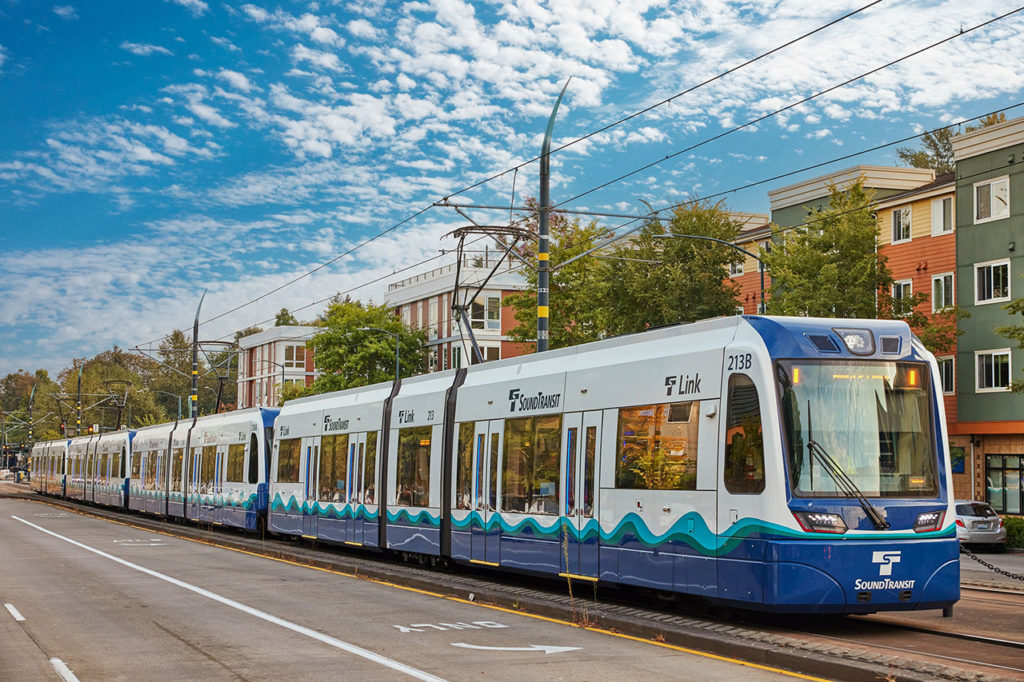
Buses still provide most of the transit in Seattle today, and Third Avenue is a busy busway downtown. Most buses are operated by King County Metro (a county-level agency) and Sound Transit (the Central Puget Sound Regional Transit Authority), a tri-county regional provider. Sound Transit also operates light rail in and around Seattle. Its spine is the Central Link (now also known as the 1 Line), which runs on a north-south alignment from Lynwood, north of the city in Snohomish County, to Federal Way, south of SEA-TAC Airport. The agency also operates the T Line (also known as the Tacoma Link), a light rail line in Tacoma. Plans call for them to be connected eventually. The 2 Line, which now runs between Bellevue and Renton, opened its initial segment on April 27, 2024, with an extension in Redmond that opened on May 12 of this year. The lines are presently disconnected, but the missing segment, including a “floating bridge” is under construction. Several more system extensions are planned for construction over the next two decades.
Sound Transit also runs the Sounder trains between tracks adjacent to King Street Station (but not accessible from the station building, which only serves Amtrak trains) to Everett to the north and Lakewood to the south, through Tacoma in Pierce County. Except for one Tacoma round trip, all Sounder trains run during peak-commuting hours in the prevailing commuting direction from Everett (north) and Lakewood (south), and in both directions between Seattle and Tacoma.
There are also two City-owned streetcar segments operated by King County Metro: the First Hill Streetcar and the South Lake Union Streetcar (originally the South Lake Union Trolley, but the name was changed on account of its acronym). Those lines are also disconnected, and there is a proposed project that would connect them: the Central City Connector, also known as the Culture Connector, with new tracks along First Avenue and Stewart Street. There is also a proposal to extend the First Hill Streetcar further north on Broadway. The other “rail line” in the city is a curiosity and a tourist attraction: the Seattle Monorail, built to take visitors to the Space Needle at the 1962 World’s Fair. It still runs with the original equipment as a “transit oddity” that charges a high fare ($4.00 base fare for a two-minute ride), and it allows transfers to the light rail and streetcar.
“Union” For Riders
The Transit Riders Union describes itself as “an independent, democratic, member-run union of transit riders organizing for better public transit in Seattle, King County and beyond.” The organization had announced on Sept. 5, during the campaign, that it was looking to replace Wilson as Executive Director, saying: “Katie has long held two official positions in TRU. She’s been our General Secretary, serving as an elected officer (and board member), a position similar to president. And she’s been our Campaign Coordinator, a paid staff role responsible for working with the membership and with allies to carry out TRU’s campaigns and projects. Together these roles have been much like an executive director position at a more traditional nonprofit.”
TRU is concerned with labor-related causes, in addition to transit issues, like affordable housing and higher wages. The TRU adopted the slogan: “People Power, Not Money Power.” The “history” section of the TRU website expressed the organization’s philosophy: “In order to win the world-class transit system that Seattle needs—not to mention solving all the other problems that we face now—it is clear that an organization of transit riders, no matter how large, is not sufficient. What is needed is a new mass movement of working and poor people that fights along all the lines that affect our lives: transit, housing, social services, healthcare, employment and workplace issues, and the environment … By successfully organizing transit riders, we set an example for and give encouragement to those who fight on other issues. We become their allies, and they become ours.” The TRU’s core mission statement is: “The Transit Riders Union is a democratic organization of working and poor people—including students, seniors and people with disabilities—taking control over our own lives, and building up the power we need to change society for the good of humanity and of the planet. We will fight to preserve, expand, and improve the public transportation system in Seattle and beyond, so that every human being has access to safe, affordable, and reliable public transit.”
The TRU’s statement about transit says: “Mass transit is part of the solution to the great crises of our age. We can’t stop climate change without a realistic alternative to driving for the great mass of people. And we can’t build a just society as long as low-income people must choose between compromised mobility or spending more than they can afford on car-ownership. Bottom line? We need a true round-the-clock mass transit system that unites our region, serves our neighborhoods, and is accessible and affordable for everyone.” Other statements on the TRU website also include environmentalist and Socialist themes. For example: “TRU is helping to build a movement to take our democracy back from the organized power of big money that is sacrificing our planet and well-being for sake of short-term profit. Join us!”
Wilson’s platform, including a section on Transportation, is available on her campaign website. Her four-point transportation program would: “Fix our streets and make them safe for walking, biking and rolling, Pursue the world-class transit system of our dreams, make public transit affordable, comfortable and safe, and Mode-shift because we can’t keep adding cars to our streets.” She mentioned rail transit sparingly, but she said she would “Expedite the delivery of Sound Transit Link Light Rail projects by providing needed leadership on the Sound Transit Board and using the City’s powers to lead on planning, minimize permitting burdens, leverage existing right-of-way, and avoid excessive process.” Another rail-oriented campaign promise was: “I will cut red tape to expedite building out light rail to West Seattle and Ballard and expand and improve bus service. I will pursue programs that encourage people to get around via transit to prevent our traffic from getting even worse.” Regarding modal shift, she called on employers who subsidize parking for employees or offer it at no cost to give the cash equivalent for employers who don’t use that benefit and endorsed what she called New York’s “(de)congestion pricing” program, saying it was “worth our attention.”
On Dec. 8, after she was elected, Wilson told Kea Wilson (no relation) of StreetsblogUSA: “Over the years, TRU grew into more of a multi-issue economic justice organization. But transit has remained close to the organization’s heart and close to my heart, especially in the couple years since my daughter was born. I used to ride my bike everywhere, because it was almost always faster than taking public transit. But after my daughter was born, we just ride transit everywhere. I’m always on the bus; I’m always on the train; I love our transit system.” She also said: “I don’t own a car. I’ve never owned a car. Now, my security detail drives me around, so that’s very weird.”
On October 21, Katie Campbell reported on an interview with Wilson that aired on KUOW, Seattle’s NPR station. Campbell’s story bore the headline Katie Wilson can barely afford to live in Seattle. That’s why she wants to be mayor. She described Wilson this way: “Wilson presents herself as a sensible coalition-builder who runs a small nonprofit—the Transit Riders Union—and has lived a mostly working-class life. A renter and a mother, she runs on issues close to her heart. She speaks the language of struggling people.” Quoting Wilson, Campbell reported: “‘I’m a Democrat, I’m a socialist, fine with being called a democratic socialist,’ she said, seemingly bored with the question. ‘It’s really just more of a belief system or an orientation for me.’” Campbell went on to say: “Foundational to that is the belief that the government should take on big challenges, she said. She believes everyone should have a roof over their head, an opportunity to do meaningful work, and access to childcare, health care, and elder care.” Wilson’s support for better transit was mentioned elsewhere in the report.
Seattle Advocates Speak
Advocates for more trains and better transit in the region are optimistic about what Wilson will be able to do for local and regional mobility once she takes office, although their level of optimism varies. The one issue that all of them raised during our interviews that was not mentioned on the TRU website what the incoming mayor could do for Amtrak’s Cascades trains the connect Seattle with Vancouver, B.C., Portland and Eugene, Oregon, and intermediate stops.
Luis Moscoso is Communications Director for All Aboard Washington (AAWA) and the Association of Oregon Rail and Transit Advocates (AORTA) and served on the Rail Caucus during his time in the Washington legislature. He expressed his hope that Wilson will appreciate the need for strong intercity service on Amtrak’s Cascades corridor, which connects with Seattle’s rail transit and Sounder trains at King Street Station. He sent this statement for Railway Age: “I am buoyed by Mayor-Elect Katie Wilson’s background organizing the Transit Riders Union in Seattle. Her campaign Mayoral Platform Statement on Transportation and Mobility maintained that ‘mobility is fundamental to our quality of life.’ That corresponds exactly with my belief in Mobility Justice that I brought to the Legislature when I founded the Legislative Rail Caucus as Vice Chair of the House Transportation Committee in 2013. I worked to realize a 1993 Legislative commitment to provide statewide intercity passenger rail as part of the state’s High Speed Ground Transportation Plan. That work to provide intercity passenger rail proceeds today with the Big Sky North Coast Corridor ID Long Distance Study that will restore service to eastern Washington cities, upgrades to WSDOT’s Amtrak Cascades and a future Cascadia High-Speed Rail program.” The Big Sky North Coast Corridor is a proposal to restore service on the route of the North Coast Limited (which lasted until 1979)on the former Northern Pacific, now part of BNSF.
Bill Moyer, Executive Director of Solutionary Rail, told Railway Age that he is enthusiastic that Wilson will soon be Seattle’s mayor. “She knows how to form coalitions, and she will stand up for ordinary people and their mobility” he stated. “TRU is a champion for all things that make a material difference in the lives of those who use transit, thus their involvement in tax policy and other issues beyond transit” and “I have immense respect for Katie Wilson and 100% confidence in her integrity, analysis, and capacity to propose and build coalition support for much needed solutions across all areas of policy. I deeply admire Katie’s people-focused approach to organizing and her commitment to making a material difference in people’s lives.” Regarding trains on Amtrak routes, he added: “TRU has been a solid partner in the fight for a return of common sense to intercity rail in the Pacific Northwest, despite the disregard and setbacks that plans for the Amtrak Cascades service has suffered, dismal on time performance that has resulted, and the attempts to supplant improvement plans with a billionaire-sponsored, ‘ultra’ high speed boondoggle project.”
Tom White is a railroad consultant, currently at VTD Rail Consulting and environmental advocate with a 58-year railroad career at BN/BNSF and other railroads, and who was instrumental in getting the Sounder train service started. He told Railway Age that he is attempting to get the transit people to realize that there is a connection between the Cascades service and city transit. He thinks that Wilson can help the locals get the picture about that connection: “She’s done transit advocacy and advocacy for working people. I just hope she doesn’t get stopped in her tracks by the City Council. I’m expecting her to pursue all the good things, including affordability and transit advocacy, but I hope she can get it through the Council. I hope she can get the streetcar line connected and turn it into something real.”
Seattle’s Mamdani?
There are a number of parallels between Wilson and New York’s Mayor-Elect Zohran Mamdani. Both are young, neither possess great personal wealth, both support transit and show that support by using it, and both are outsiders who scored surprise victories against established politicians. Both have expressed deep concerns about the economic woes that “ordinary” residents of their cities are facing. Wilson’s TRU has fought for higher wages for transit workers and keeping fares down, while the key word in Mamdani’s campaign was “affordability.”
In both New York and Seattle, voters chose a young mayoral candidate over an opponent who is a senior and had the backing of long-time politicos. Outgoing Mayor Bruce Harrell, who Wilson beat, is 67, while she is 43. Former Gov. Andrew Cuomo is also 67 and lost to Mamdani, who is 34. A younger generation of voters seem to be making their voices heard, and one thing they want is better transit.
In our election report last month, I reported Mamdani’s victory, noting that he is a strong transit supporter, but questioned how much he can really accomplish to improve transit in the city. The agency that operates it, the Metropolitan Transportation Authority (MTA) is a state agency, where the City’s influence is limited. According to White, Wilson might have a similar problem with the City Council.
The KUOW report cited earlier in this article said: “Wilson, a relative unknown when she filed her campaign paperwork, surprised political observers—and even herself—in August, when she trounced Harrell in the primary by almost 10 points. Despite her inexperience in elected office, she could defeat the well-known incumbent in the general election on Nov. 4 and run a city with 41 departments and a budget close to $9 billion.”
The situation she faces in Seattle might be similar to the one Mamdani faces 3000 miles away. Sound Transit is a regional tri-county agency, where Seattle’s mayor holds a place on the Board. Can she help accelerate the process of expanding Sound Transit’s light rail network and persuade the agency to run Sounder trains on weekends and at times other than peak-commuting hours on weekdays? King County Metro covers only its namesake county, but there are many other municipalities in the county, not just Seattle. Will Wilson be able to expedite construction of the Culture Connector / Center City Connector between the two disconnected segments of the Seattle Streetcar and the eventual expansion of the line on Broadway? With public safety, affordable housing, other rising prices, and all the other difficulties inherent in American city life today, Katie Wilson will certainly have a lot on her plate. With all these pressing issues, will she also be able to improve local transit so motorists will use it more often for discretionary trips, and non-motorists (estimated at about 20% of Seattle residents) will have more mobility after she takes office than they have today?
Time will tell and nobody knows for sure, but advocates are hopeful. If anyone can improve Seattle’s transit, it would seem Mayor Katie Wilson can.