Sound Transit Launches ‘Crosslake Connection’ (UPDATED 3/30)
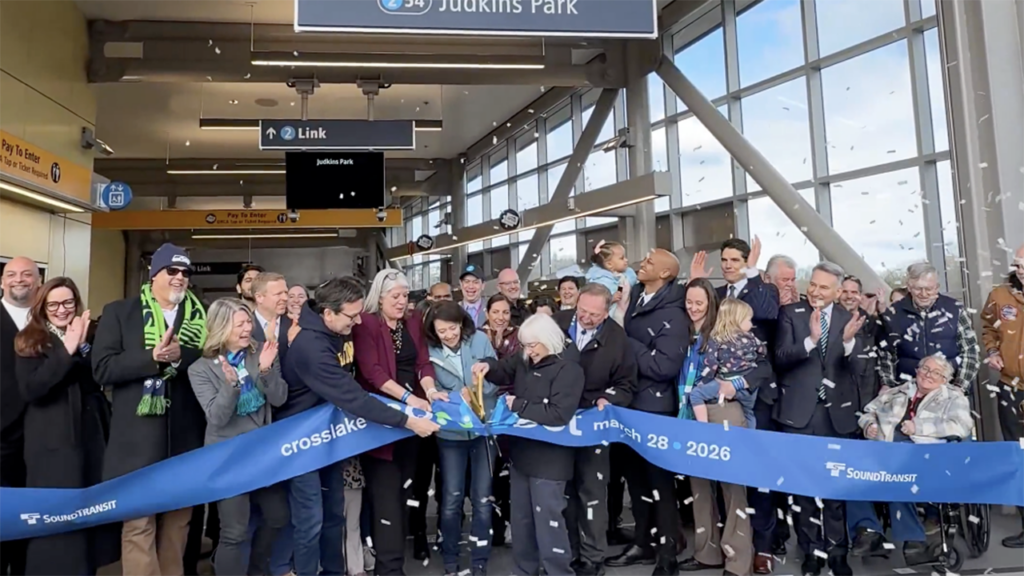
This final component of the 2 Line—dubbed the Crosslake Connection—spans approximately seven miles and includes two new stations at Mercer Island and Judkins Park (see map below). It completes the regional transit system expansion approved by voters in 2008 under ST2, increasing the light rail system from 55 to 63 miles.

Service on both the 1 Line and 2 Line will run from about 5 a.m. to 12 a.m. seven days a week. Trains will run approximately every eight minutes at peak at the new stations, and between 10-15 minutes the rest of the day. Between Lynnwood City Center and International District/Chinatown stations, combined 1- and 2-Line headways will mean trains arrive every four to five minutes.
The launch of the Crosslake Connection marked the agency’s opening of six light rail expansions in five years: in 2023, T Line service to Hilltop; in 2024, the 2 Line between South Bellevue and Redmond Technology stations and the Lynnwood extension into Snohomish County; and in 2025, the 2 Line extension to Downtown Redmond and the 1 Line extension between SeaTac and Federal Way. The Pinehurst Station at NE 130th Street in Seattle is expected to open later this year.
“The milestone we celebrate today [March 28] is possible because of a shared vision that began more than 60 years ago and has continued through the decades with resolve, innovation and hard work,” Sound Transit CEO Dow Constantine said. “We all share in this achievement—from the regional leaders who had the foresight to plan for future transit, to the voters who put their support behind those plans, to the thousands of people who have worked to bring the vision to life.”
“I’ve spent a lot of time getting around on buses and trains, and organizing to make them better, faster, and more reliable,” Seattle Mayor and Sound Transit Board Member Katie B. Wilson noted. “So, it’s incredible to be here today [March 28] to celebrate the opening of the Crosslake Connection and show that yes, we can take on big challenges and accomplish big things. I know there is so much more to do to continue delivering the world class transit system our region deserves, and I can’t wait to help make that happen.”
“The Building Trades want to thank Sound Transit and its leaders and staff for creating economic opportunity for generations of working people,” added Monty Anderson, Executive Secretary for the Seattle Building & Construction Trades Council. “Sound Transit’s investments throughout the region have created thousands of family-wage jobs for skilled craftspeople and pathways out of poverty for women, people of color, veterans and others who are disadvantaged into construction careers. Through apprenticeships and strong training programs, we are working together to help build the next generation of construction workers, many from local communities. Getting to this huge milestone on this historic regional system took vision, tenacity and bold leadership—and it’s building better lives. Let’s keep building!”
“Light rail running across Lake Washington is the result of decades of work by public and private partners committed to the same goal—and we’re proud to have been there from the beginning,” said Brad Smith, Microsoft Vice Chair and President. “This is a meaningful step forward for the entire region.”
BACKGROUND
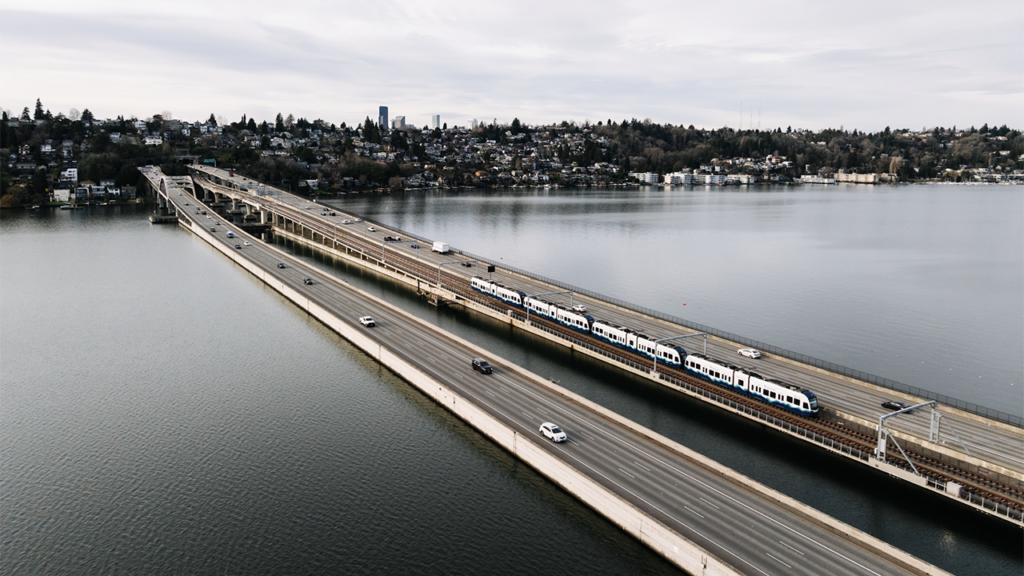
“To complete the 2 Line and connect to the Eastside, Sound Transit engineers had to do something that had never been done before—design light rail on a floating bridge,” the transit agency reported Jan. 23. “This world-first achievement was made possible by innovative engineering to address the unique challenges of running electric trains across a moving body of water.” (Watch the video below to learn more.) The Homer M. Hadley bridge, which supports light rail and highway traffic alike, is a “pioneering first in engineering, creating a vital east-west connector within the Puget Sound region and an alternative to the congested I-90,” according to the American Public Transportation Association, which presented a 2025 Innovation Award to Sound Transit for the bridge project. “By repurposing existing highway infrastructure rather than building a new crossing, the I-90 Segment saved billions of taxpayer dollars and minimized environmental impact. This strategy serves as a model for other public transit agencies operating in dense, infrastructure-constrained urban environments.”
“After decades of hard work, creative design, and world-class engineering, we are finally linking the east and west sides of Lake Washington with rail,” Snohomish County Executive and Sound Transit Board Chair Dave Somers said in January. “I applaud all those who worked on this project, and I appreciate the patience of the traveling public as the project worked through many barriers.”

“The completion of the 2 Line exponentially expands employment, housing, and recreation opportunities for people on the east and west sides of Lake Washington,” King County Executive and Sound Transit Board Member Girmay Zahilay commented in January. “When the 2 Line opens, it will serve 26 stations and more than 35 miles, while knitting together five King County cities and two Snohomish County cities, creating new transit hubs throughout the region.”
“Washington State Department of Transportation operates the longest floating bridge in the world and now operates the only floating bridge in the world that carries light rail,” Washington Secretary of Transportation and Sound Transit Board Member Julie Meredith said in January. “We’re proud to partner with Sound Transit on this important project, which will better connect the region and increase capacity in some of our busiest corridors.”
“Conceived in the early 2000s and approved by the voters in 2008, this project has faced challenges of every kind,” King County Councilmember and Sound Transit Board Member Claudia Balducci said in January. “There was fierce opposition to the very idea of rail in East King County, a failed ballot measure, local political challenges, court cases, design and construction challenges, a world-wide pandemic, a concrete delivery strike, multiple financial cycles with major cost impacts, and maybe the biggest challenge of all—engineering and constructing a fixed rail system on a floating bridge for the first time in world history. I could not be more proud of the thousands of people who have poured their efforts, energy, creativity and passion into this project over so many years. I am deeply grateful to the agency, contractors and partners who answered the call to open Eastside light rail ahead of the bridge—that innovative approach kept the Redmond station openings on schedule and has served the public well, as evidenced by growing ridership on the Eastside. As the Eastside continues to grow and thrive, this moment represents more than just a transit opening, it demonstrates all this region can achieve when we commit to audacious goals and persevere to get things done.”
“This extension connects east and west, connects the 1 and 2 Lines, vastly improving mobility and quality of life in our region,” Sound Transit CEO Dow Constantine noted in January. “It’s a transformational achievement that took grit, persistence, and ingenuity, and it fulfills a generational promise of uniting both sides of Lake Washington with high-capacity transit.”