

The second segment of the Réseau express métropolitain (REM) officially opened to the public on Nov. 17. Delivered by La Caisse and its wholly owned subsidiary CDPQ Infra, the segment extends the automated urban rail system by 20.5 miles (33 kilometers) and adds 14 stations between downtown Montréal and Deux-Montagnes (see maps below).

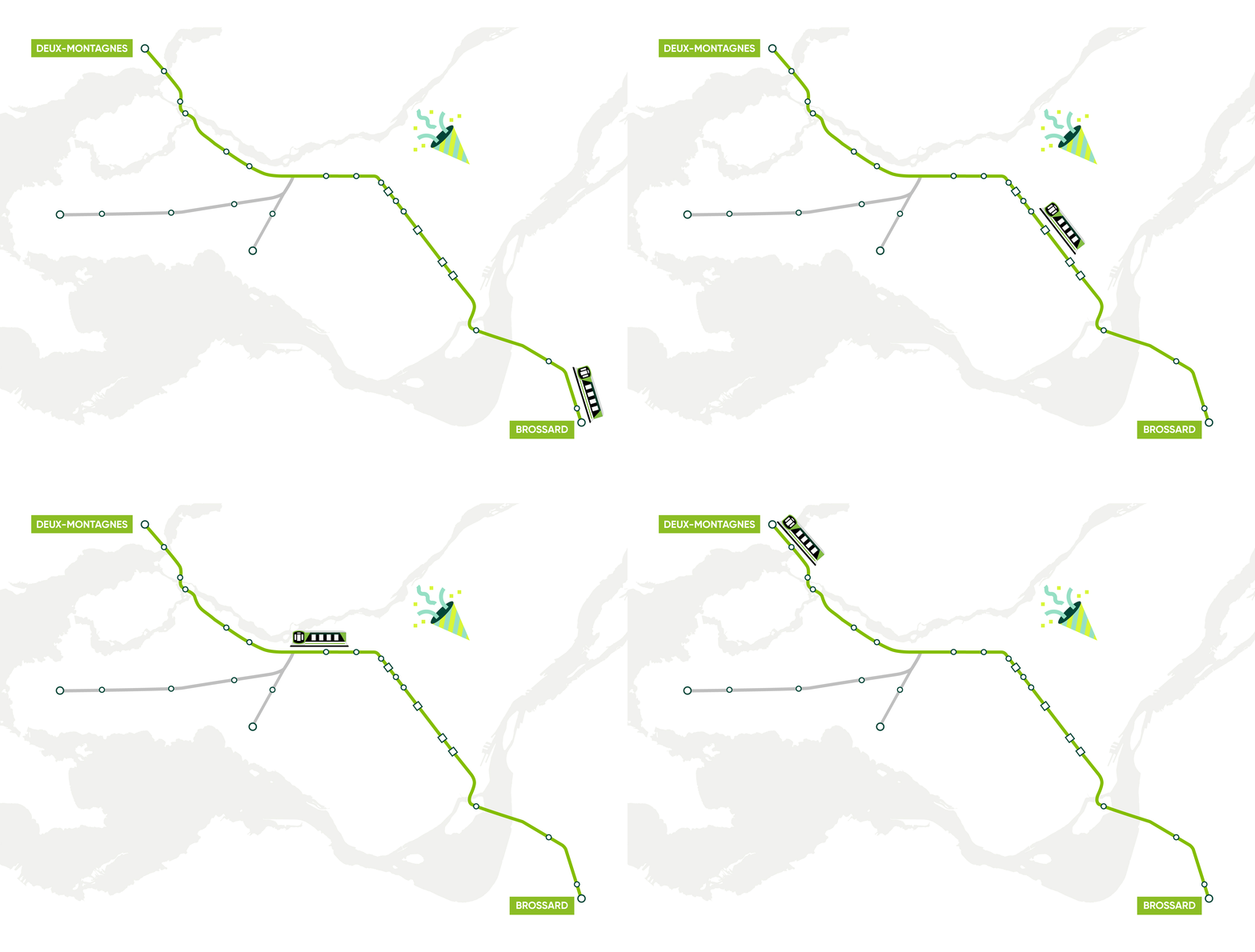
The first segment that connects Brossard on Montreal’s South Shore with Montreal’s Central Station opened in 2023.
Following seven years of construction, REM service now stretches nearly 31.1 miles (50 kilometers) and serves a total of 19 stations, according to CDPQ Infra, the project developer. It links the North and South shores to downtown Montréal, with stations on the West Island, and provides direct access to three of Montréal’s four metro lines, as well as the soon-to-be-available Mascouche exo line.
“For the first time, REM users will be able to cross Greater Montréal from Brossard to Deux-Montagnes,” CDPQ Infra reported. “This new route travels through Mount Royal and across three major waterways—the St. Lawrence River, Rivière des Prairies and Rivière des Mille-Îles—and marks a major transformation in public transportation in the metropolitan area.”

When the segments to Anse-à-l’Orme and to Montréal-Trudeau International Airport open in spring 2026 and 2027, respectively, the system will have 26 stations, span 41.6 miles (67 kilometers), and accommodate up to 170,000 riders.
For the REM project, Alstom is delivering a complete driverless light metro system, including 212 Metropolis metro cars (106 two-car trainsets), Urbalis GoA4 for driverless operation and communications-based train control, the Urbalis Vision control center system, platform screen doors, onboard Wi-Fi connectivity, and cybersecurity. The supplier has also provided equipment for two depots and two train washing facilities. Pulsar, an Alstom-AtkinsRéalis joint venture, is REM’s 30-year operator and maintainer. Maintenance teams use Alstom’s HealthHub digital platform, which is described as “a predictive maintenance tool that monitors the health of the train fleet and infrastructure in real time, leveraging AI to analyze all data captured across the rail system.” NouvLR is the project builder.

The REM system is the result of a partnership between the government of Canada through the Canada Infrastructure Bank (CIB), La Caisse, CDPQ Infra, REM Inc., the government of Quebec, Aéroports de Montréal, and Hydro-Québec.
The government of Canada invested C$1.28 billion into the system and another C$400 million to directly connect the airport terminal. In July 2025, the CIB announced a C$1 billion loan to Aéroports de Montréal for a new building that will directly connect the airport terminal to the REM network.
“We are very proud of the work accomplished by our talented employees, in collaboration with our partners, to commission this new branch of the REM,” Michael Keroullé, President and CEO of Alstom in the Americas, said on Nov. 14, during the Deux-Montagnes segment’s inauguration. “This new section, which offers a state-of-the-art, fully electric, automated, and high-frequency metro system, will transform the lives of thousands of residents of Montreal and its North Shore who travel daily, enabling them to do so efficiently, comfortably, and safely. More specifically, this extension will allow them to cross Mount Royal in less than three minutes—a first! With the REM, Alstom is showcasing its full range of urban technologies, highlighting both its local and global expertise in sustainable and smart mobility.”
“The REM project and its connection to Montréal-Trudeau International Airport mark a transformative investment in how people move in and around Montréal,” said Steven MacKinnon, Minister of Transport and Leader of the Government in the House of Commons in Canada. “This transit link will ease congestion, strengthen our economy, and make travel smoother, faster, and more sustainable for everyone, from daily commuters to visitors from around the world.”
“The REM is a historic project carried out under exceptional circumstances,” commented Charles Emond, President and CEO of La Caisse. “Yet it was completed at a fraction of the cost and within very tight timelines compared to other transportation projects in North America. Building such a network in seven years, during a pandemic and despite major obstacles, is an extraordinary achievement. It is also a great example of the scope and diversity of projects that La Caisse undertakes in Québec, with a significant impact on the economy while enhancing Québecers’ retirement funds at the same time.”
“We are very excited about this historic moment for the project,” CDPQ Infra President and CEO Jean Marc-Arbaud said. “The addition of the Deux-Montagnes branch is a turning point for the REM, enabling tens of thousands of users to travel around Greater Montréal more quickly and easily. Completing a network that we can all be very proud of is now the focus of our energies.”
“We are proud of our investment in the REM, one of Canada’s most significant transit infrastructure projects,” added CIB CEO Ehren Cory. ”14 new stations along 33 kilometers of additional track will help move more Montrealers across the city, quickly and conveniently. This was the CIB’s first and largest investment and it shows the real impact of our work. It’s just one of over 100 CIB projects currently under construction and development across the country.”

“The past few months have demonstrated our teams’ commitment to strengthening their capabilities to operate a large-scale network and the importance of moving forward step by step,” noted Loïc Cordelle, General Manager of Pulsar. “This approach will allow us to deliver a high-quality experience that meets the expectations of users who will start adopting the REM as of November.”
“This achievement demonstrates our global engineering capabilities and our ability to solve complex challenges in collaboration with our partners,” AtkinsRéalis President and CEO Ian L. Edwards said. “We continue this commitment by contributing to the operations and maintenance of the network, ensuring users enjoy a reliable, seamless, and sustainable transportation experience.”
“Powered by our renewable electricity, this project represents innovation in the service of a sustainable Québec and demonstrates everything we can accomplish when we embrace collective ambition,” added Claudine Bouchard, President and CEO of Hydro-Québec.
Technical teams will continue testing the Anse-à-l’Orme segment until spring, according to CDPQ Infra. This ongoing work will mean the service schedule between Côte-de-Liesse and Deux-Montagnes stations will be modulated, it said. In the morning, service will start at around 5:30 a.m. from Brossard and Deux-Montagnes; in the evening, the last departure toward Deux-Montagnes station from Brossard will be at 8:30 p.m. Service between Brossard and Côte-de-Liesse will continue until the last departure at 1 a.m. on weekdays. According to CDPQ Infra, shuttle buses will be provided by public transportation partners to ensure evening service is provided beyond the Côte-de-Liesse station.




