On Oct. 1 and 2, Railway Age and Railway Track & Structures held the annual Light Rail Conference. This year’s event took place in Pittsburgh, and it focused on responding to change in terms of equipment procurement and operations, as well as other technical issues. There was also a panel devoted to Pop-Up Metro, an innovative proposal for starting rail passenger service in an affordable manner.
Of the approximately 75 attendees, the many represented businesses offering products or services to the industry. Three agencies were represented: host agency Pittsburgh Regional Transit (PRT), the Greater Cleveland Regional Transit Authority (RTA), and New Jersey Transit. The crew from Railway Age and its parent company, Simmons-Boardman were on hand, along with two students.
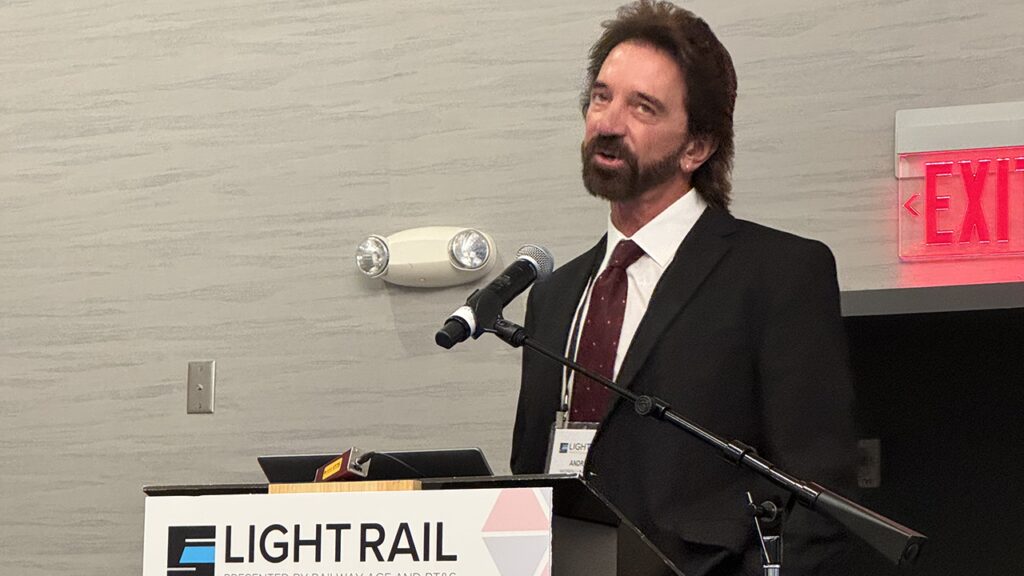
Andy Lukaszewicz, Deputy Chief Officer for Rail Operations at PRT, kicked off the conference as keynote speaker. He gave a “nuts and bolts” presentation about how rail transit operates in Pittsburgh, along with some of the history of the system, which now includes three light rail lines and two inclines, historic funicular railroads. He described past projects at the agency, including the conversion from 1940s-vintage PCC cars to the current light rail vehicles (LRV) in the 1980s. He described efforts to keep the system in a state of good repair and to upgrade it when required, projects such as improving ADA (Americans with Disabilities Act) compliance at low-level platforms. The system has a mix of high and low-level platforms. He noted that the recent reprieve, which the system received by “flexing” money originally earmarked for capital projects over to the operating side, will cause maintenance to suffer. Still, that decision will keep the system running. His advice to attendees was: “When you’re in charge of something, you’d better know how to do it.”
The next presenters were Brian K. Moore and Casey Blaze of the Greater Cleveland RTA. They focused on a project that would consolidate two types of equipment and operations into one. The current fleet includes 1981-vintage Breda LRVs for the Blue and Green Lines, which operate with low-level platforms. The lines run east of downtown Cleveland and diverge at Shaker Square. The Red Line runs two-car heavy-rail trains on an east-west alignment with a connection in downtown Cleveland and shared track for the common part of the routes, a unique mix of different modes sharing track and platforms. RTA’s objective is to order cars that can operate on all three lines. Moore and Blaze described the agency’s contract for vehicles from Siemens, which is now under way.

Next on the program was a panel about Pop-Up Metro, a system designed to allow new rail operations to start running on existing tracks at low cost. This writer moderated the panel, and there were four other presenters. The panel stressed the need for innovative ways to initiate new rail starts, considering the decline of rail projects in grant applications before the FTA (less than one-third are for rail projects, the rest are for busways) and Washington’s apparent antipathy toward transit, especially rail. The core benefit of the Pop-Up Metro concept is that a prospective operator with an available rail line can lease a “kit” that would include rolling stock, maintenance, training and other components of running service for a specific term, which would serve as a beta test of the new line at a significantly lower cost than commissioning a consultant’s report. Through this actual operation, the provider would obtain actual numbers for ridership, revenue and costs as the lease term proceeds, information that would help toward deciding whether to continue service and, if so, how to operate it.
Thomas R. Hickey, an independent consultant with West Chester Intersection LLC, has participated in the formation and operation of a number or new rail starts in the United States and elsewhere during his career and is currently working with Pop-Up Metro to secure agreements to deploy the system to start new services. He gave an overview of the FTA New Starts program and the history of how light rail was conceived in the 1970s and 1980s as a less-expensive alternative to metropolitan-style “heavy rail” lines that run on legacy systems in places like New York, Boston, Chicago and Philadelphia. He sees Pop-Up Metro as the next step in the evolution of rail transit that can be offered at an affordable cost to build and run.
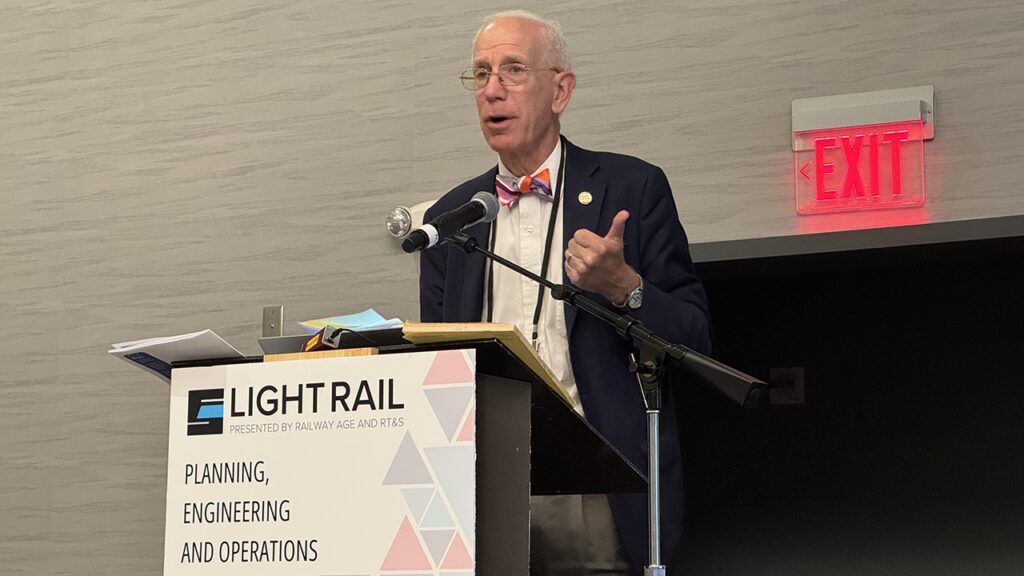
Henry Posner III, Chair of Railroad Development Corp. (RDC), who developed the Pop-Up Metro concept, described its benefits during his presentation. He started by saying that he sees a “moral responsibility to the cause of rail to make the pie bigger” and that it needs to be done “in a culturally sustainable way,” in this case his way of saying that respecting the culture of the infrastructure owner, and local politics, are critical. Posner said that that setting up an operation could be as simple as constructing new platforms on existing operations, but could also require upgrading a freight line for passenger service. He praised the system’s potential to spur real estate development by introducing rail transit and noted Pop-Up Metro’s new partnership with British firm TDI Greenway.
Nate Asplund, President of Pop-Up Metro, who is now involved with the TDI Greenway part of the operation, stressed that Pop-Up Metro would bring rail “to new markets in a new way” and possibly with new ways to fund transit. The new approach would be to supply a custom-built “kit” for starting service in new places. He described the leasing approach as “a ridership study on wheels” and said: “We don’t estimate ridership, we measure it.” He added that part of the package could include upgrading track to Class 3 standards, and that the lease was part of operating expense, rather than a capital expense. Asplund had served as CEO for the Florida East Coast Railway and had challenges with Brightline (and described himself as a “former passenger train assassin”), but he told the conference that Posner had convinced him to change his mind.
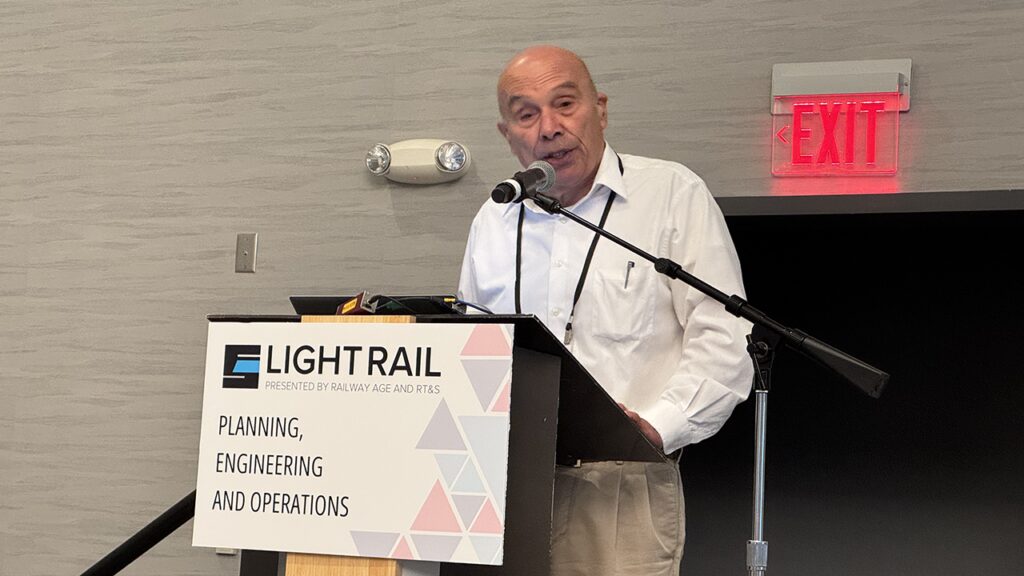
Alfred E. Fazio, a Professional Engineer consulting at BRT Rail Services and a Contributing Editor at Railway Age, gave his views on technical aspects of deploying equipment and technology according to Pop-Up Metro’s plans. He noted that “the future death of light rail is tragic” and that paying $200-$250 million per mile for new construction is too much. Fazio served as President and CEO of Twenty-First Century Rail, former DBOM contractor of NJ Transit’s Hudson-Bergen LRT and later as General Manager of NJT’s River LINE diesel LRT in South Jersey and described his experience with both. In general, Fazio called for innovation in deployment methods. He stressed keeping the “human element” in mind when deploying and operating transit and praised Pop-Up Metro’s affordable approach to preparing for new starts.

This writer closed the panel by stressing that, while Pop-Up Metro will not work in every situation, it is one innovative means for expanding rail transit, and that there will still be a need to develop other new and innovative methods for initiating new services. Pop-Up Metro will not work well on a busy freight railroad, because its U.K.-sourced rolling stock, which is considered a main line train in that environment, will require temporal separation as applied in the U.S. in other environments such as NJT’s River LINE and California’s Oceanside Sprinter. This would only work if the freight operation can run for a few hours at night, so the passenger operation can run a full span of service. An uncooperative local agency, such as SEPTA has been during West Chester, Pennsylvania’s efforts to use Pop-Up Metro to re-establish service after an absence of nearly 40 years, would also prevent implementation. Still, Pop-Up Metro is proposing a new way to bring passenger rail service to currently unserved areas, and rail expansion will need to start and operate along those lines. In conclusion, this writer mentioned the need to spread the word about Pop-Up Metro and to look toward other innovative ideas that could allow new services to run, even if federal programs like the FTA’s New Starts grants are curtailed.

Robert Hanczor of Piper Networks made a presentation about MBTA Green Line positioning technologies. The Green Line is the agency’s aggregate name for the light rail lines in and around Boston, except for the Mattapan Line. The technologies involve radio and fixed-point communications. Transmitters on the front of the vehicles signal GPS and LTE positioning technology to keep track of the vehicles. The system can also measure fouling distance, which would help to prevent collisions.
Hickey and Fazio kicked off the afternoon session with a panel on Engineering for Operations and Service Delivery. They were joined by Bill Koch of MAC-Impulse. John Mardente, Chief Engineer at the FRA’s Passenger Rail Division, was scheduled for the panel, but he was not allowed to appear on account of the federal government shutdown.

Fazio led off by discussing limitations on shared use of a line, which works best when freight activity is low. He noted that the FRA has has granted 14 or 15 shared-use waivers, which has allowed local passenger rail to grow. He also noted that the FRA is strict, saying: “It’s all in the details. You’ll need to show how you’ll operate and who dispatches.” Operations and emergency preparedness need to be thought out, especially since dispatchers might now be located in a different region of the country. He suggested looking at standards used by other providers and the industry.
Hickey gave some examples of how policies and operations can change. Portland built its MAX light rail system largely with funds originally geared toward highway projects. He mentioned that LRVs were designed for a top speed of 65 mph, but when highway speed limits were reduced to 55 mph, light rail was slowed down to avoid motorists having to see transit vehicles gaining on them. Now highway speed limits have been increased, but light rail is still stuck at 55 mph. He called for innovative stopping patters to speed service or, at least, feed the riders’ perception of saving time. Fazio described an example: The Bayonne Flyer runs on Hudson-Bergen in Jersey City and Bayonne. There are some intricate moves on a short three-track segment of the line, which allow a limited number of runs during peak-commuting periods to skip about five stops, so the trip appears to the riders to go faster even though the actual time saved is only a few minutes.
Bill Koch then described the product lines of MAC-Impulse, which include electrical items such as switch gear, cable systems, overhead power wires, and third-rail electrification. He said that the company had installed such components on many transit systems in North America.

Two managers from PRT then presented talks about how the agency maintains its LRVs and operates the electrical components in its shop. Justin Selepack, Director of Rail Car Maintenance, started by describing the agency’s fleet of Siemens cars from the late 1980s (52 cars) and CAF cars built in 2003-05 (28 cars). He mentioned the uniqueness of the operation, which runs on 5-foot, 2½-inch (broad gauge) track, only used in Pennsylvania (including Philadelphia and museums) and New Orleans. He described the “running repair” (for light repairs) and “heavy repair” (for bigger jobs, up to overhauls) operations. He described recent upgrades to the vehicles, as well as other upgrades to the shop facilities at South Hills and concluded by noting that any job costing more than $10,000 requires a 14-day bid process, and any job costing more than $150,000 requires a 30-day bid process plus Board approval.
Chris Costiloe, Director of LRT and Bus Systems Electronics, then gave a detailed description of the electronic side of PRT’s operations. The agency uses two systems: microwave and fiber optic. He described the radio system in detail, including microwave systems, telephony, and data and carrier transmission. These included sensors in tunnels and digital wayfinding systems. He described the shop installations in detail and concluded by discussing the challenge of aging infrastructure beyond its useful life, along with the difficulties of replacing equipment.

Tony Crosby of 4AI Systems then discussed AI-based applications suitable for light rail. He promoted fitting servers on the front of vehicles to collect data, which he said would improve operations and safety. He suggested that virtual trip stops could replace trackside trip stops but stressed that it’s necessary to demonstrate that there will be no adverse effects on safety or mobility. He said that AI can be used to look for hazards and added: “If a system can’t prevent a collision, it can reduce its gravity.” As a general concept, he mentioned the comparison between “smart trains” and “dumb trains.”
Barbara Schroeder, Rail Transit Project Manager for Benesch, concluded the day’s program with a talk on “Embracing Sustainability & Resiliency through Education and Professional Development.” She discussed AREMA (American Railway Engineering and Maintenance-of-Way Association) standards and the organization’s educational and professional development programs. She then turned to the goal of sustainability, praising Pop-Up Metro, MAC products, and Piper Networks. She called for an emphasis on sustainability, for private developers to help pay for transit, and for partnerships to achieve such goals as improving the environment and quality of life.
The Oct. 2 program featured three presentations. The first came from Rachel Burckardt, Senior Project Manager and Northeast Lead at WSP USA and a regular presenter at Railway Age light rail conferences, with a talk that described how Riverside Yard, the largest yard and maintenance facility for LRVs on the Massachusetts Bay Transportation Authority (MBTA or the “T”) in Boston, is being reconfigured to accommodate the new Type 10 “Supercars,” articulated units with seven sections, being built by CAF USA, and expected to begin service in 2027. The first topic was a description of the Green Line, a group of four light rail lines that run through downtown Boston and branch out at the ends. Riverside is at the outer end of one of the lines. The new cars will be more than 113 feet long, and a fleet of 100 of them are slated to replace 220 cars, which are 40 feet shorter. Much of the infrastructure, from platforms to yard tracks and maintenance facilities, must be changed to accommodate the longer cars, with the need to accommodate the existing cars, while they are still in service. Burckardt specifically mentioned the major changes in yard track layout needed at Riverside and the phased implementation of the project but also said that the “T” had considered alternatives.
Harry Skoblenik, a Senior Engineer with Alstom, gave the most technical lecture on the program, on LRV Wheel/Rail Interface Interaction. He focused on design for wheels regarding suspension, stability, and improving wheel performance. He discussed primary (between the wheelsets and the frame of the truck) and secondary (between the truck and the carbody) suspensions, and how they isolate riders from track instability. He also mentioned how lateral accelerations (at roughly 1Hz.) can make operators uncomfortable, and how a well-designed suspension system can alleviate that problem. He described how wheel profiles can be designed for stability, and how frogs and their wings can be designed to improve contact with wheels.
Hans Cruse, Sales Manager for the North American streetcar market at Stadler Rail, concluded the proceedings with a case study on Green Technology Applications for Light Rail. They include new alternative-propulsion vehicles operating on existing lines. He said that new systems are lighter in weight and can reduce energy consumption and noise pollution. He mentioned the hydrogen-powered FLIRT (“Fast, Light, Innovative Regional Train”) which will run between San Bernardino and Redlands, Calif. Local advocates in the area have questioned how beneficial such a train will be for the environment, but time will tell after the unit at issue has been tested in service.
Railway Age Editor-in-Chief and conference moderator William C. Vantuono announced that next year’s conference will be held in Philadelphia and will be expanded in scope to include regional rail. After the conference, many attendees took a tour of the PRT’s light rail maintenance and operations control facilities before heading home.