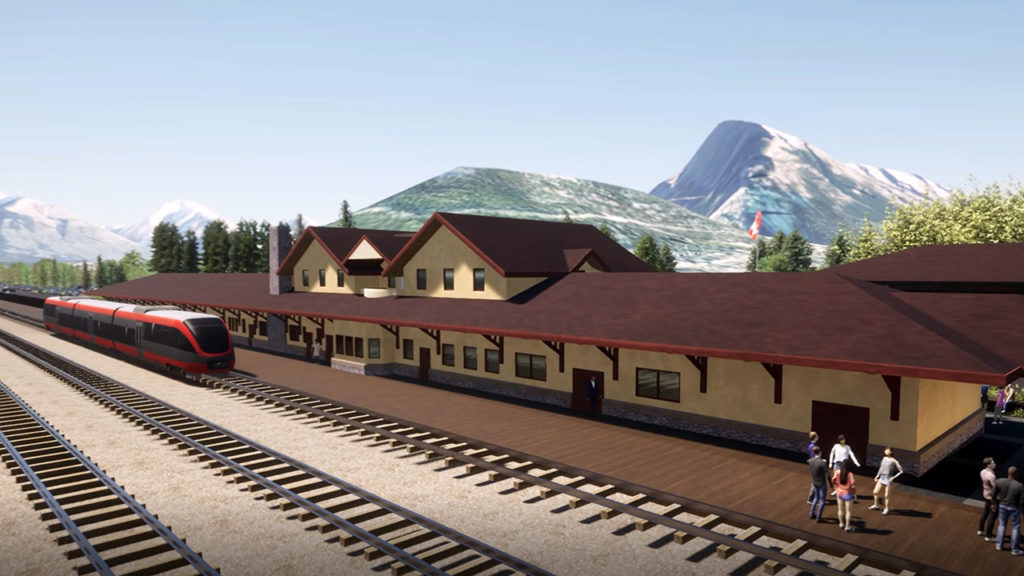
Liricon Capital Ltd. and Plenary Americas, a portfolio company of Caisse de dépôt et placement du Québec (CDPQ), in July 2022 advanced Phase 4, design, of the C$2.6 billion Calgary Airport – Banff Rail (CABR) project, which was planned to be built within the Canadian Pacific Kansas City right-of-way but not share operations.
In June 2024, following eight years of research and planning, the Town of Banff Administration and Banff Town Council approved 6-1 the Banff Railway Lands ARP (Area Redevelopment Plan) and the bylaw to officially adopt the ARP, “marking a pivotal moment for Banff.” In August 2024, Liricon/Plenary announced a restructuring of the project that would significantly change the proposed operation from a separate passenger right-of-way within the CPKC right-of-way main line to a shared-use (freight and passenger) double-track corridor “built to CPKC requirements.” In December 2025, proponents submitted a plan in the hopes of attaining Canadian federal major project status, but Alberta Province Premier Danielle Smith appeared to have a more pressing priority—an oilsands pipeline, according to a Calgary Herald report.
On Jan. 20, Canada’s Building Trades Unions (CBTU), Building Trades of Alberta (BTA), and Friends of CABR signed a Memorandum of Understanding (MOU) to formalize collaboration in support of building the Calgary Airport–Downtown–Bow Valley–Banff passenger rail system. The agreement, the parties said, “signals a shared commitment to move from years of study to construction on one of Canada’s most shovel-ready passenger rail projects, creating good-paying union jobs, strengthening Alberta’s economy, and building confidence in Canada’s ability to deliver major infrastructure. CABR represents an immediate opportunity to put Canada’s skilled tradespeople to work while diversifying Alberta’s economy. Designed primarily within an existing CPKC rail corridor and supported by MOUs with CPKC and the Canada Infrastructure Bank, the project is positioned to advance far more quickly than typical greenfield infrastructure. CABR was formally submitted in December 2025 to the federal Major Projects Office as a Project of National Interest.”
According to proponents, “Independent analysis estimates that combined Calgary Airport – Downtown Express (CADE) and CABR construction from Downtown to Banff would support approximately 9,900 job-years, equivalent to roughly 1,700 full-time jobs, generate nearly C$700 million in economic output over a three-year build, and create hundreds of permanent operational jobs. Over the long term, the project is projected to support more than 22,000 jobs through tourism and related economic activity.
“Passenger rail from the airport through downtown Calgary to Banff is more than transportation, it’s an economic development strategy,” said Adam Waterous, Chair of Liricon Capital and lead proponent of CABR. “This MOU demonstrates alignment between labor, proponents, and advocates. With collaboration across governments, Alberta can show leadership by building infrastructure that works for workers, communities, and the economy.”
PRIOR DEVELOPMENTS
“Champions of [the] plan … are hoping their vision will be included among Canada’s nation-building infrastructure,” the Calgary Herald’s Bill Kaufmann reported Dec. 3. “CABR [submitted a] proposal on Dec. 2 to Ottawa’s Major Projects Office (MPO), a body meant to fast-track proposals through streamlined approvals and funding. It’s a plan that meets the criteria of the Building Canada Act that is the foundation of the MPO, said Jan Waterous, Managing Principal of Liricon Capital, which is developing the proposal along with infrastructure investor Plenary Americas. ‘We can’t help but be optimistic [it’ll be selected]—it checks off the boxes and has so many benefits not just for the communities along the route but for the country,’ said Waterous.
“So far, 11 projects have been named to the major projects list, including infrastructure for mining, nuclear energy, LNG, a container port and hydro electricity. None of those are located in Alberta, whose government nonetheless signed a memorandum of understanding with Ottawa last week to expedite a bitumen pipeline running from its oilsands to British Columbia’s north coast. Waterous said Premier Danielle Smith had made it clear she wouldn’t focus on the [CABR] project and possibly ultimately lend its approval until after the pipeline MOU had been secured. ‘That’s why we’re submitting now—we want to show the Province we’re serious and that we have the project under [federal] review, maybe to give them confidence to do their part,’ she said. “It’s got a long way to go but we think it’s a really good candidate for the MPO.’”
“[Alberta] recently completed a regional passenger rail master plan that focuses on creating and improving train service around cities while also exploring high-speed rail links. ‘We’re trying to structure this in contemplation of what that master plan will be, but we’ll obviously adapt to that as we see it,’ said Paul Martin, Senior Vice-President of Plenary Americas.”
“We are pleased to announce that we have restructured our CABR project proposal,” Liricon/Plenary said in August 2024. “The updated approach supports the Province’s recently announced plans for the Province to advance development and to potentially build and operate an express passenger train service from the airport terminal to downtown and a ‘Grand Central Station’ in the Rivers District. Specifically, should the Province decide to build the 20-km (12.4-mile) track from the terminal to downtown and Grand Central Station, and provide track access for three CABR trains per hour from the airport terminal to Grand Central Station, then Liricon/Plenary will develop and build the 130-km (80.6-mile) track from Grand Central Station to Banff and operate CABR at no cost to the Province. Structured as a public-private partnership, CABR’s ‘one seat ride’ from the terminal to downtown and on to the mountains will provide reliable, high frequency, multi-class mass transit on a dedicated track in the CPKC rail corridor.”
SPECIFICS
“Incorporating this new information and to support the Province’s vision for regional rail, Liricon/Plenary, with the support of the Canada Infrastructure Bank (CIB), has updated the underlying approach to CABR in its Proposal,” the consortium said. “Specifically, should the Province build the 20-km track from the Airport Terminal to downtown, resolve a CPKC rail corridor downtown pinch point, and construct Grand Central Station, then Liricon/Plenary will :
- Build a 130-km track west from Grand Central Station to Banff by twinning (double-tracking) the existing track in the CPKC rail corridor to CPKC’s specifications.
- “Build platforms or otherwise accommodate stations at Beltline, Calgary West, Cochrane, Stoney Nakoda, Canmore and Banff.
- Operate three CABR trains per hour from the Calgary Airport Terminal to Grand Central Station, and then on to Banff.
- Provide multi-class service (economy and premium).
Alberta Province, Liricon/Plenary noted, “will provide CABR track access at no cost for three trains/hour from Airport Terminal to Grand Central Station and makes no contribution for CABR’s development, capital or operating costs.”
“Liricon/Plenary’s restructured Calgary Airport Banff Rail proposal allows the Province to leverage the government’s investment by integrating with a private sector solution,” commented Liricon Managing Partner Jan Waterous. “In doing so, the Province will maximize the impact of its investment since the Grand Central Station to Banff line will require no Provincial tax dollars.”
A plan that has the Province develop the 20-km route from the airport to downtown, along with a new Grand Central Station, and Liricon/Plenary developing the 130-kilometre route from Grand Central Station to Banff, creates a strong, taxpayer-friendly solution to providing passenger rail service in a critical transit corridor,” said Plenary Americas President Brian Budden.
The Province “can consider our Proposal, as well as other private and public sector proposals, as part of the Rail Master Plan Study the Province announced in May 2024,” Liricon/Plenary said. “Upon the completion of the Rail Master Plan Study, expected in April 2025, should the CABR route be of interest to the Province, it will then be able to evaluate the updated Proposal relative to other private or public sector options for the CABR route. Assuming the Province conducts that evaluation in May 2025, and a private sector option is selected, then the Province can proceed to negotiate a Project Development Agreement (PDA) with a selected proponent in June 2025. Should the Province select Liricon/Plenary’s updated Proposal at that time, then by signing a PDA with Liricon/Plenary by July 2025, the Province will secure the CIB financing required for the updated Proposal prior to the federal election, expected in October 2025. Without CIB financing, the Liricon/Plenary Proposal for CABR will be terminated.
“A PDA for the updated Proposal will be subject to the Province making a subsequent final investment decision (FID) on the Province developing the Airport Terminal to Grand Central Station at a later date. This sequence allows the Province to complete the Rail Master Plan, then evaluate both public and private sector approaches and proposals and then have the option of advancing the updated Proposal that itself will still be conditional on an FID.
“To ensure that the Province’s Terminal to Grand Central Station section and Liricon/Plenary’s Grand Central Station to Banff section provides the CABR traveler a seamless experience and addresses CPKC’s requirements for dedicated track within its corridor, both services would develop heavy-gauge, non-electrified rail, interoperable with freight, which will ensure rolling stock consistency across facilities. This will provide travelers a one seat ride from the airport terminal to downtown Calgary and Banff. The Province may opt to have same system connect the airport to Calgary Transit’s Blue Line [LRT], replacing the contemplated Airport Transit Line. The Province’s airport connection plan provides the opportunity for total airport departures of 15 trains per hour.”
The revised operating plan provides a “route split”: The Province operates two trains per hour, with departures serving downtown and potentially Airdrie and Okotoks. CABR operates three trains per hour, with departures serving downtown and on to Banff, with stops at Beltline, Calgary West, Cochrane, Stoney Nakoda and Canmore.
BACKGROUND
The Banff Railway Lands ARP was to be sent to Parks Canada for review, which will make recommendations to the Minister of Environment and Climate Change. The next steps were to include a Strategic Environmental Assessment of the entire plan and then recommendations from Parks Canada to the Government of Canada’s Minister of Environment and Climate Change on whether to proceed.
“This is a profoundly exciting day for our family,” said Liricon Managing Partner Jan Waterous in late June 2024. “While the path to this moment has been a long and winding road, it has been immensely rewarding as we navigated the most extensive community engagement process in Banff’s history.”
Liricon had submitted a draft of the proposed Banff Railway Lands ARP (download below) prepared by Dialog, Shift Consulting, Jackson McCormick Design Group, Donald Luxton & Associates Inc., WSP Canada and Golder Associates, to the Town of Banff on Sept. 29, 2023, along with Technical Appendices and a copy of Liricon’s “What We Heard Report” on their consultation about the ARP.
CPKC, which pre-merger as Canadian Pacific signed a non-binding MOU (memorandum of understanding) with Liricon/Plenary, had told Railway Age that it was willing to support the project and was prepared to offer design and engineering assistance, with the requirement that the passenger service have no impact on CPKC’s main line freight operations. As of late June, The MOU still stood, according to Liricon Chairman Adam Waterous.
The coming year will be critical, Adam Waterous told Railway Age on June 29. A formal agreement needs to be in place with Alberta Province by early 2025. Canadian federal elections will occur in the fall of 2025. If the Conservative Party (“Tories”) assumes the majority, replacing Liberal Prime Minister Justin Trudeau, it is expected to abolish the Canada Infrastructure Bank—and the funding the agency has provided to transportation and other P3 (public-private partnership) projects nationally, among which would be a 50% match (C$1.3 billion) of CABR. Alberta Premier Danielle Smith, United Conservative Party, is a CABR supporter, as the project is within the scope of a master Passenger Rail Plan she has launched. Smith discussed the plan and her general views on passenger and freight rail in a June 3, 2024 Rail Group On Air podcast.
Liricon/Plenary submitted an Enhanced Unsolicited Proposal in November 2021 to the Government of Alberta Ministry of Transportation, Invest Alberta Corp. and Canada Infrastructure Bank (CIB) to advance the CABR project from Phase 3, development, to Phase 4. The consortium said in early July 2022 that it had reached 11 milestones:
- Obtaining an improved economic impact analysis.
- Developing a solution for region-wide transportation through a Calgary Airport rail hub.
- Initiating an operations integration strategy with the potential Edmonton-Calgary high speed rail project.
- Furthering a wildlife impact mitigations approach.
- Investigating hydrogen fuel-powered rolling stock and supply alternatives.
- Securing support from affected municipalities/governments.
- Solidifying tourism industry support.
- Receiving business stakeholder support.
- Initiating engagement with Stoney Nakoda First Nations people.
- Advancing construction strategy.
- Improving ridership forecasts.
“These achievements will decrease the time to complete Phase 4, reduce development risk and enhance the proposal’s attractiveness,” Liricon/Plenary said. “This progress supports CABR’s ability to improve the environment, including being North America’s first hydrogen-powered passenger train system; expand the tourism economy by providing passengers seamless travel experiences with airlines, hotel companies and hospitality operations; increase labor mobility through integration with local transit systems, and being the foundation upon which to advance complementary new rail systems including Edmonton-Calgary HSR (Prairie Link Partnership consisting of EllisDon & AECOM); and reduce the impact of vehicles in Banff National Park and support the BANFF NATIONAL PARK NET ZERO 2035 initiative. New analysis indicates that, should Parks Canada adopt policies that encourage Banff National Park visitors to use mass transit options like CABR rather than personal vehicles, there would be an opportunity to reduce or eliminate the proposed Provincial financial contribution.”
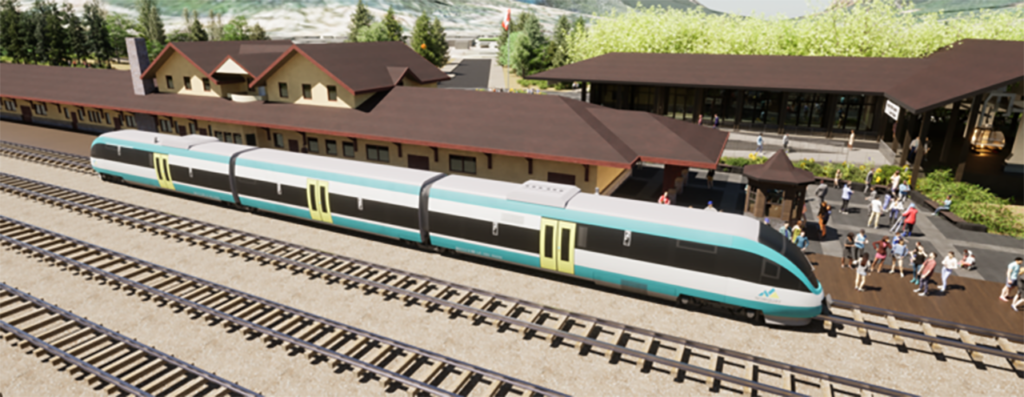
CABR needed the Government of Alberta to match funding of up to C$10 million that is being contributed by Liricon/Plenary and CIB to complete the second stage of Phase 4 and achieve a final investment decision. Liricon/Plenary would then fund the third and fourth stages of Phase 4, permitting and financial close, budgeted then at C$75 million.
“The Government of Alberta can then decide whether to continue to the next stage, based on the more detailed information then available to it, and will ultimately make a final investment decision whether to proceed into permitting and the project’s fifth and final phase, construction and Implementation,” the consortium noted. “This process provides the Government of Alberta with multiple opportunities to decide whether to continue to advance the project, and thereby limits the Government of Alberta’s development risk. The project is uniquely low-risk to Alberta taxpayers since the structure proposed for CABR is a P3 (public-private partnership) designed to share commercial risks across multiple partners, including risks relating to capital costs, ridership and revenue.”
Liricon/Plenary said CABR’s P3 structure “is different from the conventional government approach of using solely taxpayer money to develop, procure and build public transit projects. In 2016, CIB was established to structure and fund P3 projects that take the commercial risk government usually is forced to assume under traditional delivery models. The Government of Alberta had the vision to create an Unsolicited Proposal framework to accommodate this new, innovative P3 structure.”
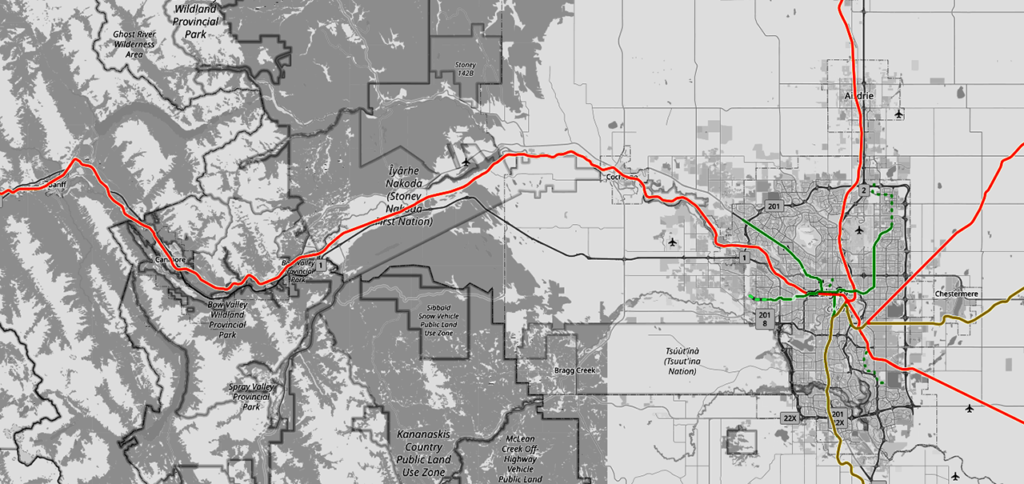
The CABR system will operate on a new, dedicated passenger line built within the existing CPKC freight corridor and “will provide high frequency, reliable service” among seven destinations: Calgary Airport, Calgary Downtown, Calgary Keith, Cochrane, Morley (Stoney Nakoda First Nations), Canmore and Banff. Three service classes are envisioned. Economy class tickets are estimated to be about C$10 from the Airport to Downtown Calgary and C$20 from Downtown Calgary to Banff, taking into account discounts for entry to Banff National Park. The projected start-up date is late 2029. Construction is projected to begin in 2027.
CIB has agreed to provide 50% of the project’s C$2.6 billion capital cost, with the remainder sourced from a combination of debt from private lenders and Liricon/Plenary. A portion of the capital costs and interest would be paid back over 50 years, once service is operational, by Alberta Province, after which Alberta would assume full ownership. A yet-to-be -named private company would build and operate the system. Adam Waterous told Railway Age in 2022 that the province’s then-$30 million in annual payments “may not be needed if Banff National Park supports transit use by raising its entry fee for private passenger cars, or expanding bus and shuttle service between park attractions.”
Liricon/Plenary engaged Mott MacDonald to undertake an economic impact assessment of CABR. “For perspective, according to a Tourism Economic Impact Study by Grant Thornton in 2016, the overall province-wide gross output economic impact from Banff and Canmore was approximately C$3.145 billion in 2015,” Liricon/Plenary noted. “Banff and Canmore generate C$8.6 million in economic activity each day for Alberta. Provincial and federal taxes generated from Banff and Canmore were roughly C$199 million and C$377 million respectively in 2015. CABR will support and grow these figures.
“The Mott MacDonald report indicates that the project will deliver an economic rate of return on the proposed investment by the Government of Alberta of more than 6.9 times. The study conservatively forecasts the project’s cost benefit ratio to be 2.8 times, and the project is expected to contribute more than 9,880 job-years of employment during construction and an additional 22,500 jobs and C$6.4 billion of gross value added to the Alberta economy once completed. These conservatively estimated economic benefits almost triple when using Liricon/Plenary’s upside ridership projections underpinning the broad and diverse benefits to the Province.”
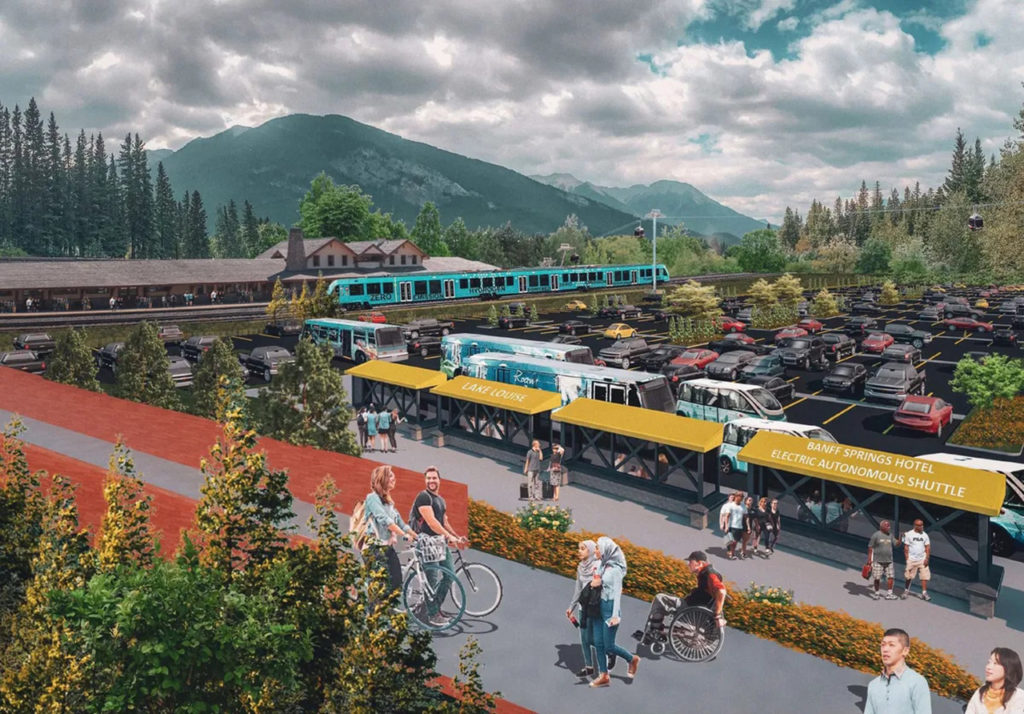
Liricon/Plenary describes CABR as “a distinct stand-alone project but also a key part of an overall transportation vision for Alberta that extends beyond the unique benefits to the Calgary region. CABR, as a brownfield project, is capable of being rapidly advanced by Liricon/Plenary to serve as a foundation upon which to develop a rail hub at the Calgary Airport for future greenfield rail projects, including proposed high-speed rail between Edmonton and Calgary and future expansions of Calgary Transit’s light rail network.”
Liricon/Plenary added it has “conducted significant research on the potential for CABR to use hydrogen-powered rolling stock. This research has entailed multiple meetings and site visits with the major hydrogen rolling stock providers including Alstom, Siemens and Sumitomo. While Liricon/Plenary has not yet selected a rolling stock provider, this alternatives study has increased Liricon/Plenary’s confidence that hydrogen-powered systems are feasible for CABR. In subsequent stages of CABR’s Design Phase, the specific rolling stock provider will be selected.”
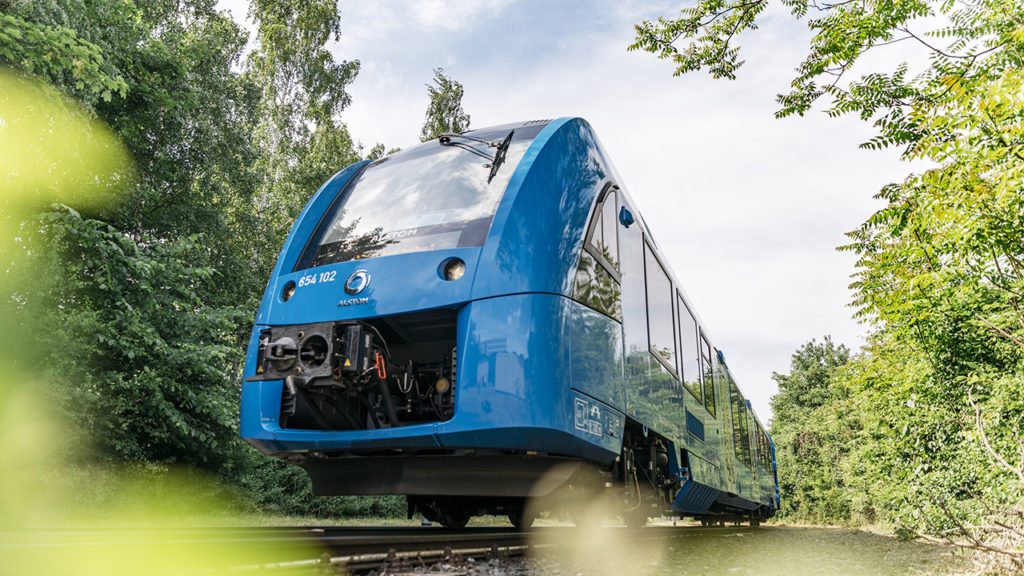
Alstom’s Coradia iLint HFC (hydrogen fuel cell) multiple-unit, in revenue service in Europe, is featured on CABR promotional materials. Alstom President and CEO Americas Michael Keroullé has been quoted in CABR promotional materials as saying that “hydrogen rolling stock is ideally suited for application on the Calgary-Banff rail corridor in terms of length of alignment, alignment characteristics and capacity. We firmly believe Alberta possess all the characteristics to become the flag-bearer of hydrogen trains on this side of the Atlantic, and we are very keen to help the province realize what will be recognized as an iconic project throughout the world. Alstom is pleased to offer the benefit of our experience and know-how to bring this project to reality for the benefit of Albertans and indeed to the many global visitors to the province. Alstom is the global pioneer of this technology: Alstom’s Coradia iLint train was unveiled in 2016 and has been in passenger service since 2018 in Lower Saxony, Germany. More than 124,000 miles (200,000 km) [worth of operations] have been completed since the iLint’s entry into service.”
Liricon/Plenary has also “studied potential hydrogen supply alternatives in the Calgary Airport vicinity, in particular, with TC Energy and Suncor. Based on this research, CABR is confident that there will be readily available hydrogen supply for CABR’s hydrogen powered systems for a refueling depot, most likely on Calgary Airport lands.”
In an interview with Railway Age, Adam Waterous said the service will be modeled on Switzerland’s Glacier Express, a popular tourist train in the Alps that connects St. Moritz and Davos with Zermatt. As such, CABR, he said, “will be the only regular passenger rail service in North America to a world-class destination.”

Waterous praised CPKC and its willingness to assist, citing President and CEO Keith Creel and Senior Vice President Strategic Planning and Technology Transformation James Clements as highly supportive. “At the outset, we established a ‘CP[KC] First’ mindset,” he said. “We will ensure that freight service is not disrupted. Working with Mott MacDonald, we are developing a construction strategy that relies on using the existing [CPKC] corridor to deliver construction personnel and material and minimize the requirement for new construction access roads. Track construction within Banff National Park will be conducted entirely within the [CPKC] corridor and will not require the disturbance of Park lands.”
The Calgary to Banff line is 93 miles (150 km) long. James Clements told Railway Age in 2022 that the CABR line will be built to minimum Transport Canada safety standards, with 20-foot track centers and physical barriers separating CPLC’s single-track main and the CABR main, also single-track. CPKC has a non-binding MOU with the project’s developers. Engineering is not expected to be problematic, as the right-of way has ample width to accommodate a dedicated passenger track. “This allows us to protect our freight capacity, both current and future,” he said.
Keith Creel added that “freight capacity and the nation’s commerce is[CPKC‘s] holy grail to protect.”
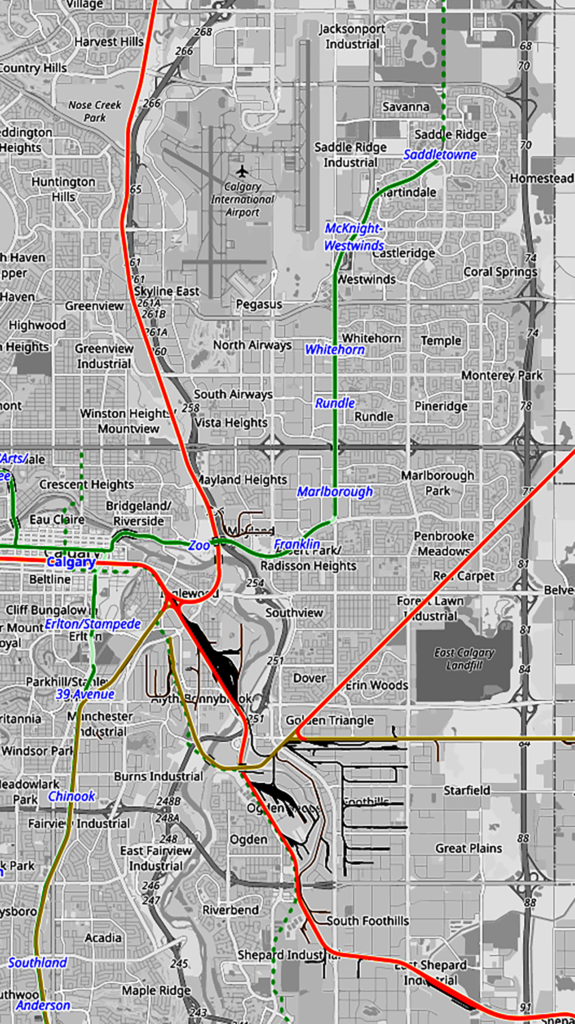
CABR’s “pinch point” will be the 9.3-mile (15 km) line from Calgary Airport to Downtown Calgary, in particular, Calgary Depot, which currently sees only CPLC freight trains. The right-of-way is narrow. Waterous said in addition to Mott MacDonald, Liricon/Plenary has engaged Stantec as an engineering consultant to design a CABR station in Downtown Calgary that will work within the constraints of CPKC’s freight operations.

Then-Alberta Transport Minister Prasad Panda, in an interview the Toronto Globe & Mail, said that he admired the intent behind CABR because it could reduce the number of people driving to Banff National Park and help diversify the province’s economy by boosting tourism. But he cautioned that the current plan “underestimates the capital costs and what will be required from the province in terms of an annual financial contribution,” as it “overestimates the potential ridership.” He added that the “construction schedule, which envisions the service running in the mid-2020s, is unrealistic. At this moment, as it’s presented, it’s passing on all the risk to Alberta taxpayers.”
Panda appeared to be echoing the opinion of his boss, then-Premier Jason Kenney, a Progressive Conservative who the Globe & Mail said will leave provincial politics in October of this year. “We want a realistic proposal, a feasible proposal,” Panda told the Globe & Mail. “If they can assume those risks, and if they can raise private capital, without penalizing Alberta taxpayers, we’ll reconsider it. There’s still an outstanding question of what the federal contribution to the project will be. So far, it’s only Canada Infrastructure Bank that has said it’s prepared to provide a loan for half the C$1.5 billion (now C$2.6 billion) capital cost. Proponents want the Alberta government to backstop early project development costs and assume financial risks for the project that will be outside of the province’s control. The province’s annual costs, based on my department’s analysis, would be much more than C$30 million, as would the upfront capital cost estimate of C$1.5 billion.”

“Not surprisingly, the Alberta government wants to reduce the cost to the taxpayer, and our ridership study shows that this is possible,” Jan Waterous told the Globe & Mail, adding she doesn’t believe the province has responded to all of the proponents’ updated plans. “This is just part of the process of a complex project where ongoing dialogue with the government is paramount.”
HISTORY
Canadian Pacific, which reached Banff a few months after it reached Calgary in 1883, was once the only form of transportation to Banff National Park, established in 1885 as Rocky Mountains Park. CP was instrumental in Banff’s early years, building the Banff Springs Hotel and Chateau Lake Louise, and attracting tourists through extensive advertising. In the early 20th century, roads were built in Banff, at times by war internees from World War I, and through Great Depression-era public works projects. Since the 1960s, park accommodations have been open all year, with annual tourism visits to Banff increasing to more than 5 million by the 1990s. Millions more pass through the park on the Trans-Canada Highway. Except for the Rocky Mountaineer luxury tourist train, one route of which operates on the CPKC from Banff/Lake Louise to Vancouver, there hasn’t been any passenger rail through Banff since Via Rail Canada took over the CP’s famous Canadian in 1978, rerouting it onto the CN (replacing CN’s Super Continental flagship long-distance train).
About Liricon/Plenary
Liricon is the family holding company of Banff locals Jan and Adam Waterous, who have been facilitating the planning and stakeholder support for the CABR Project for more than seven years. Liricon entered into a long-term lease of the historic Banff Train Station (built by CP in 1910). Liricon, which also owns the Norquay Ski and Sightseeing Resort, is working with the Town of Banff and Parks Canada to transform the train station into a multi-modal eco-transit hub. Plenary is one of the largest dedicated P3 developers in North America,. Since its founding in Canada in 2005, Plenary has developed and now manages 55 PPP projects in North America, including the Stoney CNG Bus Storage and Transit Facility in Calgary. Plenary is owned by CDPQ (Caisse de dépôt et placement du Québec), a global investment group managing net assets of more than C$390 billion on behalf of more than 40 public pension and insurance plans.