Indian Railways (IR) plans to operate its first prototype hydrogen train on the 54-mile Jind to Sonipat line in the northern state of Haryana in December.
IR has partnered with German certification body TÜV Süd for an onboard hydrogen safety assessment. Following approval from the Petroleum and Explosives Safety Organization, a hydrogen production and refueling station has been constructed at Jind. This new plant will meet IR requirements for the 35 trainsets that it intends to build and operate in the first phase of the project, according to an official at GreenH Electrolysis, a joint venture of U.S.-based H2B2 Electrolysis Technologies and India’s GR Promoter Group.
GreenH Electrolysis has also entered a contract with Hyderabad-based Medha Servo Drives, which has been commissioned by IR to modify an eight-car DEMU (diesel-electric multiple-unit) to enable it to run on hydrogen. Canada-based Ballard Power Systems will equip the trains with fuel cell technology. Each of the trainset’s cars will be powered by 100 kW FCmove-HD+ fuel cells, enabling them to run entirely on hydrogen.
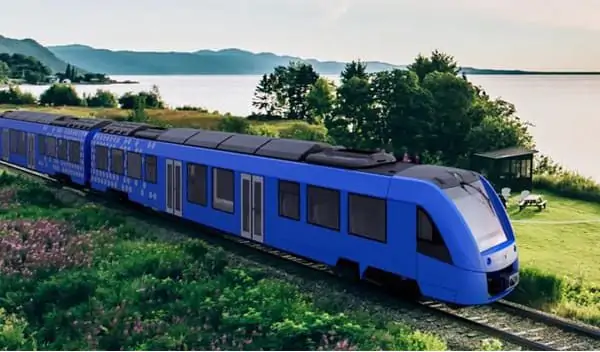
Both conversions are expected to cost $9.7 million, with an additional $8.5 million required for infrastructure development.
The initial hydrogen trains will operate mostly on narrow-gauge lines in the hilly terrain of northern and northeastern India as part of an initiative designated as Hydrogen for Heritage. “IR will look at increasing the number of these trains in the coming years,” an official says.
GreenH Electrolysis will provide the necessary equipment from its newly constructed manufacturing plant at Jhajjar, also in Haryana state. To achieve the first stage of production, a 1MW electrolyzer will operate around the clock, with an expected output of 925 pounds of hydrogen per day. The refueling infrastructure will incorporate 6,600 pounds of hydrogen storage, compressors and dispensers with precooler integration that will enable rapid refueling, according to GreenH Electrolysis.
Introduction of hydrogen trains is part of a wider IR program to achieve net-zero carbon emissions by 2030. IR has been allocated $350 million in government funding for the development of hydrogen-powered trains. The government also allocated $72 million for the installation of hydrogen infrastructure on heritage routes.
While India does not face a hydrogen shortage, most of the hydrogen currently available is a byproduct of fossil fuel use. IR also faces the challenge of a lack of in-house technical expertise in building hydrogen-powered trains.