
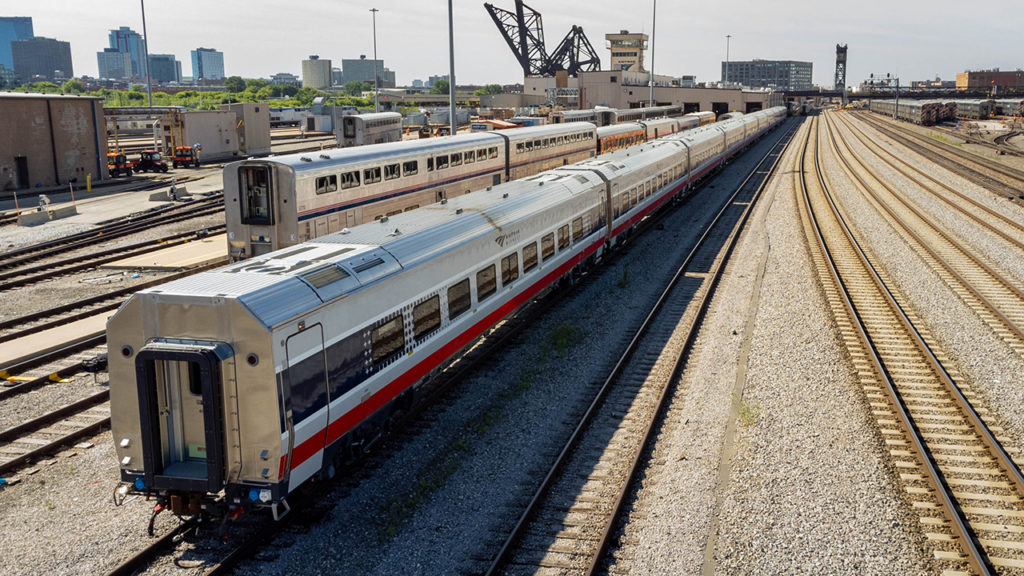
RAILWAY AGE, AUGUST 2024 ISSUE: Chicago Union Station is a busy place. Trains come and go throughout the day, from early morning until after midnight. Most of those trains are operated (directly or under contract) by Metra, Chicagoland’s regional rail agency that serves suburban towns in Illinois, but not in Indiana. Amtrak controls the station and has an operating presence there, but its skeletal network of long-distance trains (seven per day plus one tri-weekly train to and from the Windy City) and a Midwest corridor network that has shown little growth over the past half-century account for only a small fraction of station use.
In this article, I will look at Amtrak’s services in the region when it was founded and today, at efforts to expand services, and at a major reason why the region’s passenger train network is not as comprehensive as riders and their advocates had hoped. (Hint: As usual, it’s about politics).
In a half-century of riding Amtrak trains (as well as some pre-Amtrak riding), I have watched the Midwest network grow and retrench, while observing plans that did not come to fruition, and sometimes reporting about them. I have visited every stop on Amtrak’s Midwest routes, except Milwaukee Airport and Sturdevant, Wis., along with some places in Michigan where logistics render a visit impossible, or nearly so.
Corridors Denied
On May 1, 1971, Amtrak began operations, and two-thirds of the trains that had left their points of origin the day before had done so for the last time. What appeared on the map to be a somewhat-comprehensive network of corridor-length routes in the region and was actually a hodge-podge of trains that happened to survive the discontinuances of the previous decade, was swept away. There were few survivors. Milwaukee service remained at four round trips. Detroit service went from three to two daily round trips, as did the historic Alton route to and from St. Louis. The Illinois Central had run six trains each way between Chicago and Carbondale, of which only two survived. Elsewhere in the region, there was one daily train between St. Louis and Kansas City, an extension of the National Limited between New York and St. Louis, which was discontinued in 1979. There was also a single daily train to Indianapolis and Cincinnati, which is now the tri-weekly Cardinal. The Floridian ran to Florida south of Indianapolis until 1979. Other long-distance trains ran from Chicago, and still do.
For this article, I will define a “corridor” in a practical sense: in terms of the flexibility offered to potential riders through a choice of departure times. A route with one daily departure in each direction is not a corridor. Two trains that allow riders at intermediate stops one daily departure toward each endpoint is an improvement over the single round trip, but still does not allow customers to choose from different departure times. So, running two round trips per day would not elevate a line to “corridor” status. There must be at least three daily departures in each direction, and they must be sufficiently far apart to give riders a clear choice of departure times throughout the day. By that definition, Amtrak operates four corridors from Chicago: to Milwaukee, Pontiac through Detroit, St. Louis, and Carbondale, the latter having lost its third daily round trip from time to time.
Building the “Network”
There are more Amtrak trains in the Midwest than there were a half-century ago, and almost all the improvements occurred in Illinois. The Prairie State experimented with routes to places like Peoria and Decatur, but they did not last long. The state added the Illinois Zephyr to Quincy, and now runs two trains on that line, although the Quincy station is located almost five miles from the center of town and its riverfront. In 2006, the state increased service on the line to Carbondale and the Lincoln Service to St. Louis. On the former line, a second train to Carbondale was added, with the City of New Orleans also on the route. On the latter line, the number of trains to and from St. Louis went from two to four, plus the Texas Eagle. That is a marked improvement, although there is still a long midday service gap. It was at that time that a second Quincy train was added, allowing day trips from Chicago to its stops.
Because those trains are state-supported, as are other trains in the region, they are subject to state politics, including politically mandated budget pressure. When the COVID-19 pandemic was at its worst and every long-distance train that was available to non-motorists and motorists alike had been reduced to tri-weekly schedules, Midwest trains suffered, too. During that time, only one daily round trip on each route was still running, in addition to a tri-weekly long-distance train, if one happened to use that stretch of rail as a segment of its longer route. That also happened to the Wolverine Corridor in Michigan and the Missouri trains between St. Louis and Kansas City. Since that time, service on those routes has returned to pre-COVID levels.
Ridership is strong, too, according to Amtrak Chicago spokesman Marc Magliari. He told Railway Age: “Amtrak and our state partners are pleased with the Amtrak Midwest network’s ridership recovery in the post-COVID-19 period. These trains are contributing to our projected new record nationally in this Amtrak fiscal year.”
One recent service enhancement is the addition of the Borealis, a second frequency between Chicago and St. Paul that started service May 21, 2024. While any service enhancement is better than the previous situation with less service, that addition could have done better when it comes to providing riders with a choice of departure times when combined with that segment of the Empire Builder schedule. The two trains leave each endpoint only about three hours apart, and if Train 8 is sufficiently late, the two trains can leave St. Paul at about the same time. A different schedule, with the Borealis leaving Chicago early in the morning, turning at St. Paul in mid-afternoon and arriving back at Chicago in the late evening, would give riders a clear choice of departure times, and such a schedule could run with a single trainset covering both directions.
Current reports indicate that the new train is very popular, but it’s too early to determine the reason for this. It could be that just having another train sends an encouraging signal to potential riders that Amtrak and the states care about improving service, a variation of the Hawthorne Effect. If that’s the case, the mere act of adding trains will spur increased ridership and revenue.
Some Disappointments
Whatever hopes that advocates for riders have harbored over the years for a comprehensive region-wide network of passenger trains has never come to fruition. During the early days of the Obama Administration, the feds offered grants for “high-speed rail” projects to the states, even though the trains would run no faster than 110 mph. Gov. John Kasich in Ohio turned down the grant to build the “3C+D” corridor that would have served Cleveland, Columbus, Dayton and Cincinnati. Scott Walker, his counterpart in Wisconsin, rejected funding that would have started service to Madison, with a connection providing an additional route from there to St. Paul, Minn. At least Walker was willing to work with Illinois officials to keep the Milwaukee service going.
River Runner trains between St. Louis and Kansas City have been subject to Missouri politics. Sometimes the morning departure from St. Louis and evening return train from Kansas City ran, and sometimes they did not, depending on the state’s willingness to pay its assessment for running them.
In Michigan, the Wolverine schedule has never expanded beyond three daily trains in each direction, at least not east of Battle Creek. At this writing, the early morning departure from Chicago (Train 350) and the late-morning departure from Pontiac and Detroit (Train 353) run only on Fridays, Saturdays and Sundays, not Monday through Thursday. That means a day trip to any points on the line is impossible most weekdays. The other two trains serving the state, the Pere Marquette to Grand Rapids and the Blue Water to Port Huron, do not allow for day trips to those endpoints or intermediate stops from Chicago on any day. To make matters even worse, the trains arrive at those endpoints late in the evening and leave at or about 6:00 in the morning, and there are no affordable hotels within miles of the train stations. Early departures from Chicago with late-evening arrivals back in the Windy City would expand the utility of those routes, but nothing like that has happened yet.
The situation in Indiana is even worse. In 2019, the state government killed the Hoosier State train, which ran between Indianapolis and Chicago on the same schedule as the Cardinal on the four days each week when the latter did not run. Now, Amtrak does not serve Indiana’s capital or anywhere else on that route more than three times a week. In light of the discontinuance of service on the other days, advocates at the Indiana Passenger Rail Alliance (IPRA) have proposed a “Hoosier State Corridor” that would bypass Amtrak completely. That would become feasible when the Northern Indiana Commuter Transportation District builds its proposed South Shore Line extension from Hammond to Dyer. Trains would leave Millennium Station on Randolph Street, use the South Shore Line to Dyer, and then proceed on the current Cardinal route (historic Monon, now part of CSX) to Indianapolis. Advocates hope not only for more-frequent daily service in both directions, but also for a non-Amtrak “Hoosier State Corridor” that could eventually be expanded to serve Cincinnati, Louisville and even Nashville.
Even in Illinois, expansion plans for state-supported trains have been stalled for years. There has been talk of running service to the Quad Cities (including Moline and Rock Island on the Illinois side, and even to Davenport, Iowa), and to Dubuque, Iowa, also on the Mississippi River. There has even been talk of extending trains to Iowa points like Iowa City and Des Moines. Nothing has come of those plans yet, and there seems little reason to expect that anything will in the foreseeable future. The one possible exception might be service to the Quad Cities. Movement toward establishing a Minneapolis-Duluth Northern Lights Express is proceeding, but that’s up to Minnesota.
It’s All About Politics
Illinois is the only reliably “blue” state in the region, and it contains most of the network we have today. Still, the governorship flips back and forth between parties, so plans get stalled. Ohio, Indiana, Missouri and Iowa are now “red” states, with elected officials who have taken steps to prove their anti-passenger-train credentials. Michigan, Wisconsin and Minnesota are “purple” states that have become battlegrounds in recent Presidential elections, including this year. Their record on passenger trains has gone between staunch opposition and toleration. The Borealis began operating at a time when the governors of Wisconsin and Minnesota are Democrats.
Therein lies much of the problem with expanding service in the Midwest and other places. Amtrak’s Connects US plan for 2035 depends on the states to pay increasingly large shares of the cost of running the trains. Fiscally conservative Republicans have consistently balked at such plans. Even Democrats in financially strapped states like Illinois might not be able to find the money for more trains, or even to keep current ones. Regarding efforts to operate and someday expand a network of regional trains that connect with long-distance trains, a program based on states’ rights is problematic at best, and an absolute preclusion to expansion, at worst.
What Can Be Expected?
Equipment on Amtrak’s Midwest routes is now being replaced. Siemens Venture cars are replacing them. Those cars are coming from California, and are in use on Brightline in Florida and VIA Rail. The exception is on the Carbondale trains, where CN has demanded that Amtrak use Superliner equipment normally assigned to long-distance trains.
Ironically, a new model of advocacy might deliver more service someday than today’s state-oriented one. IPRA President Tod Bassler told Railway Age he is campaigning among local officials in places where advocates want trains, along with Derrick James, Amtrak’s Senior Manager for Government Affairs. The purpose of the campaign is “to schmooze the government folks” and make the case for passenger trains in their areas of jurisdiction. While Amtrak’s Connects US plan is oriented toward the states, a line-by-line local orientation could be successful, even where state governments are opposed to adding passenger trains. Could local and regional officials work together to get a new train or a service enhancement going, despite state-level indifference or opposition?
Speculation persists that advocates in Ohio could campaign for an alliance of officials in and near Cleveland, Columbus, Dayton and Cincinnati to establish the “3C+D” corridor that former Kasich rejected and that current Gov. Mike DeWine would probably not support. James’s participation is a positive sign.
So where do we go from here? Probably nowhere we can’t go already, and no more often than currently. A strong state’s rights orientation hinders, and perhaps precludes, the cooperation required to run interstate routes on a regional basis. Budgetary considerations limit expansion, and politics in the region also serves to make expansion of the network difficult. Midwesterners who ride Amtrak’s trains in the region like them, but will their choice of departure times and destinations increase over the next few years? To quote the “Magic 8-Ball” from the 1950s, “My sources say no.”
Companion Commentary
Chicagoan F. K. Plous is the “dean” of rail advocacy in the Midwest, with more than 60 years of advocacy experience, along with a long career as a journalist. When I reached out to advocates in the region for their comments, he had this to say about Amtrak’s “Illinois Network.” It is filed along with our story, unedited and with emphasis in the original. Here are his comments:
“I put those two words in quotes because even Amtrak admits that its routes in Illinois do not form a network but only the beginnings of a hub-and-spoke system. Amtrak calls its Illinois corridor trains, including those reaching into Wisconsin and Michigan, its “Chicago Hub” service. This is linguistically and geographically correct because all the lines radiate out from the only common point, Chicago, and none of the lines intersect at any other point, making any kind of networking impossible.
“Moreover, even at their common meeting point, Chicago, the departure and arrival times of trains are not programmed to promote a quick and easy transfer of passengers from one spoke of the hub to another, and the on-time performance of the trains is so poor that anything like cross-platform coordination would be way beyond the system’s capability. Networking of trains requires not just the meeting and crossing of lines, but schedules that promote swift, efficient, coordinated transfer of passengers from one line to another at outlying junction points. This is something the Illinois system cannot do.
“Perhaps more embarrassing, even as a simple hub system, the Illinois passenger train map is weak. The two largest urban areas outside of Chicago, the Quad Cities and Peoria, each with approximately 400,000 people, have no passenger train connection to the Chicago Hub (or to each other). Currently there are no solid plans to connect Peoria to Chicago, and the only plan for a Quad Cities connection has been hanging around for almost 20 years and even if completed will be inadequate. Rather than rebuild the old Rock Island route for joint passenger/freight service and 90-mph speeds for passenger trains, the only current IDOT plan is to use the former Burlington Route between Chicago and Omaha and build a connecting ramp to the former Rock Island at Wyanet, 111 miles west of Chicago, where the former “Q” crosses over the former Rock on a high elevation. The ramp would allow trains to use the former Rock Island, now owned by the Iowa Interstate Railroad, for the last 51 miles between Wyanet and Moline.
“Unfortunately, however, the dense freight and passenger traffic already using the Burlington would limit the proposed Chicago-Quad Cities operation to only two round trips per day, a figure manifestly inadequate for a metro area of 400,000 located 179 miles from a metro area with a population of 9 million. In Europe this corridor would have trains shuttling between the end points at least hourly.
“We don’t need Europe, however, to demonstrate the inadequacy of IDOT’s plans for expansion of the Chicago Hub service. Just compare the Chicago-Quad Cities corridor with the state’s best-performing rail corridor, the Lincoln Service between Chicago and St. Louis. Although the Lincoln Service corridor is 285 miles long, the bulk of the ridership is on the northerly 163 miles between Chicago and Springfield, a one-industry town with a population of 113,000. The Chicago-Quad Cities corridor is 179 miles long, but the end point has 400,000 people, and they are employed in a variety of large, rich industries such as John Deere, Great Danes truck trailers, FedEx, the U.S. Army’s Rock Island Arsenal and hundreds of smaller suppliers to these major employers. The expected ridership of a Chicago-Quad Cities corridor must be at least four times that of the Chicago-Springfield traffic, yet IDOT has spent the better part of 20 years thumb-twiddling a little two train per day operation over the wrong route.
“And currently there are no plans at all to connect Chicago with Peoria, another metro area with 400,000 people that’s 161 rail-miles from Chicago and has a portfolio of heavy industries, medical centers and universities just as big and impressive as those of the Quad Cities.
“But what makes this gap in the Illinois passenger train map even more infuriating is that Peoria and the Quad Cities are located on the same railroad—the former Rock Island Line, with Peoria on a 47-mile branch line starting at the little Downstate junction known as Bureau. If trains ran to both cities, they could share the same right-of-way for the first 114 miles—a money-saving “two-fer” available nowhere else on the Illinois rail map.
“In a state with a serious passenger train program, there would be at least 10 trains a day between Chicago and Peoria and another 10 round trips between Chicago and the Quad Cities. In fact, if such a service existed, travelers could use trains to travel between Peoria and the Quad Cities by changing trains at Bureau to form the first peripheral passenger train route in Illinois. Now you’re talking networking.
“I would not blame Amtrak for these huge holes in the Illinois passenger train map. Amtrak establishes corridor service only when and where a state invites it to do so and provides the necessary infrastructure improvements. Historically, IDOT has not shown adequate initiative in either of these two corridors. Any apparent strength in the Illinois Hub system is attributable more to the existing pre-1971 railroad map than to any exertions on the part of Amtrak or IDOT. Chicago remains the railroad center of North America, so it has more track mileage and passenger trains than any other city between the Northeast Corridor and California. Based on the size and location of our population centers, there should be lots more, but geography and logistics do not translate into transportation without political leadership.”




