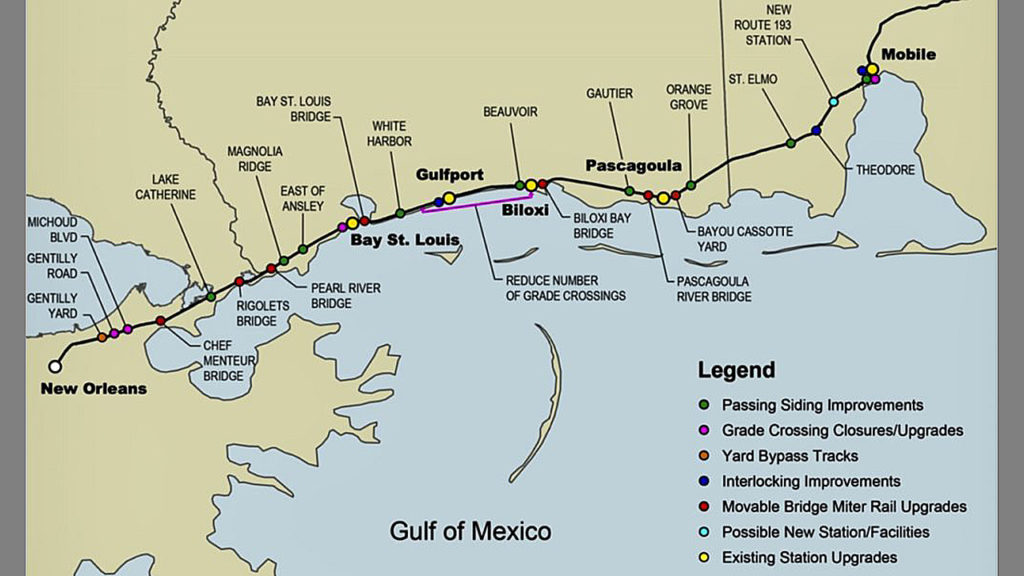
After roughly 2½ years of covering every skirmish in what we have come to call the “Second Battle of Mobile,” it now looks like the battle is essentially over. On Aug. 6, the Mobile City Council voted unanimously to take the final steps that will allow Amtrak to run two daily passenger trains in each direction between New Orleans and Mobile, with four intermediate stops along the Mississippi Gulf Coast. The campaign was fought in many venues, primarily before the Surface Transportation Board (STB) through an 11-day trail, preceded by hearings that featured statements from elected officials, rider-advocates and other concerned individuals and organizations.
The Gulf Coast service will mark the first time a new route has been added to the Amtrak network since Downeaster trains first linked Boston and Portland, Maine in 2001. The route was extended to Freeport and Brunswick in 2012. The last time new mileage was added came in 2022, when the Ethan Allen Express was extended beyond its former terminal at Rutland, Vermont to Burlington, the state’s principal city.
John Sharp told the story locally in the Mobile Press-Register with a comprehensive Aug. 7 report. He began by noting that it has been almost 19 years since Hurricane Katrina devastated the area and knocked out the New Orleans-Florida segment of the tri-weekly Sunset Limited, but “after years of negotiations, litigation, and frustrations, the conductor hats might be ready to go on sometime in early 2025, in anticipation of an ‘All aboard!’ shout in downtown Mobile. Or is that ‘Y’all aboard?’ Whatever the case, the final bureaucratic hurdle was cleared Tuesday after the Mobile City Council, with surprising unanimous approvals, authorized three crucial agreements needed to bring Amtrak service between New Orleans and Mobile.”
From Grim to Unanimous
This level of unanimity was unexpected since, as we last reported on the situation, only four Council members were prepared to vote for the measures needed to get the trains rolling, and three were opposed. We will explain why it takes five of the seven Council members to approve any ordinance or resolution before the Mobile Council in a future commentary, but the initial 4-3 vote would not have been enough. There were reports that a fifth member had said he would change his mind, but it was decided here at Railway Age that we would wait for the actual vote and report it.
The vote was 6-0, including all three members who had said earlier that they would vote “no” and who had apparently changed their minds. They included Joel Daves, who had consistently opposed the service and had been the lone dissenting vote in February 2020, when the Council decided to go forward at an earlier stage in the effort to start the trains. It appears that one of the members who had expressed support for taking the steps required to run the trains did not vote.
Members who had opposed the project objected to the city spending funds on operating the trains, a commitment that had been undertaken by Louisiana and Mississippi, but not by Alabama. That state’s elected officials had consistently objected to the service and to help pay for it, even though the project includes $72 million in grants for capital improvements for the railroad under the FRA’s Consolidated Rail Infrastructure and Safety Improvements (CRISI) grant program. The Port is supposed to receive about $4 million of that for 5,500 feet of new track or track improvements.
Alabama’s share of operating expenses for the first three years of service amounts to $3.048 million. While details have not yet been announced, it now appears that the Port of Mobile will pay about one-third of that share, and the city will pay another third. The final third is not an item in the current state budget, but Mobile officials hope the state will step up to the plate. Mobile Mayor Sandy Stimpson was reported as saying that Gov. Kay Ivey’s office had “vocally expressed interest in a financial commitment toward the project,” according to Sharp, who quoted him as saying: “We have to take the administration at its word … there is not a line item right now to draw from … But I’m confident it will be included.” The state has not committed money toward the project, and the Port had opposed the project until Amtrak, CSX, Norfolk Southern and the Port reached a settlement.
Sharp reported the applause in the Council room and quoted Stimpson, who also supported the project as saying: “All aboard, we got it done … It’s a win, win, win situation.”
In addition to funding issues, the Council authorized construction of a station on city-owned land near the Convention Center and the maritime museum in downtown Mobile, the site of the previous station at the now-demolished L&N Building (Louisville & Nashville, which became part of CSX) in downtown Mobile. In addition, the new construction includes a new layup track about 3000 feet long.
Positive Reactions
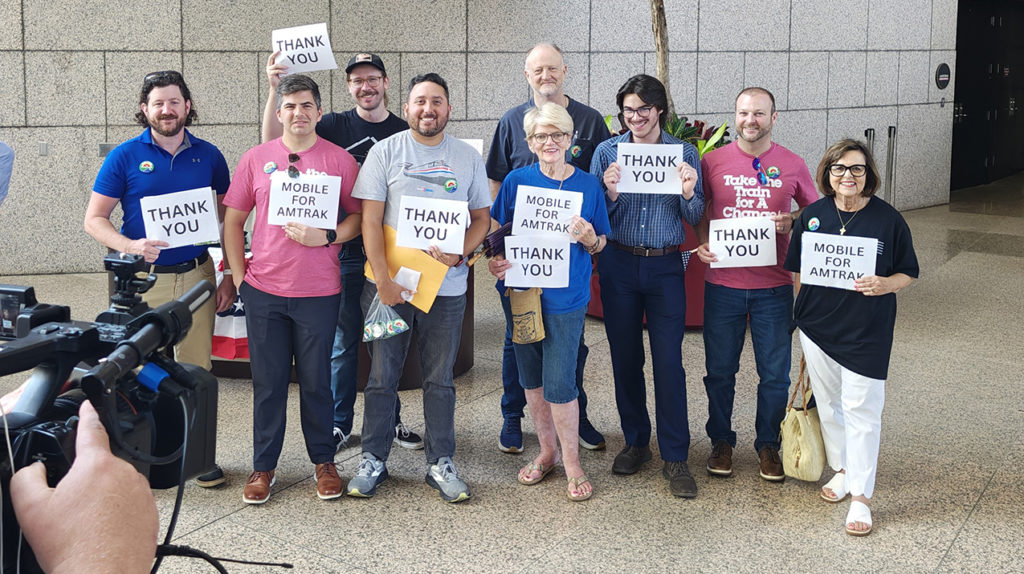
There were many positive reactions to the vote, now that the last governmental hurdle has been cleared, and there is hope that the trains will run next winter, maybe even in time for the upcoming Super Bowl game in February. Supporters showed up a City Hall carrying signs that said, “Thank you” and “Mobile for Amtrak.” Other local media reported favorable comments by elected officials and others involved with civic organizations who hoped and expected that the new trains would bring visitors to their towns and give those places an economic boost. One was Mobile Council member Cory Penn, who said, “I think this is an opportunity to allow visitors to come into our great city … We have so many opportunities.”
The Southern Rail Commission, a quasi-governmental organization authorized by Congress in 1982, has actively supported the project. Knox Ross, the organization’s Chair, issued this statement: “This is an incredible outcome, and we have worked so hard with our partners to finally get to this point. With the funding in place, this train can roll soon, and it will have a great return on investment and a tremendous impact on connecting people with jobs and education opportunities, boosting local economies and supporting our growing tourism industry in our coastal cities.”
Amtrak Chicago spokesman Marc Magliari represented the railroad to the media through the years during which the “battle” took place. He posted on Linked in: “#YallAboard. A UNANIMOUS VOTE by the City Council in Mobile completes the funding and land agreements use needed for #GulfCoastService next year. Thanks to Mayor Sandy Stimson and his staff, the City Council and its staff, and the relentless support of the #FriendsOfAmtrak” (emphasis in original). He noted that there was more work ahead for Amtrak, including with the Southern Rail Commission.
The local advocacy organization to which Magliari referred is now known as Mobile for Amtrak. Following the Council vote, the group featured a number of celebratory posts on its Facebook page. Its leader, Bryan Fuenmayor, said in his post: “A big thank you for everyone here in Mobile for Amtrak (formerly Friends of Amtrak), and all who showed up today to show support for bringing Amtrak back to Mobile and the Mississippi Gulf Coast, and to everyone in this group who contacted our elected officials!” Fuenmayor also thanked the other members of Mobile for Amtrak’s leadership team by name.
“Who would have guessed, even two weeks ago, that we would have had a unanimous vote?” Magliari told Railway Age. It’s all due to the hard work of Mayor Stimson and his staff listening to the City Council members and the support of the Friends of Amtrak in Mobile, and the Rail Passengers’ Association, which was with us every step of the way. Credit also goes to the Southern Rail Commission and its Chairman, Knox Ross. I can’t even guess the number of trips we took to Mobile, but it was all worthwhile.”
When asked about the start of service, Magliari said he was looking toward next spring. He said CSX is building the platform and train storage track, funded by a grant from the FRA. He told Railway Age, “Once we have the start date of construction and the duration of construction from CSX, we’ll know when we can start service.” He added that Amtrak will resume its safety campaign there.
Experiment With a Limitation
While the infrastructure improvements that come with the deal will be permanent, that cannot be said of the trains for which those improvements are being made. The financing for the operation will last for three years, although nothing has yet been said about exact dates, or about other matters such as fares and how the trains will be promoted or even named. Still, there no longer appear to be any legal impediments to the final steps needed to implement service.
Nevertheless, the Mobile Council placed a limitation into its authorization: It could terminate the agreement after 90 days if Amtrak ran any more trains than the two anticipated daily round trips between Mobile and New Orleans, or in response to any effort to run passenger trains east of Mobile toward Florida, or north of there toward Montgomery and points north. There had been earlier efforts to restore service as far east as Jacksonville and Orlando, a Gulf Coast extension of the Sunset Limited, which historically ran between Los Angeles and New Orleans and still runs there on a tri-weekly schedule today, and which was extended eastward from 1993 until Hurricane Katrina struck in 2005. The last time a passenger train ran from New Orleans through Mobile and points north was 1971. There was a train from Mobile to Birmingham, with a connection to New York as late as 1994.
At this juncture, with the long battle that has been fought to get this far, it seems difficult to believe that there will be any serious attempt to extend service north or east of Mobile anytime soon.
Even though the Mobile Council’s vote precludes such service at least for the next few years, there is always the possibility that the new trains could prove successful, that CSX might be open to expanding Amtrak service on its rails, and a new City Council could agree to scrap the limitation at that time. While theoretically possible, that appears highly unlikely now, but for a long time the prospect even of trains between New Orleans and Mobile did, too.
There is more to be done, including building a temporary platform in Mobile. New Orleans officials hope the trains will be running by Feb. 9, when the Super Bowl is scheduled to be played in that city. As with everything else pertaining to this project, time will tell if that happens, but at least now it appears possible.
We will continue to report on developments in the effort to bring these trains back, including when the first trains are expected to take eager riders between the Crescent City and Mobile along the Mississippi Coast. A companion commentary to this story will be coming soon.