

There is a lot happening at Brightline Florida, the nation’s only private-sector intercity passenger railroad, which runs essentially hourly service between downtown Miami and Orlando International Airport (MCO). While we ran a feature article on Brightline and its operations in Railway Age’s August issue and reported on a court case filed by the freight side of Florida East Coast Railway (FECR) against Brightline, alleging in essence that Brightline is overselling the railroad’s capacity to pursue local operations, the latest situation, which has been brewing for several months, is financial. It could make it difficult for Brightline to expand, or maybe even to keep going, in the future. Nonetheless, Brightline is still going, making new moves, and hoping that the financial picture will improve. That hoped-for improvement might be starting now, but we can’t be sure yet.
A Half-Billion Dollar Loss
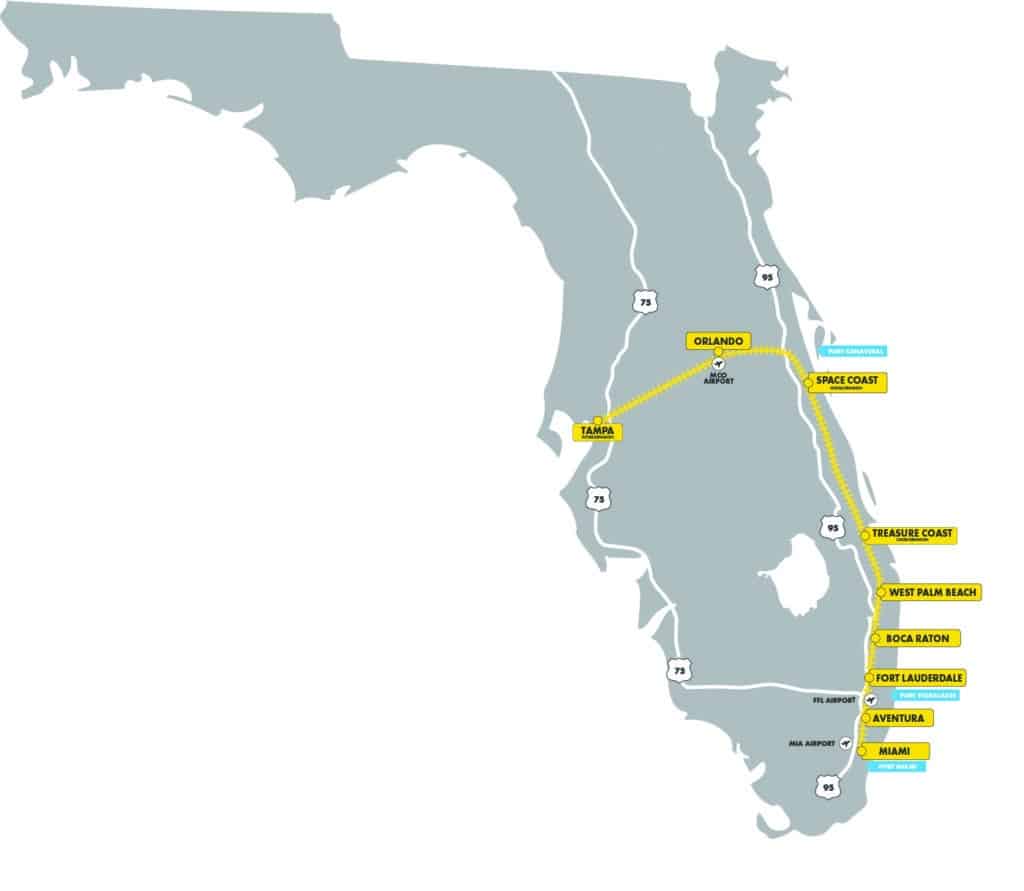
When it began operations in 2018 and for about five years thereafter, Brightline operated only in South Florida. Trains first ran between West Palm Beach and Fort Lauderdale, and service was extended to downtown Miami soon after. Then Brightline made a splash on Sept. 22, 2023, by extending service to MCO. While the airport is not near downtown Orlando, including the Amtrak station and other transit connections, this marked the first time in decades that a private-sector railroad would built and operate a corridor-length route; a trip that takes 3-1/2 hours end to end.

Now the word is out that Brightline is losing money; lots of it. C.A. Bridges and Chris Persaud reported in the Palm Beach Post on May 5, 2025, that Brightline had booked 3 million trips in 2024 but lost almost $550 million. They reported: “According to the privately run passenger train company, Brightline lost about $549 million in 2024, even though its revenue more than doubled compared to 2023.” They also reported: “A big chunk of that, more than $214 million, happened in May 2024 when Brightline refinanced its debt of about $4.6 billion. The Miami-based company also paid $178 million in interest on its debt, it said in its financial statement for 2024. But even without counting debt-related payments, the South Florida-Orlando train still spent more money than it made last year.”
At first, the Orlando airport service was not particularly helpful to Brightline’s bottom line. Business reporter Tom Hudson reported for Miami NPR station WLRN on July 24, 2024, that the service brought more passengers but not profits “while push continues for commuter rail”; the initiative over which FECR is suing. He reported: “Brightline started running its long distance service in September and those additional paying passengers were responsible for the company’s big jump in ticket revenue. If it weren’t for the passengers and fares between South Florida and Orlando, sales and ridership would have dropped. The increase in revenue did not translate into a profit, though.” Hudson went into detail about Brightline’s financial picture at the time. He noted: “It cost $23 million more to run Brightline’s trains in the first quarter than it brought in in ticket sales and other revenue. It also saw its interest expenses increase. Taken together, Brightline saw its quarterly losses more than double from last year to $116 million of red ink.” He also mentioned the 250% increase in fares on the South Florida part of the line, between Miami and West Palm Beach, which had taken effect the previous month and which we reported in May 2024.
The reports from earlier this year were not good, either. The Orlando Sentinel ran a story on May 27 that bore the headline “Brightline Draws Caution Flags from Wall Street Despite Revenue and Ridership Gains.” Chris Persaud reported the loss in the Post on May 2 saying: “Brightline spent $341 million running and maintaining its trains and stations in 2024, bringing in about $188 million from ticket sales and other sources, for a deficit of more than $153 million.”
Ernst & Young, LLP issued audited financial statements for Brightline Trains Florida LLC for the years 2023 and 2024 (download below). Here are some of the highlights that point out the changes from 2023 to 2024, rounded to the nearest million. Passenger and ancillary revenue, mostly from ticket sales, rose from $76 million to $173 million, an increase of about $97 million or 128%. Operating expenses rose from $176 million to $283 million, an increase of $107 million or 61%. Operating losses generally and specifically for the trains were by small percentages. Presumably, these changes reflected the expansion of operations on the North Segment between West Palm Beach and Orlando Airport, which took place for 101 days in 2023 and all of 2024. However, net loss and comprehensive loss increased from $307 million to $549 million, an increase of $242 million or about 79%. The value of assets increased slightly, and current liabilities declined substantially, but total liabilities decreased by about one third, apparently because long-term debt remained by far the largest liability. Cash holdings increased by a factor of five.
Persaud noted: “Brightline’s financial reports are public because it raised money through tax-free bonds sold through the state-run Florida Development Finance Corporation.” He also reported that ticket revenue increase by more than a factor of four on the Orlando route, but it decreased slightly on the South segment of the railroad, between West Palm Beach and Miami.
The railroad’s money woes are already influencing future plans. We reported on Brightline’s plan to build a new station in Stuart, in Martin County; it would be the first station between West Palm Beach and the Orlando airport. On Sept. 25, Andy Hodges wrote a story for the Sebastian Daily, a local paper in a town that the FEC served when it ran passenger trains, headlined “Funding Shortfall Sidelines Proposed Brightline Station on Florida’s Treasure Coast.” It began: “A proposed passenger rail station on the Treasure Coast for Brightline has been sidelined by a federal funding shortfall, pushing back construction and delaying potential service until at least 2028, county officials said.” He explained: “Martin County must reapply for a $45 million grant from the Federal Railroad Administration after the U.S. Department of Transportation rescinded the opportunity without awarding any funds from the previous cycle. The move, announced this week, adds roughly nine months to the timeline for the $60 million project, which would add a stop along Brightline’s expanding high-speed rail corridor between Miami and Orlando.”

Is Brightline’s Picture Looking Better Now?
Brightline might be doing better now, but the news stories don’t necessarily agree about how the railroad is doing financially. On Dec. 3, 2024, The Bond Buyer reported: Brightline wins Deal of the Year award. The story began: “Brightline won The Bond Buyer’s 23rd annual Deal of the Year award for its $3.2 billion recapitalization that represents a transformative moment in U.S. infrastructure financing.” How much good that award will do for Brightline in the future remains to be seen, though.
WLRN business reporter Tom Hudson expressed concern in his June 24, 2025, story headlined “More people are riding Brightline – but not enough to quiet concerns about its finances.” He began his report by saying: “More passengers. More revenue – and more spending. That’s been the business this year for Brightline. It led the passenger service to see its bond rating cut to junk and talk about selling some of the company to investors to raise money.” He reported that Fitch cut its ratings on Brightline’s bonds into junk territory the previous month. Still, Brightline is not out of the game. “We put Brightline at the highest rating level that’s in the speculative grade,” Fitch executive Seth Lehman was quoted as saying in the report, “which also means that if they do reverse themselves and they really get to the revenues and the ridership, there’s a chance they can get back to that investment grade status.” Still, Hudson also reported that two other rating agencies downgraded more than $1 billion worth of Brightline’s bonds.
Hudson reported: “The number of passengers riding Brightline only in South Florida was down almost 8% in the first quarter of this year compared to a year ago. Long distance riders – people catching a train between Orlando and South Florida – were up more than 26%. That was stronger than expected.” He quoted Brightline CEO Patrick Goddard as saying: “ Although we experienced great momentum on long haul growth, we had to work around the displacement of peak shorthaul ridership, who are mostly commuter riders.” Hudson also mentioned that the cost of 20 South Florida rides had gone from $400 to $1,400 in some circumstances (which Railway Age also reported on in May 2024), and concluded by saying: “Despite its new junk bond status, the company has more than a year’s worth of interest payments due to lenders set aside.”
On July 12, CNBC repeated a South Florida Reporter story that said: The Fortress Investment Group-backed railroad plans to defer a July 15 interest payment on about $1.2 billion of 10% and 12% coupon tax-exempt bonds, according to Ashley Blasewitz, a spokesperson for Brightline.”
The South Florida Business Journal on Sept. 23 published a story headlined “Brightline trims losses in first half of 2025 as ridership and revenue rise.” Reporter Cortney Danielle Moore wrote: “Brightline’s midyear filing shows ridership gains alongside financial challenges.” She continued by saying: “Brightline Florida trains reported narrower losses in the first half of 2025, as ridership and revenue grew, according to a September 19 filing of a quarterly unaudited financial report.”
In Tom Hudson of WLRN’s latest report, dated Sept. 24, it sounds somewhat better for Brightline. He wrote: “Total ridership was up 21% in August on Brightline compared to a year ago. Two-thirds of its passengers rode between South Florida and Orlando on what the company refers to as its long distance route. Average fares for those passengers rose 6% from last summer.” He noted that Brightline had reduced fares for South Florida rides, including some $15 weekend fares, and some other fares as low as $12. He also reported: “The pricing strategy appeared to work as short distance ridership jumped 34% in August versus a year earlier.” His final comment on the bond picture was: “However, when the company refinanced $985 million of its bonds in August as they neared maturity, the financial filing included disclosure that Brightline lost $60.2 million in the first quarter of the year. That was an improvement from a year earlier, though, when it ran a net loss of $116 million. About half of Brightline’s loss was due to interest paid on its borrowings. The train service ran an operating loss of $30 million in the first quarter.” The question remains whether Brightline can improve further.

Brightline Still Trying New Ideas
Brightline’s website did not comment on the railroad’s financial woes, but announced that the company is still pitching new ideas about fares, schedules and promotions. Angel Green of WFTV-9 in Orlando summarized the new changes in a report that aired on Sept. 22: “Brightline tests new schedule to boost capacity and service during peak times. South Florida commuters will have more frequent trains, with Boca Raton seeing increased daily departures – 80% of South Florida trains and 90% of Orlando-bound trains stop there.” He also reported: “Brightline will deploy longer 8-coach trains during peak times, growing to 10-coach trains by year’s end, nearly doubling capacity. Pricing includes peak and off-peak rates, with event trains considered peak regardless of time.”
For its own part, Brightline announced the changes in a press release issued the same day with the headline “Brightline Announces Network Enhancements to Meet Ridership Demand and Optimize Guest Experience”: “‘These changes reflect our commitment to delivering a predictable, reliable, and comfortable travel experience,’ said Patrick Goddard, Chief Executive Officer, Brightline Florida. ‘We’ve listened to our guests and studied ridership trends to ensure our network evolves with their needs.’” The changes took effect slightly more than two years after the railroad began service between South Florida and the Orlando airport.
There will also be new trains during peak-commuting hours. Brightline said: “South Florida commuters will benefit from more frequent departures during peak hours, with trains running approximately every 30 minutes.” Under the new schedules: five southbound trains will arrive in MiamiCentral between 7:00 a.m. and 9:30 a.m. (there are now four), five northbound trains will depart MiamiCentral between 3:45 p.m. and 6:45 p.m. (there are now four), four northbound trains will depart MiamiCentral between 7:45 a.m. and 10:00 a.m. (the same as now), and four southbound trains will arrive in MiamiCentral between 4:15 p.m. and 7:00 p.m. (there are now three, although another one arrives at 4:10 p.m.). There will also be more service to Boca Raton, an infill station located at the south end of Palm Beach County, in a town famous for its Spanish-style architecture from a century ago.
Brightline is also introducing its own version of “peak” and “off-peak” pricing between South Florida points, and the press releasee included a fare chart. The fare between Miami and West Palm Beach will be $25 off-peak and $44 peak for coach travel (Brightline calls its non-premium class “SMART Class”). Brightline said: “Brightline will now offer guests traveling within South Florida predictable pricing based on peak and off-peak travel windows, primarily aligned with commute times and rush-hour demand. South Florida peak is comprised of departures between 6:30 a.m. – 9:30 a.m., 3:30 p.m. – 6:30 p.m. Monday through Friday.” This is similar to the practice on MTA Metro-North Railroad and MTA Long Island Rail Road in New York, as well as a former practice at New Jersey Transit and at Southeastern Pennsylvania Transportation Authority in Philadelphia. The “off-peak” fares will be lower than the “peak” fares, but still higher than the former discount fares that are no longer offered. Brightline also runs special event trains: the “Home Runner” for Marlins baseball games, the “End Zone Express” for Dolphins football games, and the “Concert Connect” for special events. Brightline said those trains “will be designated as peak, regardless of time or day of week, and marked with a special icon on the Brightline website and app.”
Regarding other changes, Brightline is adding some amenities for “Premium Class” passengers and making some changes to food and drink offerings on board trains and at stations. Regarding multi-ride fares, the press release said: “Guests will still be able to purchase Brightline Passes, offering fixed rate fares for 10-, 20-, or 40-Ride options for SMART travel.”
Trains are also getting longer; the result of an equipment order that is now being delivered. Brightline said: “For travelers going between South and Central Florida, Brightline will deploy longer 8-coach trains during peak travel periods. Those trains will grow to 10-coach trains before the year’s end—adding nearly 100% more capacity when compared to same time last year—to accommodate the growth in demand from travelers heading to and from Central Florida.”
Brightline’s press release also included a quote from CEO Patrick Goddard: “‘As guests have integrated Brightline into their lives, we continue to learn valuable lessons about their preferences,’” he said. “‘Brightline has shown people will get out of their cars and integrate hospitality-driven train travel into their lives. We believe these changes will enhance that experience even further.’”

Will Changes Be Enough?
Ridership is increasing on Brightline, and the railroad’s losses are diminishing. Still, the question remains of whether the new changes will generate enough additional riders who will contribute enough additional revenue to fill the gap.
Brightline’s fares are high; several times those on Tri-Rail, which is a conventional regional rail service (see map below). The base fare on Tri-Rail between Miami and West Palm Beach is $8.75, with a 12-trip fare for $90.00, monthly commuting for $120.00, and a $4.25 fare for seniors and persons with disabilities. Tri-Rail offers service from the same Miami Central station that Brightline built and uses, although they use separate platforms with separate entrances from the street. The West Palm Beach stations for the two railroads are located within walking distance of each other, but the lines diverge between the two endpoints. The services are different, too. While both run hourly with a few extra trains to make a “commuting peak” service, Brightline offers a level of luxury (including on-board food and drink, as well as a “Premium” class) that Tri-Rail does not. It also operates on a significantly faster schedule (71 or 76 minutes between Miami Central and West Palm Beach, as opposed to two hours flat with a transfer at the Metrorail Transfer station on Tri-Rail, with one faster train). Fares have changed twice on Brightline’s South Florida segment lately, and the question is whether Brightline can attract an optimal number of riders to maximize the revenue it needs to pay its bills and satisfy its investors. That would require making a profit, which is necessary for private-sector organizations.

One of the uses for Brightline’s money is paying for the new cars that are now being delivered and that will allow the railroad to run longer consists. However, longer trains have room for more riders, so Brightline can’t depend on jacking up the fares and depending on potential riders’ demand for seats to be sufficiently price-inelastic to make running trains with shorter consists a strategically useful policy. Amtrak is engaging in that practice on its long-distance trains today, with its shortage of equipment for those trains. We won’t know how well that policy performed for Amtrak (even though we can be sure that prospective passengers who are turned away because the train they wanted to ride is sold out will not like it) until new equipment is delivered and placed into service years from now, if it ever is. That is an experiment that Brightline can’t replicate, and its new equipment order that is now being delivered provides strong evidence that Brightline wants to run longer trains, rather than shorter ones.
Still, are there enough riders who are willing to pay several times the fares that Tri-Rail (which is having its own financial problems) charges, to enjoy the more-luxurious and faster ride that Brightline offers? Brightline offers one feature that Tri-Rail can’t duplicate: convenience to downtown areas. Brightline runs on the FEC, which was the first railroad in South Florida. Tri-Rail runs on the old Seaboard line, which is several miles inland from the town centers. Brightline is an experiment in railroading today: a private-sector passenger railroad. Will its innovations pull it out of its financial hole and bring it to profitability? It seems that everybody is rooting for Brightline, but time will tell.
We reached out to Brightline for comments concerning this story but, at this writing, we have not heard from Brightline. If we do, we will update this story to report what Brightline had to say.




