
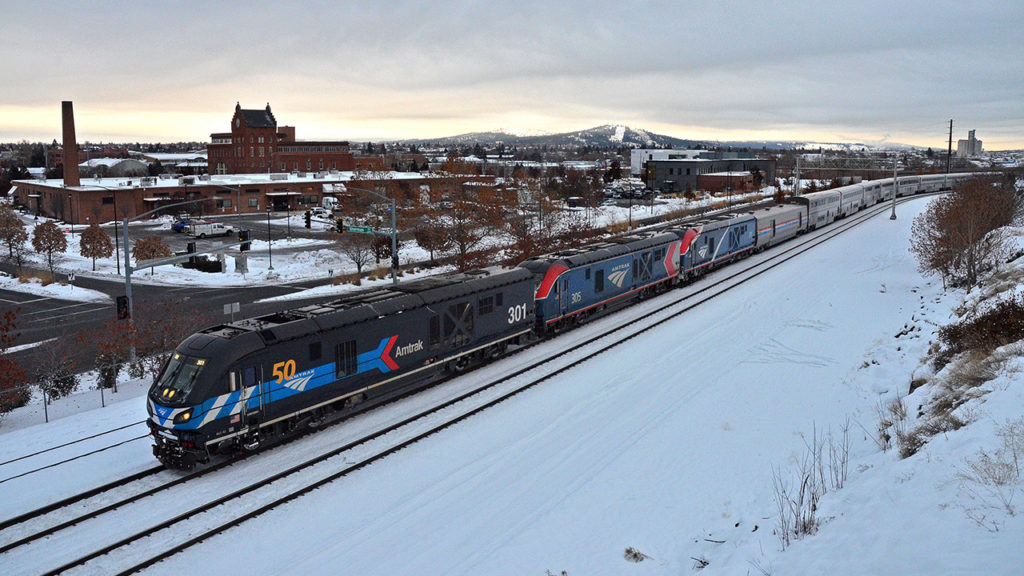
Early the week of Jan. 13, Amtrak issued a cancellation alert for its Empire Builder: “Trains 7 and 8 will be canceled between Spokane and Chicago due to inclement weather throughout the area on January 17, 18, and 19. No alternate transportation will be provided.”
Such cancellations are now standard at Amtrak, and not just for the Empire Builder, Amtrak’s northernmost long-distance service. But is the weather “inclement?” That’s a highly subjective word, but according to the forecasts from the National Weather Service, it evidently means—in Amtrak terminology—subzero weather. No snow, minimal wind. Not a blizzard. Projected overnight low temperatures range from –24 degrees F in Havre, Mont. and –22 degrees in Grand Forks, N.Dak. to –12 degrees in La Crosse, Wis., with quick moderation expected within a day or two. As any resident of these communities will observe, such temperatures are nothing out of the ordinary. Winter is, kind of, seasonally expected. What is now also expected is that Amtrak will cancel service whenever any hint of an operational problem might occur, something which has only become routine in the past decade or so.

In June 2011, when flooding along the Souris River ravaged the city of Minot, N.Dak. and closed the Empire Builder route into July, Amtrak continued to provide service on either side of the affected area between Havre and Seattle and Portland, and between St. Paul and Chicago. Maintaining service between the Twin Cities and Chicago during widespread service interruptions used to be an Amtrak priority, but no longer. This is especially perplexing, given that the St. Paul-Chicago Borealis is not planned to be canceled due to the same inclement weather. So why the change? Speculation is all over the map. In a nutshell, the Empire Builder is a prime example of the ongoing service decay infecting Amtrak long-distance trains for decades.
Touted as the first Superliner-equipped long-distance train in late 1979, the Empire Builder reminds us how very old the current rolling stock is and is the catalyst stroking the fear that these cars won’t last the eight or so years until new equipment will be available in a best-case scenario. Motive power is much newer with Siemens ALC-42 locomotives (placed in service on the Empire Builder in 2021 to replace aging P42s). These locomotives have been plagued with failures that continue to today. Therefore, given the age and unreliability of its equipment in general, one school of thought certainly must be that Amtrak is justified in cancelling service in the name of safety. Annulling a train is operationally very easy, especially with the “alternate transportation not provided” policy in place. But there is more to it.


When Great Northern debuted the Empire Builder as Western America’s newest streamliner in February 1947, the train operated on a 45-hour schedule between Chicago and Seattle, with seven hours of equipment turnaround time in Seattle and 23 hours in Chicago for its five sets of equipment. (Necessary passenger car modifications were done on the eastbound train at St. Paul.) The train was specifically scheduled for immediate connections to and from the East and South in Chicago, with early morning (eastbound) and late night (westbound) departures at Minneapolis, and train times in Spokane just prior to midnight in both directions. This equipment rotation remained in place until the inception of Amtrak in 1971, including a seven-hour or more turn time in Seattle. When an inbound consist was exceptionally late, GN (starting in 1951) also had the option of substituting equipment off its second streamliner, the Western Star, to protect an on-time eastward departure. As an Amtrak train in 1971, the Empire Builder underwent schedule and frequency changes (operating only three and four days per week at times), which usually did not allow the same-day turn of equipment at Seattle.
Beginning at the end of October 1981, a tri-weekly Empire Builder regained its shorter, faster former GN route across Washington State, which would result (again) in allowing a seven-hour turnaround time of equipment in Seattle (and Portland). The ability to turn the equipment the same day at its Western termini as well as a new mail contract incentivized Amtrak to begin again operating the Empire Builder daily, and the train returned to its 45-hour schedule in both directions. By 2020, the schedule was lengthened an hour westbound, and turn time in Seattle was reduced to 6 hours, 15 minutes.
The normal necessary servicing time at Seattle has been about 4.5 hours (to clean the train, stock the dining car and inspect and fuel the power). Unlike the Great Northern with its ability to use available substitute cars off other trains, Amtrak’s planned rotation was “in for out” of the same train in the Seattle terminal. As turn time decreased, and equipment aged, late inbound trains became more and more of a problem. Unfazed, Amtrak exacerbated the situation in the summer of 2022 by lengthening the westbound Empire Builder schedule slightly and setting back its Chicago departure time by 50 minutes. As a result, turnaround time in Seattle today is only 5 hours, 26 minutes, guaranteeing delay to the corresponding eastbound train should be westbound counterpart be an hour or more late, a commonplace occurrence. (The new schedule also made westbound train times less palatable at St. Paul, Glacier Park, Whitefish and Spokane, and since the corresponding eastbound train also had its schedule set back nearly an hour, Chicago connections to the Illinois Zephyr, the evening Wolverine and the Cardinal were severed.)
So, as we contemplate Amtrak’s “inclement weather” claim, so many other questions come to mind: Why are trains so routinely canceled today when they weren’t 40 years ago? Is it just about passenger safety (the standard default), or does Amtrak think its aging equipment becomes unreliable in anything subzero? And if this is the case, shouldn’t management have been more proactive in procuring replacement rolling stock 15 years ago?

In the case of the Empire Builder, have years of management apathy created a product line where equipment, maintenance and employees are stretched so thin that even the most routine recurrence of winter operation could result in cascading days of service interruption that would lead to forced cancelations simply because alternate (or adequate) resources are not available? Is Amtrak’s Consolidated Network Operations Center suffering from the lack of institutional knowledge to creatively deal with such situations, as was the case in the past? Are crew bases inadequately staffed to accommodate delayed trains, which create hours-of-service expirations of on crew districts too long to be feasible in a winter operation (example: Minot, N.Dak. to Shelby, Mont., 534 miles)? Or lastly, are large-scale service cancellations on long-distance trains part of a long-term plan to erode public support for the service by eliminating reliability as a reason for annual appropriations by Congress?
Even while Amtrak is seeking to bring passenger train delays by host freight railroads into the public arena, travelers deserve elaboration on the “why” of Amtrak’s recurring weather, operating, mechanical and personnel delays. To the Amtrak Board and Congress: Do your job. Get the answers.
Mark Meyer is a retired BN/BNSF railroader with 40 years of operations experience, among them 17 years as a train dispatcher on the Empire Builder route, including the morning of Dec.24, 1983 in Havre, Mont. He most recently managed the locomotive fleet on North Operations, which included South Dakota and adjacent states.





