Using a late-played and hardball parliamentary maneuver forcing Republican acquiescence despite a warning to Senate Republicans from the President-elect to block the effort, Senate Majority Leader Chuck Schumer (D-N.Y.) won confirmation early Saturday morning, Dec. 21, of four new Amtrak Board members. The outcome was not anticipated.
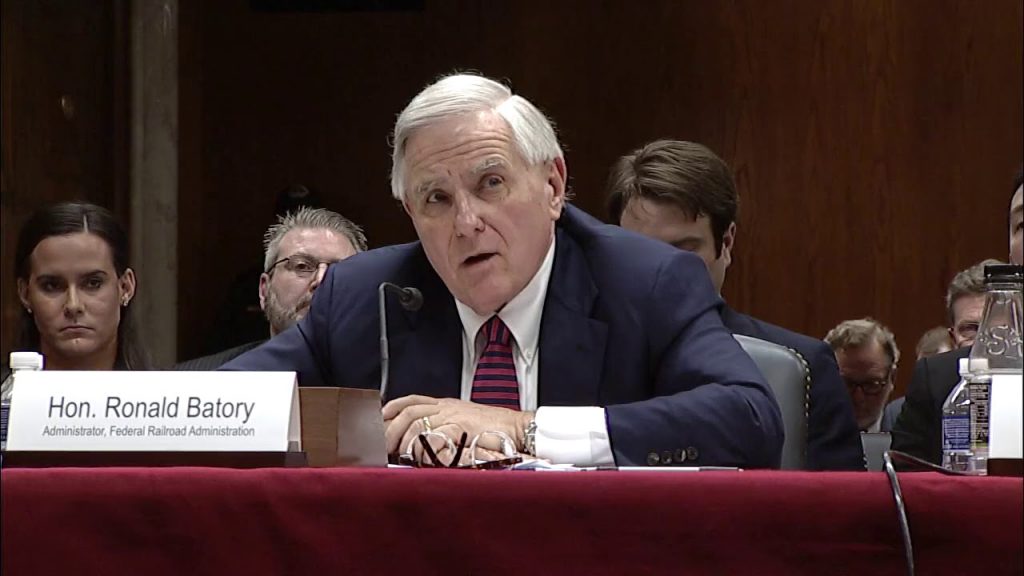
Confirmed for five-year terms to the 10-member Amtrak Board of Directors were Democrats David Michael Capozzi and Elaine Marie Clegg, and Republicans Ronald L. Batory and Lanhee J. Chen. Capozzi fills a newly created seat designated for an advocate of the disabled. Clegg succeeds Yvonne Brathwaite Burke, whose term expired. Batory takes the seat of departed Christopher R. Beall. Chen takes the seat of Jeffrey R. Moreland, whose term expired.
Batory, Federal Railroad Administrator during the President-elect’s first Administration and a career railroader, was nominated by President Biden in May 2024. He is the first Amtrak board member from rail management ranks with an operating background—he formerly was President and COO of Conrail and The Belt Railway of Chicago—and only the third railroader—preceded by former United Transportation Union President Charles Luna and former BNSF attorney Jeff Moreland, now succeeded by Chen.
The two new Democrats and two new Republicans join Board Chairman and Democrat Anthony R. Coscia and Democrat Christopher C. Koos, and Republican Joel Szabat. The Republican Cabinet-level Secretary of Transportation, when confirmed, will add a fourth Republican vote as an ex officio Amtrak Board member.
Not until the new President fills a still-vacant Amtrak board seat—also requiring Senate confirmation—will Republicans have a voting majority at 5-4. While Amtrak CEO Stephen Gardner is the 10th Board member, he does not have a vote. By law, the number of voting members of the Amtrak Board is limited to a maximum of five from one political party.
The political makeup of the Amtrak Board, which sets policy and spending priorities and approves hiring and firing of senior staff, may prove consequential. The President-elect, in his first term, advocated elimination of federal funding for long-distance trains and is anticipated to attempt a claw-back of unspent congressionally appropriated funds for Northeast Corridor projects, such as the New York-New Jersey Gateway Program, the Frederick Douglass tunnel modernization in Baltimore and Virginia’s Long Bridge expansion ahead of extending the NEC to Richmond.
Confirmation of the four new Board members appeared doomed as early as Thursday after the President-elect instructed Senate Republicans to reject fast-tracking by the Democratic-majority Senate of the nominees so that he could nominate his own slate of new Board members following his Jan. 20, 2025 inauguration, when Republicans will control the Senate.
As senators were preparing to vote on a crucial Continuing Resolution to keep the government funded and operating—the expected final Senate vote of the 118th Congress—Schumer made his parliamentary maneuver designed to force Republican acquiescence to confirming the Amtrak Board members. As Republicans earlier refused to provide unanimous consent for the confirmations, Schumer gave them a choice: delay your departure for home for the holidays for at least 36 hours—required under parliamentary rules for a roll call vote on the nominees, and where just the Democratic nominees would be presented for confirmation—or agree to immediate consent for all four, including the two Republicans, to be confirmed.
Significant is that this was the third time in two days that either House or Senate Republicans had defied the President-elect’s wishes—an individual known to demand absolute loyalty from fellow Republicans.
BACKGROUND
The Senate Commerce Committee on Dec. 12 voted to recommend Senate confirmation of the four nominees to the Amtrak Board prior to expiration of the 118th Congress. Time was of the essence if they were to be confirmed. It was a near-run situation for each nominee, given the Senate was to be be in session only Monday, Dec. 16 after 3 PM, Tuesday, Wednesday and Thursday, and perhaps some of Friday, Dec. 17-20, before adjourning. Then, the bipartisan effort to confirm the new Board members dissolved Dec. 20 following a message to Senate Republicans by the President-elect—but the dissolution was only temporary.
Schumer had intended fast-track “unanimous consent” the week of Dec. 16 for confirmation of the Amtrak Board nominees who had previously been vetted by Democrats and Republicans on the Senate Commerce Committee and recommended for Senate floor confirmation. A single objection on the Senate floor would have, however, doomed a call for “unanimous consent.” It appeared that Insufficient time remained for a cumbersome parliamentary process of confirmation absent unanimous consent. Yet, appearances are frequently deceiving on Capitol Hill
As adjournment loomed for the end of the 118th Congress—a new 119th Congress to be sworn in Jan. 3—all President Biden nominations that were pending Senate confirmation were to be returned to the White House. Although Biden remains in office until Jan. 20, it was unlikely he would send any nominations to the new Republican-controlled Senate between its seating on Jan. 3 and his Jan. 20 departure. The reason was summed up in the following message to Senate Republicans by the now-twice-defied President-elect as posted on his “Truth Social” website (incorrect punctuation and capitalization his):
“NO DEAL WITH DEMOCRATS TO FAST TRACK NOMINATIONS AT THE END OF THIS CONGRESS. “I won the biggest mandate in 129 years. I will make my appointments of Very Qualified People in January when I am sworn in.”