Amtrak issued a press release Nov. 18 touting the railroad’s performance in Fiscal Year 2025 entitled “Amtrak: A Year of Records.” With record ridership, record passenger miles, record capital investments and new trains, it would seem that Everything’s Coming Up Roses at today’s Amtrak. But as the late Paul Harvey might have said, there is “The Rest of the Story,” especially with Amtrak’s Long-Distance services.
Considering that they are the face of Amtrak for much of America, the meager amount of reference to Long-Distance trains in the document suggests different reality than what is intended to convey. It touts an 87% completion rate for the Superliner Refresh Program, without mentioning that “refreshing” is superficial, and far from the needed mechanical refurbishment, especially for cars 30 to nearly 50 years old, and that even with funding available since November 2021, Amtrak has yet to specifically determine a design for replacement equipment for the Superliners, much less select a manufacturer. Amtrak applauds its role in the complaint filed by the Justice Department in 2024 against Norfolk Southern for its chronic delay of the Crescent, but neglects to mention that Norfolk Southern gets to keep operating the northbound Crescent on a schedule more than three hours longer than in 2021 and includes an unsavory 11:29 PM departure from Atlanta.
And then there’s this from Amtrak: “Long-Distance routes saw increased capacity and strong ridership on iconic trains like the California Zephyr, Sunset Limited and Coast Starlight.” Such a claim is relative, depending on the points of comparison. Amtrak’s lack of serviceable aging equipment is well known, and most Western long-distance trains are operating or have operated with less than a full complement of equipment. Of the three trains mentioned by Amtrak, while their ridership is up from 2023, they all handled fewer passengers than in pre-COVID 2019. 2025 Coast Starlight ridership (sometimes operating with only two coaches) was only 88% that of 2019, and 82% that 2015. While 2025 overall long-distance ridership was indeed up 13% over 2023, it’s still down 2% from 2019 and slightly less than in 2015.
It should also be noted that in 2015, local ridership between New York and Washington wasn’t included for the Palmetto as it was in 2025, and ridership for the Winter Park Express ski train—included in California Zephyr numbers—was significantly higher in 2025 due to more frequent service.

But to really appreciate Amtrak’s apathy for its Long-Distance trains over the past 15 or so years, the Empire Builder is a case study. In 2005, buoyed by public recognition of the train’s 75th anniversary in 2004, Amtrak refurbished (not just “refreshed”) Empire Builder rolling stock. Not only did the equipment receive both mechanical and aesthetic makeovers but also got upgraded food service for both first and coach class passengers, and enhanced amenities such as a midday “Wine and Cheese Tasting” focusing on products from Washington State and Wisconsin. As a result, ridership soared and peaked at 554,266 in 2008, more than any other Amtrak Long-Distance train ever, and half again as much as the second-place Silver Star. (That year, nearly one out of every 50 Amtrak passengers rode the Empire Builder.)
Amtrak’s marketing department actively and specifically marketed its Long-Distance trains in the 1990s into the 2010s, creating robust patronage to Whitefish, Mont. during ski season, even advertising the Empire Builder as “The Perch Express” to lure people from the Midwest to Devils Lake, N.Dak. mid-winter for ice fishing! In 2014 amid the height of the Bakken Oil Boom causing a glut of freight traffic along the Empire Builder route ahead of BNSF’s investment of billions of dollars in new infrastructure, Amtrak had the resources to create a sixth set of Empire Builder equipment necessitated by a short-lived lengthening of the train’s schedule.
How things have changed. Rather than learn from the success of the Empire Builder in 2008 and apply it to other routes, Amtrak chose to phase out the added amenities. Much of the Whitefish ski business has disappeared due to an unpalatable schedule. Amtrak unstaffed stations in the larger college communities of Winona, Minn. and Grand Forks, N.Dak. and at Columbus, Wisc., the stop for Madison, the state capitol and Wisconsin’s second-largest city. Prior to 2022, the eastbound Empire Builder still had the distinction of being the only Long-Distance Amtrak train on a faster schedule than its pre-Amtrak counterpart, which also included the shortest equipment turn time of any Long-Distance train at only 6 hours, 20 minutes in Seattle.
In mid-2022, turn time was reduced to only 5 hours, 26 minutes, nearly ensuring a late eastbound departure when the corresponding westbound was tardy. (An extra set of equipment was/is out of the question.) Additionally, the westbound train had its departure from Chicago set back 50 minutes and additional dwell time added in Minot, N.Dak. to accommodate an hour-long train servicing and inspection that previously required only 20 minutes. As a result, train times are particularly unappealing at some of its busier stations, such as St. Paul (11:13 PM), Glacier Park (often after sunset), Whitefish (10:21 PM.), and Spokane (3:19 AM). Eastbound, the additional dwell time inbound and at Minot changed the arrival time in Chicago to late afternoon, severing connections with the Cardinal and Wolverine service. August is historically the busiest month for the Empire Builder, so effective Aug. 1, 2024, Amtrak eliminated one of the two coaches on the Seattle section of the train and operated as such for all of 2025.
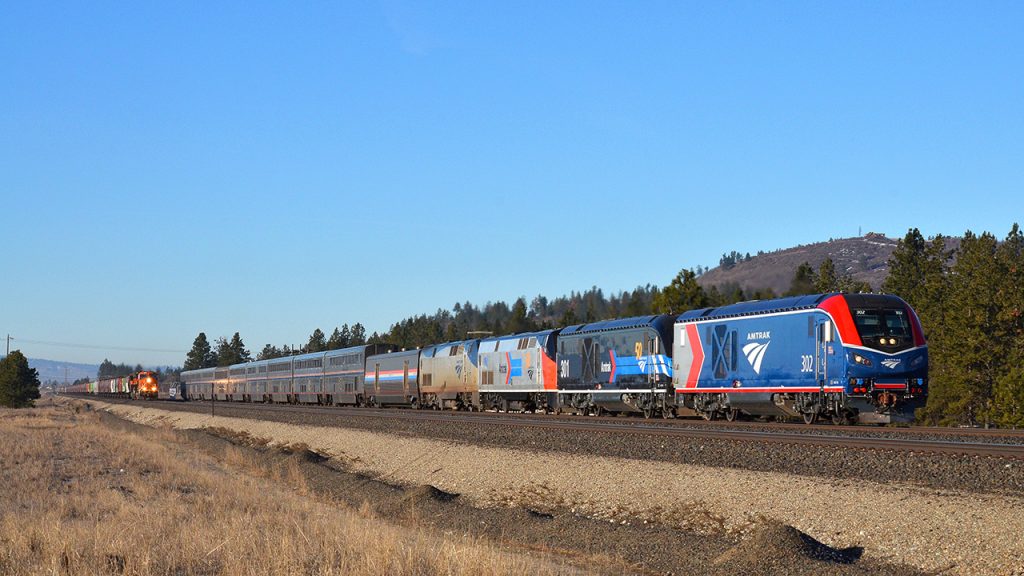
The Empire Builder was the guinea pig as the first Long-Distance train to use the new ALC-42 Siemens locomotives in 2022. That these locomotives had teething problems is an understatement, and they didn’t fare well during the seasonal Northern Plains winter, resulting in numerous late trains and long-term cancelations of service that continued into 2025.
Not surprisingly, Empire Builder performance reflects the service deterioration. Ridership dropped significantly from its peak in 2008 as amenities were phased out, but throughout most of the 2010s, the train still handled 400,000 to 500,000 patrons—some 433,000 in the last pre-COVID year, FY2019. Since then, reduced connections, poor train times, late trains, equipment malfunctions and fewer available seats have reduced ridership by 16% over the pre-COVID level (364,495 in 2025).
So, as Amtrak pats itself on the back for all its perceived successes in 2025, remember “The Rest of the Story” with its Long-Distance trains and where they stand on the pecking order of Amtrak priorities. Amtrak proudly touted the Empire Builder (its most-ridden Long-Distance service) on its Diamond Anniversary in 2004. Today, we must ask: In light of aging equipment with replacement cars anything but certain, what is Amtrak’s plan to ensure that the Empire Builder will be a viable service to its Centennial in 2029 and beyond?

Mark Meyer is retired after spending 40 years in railroad operations at Burlington Northern and BNSF, most recently managing the locomotive fleet on North Operations, which included South Dakota and adjacent states. The opinions expressed here are his, not those of Railway Age.