
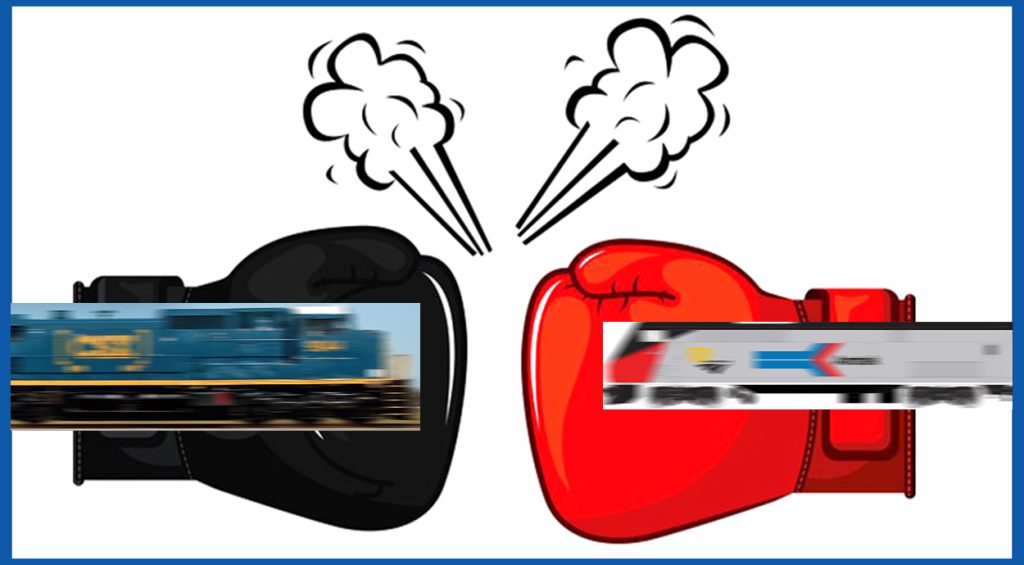
The “Second Battle of Mobile” is over. It ended in a victory for Amtrak, the officials and advocates who fought for the coming Gulf Coast trains, and the riders who will have a slightly expanded rail mobility network starting next year.
It was sheer happenstance that I was in New Orleans when I learned about the Mobile City Council’s surprisingly unanimous vote to move forward with steps required to build the platform and the layup track that will accommodate the new trains. The unexpected and unreported dateline where from I reported this development from the other end of the new service seemed as fitting as it was unexpected.
This report comes to you from aboard an Amtrak train, traveling through North Carolina. The long ride from New Orleans on Amtrak Train 20, the Crescent, provided a useful opportunity to think back through the battle and our coverage of it, which was not only a personal effort on my part but included reporting by several of us here at Railway Age. As I look back over the developments in this case, I also look forward, to consider what effect the prolonged struggle to establish trains between New Orleans and Mobile might have on future starts under Amtrak’s ConnectsUS program for new state supported routes. This commentary also provides a unique opportunity to explain why the Mobile City Council requires a supermajority 5-2 vote to do anything. That requirement almost derailed the plan within sight of its “final destination” and constitutes an important but under-reported part of the story.
Reflections After the Battle
The ride on Train 20 provided an opportunity to reflect on the long struggle to get the new service going. If you consider the “Second Battle of Mobile” as having started with the 6-1 vote taken shortly before the COVID-19 virus struck, the battle took longer than the Civil War, which included the original Battle of Mobile. My own efforts toward covering the conflict were spread over a slightly more than half its duration.
It was fought in several venues: an 11-day trial before the STB, hearings where concerned officials and advocates expressed their views and (and prospective host railroads CSX and Norfolk Southern, along with the Port of Mobile, expressed opposing views), the U.S. Senate and the Mobile City Council among them. The Senate came in during the confirmation hearing for USDOT Secretary Pete Buttigieg, when Republican Sen. Roger Wicker from Mississippi asked about the prospective Gulf Coast trains, the only question about passenger rail during the entire proceeding.
As I started to look back on the events we covered and the tens of thousands of words we used to report them to you, I thought of other “post-war” reflections, particularly those of the legendary Norman Corbin, as he commented on the victories that ended World War II in his radio productions On a Note of Triumph (V-E Day) and 14 August (V-J Day). While I would never claim that my own comments rise to the level of his or that getting two more daily passenger round trips comes anywhere near the importance of winning the bloodiest conflict in the history of the human race so far, getting the final commitment needed to start the new service might stand as a turning point in the overall effort to start new state-supported Amtrak services, although time will tell whether that actually happens, especially within Amtrak’s 2035 planning frontier announced in April 2021.
Whither (Wither) New State-Supported Routes?
At this juncture, the effort to establish new state-supported Amtrak trains could either see a solid green aspect with its “clear” indication, or a continuation of an indication for restricted speed with long intervals of solid red.
I commented on the program on April 9, 2021 in a column that bore the headline Amtrak’s 2035 Plan: Hopes and Challenges. I gave Amtrak credit for finally daring to dream about starting new routes, but also expressed concern that many states would not be interested in having more passenger trains, or that cash-strapped state governments would not believe that they could afford to pay the state’s share of the cost. As I saw the situation at the time, I expected few new routes to be established under the plan, a sad and disappointing outcome.
Not much has changed since then, except that the Gulf Coast situation makes an interesting test case. It concerns three states where Republicans dominate. The only other state-supported trains in a “red state” are the Missouri River Runner trains between St. Louis and Kansas City. There are normally two daily round trips on that line, but sometimes Missouri has cut funding, which resulted in the elimination of one of them. Indiana is also a red state, and it discontinued funding in 2019 for the Hoosier State that ran between Chicago and Indianapolis on the four days a week that the Cardinal does not.
Interstate cooperation is another matter. In a recent commentary headlined A Network of Unfulfilled Hopes, I examined the difficulty in getting a strong network of corridor-length trains running in the Midwest. Illinois, a “blue state” experiencing financial difficulties, is managing to run a relatively comprehensive network of corridors, but that does not hold for neighboring “red states” or the nearby “purple states” that will again serve as the battlegrounds this November.
Interstate cooperation has been even more difficult to achieve during the recent “Second Battle of Mobile.” Louisiana and Mississippi were on board, but Alabama objected every step of the way. The Port of Mobile has now agreed to chip in, and so has the City in the recent vote, but the effort to get the State to cover a share still runs on hope. We’ll keep an eye on that story.
In addition, CSX, NS, and the Port initially fought vigorously against the new passenger service. CSX fought especially hard. Will prospective host railroads fight that hard against other proposed Amtrak routes?
Judging by the present case, that appears likely. CSX and NS had allies in Alabama: the Port and state officials, while the Mobile Council vote was a cliffhanger with a result that came as a pleasant surprise. The strong opposition scored gains for the host railroads, not the least of which was to delay the start of service for several years and to force Amtrak and other supporters to expend time, effort, and money, including for legal fees. It costs a lot to get specialized legal representation for a long trial like the one before the STB. Under circumstances similar to the present case, it appears unlikely that Amtrak or other states would go to the trouble to support such a long and costly struggle.
After all, this was the test case, and the results were mixed. Some new state-supported trains will soon run in “red states” but at a high cost in terms of time and money. The City of Mobile also placed limitations on expansion of passenger service in or beyond its jurisdiction, which provides an unpleasant precedent when other new routes are considered. Ray Lang, who oversees state-supported trains for Amtrak, was reported as complaining about that situation, and it’s hard to blame him. This is not good news.
As for host railroads, anything can still happen. The new Borealis train between Chicago and St. Paul runs mostly on CPKC, which has generally cooperated well with Amtrak. CN has shown the opposite attitude. BNSF has generally worked with Amtrak better than UP, but none of those railroads were involved with the present case. As for CSX, will Joe Hinrichs be more amenable to allowing more passenger trains on that railroad than Jim Foote was? Time will tell, but it’s difficult to conceive that anybody else would act as belligerently as Foote, now deceased, did in the present case. NS provides another question mark. I don’t know what effects the recent proxy fight and the more-recent efforts by the Justice Department will have on that railroad’s behavior concerning new passenger trains. Time will tell about that, too.
Why Mobile Requires a Supermajority
The Mobile City Council has seven members, and under “normal” circumstances, four members of a seven-member body can approve items before it. That is not the case in Mobile, and I recently found out why.
The reason has roots in a dark chapter in the South’s past, which still spreads its influence into the present and, for at least some time, into the future. It is derived from an effort to improve equity and fairness in government, but it nearly derailed the effort to get the new trains running.
During our reporting, I often quoted John Sharp, who covered this story for the Mobile Press-Register and the web site www.al.com. I found his reporting to be thorough and accurate, and he deserves to be complimented, especially as a reporter on the local beat. I asked him about the requirement for a 5-2 vote, and he sent me an article datelined March 11, 2020 and headlined: Black Mobile council members: Effort to shed supermajority rule a ‘full-out assault on our citizens.’
Sharp reported that the 5-2 majority is required under the Zoghby Act: legislation that changed the composition of the city’s government from a three-member commission to the current seven-member Council in 1985. The purpose was to make sure that anything approved by the Council had the support of some black members and some white members, even at the cost of placing a higher bar in front of every act than most legislative bodies require.
The current lineup consists of three black men, three white men and one white woman. When we reported that prospects for passage of the action item that would commit the City of Mobile to get on board with the project and commit money toward implementing it, the three black men and the woman on the Council supported the measure, while the three white men opposed it. One of them had consistently opposed it, while the other two expressed concern about the cost to the City, compared to potential benefits.
That is why I recently reported that indications for passage appeared grim. I was prepared to write an obituary for a good project that was killed at the final hurdle before implementation because of a rule that was designed to improve racial equity in a city that did not believe in the concept in the past, even though the issue did not appear to venture anywhere near any sort of race-based controversy. Fortunately, the required consensus materialized, and many of us (including Amtrak spokesman Marc Magliari) were pleasantly surprised.
New Mobility For New Orleans
So, the trains are coming. They will add five new places, and possibly a sixth, to the nation’s mobility map for non-motorists and motorists alike. Today there is no public ground transportation to the Mississippi towns of Bay St. Louis or Pascagoula. Greyhound operates only one bus from New Orleans to Biloxi, leaving in the morning. Returning, there is one that allows a day visit and another in the middle of the night.
It’s possible to get from Biloxi to Gulfport on local buses operated by the Coast Transit Authority, but probably not within the time allotted for a trip from New Orleans on Greyhound. Coast Transit also goes to Ocean Springs, an interesting town along the rail line, but where the trains are not slated to stop. Maybe sometime in the future?
There are four departures from New Orleans for Mobile, one of which arrives late at night. Going to New Orleans there are three, but one leaves in the middle of the night and another leaves early in the morning. The bus station is located more than four miles from downtown Mobile, and local buses do not connect there for all arrivals and departures. While it is theoretically possible to go to Mobile for a few hours, there is no such practical trip.
All stations for the new trains will be located in downtown areas, which will make access, especially for a day trip to any of its destinations, practical for the first time in decades.
The New Orleans Union Passenger Terminal will also be busier than at any time since 1971. Today, there are 17 arrivals and departures per week. With two more added every day, there will be 31, an 82% increase. That means more jobs, more activity and more reason to visit the Crescent City, when side trips to Mississippi and Mobile become available.
So, the improvements are coming. It has been a long and difficult struggle, and the final obstacle almost killed the plan. Still, the Mobile City Council came through with a surprising consensus.
I’ll have more to report, but at least the Second Battle of Mobile is over.
David Peter Alan is one of North America’s most experienced transit users and advocates, having ridden every rail transit line in the U.S., and most Canadian systems. He has also ridden the entire Amtrak and VIA Rail network. His advocacy on the national scene focuses on the Rail Users’ Network (RUN), where he has been a Board member since 2005. Locally in New Jersey, he served as Chair of the Lackawanna Coalition for 21 years and remains a member. He is also a member of NJ Transit’s Senior Citizens and Disabled Residents Transportation Advisory Committee (SCDRTAC). When not writing or traveling, he practices law in the fields of Intellectual Property (Patents, Trademarks and Copyright) and business law. Opinions expressed here are his own.




