California’s High-Speed Rail (CAHSR) project is under attack from the U.S. Department of Transportation again. On Feb. 20, Transportation Secretary Sean Duffy called for an investigation of the project, which aims to connect Northern and Southern California with trains that can run between San Francisco and Los Angeles in three hours or less. During the POTUS 45 Administration, the feds tried to claw back money that had been given to the effort to build the high-speed line. We reported that effort and asked the question reprised in the title of this article on Feb. 21, 2019. Then the government changed, and the Biden Administration was more supportive, leading us to report on Feb. 22, 2022 that the project’s way forward had been upgraded to “limited clear.” Now it’s in official trouble again, probably with a bright red signal ahead (in more ways than one).
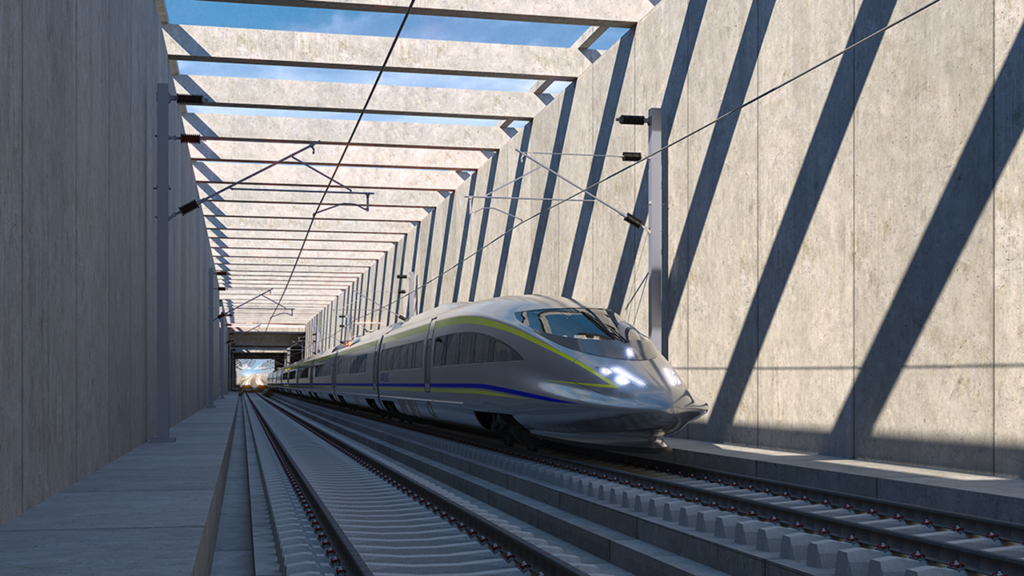
Construction is already under way in the state’s Central Valley, on a new railroad roughly parallel to the historic Santa Fe line (now part of BNSF) where the San Joaquin Line provides corridor service between Bakersfield (with a connecting bus to and from Los Angeles) and the San Francisco Bay area. There are five daily round trips on that line, including one that connects with an overnight bus between Los Angeles and Bakersfield. There is also a single round trip between Bakersfield and Sacramento, through Lodi. That train connects with Trains 11 and 14, the Coast Starlight, north of the state capital. The portion of the line in the Central Valley is anticipated to gain the FRA’s Class 9 rating, which means it could support trains moving at 200 mph. It is slated to be the first Class 9 track in the country. That would be genuine high-speed rail (HSR), but the segment now under construction would not go near any major cities until at least several years after opening for service, as the cost keeps going up.
Duffy Aim and Shoots
The latest round of trouble for the project comes from Transportation Secretary Sean Duffy. The Feb. 20 DOT release started by saying: “Today, at the direction of Secretary of Transportation Sean P. Duffy, the Federal Railroad Administration (FRA) initiated a review of the California High-Speed Rail Authority (CHSRA). This review will help determine whether roughly $4 billion in taxpayer money should remain committed to the proposed project to build high-speed rail in the California Central Valley between Merced and Bakersfield.” The statement mentioned how costs had climbed since the original estimate: “The entire San Francisco to Los Angeles project was initially supposed to be completed by 2020 and cost $33 billion. Today, the Merced-to-Bakersfield segment alone would cost more than the original total. The latest estimate for San Francisco to Los Angeles is $106 billion — more than three times the original cost estimate.” While some of the cost increases can be ascribed to the inflation that helped Republicans win last fall’s election and some can be ascribed to the costs of defending against the project’s adversaries, a cost increase that large hits a nerve with some taxpayers, although highway projects often go unchallenged.
The DOT Release quoted Duffy as saying: “For too long, taxpayers have subsidized the massively over-budget and delayed California High-Speed Rail project … the President is right that this project is in dire need of an investigation. That is why I am directing my staff to review and determine whether the CHSRA has followed through on the commitments it made to receive billions of dollars in federal funding. If not, I will have to consider whether that money could be given to deserving infrastructure projects elsewhere in the United States.” The statement went on to describe the funding gaps faced by the project and said: “Given the red flags raised about this project, FRA will investigate the delays and cost overruns through a compliance and performance review.” It contrasted and praised the private-sector Brightline West project, which plans to bring high-speed rail service between Las Vegas, Nevada and the Los Angeles area, specifically Rancho Cucamonga in the eastern suburbs of the city on Metrolink’s San Bernardino Line. The DOT document concluded by saying: “At the direction of Secretary Duffy, FRA will review CHSRA and the progress on the Merced-to-Bakersfield Corridor. The detailed review will look at CHSRA’s compliance under the FRA-administered grant agreements to determine whether CHSRA has fully met its obligations under the award terms.”
The same day, Doug Cunningham reported the story for UPI, repeating most of the substance of the Release, but his report also reminded his readers that “DOT investments in infrastructure projects are national investments using congressional-approved funds for infrastructure. The money comes from U.S. taxpayer funds appropriated by Congress, not from the Biden Administration.”
KCAL, the CBS-TV station in Los Angeles reported that Duffy made the announcement at the city’s Union Station: “At a news conference Thursday morning at Union Station in Los Angeles with Republican members of the state legislature, Duffy said the project has been mismanaged and will continue to cost taxpayers billions of dollars with no definitive timeline for completion.” Duffy was quoted as saying: “If California wants to continue to invest, that’s fine. We in the Administration are going to take a look at whether this project is worthy of continual investment.” The report continued: “Among the lawmakers present at the press conference were several who sent a letter to the President last week encouraging him to review the project’s funding. [POTUS 47], who earlier this month called California’s high-speed rail project, “the worst-managed project” he’s ever seen, also targeted the project during his first term, canceling nearly $1 billion in federal funding that was later restored and increased by the Biden administration to more than $4 billion.”
The project was originally approved by the voters in 2008, but the cost has risen dramatically. The price tag for the first segment of the line, in the Central Valley between Merced and Bakersfield, is now estimated at $32 to $35 billion, with another $100 billion needed to complete the line between Los Angeles and San Francisco, according to the report.
Project Defenders
The event at Union Station did not go off without protest from the project’s supporters. KCAL reported: “Much of the press conference was punctuated by shouting and chants from protesters and activists supporting the state’s high-speed rail plans. Duffy told the demonstrators they should take their protests to Democratic lawmakers and Gov. Gavin Newsom.” Duffy was quoted as saying: “If you want to go protest somewhere, if you want to shout at someone, go to the governor’s mansion. Go talk to Democrats in the Legislature who have brought us this crappy project.”
A quote from a statement by Newsom said: “No state in America is closer to launching high-speed rail than California … We’re moving into the track-laying phase, completing structures for key segments, and laying the groundwork for a high-speed rail network.” A report last year form the California High-Speed Rail Authority (CHSRA) touted economic benefits of the $13 billion spent on the project so far: nearly 15,000 jobs created, $8.3 billion in labor income, and $21.8 billion in total economic output.
In a 2025 Project Update Report by the CHSRA, which did not show an exact release date, touted the project. CHSRA CEO Ian Choudry praised the project, saying that its mission is clear: “Deliver the nation’s first true high-speed rail system. This is not just a transportation project, it is a transformative investment that will shape California’s economy, infrastructure, and environmental leadership” (at V).
A section of the report, which was over Choudri’s signature and headlined The Funding Imperative addressed the funding challenges, at least to some extent. It said: “Lack of stable, long-term funding has been a persistent challenge. The stop and go approach has cost us time and money. Achieving full system connectivity requires a new financial strategy that includes: Long-term sustained state investment. Innovative financing to drive construction momentum. Public-private partnerships to leverage state funds.” The report continued: “The State recognizes this urgency and we are working closely with the Newsom Administration, California Legislature, and federal partners to secure a stable funding path forward” (at VII).
Dejavu All Over Again
Baseball great Yogi Berra’s expression is relevant to the California HSR Project. The POTUS 47 Administration is attempting to claw back federal money given to the project, on the grounds of rapidly increasing costs and a lengthening interval between now and any anticipated completion date, at least for a line between San Francisco and Los Angeles, never mind Sacramento or San Diego, which are the parts of Phase II. The line is under construction in the Central Valley, and Caltrain on the Peninsula between San Francisco and San José has been electrified and is now operating with electric power. Still, it will take at least into the 2030s before HSR will reach either of the state’s two biggest cities.
The same person who attacked the project as POTUS 47 also did that as POTUS 45 in 2019. We ran a commentary about the future of the line at that time in light of that similar event. That time, POTUS 45’s FRA Administrator was Ron Batory, now a member of the Amtrak Board. In reporting this development, I quoted Batory and also reported: “‘The FRA is terminating its cooperative agreement with CHSRA because the agency ‘will not complete the project by 2022,’ the performance deadline. Newsom’s new proposal ‘represents a significant retreat from the State’s initial vision,’ which included running the high-speed line beyond the Central Valley to Los Angeles and San Francisco, and that the FRA intends to ‘de-obligate’ nearly $1 billion that had previously been obligated under the now-revoked agreement. The FRA wasted no time, but is difficult to fathom how knowledgeable people could have been surprised by the ultimate result.” Now the figure is more than four times as much, and Duffy’s reasoning, like it or not, does not appear that different from Batory’s.
I commented on why, despite all the good things that many elected officials and rider-advocates said about HSR, it is not catching on: “In short, true HSR costs more than Americans are willing to pay, the few current proposals do not make good transportation sense, and the nation does not have the supporting transit structure and service to justify HSR at this time.” More specifically, I said: “Politicians and promoters are reluctant to admit it, but true HSR is expensive. It is not compatible with conventional rail operations, and it requires its own right-of-way, with very slight grades and gentle curves. High-speed trains can run on conventional railroads for part of their trips, as they do in Europe. There were plans to use the Caltrain right-of-way between San Francisco and San José for a portion of the HSR trip, but using a conventional rail line increases travel time, which runs against the core benefit of a high-speed train.” I added: “It is difficult to fathom how the U.S., with its current attitudes and policies toward transportation, could convince itself to make the required investment. It is difficult to see how the private sector would invest in new rail lines, because investors would need to make a return on their investments, and new rail lines would have to compete with heavily subsidized airline travel and even-more-heavily subsidized automobile use on the highways, most of which are available to motorists without paying a user fee.”
It was a controversial move to pronounce HSR dead, but there seemed to be no reasonable alternative at the time. The money just did not seem to be there, it was difficult to fathom who would come up with it. Even in its recent report, the CHSRA was aware of “funding uncertainty”: “The Authority is proactively seeking new opportunities for funding to sustain and expand design, early works, and construction, and to reduce downstream delays associated with insufficient funding” (at 35). While the Authority proposed some measures that could mitigate funding problems, these are methods that work around the edges to produce marginal improvements, rather than funding at the magnitude that such a project needs. The bar graphs in Appendix C (at 53-57) does not paint a pretty picture, as costs kept rising over time. Appendix D (at 58) shows estimated completion dates receding into the future. The 2023 and 2024 business plans showed anticipated completion of the Merced-Fresno-Bakersfield segment between 2030 and 2033. San Francisco (three hours from Oakland by conventional San Joaquin train) and Los Angeles (2:20 from Bakersfield by bus over some territory near a rail line that has not hosted a scheduled passenger train since 1971) are not mentioned. When those segments could be completed is anyone’s guess.
Three Years Later
By Feb. 22, 2022, the project’s prospects had improved, and the indication had changed to a limited clear. In a comprehensive commentary, I started by saying, “Exactly three years ago, I pronounced the California High-Speed Rail project dead, and issued a poor prognosis for high-speed rail generally in the United States” and citing the article from three years prior. I continued: “Things looked terrible for the project then, especially since the FRA was about to claw back a $929 million grant because it did not look like the project would be completed by its original projected date in 2022. By that time, also, the projected cost had grown from $32 billion to $70 billion. Today the cost could go as high as $105 billion but, all in all, the proposal appears to be in better condition than it was three years ago. Construction is proceeding in the Central Valley and its proponents, especially the California High-Speed Rail Authority (CHSRA), are hopeful.” This is the way I saw the project three years ago: “In a nutshell, it is better off than it was three years ago, although that might not be saying much. The project is moving forward, and construction is proceeding in the Central Valley. There is funding for now, although sufficient continued funding could become problematic later. It will also be at least 11 years before any trains roll, and more years before the Authority expects to get out of the Central Valley and go south of Bakersfield toward Los Angeles. They have their reasons for that, which I will describe. Whether or not their decision will be remembered as optimal in the long run, despite their reasons, remains to be seen. For now, though, the bottom line is that the project is moving forward, and even if signals are yellow rather than green, one of the goals is to build an operable segment of FRA Class 9 track, with a maximum operating speed of 200 mph. If the plan succeeds in the Central Valley, even if nowhere else, that part of the line will be the first segment of such track in the U.S.”
As much as prospects for the project looked better in 2022 than they had in 2019, I still did not see any green in the aspect, only yellow. I explained that, if only the portion of the line now under construction in the Central Valley is eventually built, it will not save much time for passengers going between the state’s largest cities, because the $17.5 billion (estimated cost at the time) would only save about 90 minutes, because it would still be necessary to take a conventional train north of Merced and a bus to Los Angeles from Bakersfield. I expressed another concern, too: “If the current project is not completed because there is ultimately not enough funding available to complete it, and especially if there is not enough to build the spine between San Francisco and Los Angeles, a line ending in Bakersfield will continue to serve as an object of scorn and false narratives about how the U.S. does not have the population density to support true high-speed rail. As things look from here, the California HSR Project is facing yellow signals, and it could go either way.”
Three More Years Later
Three more years have gone by, and the project’s situation has come full circle. Costs have risen over the years, and Washington is questioning the cost-effectiveness of the project as forcefully as possible. What happened to change everything, and then take it right back to the high-risk zone? To me, the answer is very simple: the politics changed. Simply stated, the tide turned toward the Democrats.
California is one of the “bluest” of “blue” states. It has been a long time since a Republican held state office, probably due at least in part to the fact that Republicans were different then. Ronald Reagan (POTUS 40 and himself a Californian) stood far to the right of previous Republicans, while POTUS 45/47 stands far to the right of Reagan. Democrats hold most of the Congressional and state legislative seats in the Golden State, so they could gravitate toward mega-projects like HSR and get a consensus within the state for it. The same goes for raising taxes to pay for new transit starts, even though it is necessary to get a two-thirds vote to raise taxes. Enough Californians seem to be willing to spend money for such improvements that they often form the necessary consensus at the polls.
When the Democrats are also strong at the national level, that seems to work well for states like California, because the feds seem willing to chip in. Republicans are not, though, while not even any Republicans in the past (including POTUS 45, who is the same person as POTUS 47) showed the zeal to cut federal and state programs (where that’s possible through withholding federal funding for them) that we are seeing today, in an administration that has not yet even been in office for two months.
So the politics changed, with Nancy Pelosi as Speaker of the House and POTUS 46 (Joe Biden) leading the country. Times were good for projects like CAHSR. Now the politics have changed again, and for the project, it looks more like 2019 again.
The HSR project has its supporters, and they appear to believe that they can withstand whatever “review” Duffy’s DOT can force them to endure. The CBS report quoted earlier in this article also said: “‘Every dollar of the project is accounted for and has been thoroughly reviewed by the independent Office of the Inspector General’, said [Sen. Dave] Cortese in a prepared statement. ‘The OIG’s sole focus is improving oversight and accountability of the California high-speed rail project by conducting independent, objective reviews and investigations of the High-Speed Rail Authority’s planning, delivery, and operation.’” It was also reported that Cortese “introduced a bill to commission a study on commercial and residential development opportunities along the high-speed rail corridor.”
CBS in Los Angeles also reported that a recent Emerson poll indicated that 54% of Californians believe that the HSR project would be a good use of State money. Maybe if the State could fund the project without help from the feds, the public would be willing to invest the entire cost, but that seems like a long shot from here. This is a huge mega-project, with skyrocketing costs and receding completion dates, at least if the public is looking for a line that will go far beyond Merced and Bakersfield.
We’ll keep an eye on the project but keeping it going without participation from the federal side would be an extremely daunting challenge, especially since the likelihood of the feds chipping in any significant money toward the project during the remaining 46 months of the current Administration approaches zero.
Maybe it’s time to look at alternatives, like fixing up the Coast Line and offering relatively frequent and relatively high-performance service between Los Angeles and the Bay Area. The line is scenic, too.