
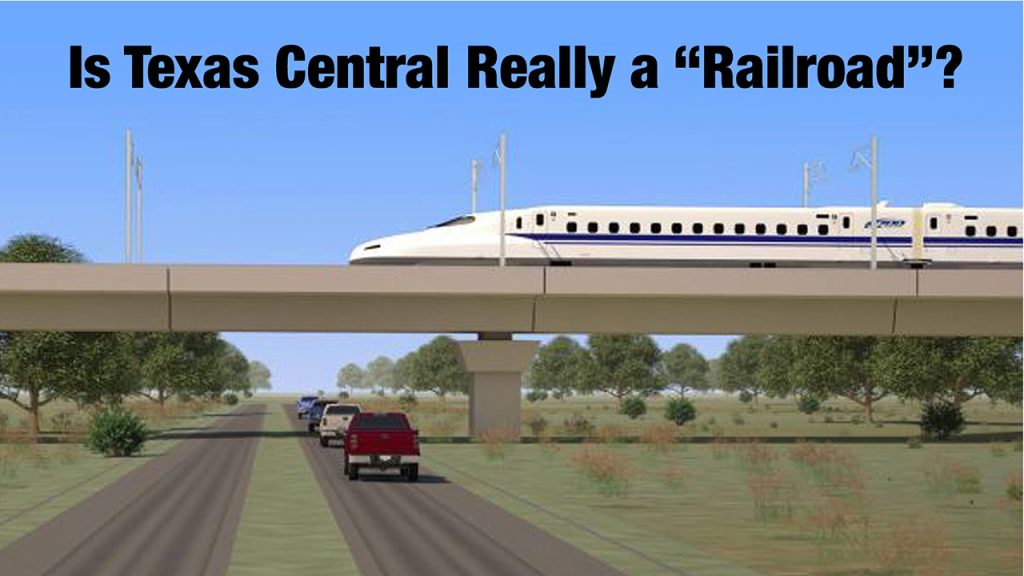
The big buzz and bigger controversy around Texas during the past several years has been a proposal by a company called Texas Central to build and operate a high-speed rail line between Downtown Dallas and a point in the Houston area, about eight miles from downtown Houston where two highways intersect, a great spot for a parking lot, but not such a great spot for connecting transit to take passengers the “last mile” or more to their final destinations in a place that looks more like Houston.
Houstonians, through their elected officials, thought it would be a great idea to have a railroad like that. Some Dallasites did not seem quite as enthusiastic, but they liked the idea, too. In between, it seems that almost everybody hated it. They’re still fighting it today, but that’s getting ahead of the story.
I covered the story with 11 articles, mostly in 2022, reporting plenty of litigation against Texas Central from angry landowners along the prospective ROW and their elected officials, a decision by the Texas Supreme Court that I found very difficult to believe: that Texas Central was not a “railroad” but an “interurban electric railway company” like those big streetcars that used to zoom through the countryside a century ago and provided much better than persons living in those locations have today (like the legendary Texas Electric Railway), which still gave Texas Central eminent domain rights, the apparent demise of Texas Central, and the apparent end of the line for the project.
Then, last April at the Southwestern Rail Conference near Fort Worth, sponsored by the Texas Rail Advocates (TRA), New York City’s beloved “Train Daddy” (imported from London, Sydney and Toronto), Andy Byford, came to promote the project on behalf of Amtrak. With such a well-respected and beloved railroader (on the transit side, anyway) making the pitch, the project seemed to be reinvigorated almost overnight. On Sept. 4, 2024, long after it appeared that the project was dead, Railway Age Editor-in-Chief William C. Vantuono reported the next episode with the headline: Texas Central: Amtrak to the Rescue? It was an enthusiastic and hopeful commentary, as if the project had suddenly somehow made it past a solid red aspect and was facing at least a limited clear indication. To raise a comparison, we had said that about the California High-Speed Rail Project in 2019 and 2022, but circumstances are changing, maybe for both projects.
Lots of Reports. Where’s the News?
Then came a flurry of reports at the end of this past February about a new “document” that Amtrak had placed on the “Procurement” portion of its web site. It’s not easy to find. The project in question was “TEXAS HSR DELIVERY PARTNR” (all caps and missing “E” in original), and the title was “Notice for the Texas High Speed Rail (HSR) Project Delivery Partner.” There was a “Start Date” of Feb. 25, 2025, but nothing was filled in under the “Commodity” or “Project Value” columns.
Lest we get ahead of ourselves, here’s what the Notice said, in its entirety: “Amtrak previously issued an Advance Notice to initiate a procurement to select a firm (the ‘Delivery Partner’) to provide programmatic support for the development and execution of the Texas High Speed Rail Project (the ‘Project’) and is reissuing this Notice to continue industry engagement for the Request for Qualifications (‘RFQ’) that will be released this Spring to interested firms. Interested firms who did not previously submit a request to receive the solicitation documents, updates, and notifications related to the RFQ should contact [the contracting officer] with the following information: name of firm, name of single point-of-contact, address, phone number, and email address. Firms that have previously responded to the ‘Advance Notice for the Texas High Speed Rail (HSR) Project Delivery Partner’ will receive the solicitation documents once issued, as well as updates and notifications, and are not required to respond to this posting” (emphasis in original).
There was more content, but it was in a longer document, about one and one-third pages, not counting the title page. It bore the title: “NOTICE FOR THE TEXAS HIGH SPEED RAIL (HSR) PROJECT DELIVERY PARTNER” (all caps in original). The “Project Overview” section began by saying: “Intended to complement future new and improved corridor and long-distance service in the southern region, the Project would construct a new, grade-separated high-speed rail system between Dallas and Houston, the fourth- and fifth-most populous metropolitan areas in the country. With top speeds of up to 205 mph, the Project would offer a 90-minute trip, including an intermediate stop in Brazos Valley, over a 240-mile alignment” and concluded by saying: “The Delivery Partner will be responsible for facilitating Amtrak’s delivery of the Project and will become a fully integrated and accountable member of the Project team. The Delivery Partner will provide advice, leadership, and support to Amtrak to allow Amtrak to successfully deliver the Program, and will undertake, direct, and coordinate a broad range of program management, design management, construction management, quality management, third party and stakeholder coordination, procurement, commercial strategy, field representation, and monitoring services (collectively, the “Services”).
In addition, although Delivery Partner will not design or construct the Project, the Delivery Partner will be a source of sound professional design and construction expertise and judgement to Amtrak. Performance of all Services is subject to the direction of Amtrak’s Contracting Officer/Contracting Officer’s Technical Representative. Amtrak seeks a Delivery Partner that is aware of and willing to enter into incentive/disincentive compensation structures to ensure the Project is delivered in the most innovative and cost-efficient manner.”
Amtrak described the pertinent part of the procurement process this way: “A two-step best value procurement process will be used to procure the Delivery Partner. The first step will be a Request for Qualifications (RFQ), where prospective Proposers will be invited to submit their Statement of Qualifications (SOQs) to perform the Services. Each SOQ will be required to identify the Proposer, which may be an individual entity or a Joint Venture, as well as any known subcontractors or subconsultants and the functions they will perform. Based on those submissions, Amtrak will establish a shortlist of eligible Proposers who will be invited to participate in the second step, the Request for Proposals (RFP). The RFQ shall be released via Amtrak’s Ariba on Demand website.” In the final two paragraphs of the document, Amtrak mentioned competitiveness, fairness, potential conflicts of interest, and Amtrak’s status as a “heavily regulated entity,” the sort of boilerplate language that contracts of that sort could reasonably be expected to contain. Still, the document is not specific and does not define in any sort of detail what a “delivery partner” is, and does not mention what such an entity is expected to do for Amtrak to move the project forward.
TRA, an organization that advocates for improvements in passenger and freight rail service in the Lone Star State, as well as rail transit there, reported the Notice on its website, www.texasrailadvocates.org, on Feb. 26, adding that the organization was the first to report it. The story called it a “‘Texas Two-Step’ invitation” and reported: “Amtrak issued a Request for Qualifications (RFQ) and is actively seeking a delivery partner for the Texas High Speed Rail (HSR) Project. The RFQ, issued February 25th, invites prospective companies, joint ventures, contractors and subcontractors to submit their qualifications so that Amtrak can whittle the entries down to a shortlist. That short list would then lead to project management finalists submitting their best price estimate in a Request for Proposal (RFP) for the high-speed rail project.”
TRA also released a statement from Amtrak that said: “Amtrak is working to confirm the viability of the concept of a dedicated high-speed rail route between Dallas and Houston. As part of these efforts, we are seeking to identify the interest of potential partners through responses to this Request for Qualifications process.”
On Feb. 26, Donnie Tuggle of KTBS News 3 in Bryan (near College Station, home of Texas A&M) reported: “According to Amtrak, the delivery partner will be responsible for providing ‘advice, leadership, and support’ to facilitate the execution of the project. According to the request, this firm will not design or construct the rail system, however, it will play a key role in program management, construction oversight, stakeholder coordination, procurement, and quality management. Amtrak says the partner must be ‘aware of and willing to enter into incentive/disincentive compensation structures to ensure the Project is delivered in the most innovative and cost-efficient manner.’”
Houston Public Media ran a story on Feb. 28 that was longer than the Amtrak document, headlined Houston-to-Dallas bullet train project takes another step as Amtrak seeks delivery partner. With so little new information to report, the story summarized information known within the railroad community, along with the project’s supporters and opponents, although probably not to members of the public who are not directly concerned with it. The new information was “Amtrak is searching for a delivery partner to assist with the long-standing plan to construct a high-speed railway between Houston and Dallas.” Tuggle mentioned the two-step process, with the RFQ and the SOQ, and added: “According to Amtrak, the project would consist of a new high-speed rail system between Dallas and Houston that would be able to reach speeds of up to 205 mph. The line would also have a stop in the Brazos Valley.”
One piece of information the public station revealed: “The high-speed rail project has been in the works for several years but experienced stagnation during the COVID-19 pandemic. However, in September 2024, Amtrak received a $63.9 million federal grant to continue planning for a Texas bullet train, which reignited discussion around the project.” How far that will go toward actually building a true HSR line is anybody’s guess and so is whether the Duffy administration at USDOT will allow the project to proceed, even to the point of spending that money, which was announced during the Biden era. The report concluded by saying: “Amtrak did not immediately respond to a request for comment Thursday and has not released a timeline for constructing the proposed rail line.” A genuine step forward or not much of a change? Time will tell.
One thing we know is that the project is under consideration again, at least for now. Byford promoted it at the TRA conference last April, and it has gotten over an FRA hurdle. We don’t know whether an FRA that now takes orders from Duffy would sustain a decision it made under Amit Bose last year. We also don’t know what a judge in New York City will say about allegations that the Triborough Bridge & Tunnel Authority and the Metropolitan Transportation Authority in the state made in federal court, claiming that Duffy is not allowed to reverse a previously approved project (the Congestion Pricing toll for vehicles to enter downtown or Midtown Manhattan), unless there is a compelling need or change in circumstances. The outcome of that case should influence whether POTUS 47-era officials can reverse decisions made by their predecessors under POTUS 46 (Biden).
In the meantime, there remain outstanding issues of the strong dislike for the project expressed by many landowners along the proposed right-of-way, the cost of the project (again, will the feds be allowed to give grants for building the line under current political circumstances?), and where the line will end in the Houston area.
The latter question also raises the issue of the line’s overall utility for anyone, motorist or not, going to Houston from Dallas. The area is at the junction of two highways: miles from downtown, about a 40-minute bus ride away from the city’s core (yes, it does have one), and nowhere near Houston Metro’s light rail system that could deliver relatively quick and comfortable access to the center of town.
We might get some answers next month, perhaps at the Southwest Rail Conference sponsored by the Texas Rail Advocates, who are strong supporters of the project. The organization’s President and conference moderator Peter LeCody can be expected to add his organization’s support, and probably his personal support for the project, too. The question is whether Amtrak can sell the project and steer it through the obstacles that have dogged it for years and continue to make things difficult for the project. The opposition is strong, though, and it’s home-grown in Texas.
Legendary radio comedians Bob and Ray used to talk about “The News behind the News behind the News” or even “The News behind the News behind the News behind the News.” The reporters on this story had so little “News” to begin with that it was hard to find any “News behind the News” this time. Despite that, Le Cody and the TRA will be out in force at next month’s conference. I will present the closing remarks. If anything happens, I’ll report it at that time.




