
Transport Canada Launches RFP for HFR Project (UPDATE, 8/8)
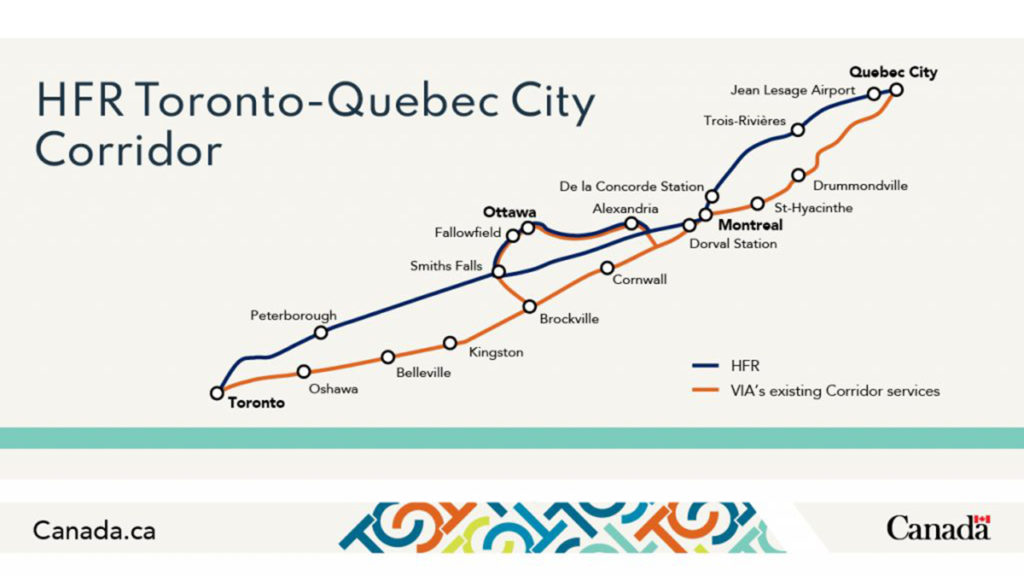
Following a Request for Qualifications (RFQ), which was launched in February 2023 and closed on April 24, 2023, the Government of Canada evaluated four responses from Canadian and international consortiums, and selected in July the following three to advance to the RFP stage:
- Cadence (CDPQ Infra, AtkinsRéalis (formerly known as SNC-Lavalin), Systra Canada, Keolis Canada)
- Intercity Rail Developers (Intercity Development Partners, Kilmer Transportation, First Rail Holdings, Jacobs, Hatch, CIMA+, First Group, RATP Dev Canada, Renfe Operadora)
- QConnexiON Rail Partners (Fengate, John Laing, Bechtel, WSP Canada, Deutsche Bahn)
According to Transport Canada, the launch of the RFP “is a major step in the procurement process that consists of a series of milestones and selecting a private developer partner to design and develop the HFR project.”
The participating consortiums will have approximately nine months to develop their proposals. Following a three-month evaluation period, the selected consortium is expected to be announced in late fall 2024 and will work collaboratively with VIA HFR to design and develop the HFR project, a “transformational project that will fundamentally change the way Canadians travel in southern Québec and Ontario, notably for communities who will be newly served by passenger rail service such as Trois-Rivières and Peterborough.”
The entire procurement process is overseen by a Fairness Monitor, an independent consultant who acts as an objective, third-party observer, and monitors the procurement process to ensure that it is conducted in a fair manner, consistent with the process set out in the RFQ and RFP.
Following the RFP process, a private developer partner will be selected based on their demonstrated capacity to deliver the HFR project with the best value and benefits for Canadians, according to Transport Canada. They will be asked to present their analysis for two technically and commercially feasible solutions, along with a business plan and management plan for the co-development, construction, and operations phases of the project.
The first solution will have trains traveling faster than existing VIA Rail speeds at up to 200 kilometers per hour. Currently, VIA Rail trains can travel up to a maximum speed of 160 kilometers per hour, with operating speeds of 60-120 kilometers per hour, depending on the segment. The second solution will include high speed segments to achieve even shorter trip times.
This approach, Transport Canada says, will allow for a rigorous assessment of the benefits and costs of high-speed rail segments to determine whether and how they should be integrated into the HFR project.
The Government of Canada will also be looking for:
- How the solutions meet or exceed the project outcomes.
- Understanding of the project and its associated risks.
- Partnership and collaborative strategies for Indigenous Peoples; and readiness and capacity to proceed.
This strategy, Transport Canada says, “will drive respondents towards the maximization of project outcomes, while considering the cost-benefit trade-offs of alternatives for meeting or exceeding project outcomes.”
“The launch of the Request for Proposals for the High Frequency Rail project marks a significant milestone,” said Minister of Transport and Quebec Lieutenant Pablo Rodriguez. “In the future, more Canadians will choose to travel by rail, because the HFR will lead to faster train journeys, more frequent departures and greener travel. I look forward to seeing how the teams participating in this process will approach the challenge of connecting communities, honoring Indigenous Reconciliation, and improving travel in the Québec City to Toronto corridor.”
August 2024 Update
The Cadence consortium, led by CDPQInfra, revealed that Air Canada and French train operator SNCF Voyageurs, had joined their HFR bid on the bid deadline of July 24. If successful, Air Canada and its partners would receive a multi-decade operating concession for all VIA Rail’s Quebec-Windsor train service.
Transport Action Canada, which “advocates for passengers and sustainable transport, encourages seamless travel and notes Air Canada’s rail-air partnerships in Europe, said that for an airline to bid on HFR “raises questions about conflict of interest, competition and the transparency of the process.”
Transport Air Canada contacted Public Services and Procurement Canada asking what steps had been taken to address the following concerns:
- “Rail-air codeshares should be available equally to all airlines flying into Canada’s international airports. If one airline owns part of the rail service, safeguards would be needed to ensure fairness.
- “The government may have given Air Canada access to HFR project data that provides competitive advantages over other airlines and VIA Rail.
- “Allowing one of three shortlisted consortia to reveal major changes in its composition only when it was too late for the others to respond was unfair.
- “Various requests for information about High Frequency Rail – including taxpayer-funded studies that would have enabled well-informed public discussion – were rebuffed or heavily redacted over the past decade on the grounds of commercial sensitivity. Either the previous redactions were spurious, or sensitive information has now been made available to a current competitor.”
“The response we received only partially addressed our concerns about future competition and didn’t address our concerns about lack of transparency nor about access to competitive information,” Transport Action Canada stated in a release. Air Canada and Cadence were unable to offer further clarification, citing procurement rules.
“It is crucial that PSPC ensure that the process is fully transparent and fair, especially for a project of this scale that is vitally important to Canada’s future productivity and sustainable prosperity,” Transport Action Canada noted.
“Transport Action Canada regrets that we can no longer be entirely confident that is the case, and calls upon the government to release the maximum amount of information possible for public scrutiny; and accelerate the construction of HFR while reducing the risk premiums and management fees payable to the selected consortium by keeping future operations in the hands of VIA Rail Canada – not another country’s railway, let alone an airline.”
Air Canada, according to a Global News report, said it aims to help with “the harmonious integration of a future intercity rail network with existing airport hubs in the Quebec-Windsor corridor, for the benefit of all travelers.”
FURTHER READING:
Canada to Create Separate Railway for Corridor HFR
VIA HFR: How Viable? How Close?




