According to CHSRA, it is required by Public Utilities Code Section 185033 to prepare, publish, adopt, and submit an updated Business Plan to the California State Legislature on May 1. The statute also dictates that, at least 60 days prior to submittal to the legislature, the Authority must publish a draft Business Plan for public review and comment (download the 2026 version below).
Business plans are published in even-numbered years (click here for the 2024 plan). They represent the status of the high-speed rail program at a point in time, and summarize the Authority’s approach to implementing the system. Business Plans include:
- A summary of progress over the last two years.
- A review of current challenges and how to address them.
- Updated capital cost and other estimates.
- Updated ridership and revenue forecasts.
“Through partnerships, proposed private financing, and legislative changes, the Authority has laid out a clear, cost-effective approach to taking travelers from San Francisco to Los Angeles,” CHSRA said upon the Feb. 28 release of the draft 2026 Business Plan (see map below). “The Authority also envisions creating new revenue streams through real estate development, ancillary projects, and initial fare service that will help pay for the delivery of transformative transportation.”

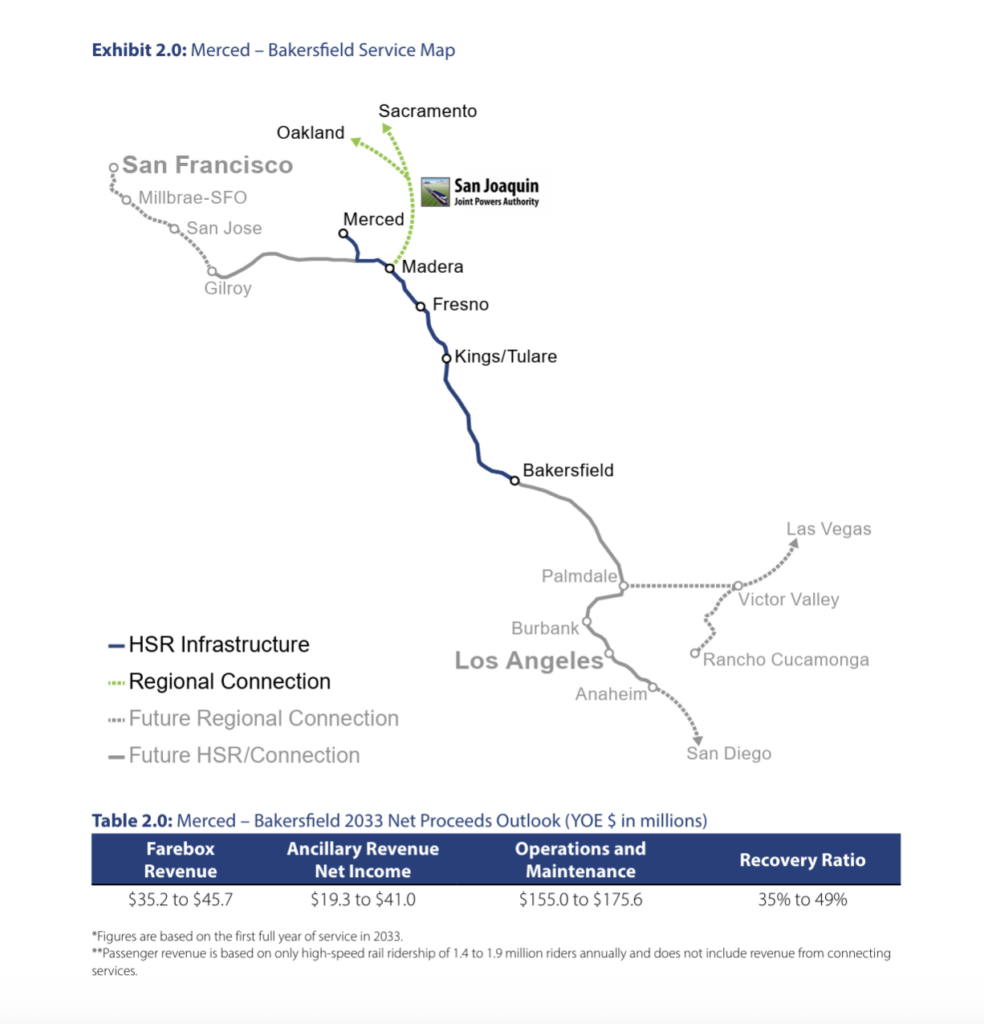
“This 2026 Business Plan sets out the path forward: completion of the [171-mile] Merced – Bakerfield segment [see map below], expansion to major population centers for revenue-positive service, and early asset commercialization to generate additional revenue to build out high-speed rail,” CHSRA CEO Ian Choudri wrote in the plan’s introductory letter. “The plan addresses various policies and implementation tools needed to help avoid construction delays experienced on the 119 miles [spanning Madera, Fresno, Kings, Tulare and Kern counties] where approximately 80 entities held rights of approval and/or permitting. It examines the [Phase I, 494-mile] San Francisco – Los Angeles/Anaheim corridor and lays out a strategy grounded in a realistic delivery schedule, market fundamentals, and disciplined sequencing. It explains how we build from progress under way, prioritize investments that produce early and durable commercial benefits, and create the conditions for long-term financial strength and private-sector participation as the system expands.”
The State of California last month dropped a lawsuit filed against the POTUS 47 administration over the federal government’s withdrawal last summer of $4 billion in funding for the high-speed line now under construction in California’s Central Valley.
California Gov. Gavin Newsom said that the federal government’s decision was illegal and described it as “a political stunt to punish California.” Speaking exclusively to Railway Age sister publication IRJ in November 2025, Choudri said “the impact of the funding withdrawal can’t be overstated.” However, he added that the withdrawal of federal capital would not create a funding gap for the 119-mile Central Valley Section.
Following the decision by California’s attorney general to abandon the lawsuit against the federal government, CHSRA said it will focus on other funding sources, including private-sector equity.
“Accelerating a revenue-positive system, as charted in this 2026 Business Plan, sets the foundation for meaningful public-private partnerships,” Choudri wrote in his introductory message. “With credible revenues to invest against, the private market can bring capital, innovation, and delivery capacity while taking on defined risks that would otherwise sit entirely with the public. Structured properly, these partnerships can accelerate schedules, strengthen cost discipline, and reduce the state’s long-term exposure by shifting defined construction, performance, and revenue risks to the parties best positioned to manage them.”
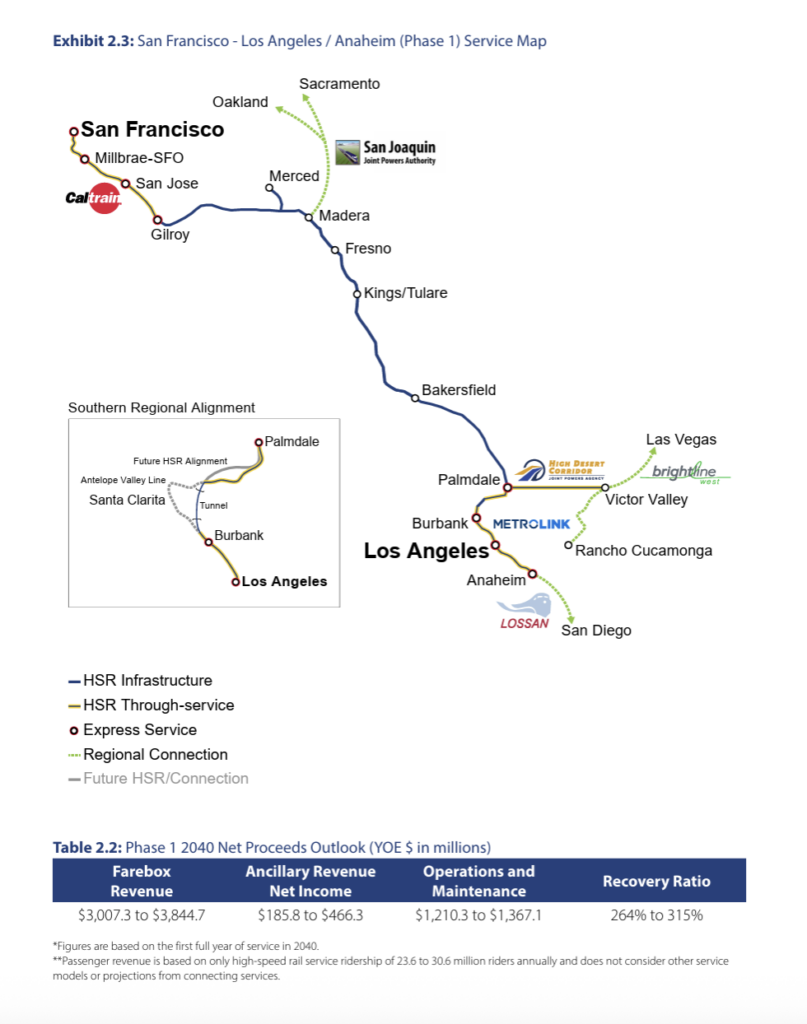
The total cost of completing Phase I’s 494-mile high-speed line between San Francisco and Los Angeles/Anaheim is estimated at $231.3 billion, according to the draft Business Plan.
The 171-mile Merced – Bakersfield segment (M-B)—with construction under way on 119 miles spanning Madera, Fresno, Kings, Tulare and Kern counties—will serve the Central Valley and form the spine of the Phase 1 alignment. The estimated capital costs for the M-B segment, as reported in the draft business plan, have been revised to $34.76 billion, which is a net reduction of approximately $2.0 billion since the 2025 Supplemental Project Update Report cost estimate, according to CHSRA. The Authority said in the plan that it “will release results of its ongoing procurement of high-speed trains and has thus updated the M-B schedule, which estimates a completion date of 2032.” This one-year extension, it noted, “accounts for additional time for optimization and concepts identified in Transforming California’s Future; however, it remains within the Authority’s schedule window.”
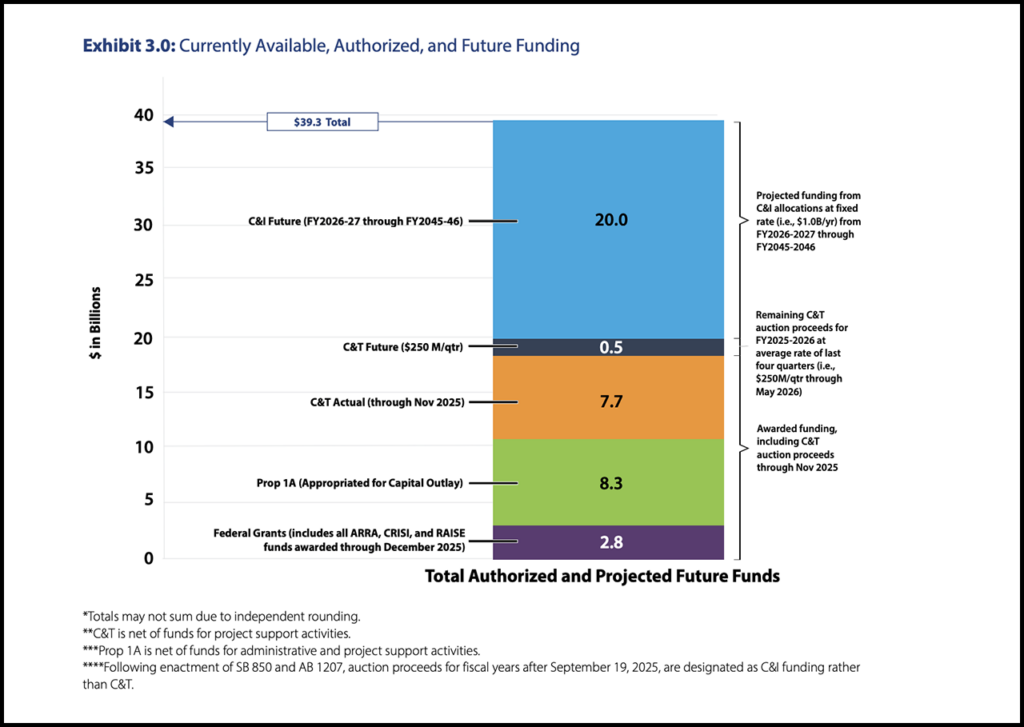
According to the plan, projected annual ridership for the M-B scenario ranges from approximately 1.4 million to 1.9 million, while farebox revenue ranges from $35.2 million to $45.7 million; ancillary revenue is estimated at $19.3 million to $41.0 million. CHSRA reported that ridership is lower than prior estimates “due to several factors including lower train frequency and station locations.” Operation and maintenance costs are forecasted to fall between $155.0 million and $175.6 million annually. Based on these projections, CHSRA said, the recovery ratio is 35% to 49%. The M-B corridor, operating as a standalone high-speed rail line with transfer connections to other rail services, would not generate sufficient revenue to cover its total operational expenses, it noted.
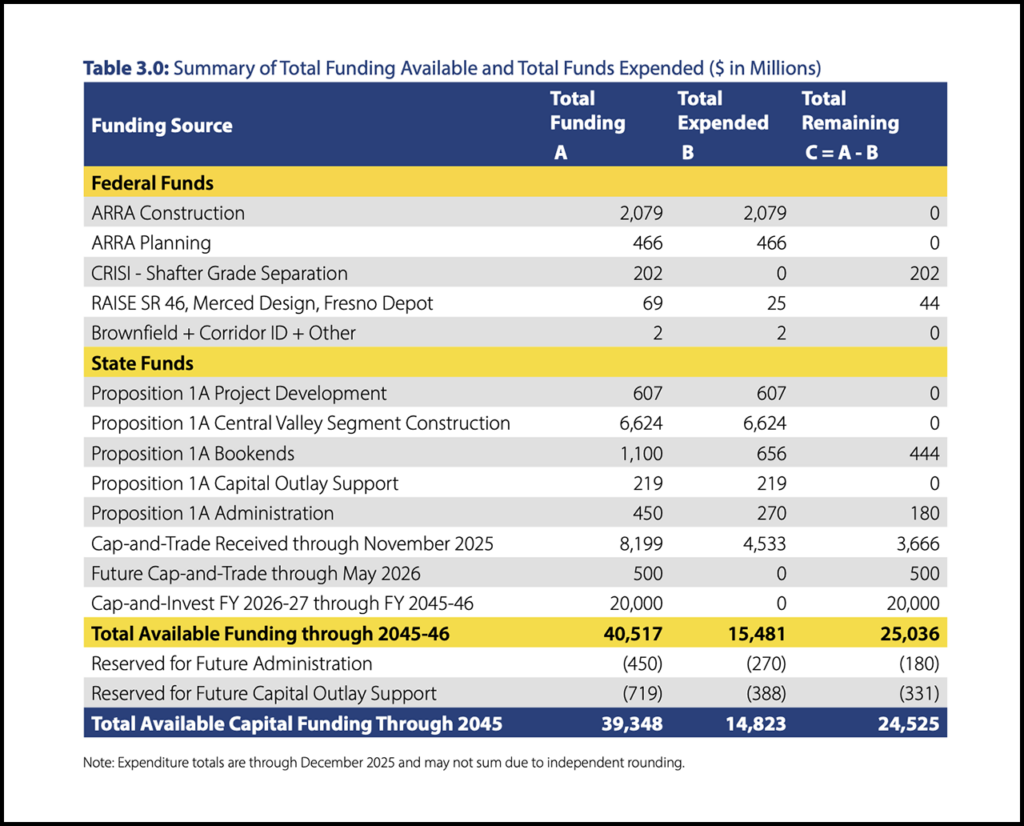
A total of $60.34 billion in capital investments is needed to deliver the San Francisco – Bakersfield segment by 2039, according to CHSRA. “A coordinated state solution, in partnership with regional agencies, will also be required to access and improve the Union Pacific rail line between San Jose and Gilroy,” it reported. “Building on past investments in Caltrain electrification, and in partnership with regional agencies, a joint improvement and electrification of the rail line will be necessary to enable high-speed rail service to reach San Jose and San Francisco. The Authority is prepared to work with state and regional partners to define the extent of the improvements and the additional costs not included in the scenarios, which may range from $2.0 billion to $5.0 billion.”
CHSRA reported that “[o]ptimization efforts show tremendous potential savings of an early-build incremental solution compared to the eventual full Phase 1 buildout as specified in the 2024 Business Plan. The Authority used methods from bottom-up cost estimating to re-estimate the full Phase 1 buildout at approximately $231.3 billion in today’s dollars. The optimized approach … lowers threshold capital investment necessary to reach the Los Angeles basin to approximately $126.2 billion while preserving strong ridership and positive revenue results. This represents $105 billion in program-wide savings, including previously identified savings presented in the 2025 Supplemental Project Update Report.”
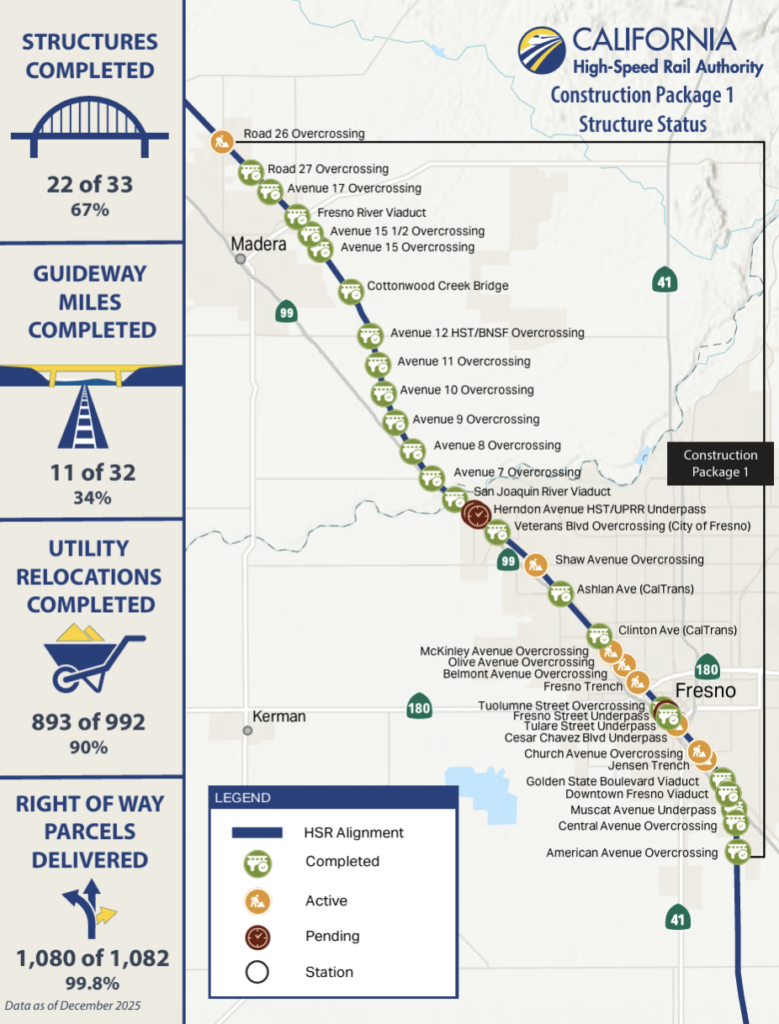
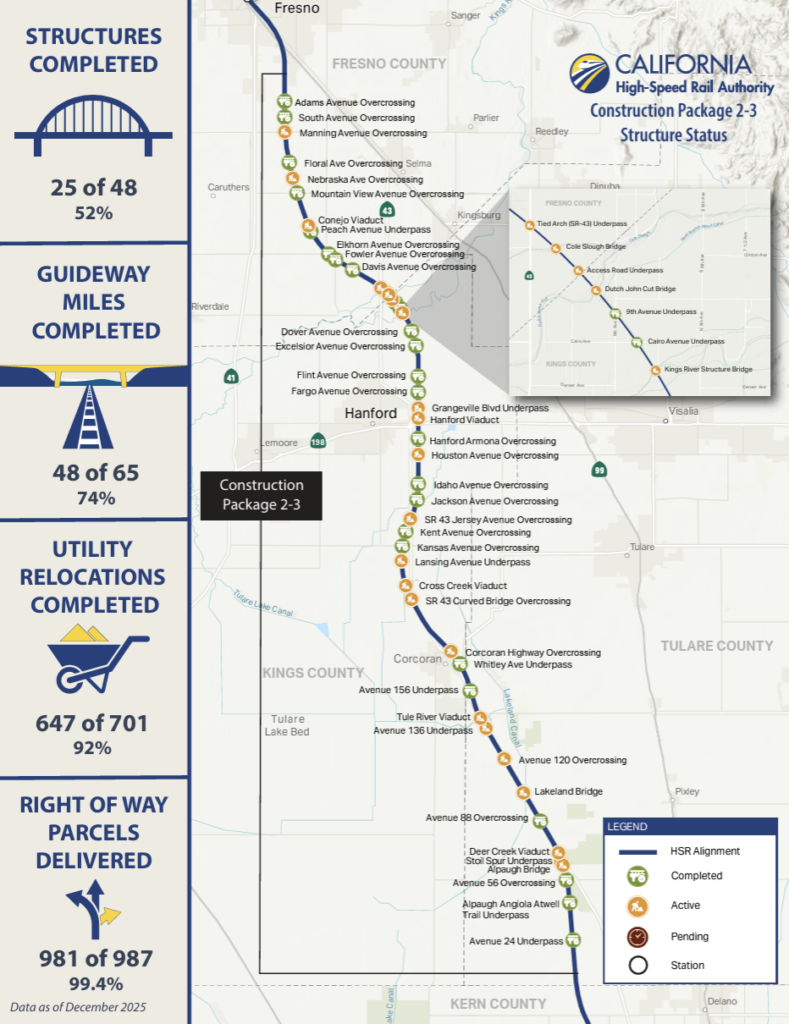
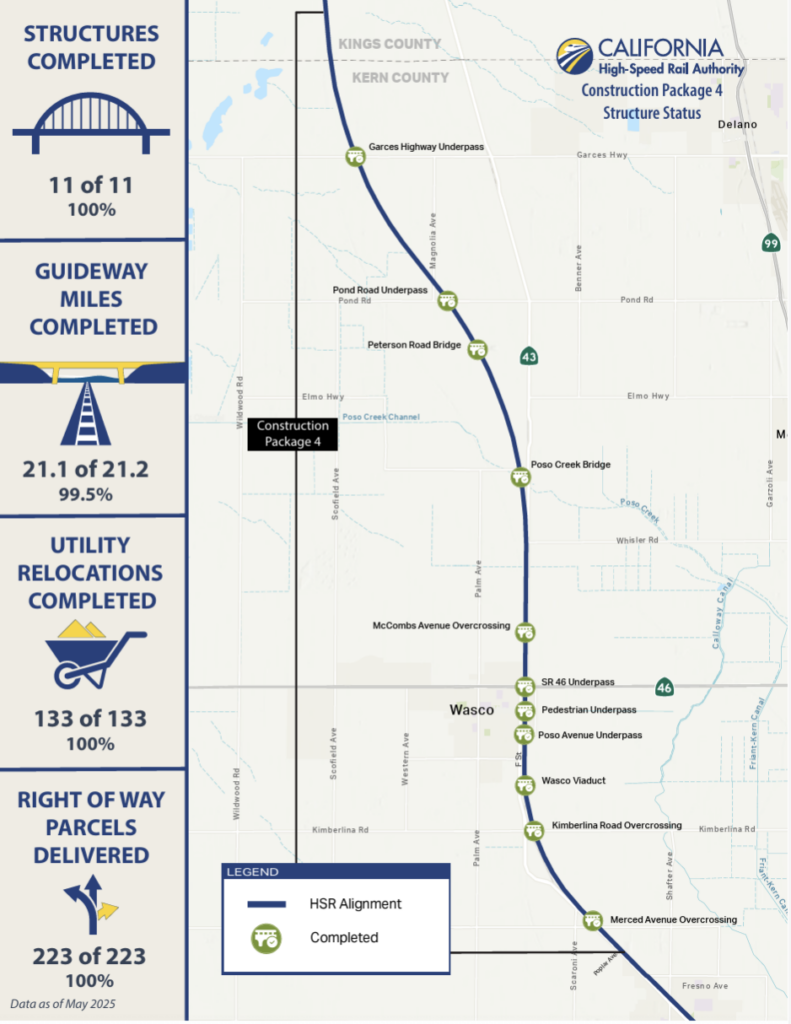
According to CHSRA, work continues daily on the project. Nearly 80 miles of guideway are complete, along with nearly 60 fully completed major structures, and 29 more structures under way across Madera, Fresno, Kings and Tulare counties. The project continues to advance statewide, with 463 miles of the 494-mile Phase I system fully environmentally cleared and construction ready, according to CHSRA. (See construction status maps by structure package above.)
The comment period for the Draft Business Plan runs through April 29. There are four ways to provide comment:
- Online comment form at: 2026 Draft Business Plan Comment Form.
- By email at: BusinessPlan2026@hsr.ca.gov.
- By U.S. mail to the Authority: California High-Speed Rail Authority Attn: Draft 2026 Business Plan 770 L Street, Suite 1180, Sacramento, CA 95814.
- At the March 4, 2026, Board of Directors meeting during the public comment section.