

Finally, nine years after VIA Rail proposed a dedicated passenger rail line for the Toronto-Quebec corridor, outgoing Canadian Prime Minister Justin Trudeau raised a highball for design of the railway by a consortium of suppliers—including its main competitor, Air Canada.
Instead of the HFR (High-Frequency Rail) service revealed first by Railway Age in 2016, Trudeau said the 660-mile (1,000-km) line, dubbed “Alto,” would be dedicated electrified high-speed rail (HSR), with 300 kph (186 mph) trains operating between Toronto and Quebec City, with stops at Peterborough, Ottawa, Montréal, Laval, and Trois-Rivières. It would be implemented as a DBFOM (design-build-finance-operate-maintain) project.
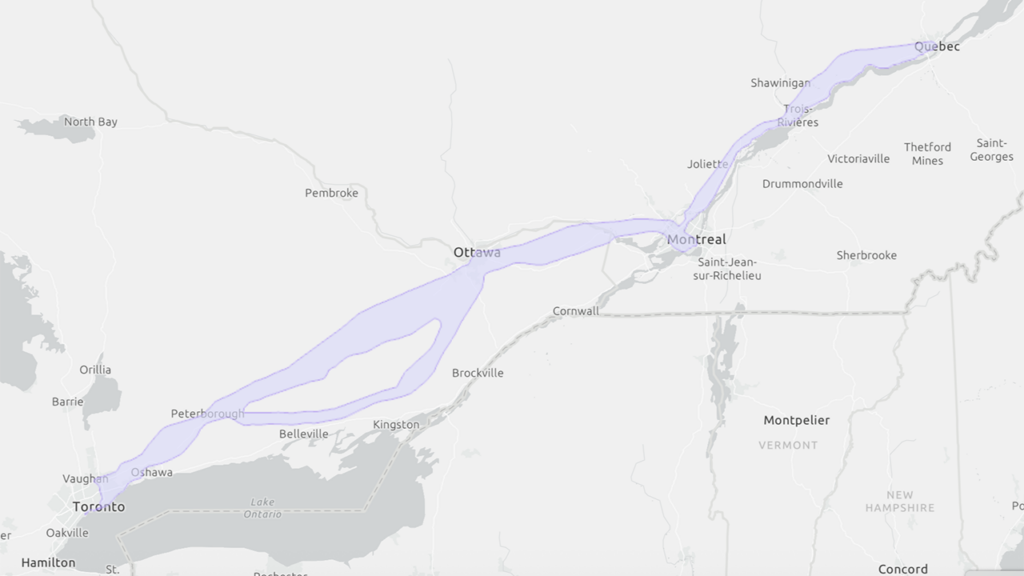
The winning design consortium, called Cadence, consists of the Quebec pension fund’s CDPQ Infra, AtkinsRéalis (formerly SNC Lavalin), Keolis, SYSTRA, Air Canada and SNCF Voyageurs, the Prime Minister announced Feb. 19: “Cadence has been carefully selected to not only co-design and build, but also to finance, operate and maintain this project. Cadence is a consortium of world-renowned companies with expertise and know-how in the design, development, and operation of large-scale transportation infrastructure. Cadence will collaborate and support Alto as work begins on detailed design, Indigenous consultations, land acquisition, and the environmental assessments necessary to enable construction.”

The newly announced Alto (until now “VIA HFR) will be a state corporation charged with supervising the Cadence consortium. But the private Cadence will run the trains as well as build the line. Thus, Canada will have two passenger railways spanning the Toronto-Quebec city corridor—Alto and the much diminished VIA Rail that will operate local services in between freight trains along the existing CN right-of-way, as well as its vintage tourist streamliner, the Canadian, between Vancouver and Toronto.
No overall cost estimate for the project was provided, though previous estimates by Transport Canada hit C$80 billion.
As expected, Canada west of Toronto is excluded from modern, federally sponsored passenger rail projects despite the presence of major cities including Winnipeg, Regina, Saskatoon, Medicine Hat, Calgary, Edmonton and Vancouver.
Mollified Trudeau, “Alto will be a truly pan-Canadian endeavor, using expertise and resources from coast to coast.” The design stage will last five years, largely at the cost of the consortium. In the meantime, Alto and Cadence will negotiate a contract setting out the terms of the next phase of the project, “co-development.”
Also in the meantime, there will be at least one federal election as Canada faces the prospect of long-term economic hardship because of tariffs threatened by the United States. That leaves open the real possibility that Alto HSR will hit a fiscal derail before construction starts.




