
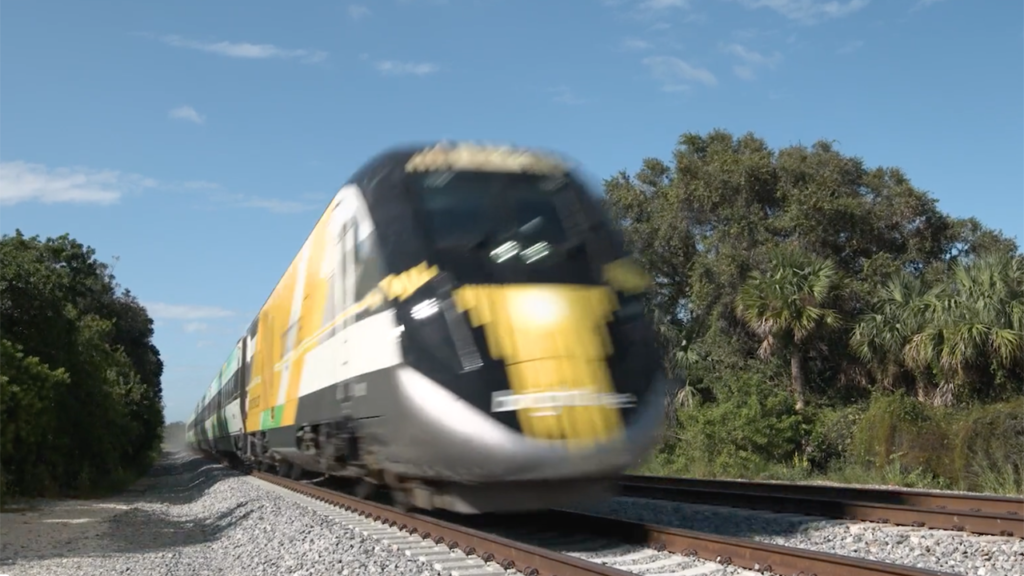
On Sept. 30, I reported on Brightline, the private-sector passenger railroad that currently operates in Florida and is building a high-speed railroad between Southern California and Las Vegas. I examined the company’s financial situation at that time, and it did not look good. There have been more indications of trouble for Brightline since then, including skyrocketing costs for building Brightline West in the Mojave Desert of Southern California and Brightline’s own action of slashing service between its South Florida stations and Orlando Airport.
Despite requesting comment from Brightline about the development I reported at the time, Brightline has not responded. I have asked again and continue to wait for the opportunity to report Brightline’s side of the story. In the meantime, I will examine some of the challenges that now face the nation’s only private-sector passenger railroad, which advocates for the private-sector business model, hoping it will revolutionize rail travel and provide an alternative to the now-dominant public-sector model.
Fewer Trains in Florida
Brightline introduced service between Miami Central Station in the city’s downtown core and Orlando International Airport on Sept. 22, 2023 with great fanfare, as reported by Railway Age Executive Editor Marybeth Luczak with comments by Publisher Jonathan Chalon, who was on board. The trip took about 3½ hours from end to end, and trains ran every hour during a 16-hour service day. There was hope that Brightline was starting something new and impressive. Other early coverage was also enthusiastic, as Editor-in-Chief William C. Vantuono noted in a commentary on Nov.22, which presented a video report by CBS reporter Kris Van Cleave. Brightline was still highly optimistic when I rode and later filed a trip report on April 8, 2024.
The hourly schedule did not last long. On Oct. 6, 2025, two years and two weeks after starting the service, the railroad cut twelve trains between Orlando Airport and the original South Florida part of its route, three-eighths of the prior service on its corridor-length route. Andy Hodges reported the reductions for the Sebastian Daily Oct. 10 in a story headlined: Brightline Reduces Long-Distance Service, Cutting 12 Trains Daily through Sebastian and Vero Beach, a region where it does not stop: “Brightline has slashed its schedule between Miami and Orlando, sending 12 fewer trains each day through Sebastian and Vero Beach as the private rail operator adjusts to rider demand. However, the changes—drawn from rider feedback and data crunching—include beefed-up schedules during busy times, more stops in Boca Raton, and longer trains to handle surging demand between South and Central Florida.” He quoted Brightline CEO Patrick Goddard as saying, “These changes reflect our commitment to delivering a predictable, reliable and comfortable travel experience. We’ve listened to our guests and studied ridership trends to ensure our network evolves with their needs.”
In its “Monthly Revenue and Ridership Report” on its website www.gobrightline.com, Brightline reported: “On Oct.6, we implemented our network planning changes, moving more capacity to higher demand lines through schedule and train length changes and increasing short-distance frequency at commuter times… In September, we temporarily reduced our departure schedule as we reconfigured our fleet for the October network changes, resulting in a 13% year-over-year train decrease in train departures in September”—all without specifically reporting that 6 out of 16 one-way frequencies (3 out of 8 round trips, 37.5%) had been (and remain) eliminated from the Orlando schedule.
It appears that Brightline is heading toward a “commuter rail” scheduling model. On its website, Brightline proclaims a new slogan: “Our Florida on Your Schedule.” The new schedules can be found at https://www.gobrightline.com/train-tickets/new-schedule/orlando-schedule, but they do not appear to comport with Brightline’s slogan.

Between Miami and West Palm Beach, there are 18 daily trains in each direction, with service concentrated in the hours generally considered “peak commuting periods,” with trains running less than hourly at other times, like midday and evening hours. In some instances, the interval between trains is two hours or more. To and from Orlando Airport, there are now only ten trains in each direction, and most of the intervals are 90 minutes or two hours, and the longest is 2:25. That is a significant service reduction, compared to the hourly service that ran for the first two years after Orlando service began.
Besides the quote from Goddard, Brightline touted all sorts of improvements in on Sept. 22: “Brightline, Florida’s higher-speed rail service connecting South Florida to Orlando, announced a series of operational changes designed to optimize the guest experience and respond to evolving ridership patterns. The updates follow two years of full-service operations across the state and are based on extensive guest feedback and data analysis.”
Reducing Operating Costs?
Brightline has touted capacity improvements that come from lengthening trains, making some consists as long as ten cars. Nonetheless, even increasing train consists from 7 to 10 cars, when the railroad places the recently ordered cars into service, would counterbalance more seats per train against fewer trains, running further apart. A quick and approximate calculation (not accounting for fewer seats in premium-class cars than in coaches) shows 43% more seats available on a ten-car consist than a seven-car train. On the other hand, the new schedule allows only 10 daily opportunities to travel between Brightline’s South Florida stations and Orlando Airport, where there had been 16. That means frequencies are reduced by 37.5%, so overall capacity has been reduced to approximately 89% of the amount that was offered during the first two years of service on the entire line, about an 11% loss.
It costs less to run fewer trains than to run more trains, and one resulting disadvantage to the riders is fewer departure times from which to choose. How many riders who have access to an automobile (as many Floridians do) will balk at the additional inconvenience under the new schedule and not bother to wait for more than an hour? That remains to be seen, and a severe service reduction sends a message implying financial difficulty, the impression that the railroad can no longer afford to run the prior level of service, whether that impression comports with the facts. In the present climate, where transit everywhere faces serious financial difficulties with severe service reductions threatened, riders might (and should) be concerned. That also holds for elected officials, investors and financial agencies.
Is Brightline West “Going South”?
Las Vegas, the mecca of gambling and glitz (and back in the day, organized crime), has not hosted a passenger train since 1997. That was when Amtrak’s Desert Wind, which ran on Union Pacific’s route of the historic City of Los Angeles and Challenger trains on a tri-weekly schedule during its last days, ran for the last time. Proposals to run passenger trains between L.A. and “Vegas” since then have not gotten anywhere. More recently, Desert Xpress, which became Xpress West, proposed high-speed trains running between a remote point in the Mojave Desert and Las Vegas on a new railroad to be built along Interstate 15.
Brightline picked up the proposed service, renamed it Brightline West, and added plans to extend it to Rancho Cucamonga on Metrolink’s San Bernardino Line (“Cuca-monga” as Mel Blank through the voices of Daffy Duck, Bugs Bunny, and the train caller at L.A.’s Union Station when Jack Benny was buying a ticket, called it). There is also a plan to extend service to Palmdale: (the High Desert Corridor) on Metrolink’s Antelope Valley Line and with a connection to the California High-Speed Rail (CAHSR) line, if it ever reaches there. While some commentators have criticized the plan for not going directly to L.A. Union Station, that criticism does not appear to have strong merit. If Brightline West can reach Cucamonga, Palmdale or both, it should be feasible for trains to continue to Union Station by agreements with Metrolink and the host railroads: BNSF for Cucamonga and UP for Palmdale. Even without through service to downtown Los Angeles, a two-seat ride with a component on Metrolink allows access by rail to Las Vegas and any intermediate stops that Brightline West chooses to establish. Unlike previous proposals to run only between Las Vegas and somewhere in the middle of the desert, Brightline West would allow the many non-motorists in the Los Angeles area (whose numbers have grown in recent decades on account of the expanding rail transit network on L.A. Metro and improved bus transit in and near the city), as well as motorists who choose to make the trip to “Vegas.” The issue now becomes whether Brightline West can “make the grade” both physically and financially.
High-speed rail (HSR) is common in Europe and parts of Asia, specifically China and Japan. It is currently not operating anywhere in the Western Hemisphere, although Brightline West proposes a genuine HSR operation. It would be the first such operation on the North American continent. True HSR is expensive to build, and the engineering required to provide the gentle curves and grades requires very close tolerances. Construction is also governed by similarly close tolerances, which makes it expensive, as well.
In Vantuono’s commentary cited above, he quoted Railway Age Contributing Editor Bruce E. Kelly as speculating: “After the go-ahead was recently announced for Brightline to build between Las Vegas and Rancho Cucamonga (some 50 miles east of Los Angeles) with the majority of the line being within the Interstate 15 right-of-way, I wondered how that would work through Cajon Pass, where a breach between the San Gabriel and San Bernardino Mountains provides steep but manageable rail and road passage from the Mojave Desert into the L.A. Basin and its surrounding suburbs. Of the existing BNSF and Union Pacific main tracks through Cajon Pass, three have maximum grades of approximately 2.2%, with a fourth line reaching 3%. But the steepest parts of I-15 are posted for 6%. Can high-speed rail (HSR) handle that? A quick, rudimentary check of the topographic contours surrounding the steepest stretch of I-15, where the east- and west-bound lanes separate just below Cajon Summit, suggests Brightline might be able to apply enough curvature to keep its maximum grade just below 4%. Some HSR lines in Europe are said to have maximum grades of 4%, and a section of the Chinese-built high-speed Quinghai-Tibet Railway is said to reach 5.2%.”
Even if Brightline West’s engineers can make the physical ruling grade on the new line, there remains the challenge of “making the grade” in a financial context. Vantuono’s Thanksgiving commentary include a map of the proposed line that bore the words “$12B EFFORT.” Can a company that reported a loss in excess of $500 million last year attract enough investors and persuade them to come up with that much money? Probably not. At the time Luczak reported on the groundbreaking for the project on April 22, 2024, the cost was still set at $12 billion: “In December 2023, the Brightline West, in partnership with the Nevada Department of Transportation (NDOT), was awarded a $3 billion grant from the Federal Railroad Administration (FRA) through the Federal-State Partnership for Intercity Passenger Rail Grant program. Additionally, last June the San Bernardino County Transportation Authority received a $25 million RAISE program grant from the U.S. Department of Transportation (USDOT) to fund the final design and construction of two Brightline West stations and associated facilities in Hesperia and in the Victor Valley of San Bernardino County. The rest of the project will be privately funded, according to Brightline West, which has received a total allocation of $3.5 billion in private activity bonds from the USDOT.” The numbers that Luczak reported do not add up to the $12 billion needed.
To make matters worse, inflation has raised the cost of building the line, a fact that even members of the public would know without having to research the numbers in the Producer Price Index. On Oct. 2 of this year, Railway Age Senior Editor Carolina Worrell reported that a Bloomberg report said that the cost to build the Brightline West project had risen to $21.5 billion and “according to the U.S. Department of Transportation (USDOT) website, which lists Brightline West as a ‘loan applicant,’ and as reported by Bloomberg, the price tag for the private high-speed passenger railroad has swelled by nearly 35%. The higher cost has led the Fortress Investment Group-backed company to seek $6 billion from the POTUS 47 Administration… “Brightline West’s 218-mile railroad from Southern California to Las Vegas will now cost $21.5 billion, $5.5 billion more than the initial projection of $16 billion, according to a Bloomberg report.”
According to Worrell, Brightline CEO Mike Reininger acknowledged that costs are rising, and is working on raising the needed funds. She reported: “According to the report, the federal loan ‘will take the place of a $6 billion bank facility on Brightline West’s original financing plan.’ The company, Reininger said, ‘plans to raise equity to cover most of the $5.5 billion increase in construction costs. It initially targeted an equity raise of $1 billion.’” Worrell also noted that U.S. Transportation Secretary Sean Duffy had bashed the CAHSR project.
Concerning the financing itself, Worrell reported: “Prices on Brightline West bonds issued by the California Infrastructure and Economic Development Bank ‘declined [Oct. 1] following the disclosure of the railroad’s rising costs. Bonds with a 9.5% coupon traded at an average of 87.3 cents down from 91.6 cents on Sept. 23, the last time the securities changed hands. The spread, or risk premium, on the bonds compared with AAA-rated municipal bonds widened to an average of about 900 basis points from 825 basis points,’ according to the report.”
I don’t know at this time whether Brightline West managers can raise the money to pay for building a line whose cost is now estimated at $21.5 billion, when it was previously estimated at $12 billion, an increase of 79% from levels cited only 19 months ago. It seems reasonable to expect that such a financial feat will not be easy.
The CBS report by Kris Van Cleave, included in Vantuono’s Nov. 22, 2023 report, contained a comment by Former USDOT/FRA NECIP (Northeast Corridor Improvement Project) Director and World Bank Railways Advisor Lou Thompson, who has been on the rail scene since before Amtrak was founded in 1971. Thompson, identified in the report as “California High Speed Rail Peer Review Group Chairman,” told CBS: “We will never see high-speed-rail without substantial public investment to build it, and we will never see it without a substantial public commitment to operate it.” The CBS report placed Thompson’s comment after remarks from Brightline Chair West Edens promoting the virtues of Brightline West and HSR generally. Brightline West remains far less expensive than the entire CAHSR project, but the question of whether Brightline West can raise the money to build the line remains unanswered.
Other Financial Questions
Returning to the big picture, it does not appear to be a pretty one for Brightline generally. In the meantime, cautionary stories have appeared not only in conservative-leaning publications and the financial media, but also in local reporting from Florida. One example is a report by Steve Thomas on www.veronews.com, dated Aug. 7 and headlined: Brightline: Ridership Up, But Financials Way Off Track, which began: “It has been almost two years since Brightline’s sleek, brightly colored trains began flashing through Vero Beach, and the apocalypse Indian River County warned against in its unsuccessful multimillion-dollar fight to block the train has not materialized.” Indian River County, where Vero Beach is located, had sued Brightline over plans to extend service from the original northern terminal at West Palm Beach to Orlando Airport.
Thomas reported a dichotomy at Brightline: “Its story remains very much a tale of two trains. On one hand, the company has managed against the odds to create a high-tech, high-speed commuter rail line along a major transportation corridor that transports millions of people a year who often give it good reviews. On the other, Brightline’s finances appear ever more dire, and the death toll along the South Florida stretch of its 235-mile route continues to grow.” Regarding the railroad’s financial picture, he said: “A burst of Brightline news in July highlighted the company’s split personality. On the plus side, the rail line reported a 22% increase in riders on the South Florida to Orlando route and a 12% jump in revenue in the first half of the year. At the same time, Brightline failed to pay interest on $1.2 billion in bonds and saw much of its debt downgraded to ‘junk’ status by S&P Global Ratings. That came on top of bond downgrades from Fitch and other rating agencies earlier in the year.” Thomas also went into detail about Brightline’s finances, especially on the debt side.
Two months after Thomas’s report, Brightline eliminated nearly 40% of its Orlando Airport runs. I have reported that Brightline is still doing what it can to improve its finances. Time will tell how successful those initiatives are, but a severe service cut is a yellow aspect at best, maybe leading to red.
“Never Had Any Equity”
“The numbers are coming out just as I simplistically modeled them many years ago,” comments an industry observer and investment expert. “Brightline is a first-class railroad, but it never had any equity. The same thing happened at Florida East Coast. It took Fortress Investment Group 11 years to get back to the profits it had before. Fortress cut costs and forgot service and on time performance—and never put any equity in after the financial crisis took away the investment. Fortress could have made 5x by replacing the equity and riding out the storm. With Brightline, Fortress is expert in real estate. The casino and the real estate were going to make it all work. Fortress has figured out it needs more stops and slower service. How ironic. Where is Brightline headed? To a prepackaged bankruptcy that wipes the debt out and gives the equity to the creditors—following distressed-debt negotiations.”




