![The NTSB observed the inspection and disassembly of wheelset #4 from railcar 7200, which caused the 2021 Washington Metropolitan Area Transit Authority derailment in Virginia. “In accordance with wheelset design, each wheel should have been flush against its bearing when mounted,” NTSB wrote in its January 2023 derailment investigation report. “Before disassembly, the inspection identified gaps between both wheels and their respective bearings: about 0.63 inches for the right-side wheel and about 1.10 inches for the left-side wheel [see above] … The back-to-back measurement was about 55.375 inches, or about 2 inches wider than the maximum design specification.” (NTSB Image)](https://www.v2.railwayage.com/wp-content/uploads/2024/02/lead-1024x576.png)
Canada’s Alto and its private-developer partner Cadence will soon begin outreach to the steel industry in support of the roughly 621-mile (1,000-kilometer) Toronto-Québec City HSR (high-speed rail) project, whose first segment the government announced Dec. 12 will run between Ottawa and Montreal.
Starting with this initial segment will let teams in both provinces—Québec and Ontario—work at the same time, “which means local communities can see benefits sooner, and workers can build the skills needed to expand the network more quickly toward both Toronto and Québec City,” Transport Canada said.
Alto, a Crown Corporation, will begin a three-month consultation process in January, according to the government. Through open houses, virtual sessions, and an online platform, the public will be able to share their views on the corridor.
Construction of the approximately 124-mile (200-kilometer) first segment is slated to begin in 2029.
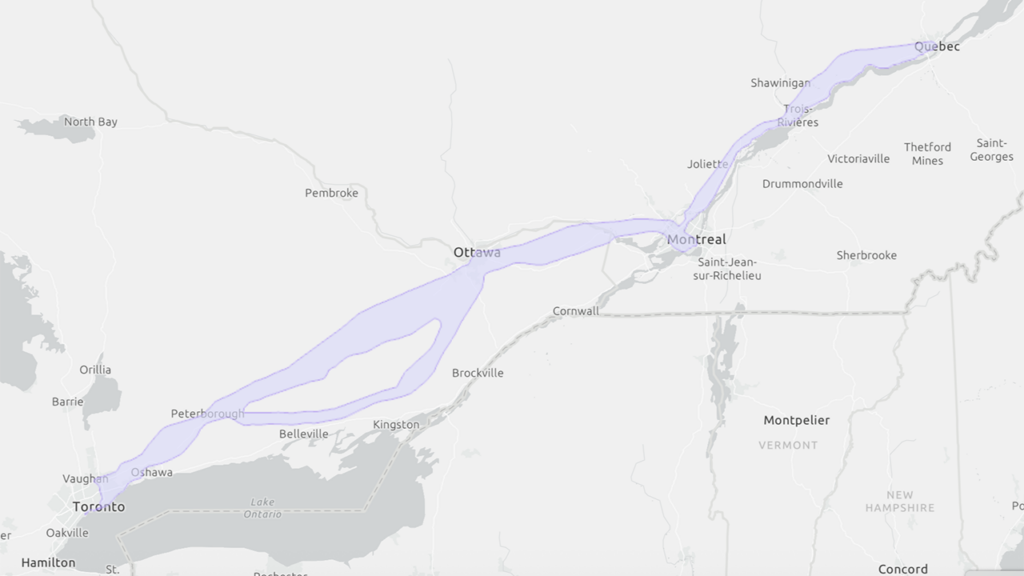
The planned HSR network would offer stops in Québec, Trois-Rivières, Laval, Montréal, Ottawa, Peterborough and Toronto (see map above). Alto earlier this month said it is “weighing several options for the location of a future HSR station in Toronto [including Union Station],” according to a TorontoToday report.
Alto and Cadence in March 2025 signed a development agreement that includes detailed design work, land acquisition, environmental assessments, and consultations with nearby residents, including Indigenous communities.
Instead of VIA Rail Canada’s HFR (High-Frequency Rail) service revealed first by Railway Age Canadian Contributing Editor David Thomas in 2016, outgoing Canadian Prime Minister Justin Trudeau earlier this year said the new line, dubbed “Alto,” would be dedicated electrified HSR, with trains running up to 186 mph (300 kph); it would be implemented as a DBFOM (design-build-finance-operate-maintain) project.
The project is slated to create more than 50,000 jobs during construction, “generate productivity gains that could reach up to C$35 billion annually,” and contribute to cutting greenhouse gas emissions, according to Alto and Cadence, the consortium of Quebec pension fund’s CDPQ Infra, AtkinsRéalis (formerly SNC Lavalin), Keolis, SYSTRA Canada, Air Canada, and SNCF Voyageurs.
On Nov. 18, Alto and Cadence reported that outreach to the steel industry was expected “in the coming weeks.” The goal: “to shape a procurement approach that prioritizes Canadian suppliers.”
Guided by the government’s intent to Buy Canadian, the partners said that key components of the future rail network—including “several hundred thousand tons of steel for high-speed [track], structures, facilities and electric infrastructure”—will be sourced from Canadian suppliers “to the greatest extent possible.”
Alto and Cadence said they will meet with leaders across the Canadian steel industry “to better understand current production capabilities, scaling potential, and opportunities for modernization.”
“Building Canada’s first high-speed rail network will require more than 4,000 kilometers [2,485 miles] of steel rails in addition to massive quantities of structural beams, catenaries, and other core materials,” the partners reported in November. “Few infrastructure projects in modern Canadian history have generated an industrial demand of this magnitude. This scale of procurement presents a rare opportunity for Canada’s steel and manufacturing sectors to expand capacity, accelerate investment, and innovate to position themselves for the opportunities ahead. By sourcing locally where possible, Alto aims to strengthen domestic supply chains, support Canadian jobs, and ensure that the economic ripple effects of this nation-building project are felt across the country.”
Alto and Cadence said the government of Canada has identified the project as “a transformative strategy for the country” that will receive support from the Major Projects Office, enabling the start of construction in four years; pre-procurement activities for project components will commence in 2026.
“Focusing first on the Ottawa–Montréal segment is a logical step to optimize the project, accelerate delivery, and generate tangible local economic benefits,” Alto President and CEO Martin Imbleau said on Dec. 12. “This approach allows us to mobilize teams even more rapidly in both provinces while continuing work on all other segments of the corridor, from Toronto to Québec City. As consultations begin, we look forward to engaging with communities and hearing their perspectives firsthand.”
“This initiative is one of Canada’s largest infrastructure investments in decades,” said Steven MacKinnon, Minister of Transport and Leader of the Government in the House of Commons, on Nov. 18. “It is about strengthening our country by building more here at home. This new High-Speed Rail Network will be transformational. It’s a once-in-a-generation opportunity to connect Canadians in new ways while creating a new industry and high-quality jobs.”
“Canada hasn’t seen an infrastructure project of this magnitude in decades,” Cadence General Manager Daniel Farina said on Nov. 18. “We will need huge quantities of steel, and we want Canadian steelmakers to be ready to respond to request for proposals, because they are coming fast! This is a massive opportunity for Canadian suppliers, and we want to make sure they can seize it.”
“Alto is a nation-building project that will create major opportunities for Canadian businesses,” Martin Imbleau noted on Nov. 18. “We’re inviting the industry to engage early, to prepare, to build capacity, and to modernize to meet the scale of this project, one of the most complex infrastructure builds in Canadian history. The time to get ready is now.”
The National Post of Toronto on Nov. 21 reported that the Mark Carney administration is proposing to grant Alto “sweeping new powers to accelerate the acquisition or expropriation of land for the project,” as part of a new High-Speed Rail Network Act, which it said “also proposes to exclude the massive railway project from review by the Canadian Transportation Agency by deeming it de facto approved and barring the agency from rescinding the approval.” The proposed Act “is tucked away in the hundreds of pages of the Liberals’ bill to implement the 2025 budget tabled Tuesday [Nov. 18],” according to the National Post.
The media outlet reported that the “legislation offers a first glance at how Prime Minister Mark Carney’s government intends to deliver on its commitment to reduce red tape and speed up the building of major projects.” The new Act “contains sweeping changes to how the railway project — estimated to cost between [C]$60 [billion] and [C]$90 billion — will be reviewed all the while boosting the government’s land acquisition and expropriation powers required for construction,” it said. “This summer, the Carney government designated the high-speed railway as a ‘transformative project’ under its new Major Projects Office and promised to cut the time before construction from eight to five years.”
According to the National Post, traditionally, such “major transportation infrastructure projects would be subject to two key reviews agencies: the Impact Assessment Agency of Canada (IAAC) and the Canadian Transportation Agency (CTA). But with the bill proposing that the high-speed rail be automatically deemed approved by the CTA, the project would only be subjected to an environmental assessment by the Impact Assessment Agency.”
Further Reading:
- Canada Dumps VIA Rail Brand for Private ‘Alto’ HSR
- VIA HFR: How Viable? How Close?
- Red-Over-Green for VIA Rail’s High-Frequency Corridor
- Canadian HFR: From Proposal to Project