The Gateway Development Commission (GDC) on July 8 signed a $6.88 billion Full Funding Grant Agreement (FFGA) with the Federal Transit Administration (FTA) for the Hudson Tunnel Project (HTP) and closed on three Railroad Rehabilitation and Improvement Financing (RRIF) loans from the Build America Bureau totaling $4.06 billion to fund the local share of the project. GDC said it has now secured the entire $16 billion commitment needed to complete the HTP, including $12 billion in federal funding, “the largest federal commitment to a rail transportation project in modern history.”
The HTP’s $16.057 billion cost will be split 70/30 between the federal government and the project’s local partners: the states of New York and New Jersey, and the Port Authority of New York and New Jersey (PANYNJ), a financing structure that “saves the local partners multiple billions of dollars compared to the original plan to split the project costs 50/50.”
GDC said the $6.88 billion FFGA, sourced from the New Starts Capital Investment Grant (CIG) Program, “is the largest grant in the history of the CIG Program and the largest single funding source for the HTP.” The federal government has also committed $3.8 billion to the project through USDOT’s Federal-State Partnership for Intercity Passenger Rail (FSP) Program, $292 million from the Bipartisan Infrastructure Law’s Mega grant program, and $25 million through the Rebuilding American Infrastructure with Sustainability and Equity (RAISE) Program. Amtrak is contributing an additional $1 billion. The three low-interest RRIF loans totaling $4.06 billion, will fund the local share and “represent the largest aggregate loan the USDOT has provided through the RRIF program.” These figures total $16.057 billion.
Progress Report
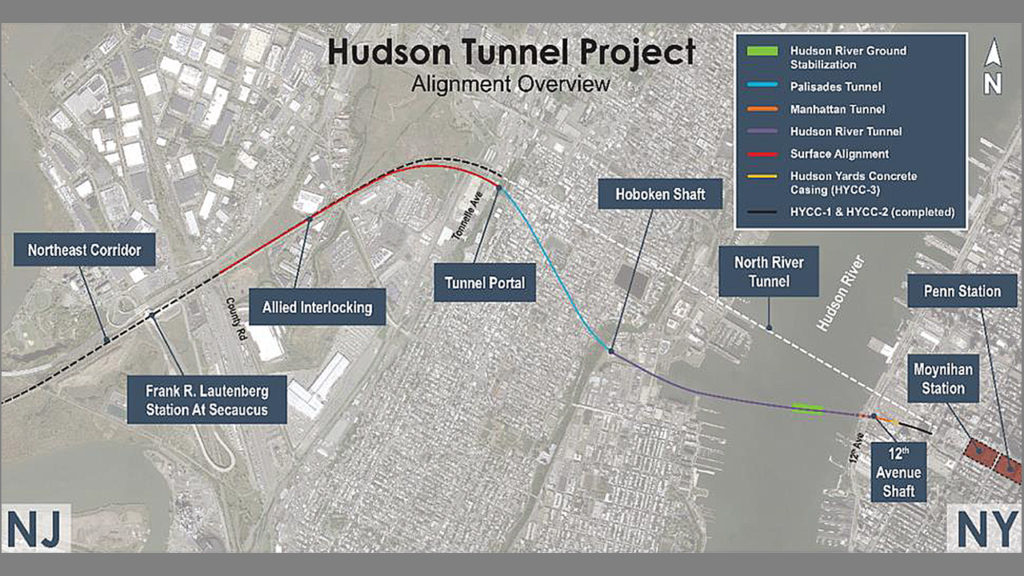
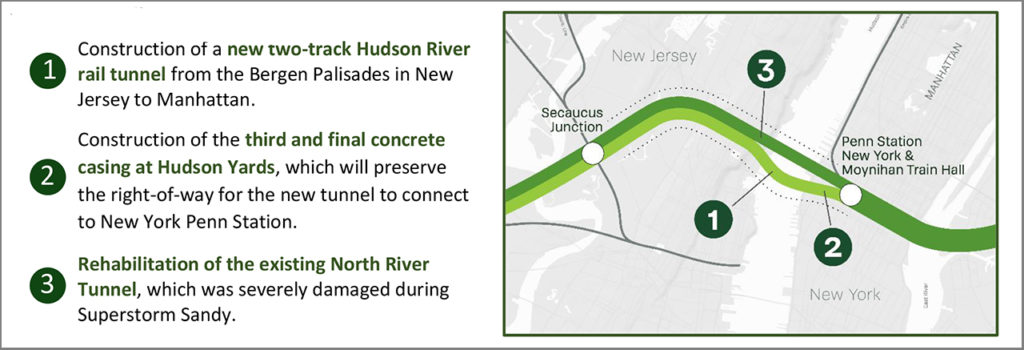
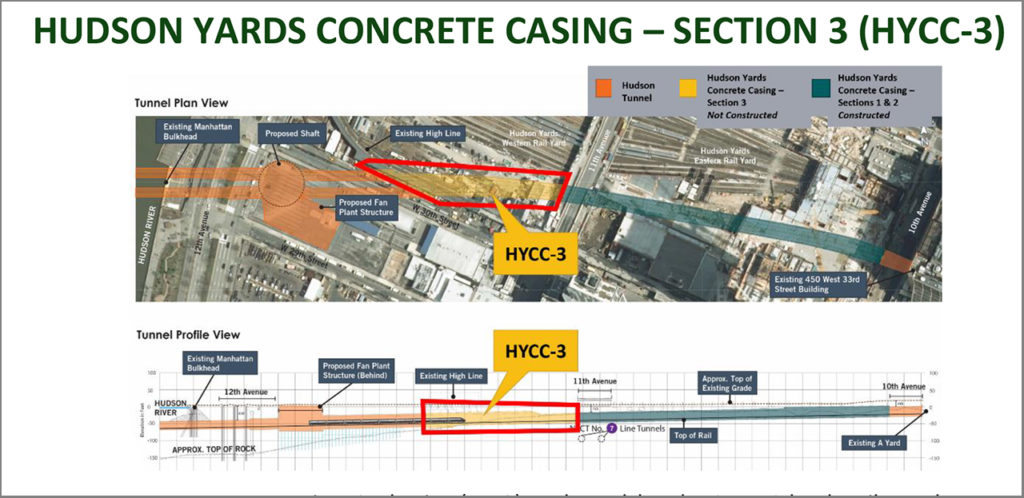
Construction of the HTP started on both sides of the Hudson River in November 2023 “and is expected to create 95,000 jobs and generate $19.6 billion in economic activity,” GDC noted. In New Jersey, the Tonnelle Avenue Bridge and Utility Relocation Project is building a new roadway bridge to allow for a connection to the new tunnel portal and an access point for TBMs (Tunnel Boring Machines). In Manhattan, work is under way on the Hudson Yards Concrete Casing Section 3 (HYCC-3) Project that will preserve a rail right-of-way to link the new Hudson Tunnel to New York Penn Station.
GDC said it can now “move forward with heavy construction and tunnel boring activity.” Heavy construction will begin in the coming weeks with the Hudson River Ground Stabilization (HRGS) Project, which will stabilize the riverbed on the Manhattan side of the Hudson River to enable the TBMs to excavate the new tunnel. The HRGS involves injecting grout into the silt that makes up 1,200 feet of shallow riverbed, then creating columns of soil mixed with cement and water. The end result will be a block of reinforced earth off the Manhattan shoreline “that is ”strong enough for tunnel construction to begin without disrupting the river ecosystem.” The project has two phases:
- Phase One, design and construction of a test cofferdam; bathymetric and geophysical surveying;
identification and removal of obstructions; and completion of a demonstration test program. This phase will be completed in 2024. - Phase Two will use the findings from Phase One to complete the heavy construction portion, expected to be completed in 2027.
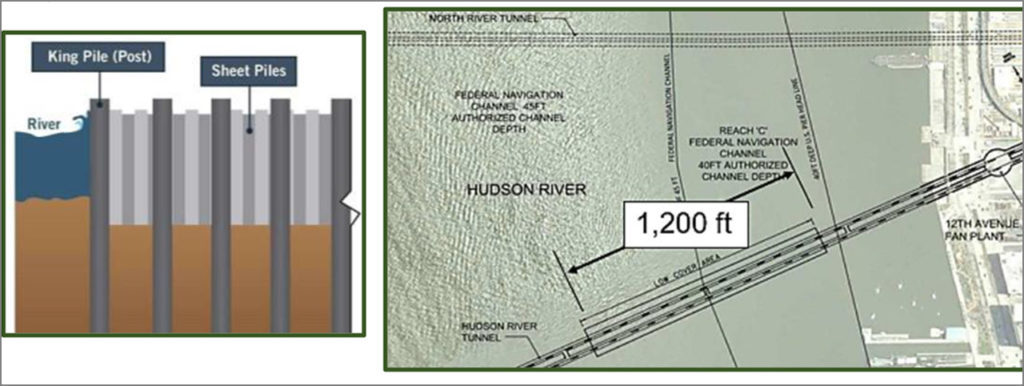
By year-end 2024, GDC expects to have awarded contracts for more than $5 billion in construction activity, including contracts to build sections of the tunnel passing through the Palisades in New Jersey and going through the Manhattan bulkhead under Hudson River Park, and will have ordered the first TBM.
“Today marks the culmination of securing funding for a project that stands as the most consequential undertaking of our generation and for the next 100 years in this region,” said NJ Transit President and CEO Kevin S. Corbett. “The commitment from all levels of government … underscores the profound understanding of this project’s significance. As a primary user of the current tunnels, no one knows better than NJ Transit and our riders about the desperate need for the new tunnels.”
“After years of planning and persistence, the Hudson Tunnel Project’s days of uncertainty are finally behind us,” said Kris Kolluri, GDC CEO. ”For 23 months, we worked tirelessly to complete the funding puzzle for this vital project. Today we have secured the funding needed to see this project through. [W]e navigated the complex FFGA process without missing a single deadline.”
Editor’s Note: The GDC press release announcing the FFGA included more than 1,200 words’ worth of statements from politicians and federal officials. Yeah, we get it: The money wouldn’t have come through without them, but we left them out anyway. Our readers don’t need “the Pope is a Catholic” statements that “make the obvious less obscure,” as my predecessor Luther S. Miller like to say. – William C. Vantuono