Fearless and Driven: Women Train Operators Who Prove You Can Do It

Sandra Romero stands at 5 feet, 6 inches and weighs 150 pounds, but she has the skill to move a 270-foot-long, 1.5-ton light rail train. As a train operator on Metro’s E Line, she transports hundreds of passengers daily from East Los Angeles to Santa Monica.
Sandra began her career at Metro as a bus driver, but eight years later, her curiosity led her to wonder if she could also operate a train. During her training, she learned about the train’s parts and operational system, safety protocols, track signaling, and more. “It was a whole new world. The hardest part was learning radio communication…. I couldn’t understand what they were saying!’” Sandra recalls. But she didn’t give up and passed all the tests.
Ten years have passed since Sandra became a train operator. Today, what she enjoys most about her job, aside from not dealing with traffic, is seeing the excitement in children’s faces when they spot her train. “They smile and wave their little hands to say hello,” she says. However, she emphasizes that the job requires responsibility and constant awareness of speed, the presence of workers on the tracks, and pedestrians and vehicles who might not be following the safety rules.
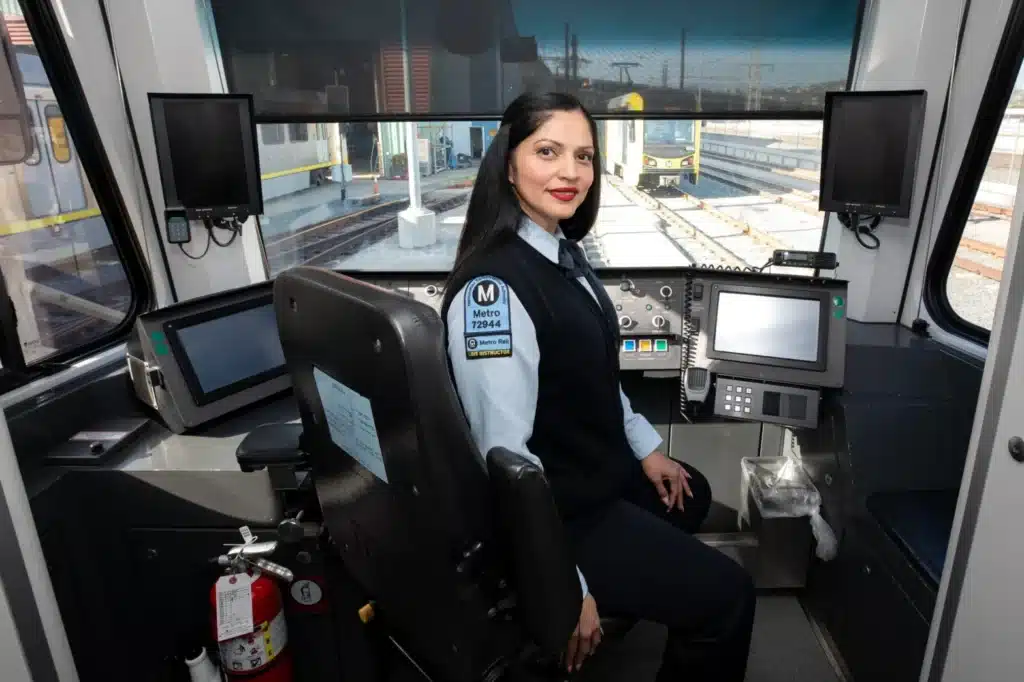
Sandra’s path wasn’t easy, especially in the beginning. When she shared her desire to become a train operator, she received some discouraging comments. “Some told me it was too difficult, and one person even told me I wouldn’t make it,” she recalls. In her training class, only 5 out of 35 students were women. “That can be intimidating, but my curiosity pushed me to take on the challenge and I succeeded,” Sandra says.
Much of her determination comes from her grandmother Victoria, who raised Sandra in El Salvador until she was 11 years old. “She lived through the civil war, had seven children, and taught me how to be a fighter,” Sandra says. That strength has helped her overcome obstacles and defy expectations. “The only person who can stop you is yourself,” she affirms.
Passengers also ask Sandra about her job, especially the challenge of operating such a big train. She usually explains her role and encourages them saying with confidence: “You can’t live with fear, just give it a try!” Her mentor also played a crucial role in her success, guiding her each step of the way and offering encouragement. “Support, not just among women but from the entire team, is key to growth,” she emphasizes.
She adds that if you have a goal, you can be whatever you want to be. “I believe we need to stop thinking of train operations as a man’s job… it’s a job for women too.”
Currently, Metro has 464 train operators, and 139 (30%) of them are women. We want to see that number grow!
Another operator making a difference is Glenda Murrell, who began driving buses for Metro in 1997. Twenty years ago, she decided to challenge herself and become a train operator, too. “It was during a class at Metro that two supervisors encouraged me to give it a try, and here I am,” she recalls. “When I passed the course, my family was so proud… My dad was elated.”
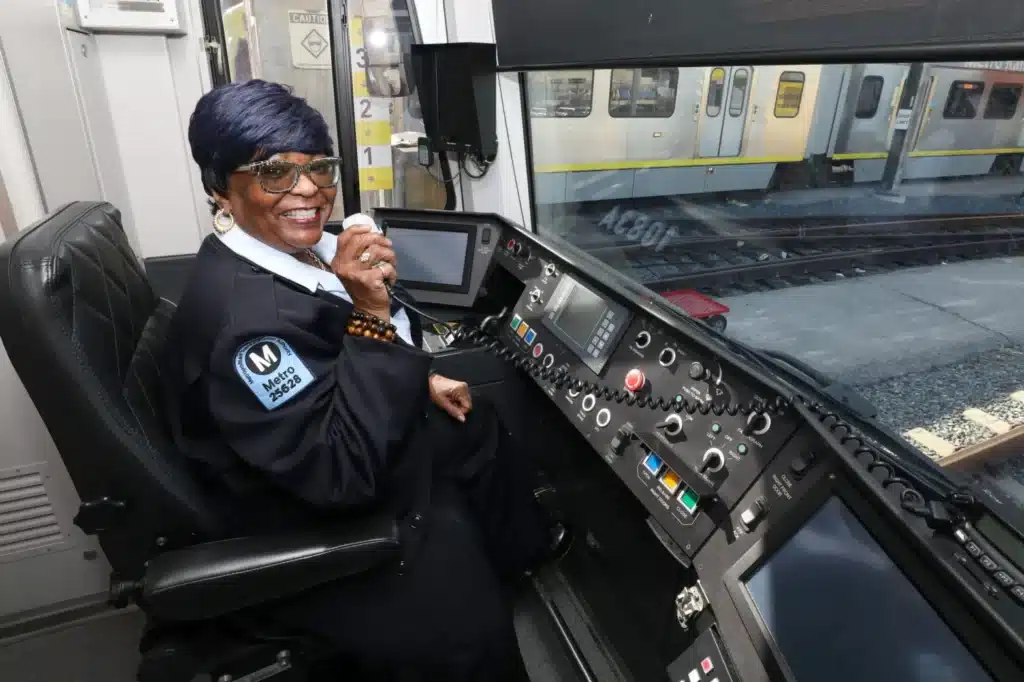
The training was challenging, but Glenda always believed that you could achieve whatever you set your mind to. “Give yourself confidence, and above all, give yourself the opportunity to try,” she says.
Today, what Glenda enjoys most about her job is the connection with her passengers. “I know several by name. There’s even one who calls me ‘mama,’” she says. “I met him when he used to take the train with his toddler, and now that child is 11 years old.”
Glenda has been named Employee of the Month at least twice and has participated in the Rail Rodeo, a competition that tests operators’ skills. For her, proving you can do your job well is crucial to overcoming the challenges of being a woman in this industry. “The best thing is to learn as much as you can and be prepared,” she says.
Despite being a train operator, Glenda never loses her personal style. “I always wear makeup, perfume, and sometimes pearls. And my shoes are always shiny,” she says with her characteristic smile. “This isn’t just any job,” the mother-of-three asserts. “Being in charge of a train is something special.
”Sandra and Glenda, who are both colleagues at Division 21 in DTLA, agree that sharing their experiences and starting conversations about the lives of train operators is important to motivating other women to join the transportation industry. “Seeing other women do what you want to do is important; seeing that there is representation,” says Sandra.
Women are making a significant impact at Metro. To learn more about job opportunities, benefits, and careers, visit: Metro Careers.