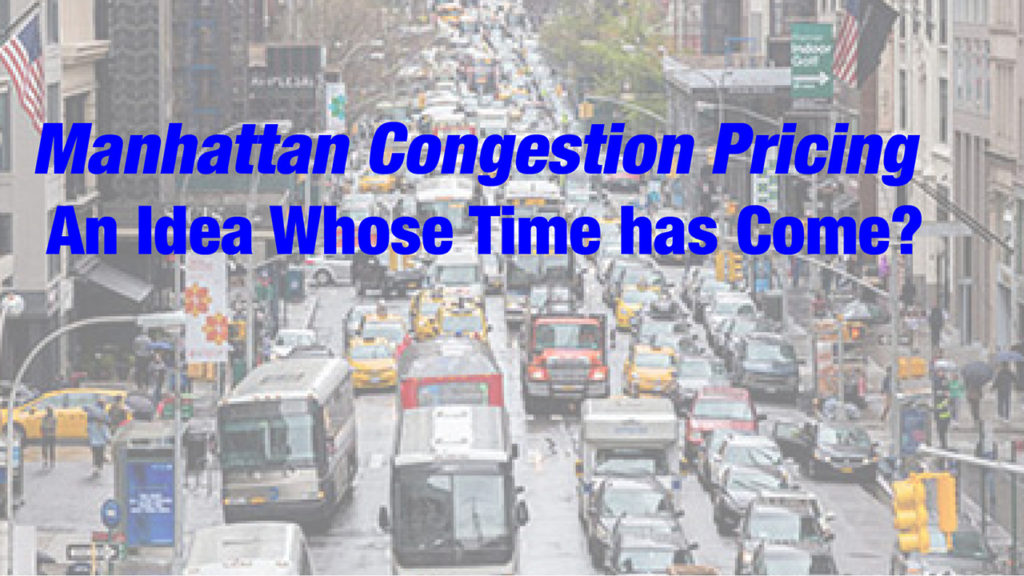
After “pausing” the implementation of a proposed Congestion Toll for vehicles entering the zone south of 60th Street in Manhattan on June 5, Gov. Kathy Hochul has again recommended that the toll be collected. This time, the implementation date is set for Jan. 5. The rules would be the same as in the original proposal that was set to go into effect on June 29, although the tolls would be 60% of those originally proposed.
The base rate for passenger automobiles would be $9.00 per day to enter the “Central Business District (CBD) of Manhattan, defined as the area from 60th Street south, but not including the highways ringing the island in the tolling zone. The toll during overnight hours (9:00 PM to 5:00 AM on weekdays and 9:00 AM on weekends) would be $2.25. The original rates were $15.00 and $3.75 respectively. The tolls for other vehicles, such as trucks, motorcycles, and charter and tour buses, would be reduced accordingly. Buses running scheduled service, school buses, certain vehicles transporting persons with disabilities, and emergency vehicles would be exempt.
There would be an exception to the “daily fee” for taxis and other “for hire” vehicles. Yellow cabs, green cabs (which primarily serve the “outer boroughs”), and black livery vehicles will be subject to a charge of 75¢ per trip, while other “for hire” vehicles (such as Uber and Lyft) will be charged $1.50 per trip. There would be a $3.00 credit for passenger automobiles (proportional for other vehicles) entering Manhattan from tunnels that charge tolls (including the Holland and Lincoln Tunnels from New Jersey), but it would not be offered during overnight hours. Low-income New Yorkers could also apply for a 50% discount that would become effective after the first ten trips during a calendar month.
The MTA Board approved the plan on Monday, Nov. 18. According to a report by Marcia Kramer aired later that day on CBS-2, there was only one dissenter, David Mack. He represents Long Island and has had a career in law enforcement and real estate investment. He suggested that, instead of implementing the congestion toll, the City should step up enforcement of parking regulations to help relieve congestion by eliminating double-parking, and that tolls should be implemented on bridges and tunnels within the City that do not have them.
When she “paused” the implementation of the plan this past June, Hochul said that the original fee schedule would be a burden on many motorists, and she has reduced the tolls. Those reductions are slated to be temporary. Plans call for an increase to 80% of the original schedule in 2028 ($12.00 for passenger automobiles at most times and $3.00 during overnight hours), and the full amounts from the former proposal ($15.00 and $3.75 at overnight hours) would be collected beginning in 2031.
Opposition Remains Strong
Opposition to the plan remains strong among groups and elected officials representing communities where most residents are motorists who would be subject to the toll, both in New Jersey and on the New York side of the Hudson River. These places include the city’s outer boroughs and suburban areas. In a relatively rare show of bipartisanship, Democrats (especially in New Jersey) and Republicans (especially in New York State) have demonstrated their opposition to the plan and have fought it in court, with cases in federal courts for the District of New Jersey and the Southern District of New York.
Four WNYC reporters covered Hochul’s announcement in a Nov. 13 report in Gothamist: “In pausing the program, Hochul claimed the tolls would be too costly for drivers who were already wrestling with inflation. Two sources said the governor was asked by congressional Democratic leaders to hold off on launching the tolls until after the election in hopes of winning competitive House races in the city’s suburbs.” In this term, Democrats held 16 seats to 10 for Republicans, including three where Democrats hold a slight registration advantage. Democrats gained three seats in the recent election, but it was not enough to prevent Republicans from keeping their majority, and they will control all branches of government. The President-elect has vowed to kill congestion pricing once he takes office, but transit advocates say he will have a harder time dismantling the tolls if they launch by the time he takes office. Local Republicans have vowed to challenge the program.”
The President-elect is not the only Republican who opposes the tolling program. The Gothamist report also said: “On Wednesday [Nov. 13], five Republican Congress members from New York sent a letter to [the President-elect] asking him to permanently halt congestion pricing in Manhattan by rescinding Federal Highway Administration approval.” Of those five, four will remain in office for the next two years. The report quoted them as writing: “Congestion pricing, the latest in a long string of tyrannical taxes, has been pressed forward through consistent opposition about the burden on New York families and workers.” In actuality, the toll would be a user fee, and not a tax, because it would not apply to everyone, but only to the motorists who decide to use their vehicles to enter the tolling zone.
Democrats control politics in New Jersey, and Garden State elected officials continue to oppose the toll. A Nov. 14 report in the New York Post that highlighted the opposition to the program quoted Gov. Phil Murphy on the subject: “All of us need to listen to the message that voters across America sent last Tuesday, which is that the vast majority of Americans are experiencing severe economic strains and still feeling the effects of inflation,” he said. “There could not be a worse time to impose a new $9 toll on individuals who are traveling into downtown Manhattan for work, school or leisure.” Congressman Josh Gottheimer, another vocal opponent of the plan, said: “I’m ready to fight the congestion tax yet again, to protect Jersey families from more taxes and cancer-causing pollution.”
Legal Battles Continue
Since Hochul “paused” implementation of the program last June, we have covered several major developments, especially concerning the court cases filed both by plaintiffs who are suing to prevent the toll from being implemented and those suing to force implementation as a statutory obligation.
We reported Hochul’s action in Part 12 of this series, most recently updated on June 27 and including a commentary that delved into the politics of her action of flipping the switch to OFF. Part 13 on Sept. 20 reported on Judge Lewis J. Limon’s comprehensive decision in the set of cases consolidated in the Southern District of New York, that challenged the decision by federal highway officials that approved the congestion toll in the first place. While Limon left one issue unresolved, he held that the defendants had acted properly concerning the other issues, effectively approving the tolls.
Meanwhile, the case filed by Gov. Murphy and other plaintiffs in the District of New Jersey has not yet been resolved. It was expected that Judge Leo M. Gordon would issue a decision in June (in advance of the proposed implementation date later that month), but that has not happened. Presumably Hochul’s decision to “pause” implementation, the case could have become moot, but her decision to flip the switch to ON will probably bring it back to life. In Part 15 on Sept. 26, we reported that lead counsel Randy Mastro (the State is not represented by the Attorney General’s office) had raised a new argument, based on a case decided by the DC Circuit Court, concerning a port in Texas. We will report Gordon’s decision, if and when it comes down.
Meanwhile, as we reported in Part 14 on Sept. 26, proponents of the tolling program sued to compel the State to implement it. In one case, the City Club of New York said that the State has an obligation to implement the program under the Traffic Mobility Act of 2019, which established the tolling program in the first place. The other case, brought by Riders Alliance, challenged Hochul’s “pause” primarily on environmental grounds, under the State’s Climate Leadership and Community Protection Act. Gothamist reported: “‘They should be able to stand this up relatively swiftly,’ said Justin Balik, a state program director with the environmental group Evergreen Action, which filed an amicus brief supporting congestion pricing in one of the lawsuits. ‘The governor’s team has thought about this carefully. The MTA has thought about this carefully. All the environmental work under NEPA has really been done already. We were ready to go as folks know before the pause.’”
Will It Be Enough?
The toll was originally supposed to raise $1 billion per year to support the MTA’s capital programs for New York City Transit (80%), and the Long Island Rail Road and Metro-North (10% each). Using that money as collateral for loans, the result was supposed to be an influx of $15 billion per year for those capital programs. None of that money would be spent for transit or railroad operations, but it would be spent for such enhancements as signal improvements, electric buses, and a long-delayed extension of the Second Avenue Subway from 96th Street to 125th Street and Lexington Avenue. In addition, the new funds would pay for more stations to be made accessible for riders with disabilities. The MTA has already postponed several projects because of Hochul’s decision in June to “pause” the program.
Throughout last summer, we reported on the “fiscal cliff” that will threaten operating funding for transit providers around the country, as the temporary money enacted as part of COVID-19 relief runs out. In Part 16 of this series on Sept. 30, we reported on a different “fiscal cliff” that the MTA could face on its capital side without the anticipated revenue from the tolling program.
Assuming that the program is implemented at the beginning of next year, Hochul’s proposed phase-in of the tolls will raise only 60% of the previously anticipated revenue for the next three years and 80% of that amount for the following three. Ignoring net present value calculations, that means the capital program will lose $1.8 billion in direct revenue that would otherwise have been collected. Added to that is half of the amount that would have otherwise been collected this year, or another $500 million. That adds up to of $2.3 billion, which the MTA would have used as leverage to raise $34.5 billion over time.
There is also the question of how effective the proposed lower toll (for the next few years) will be toward the overall goal of reducing traffic congestion in the lower half of Manhattan. The Gothamist article reported: “The lower toll price would save a motorist who drives into Manhattan five days a week $1,500 over the course of a year compared to the prior plan. But Hochul is expected to face questions as to whether the lower toll will discourage motorists from entering the city to reduce congestion in the same way a $15 toll would have, which was a key goal of congestion pricing.”
There are still plenty of unanswered questions, and we will have more to report as the situation continues to play out. In the meantime, it appears that the tolls will start on Jan. 5, unless a court order prevents that. For the time being, at least, Gov. Hochul has again flipped the switch to ON.
“Increased Efficiencies and Narrowed Deficits”
Meanwhile, the MTA on Nov. 19 released its final proposed 2025 operating budget and four-year financial plan (download below) and announced the plan “has identified $100 million in cost savings from increased operational efficiencies. Building on $400 million in cost savings announced in July, this brings to $500 million the total expected annual recurring cost savings projected for 2025.”
“This November Financial Plan remains broadly in line with budget details announced in July,” the MTA said. “The plan forecasted $50 million less in deficits for Fiscal Years ’27 and ’28, totaling $100 million due in part to higher commuter rail recovery and growing vehicular traffic at Bridges & Tunnels crossings. This operating budget funds priority initiatives including the Queens Bus Network redesign, paratransit services, and fare evasion mitigation efforts. The 2025 Operating Budget of $19.9 billion remains 3% below inflation adjusted spending since 2019.
“The operating budget also achieves $400 million in efficiency savings in 2024 and $500 million in 2025. The MTA identified specific savings across all its agencies. New York City Transit efficiencies included implementing a new maintenance system cycle for railcars, more efficient scheduling of crews and consolidation of facility leases. Long Island Rail Road and Metro-North Railroad streamlined equipment maintenance and implemented various energy efficiency projects. And Bridges & Tunnels reviewed staffing requirements and reduced vacancies.
“This plan assumes a 4% fare and toll increase in both 2025 and in 2027. The MTA will rebase ridership projections using the latest ridership numbers to build updated forecasts.”