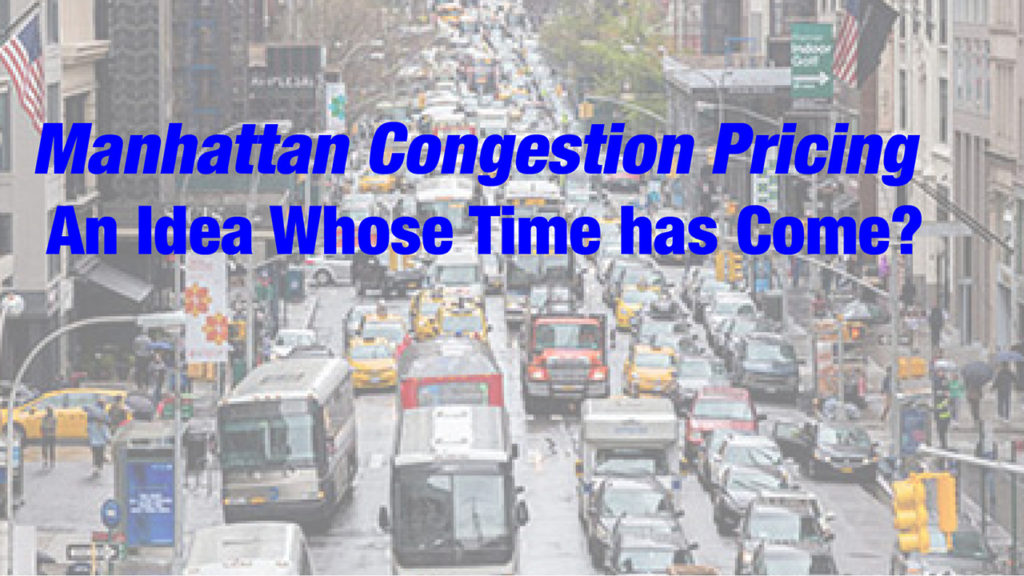
Congestion Pricing, the controversial plan to charge tolls for vehicles entering Manhattan south of 60th Street, came a step closer to implementation when two federal judges from the Southern District of New York denied requests by anti-toll plaintiffs to grant injunctions that would have stopped the Triborough Bridge and Tunnel Authority (TBTA), a subsidiary of New York’s Metropolitan Transportation Authority (MTA), from starting to collect the planned tolls. Both decisions were handed down on Monday, Dec. 23, less than two weeks before the date the tolls are scheduled to go into effect. Barring an injunction in another case, that will happen Sunday, Jan. 5, shortly after midnight.
Judges in two separate cases filed against the plan denied the requested relief. One was Lewis J. Limon, sitting in Manhattan, who had already issued a 113-page opinion on June 20, upholding the basis for the decision by federal highway officials to allow the toll. The other was Cathy Seibel, sitting in White Plains, who had denied a request from Rockland and Orange Counties for an injunction.
In his previous ruling, Limon held that federal highway officials had acted properly when they approved the tolling program. Shortly after Liman issued his ruling, Gov. Kathy Hochul had “paused” the collection of tolls, even though the equipment purchased for the purose had already been installed, so it appeared that the cases filed both against the toll and demanding that the tolls be collected appeared to have become moot. We reported that decision on Sept. 20, essentially for the record. At the time, it appeared that Hochul had “paused” the program to relieve other Democrats, especially candidates for House seats, to campaign without having to defend the toll program, which was and remains highly unpopular outside Manhattan. Democrats in the state picked up some House seats, but losses elsewhere kept Republicans in charge for the next Congressional session. Hochul reversed her June position and reinstated the tolling program in November, this time with a $9.00 base toll for passenger automobiles instead of the former $15.00 price for the next three years, and a $12.00 base toll for the three following years, as we reported on Nov. 19. This reversal gave the court cases renewed relevance, even though the proposed tolls were to be lower.
Standard for Injunctive Relief
Requests for an injunction are rare, and judges do not ordinarily grant that form of relief. The burden that a petitioner must meet to obtain an injunction is a high one. The standard in New York is similar to that of other states. The New York Litigation Guide says that the rule is found in the state’s Civil Practice Law and Rules (CPLR): “A preliminary injunction may be granted under CPLR article 63 when the party seeking such relief demonstrates: 1. a likelihood of ultimate success on the merits, 2. the prospect of irreparable injury if the provisional relief is withheld, and 3. a balance of equities tipping in the moving party’s favor.” The standard used in Federal courts under Rule 65 of the Federal Rules of Civil Procedure (FRCP) is similar: “1. irreparable harm and 2. either (a) likelihood of success on the merits or (b) sufficiently serious questions going to the merits and 3. a balance of hardships tipping decidedly toward the party seeing the injunctive relief.”
The commentary to the above-cited rules says: “‘Such relief, however, is an extraordinary and drastic remedy, one that should not be granted unless the movant, by a clear showing, carries the burden of persuasion.’ A plaintiff’s burden to obtain a preliminary injunction is the same as that required for summary judgment” (citations omitted). As we have reported before, all the cases concerning the Congestion Pricing plan began as requests for summary judgment. Parties requesting it must demonstrate that there are no disputed material facts in the case, and that a judge can decide on the law, after reviewing the facts shown by the exhibits which the parties submit.
In the present cases, the judges could determine the balance of equities between the two sides and determine whether “irreparable harm” would have befallen the plan’s opponents if it were to be implemented, but “likelihood of success of the merits” would have proved to be a high bar, especially because Judge Limon had previously ruled that federal highway officials had acted appropriately.
Manhattan Decision From Judge Limon
As we reported previously, the Manhattan case resulted from the consolidation of three cases, two of which were originally filed in the Southern District of New York (a court based in Manhattan), and the Eastern District of New York (a court based in Brooklyn). There were many plaintiffs in the case as finally consolidated, and the one thing they all had in common was that they opposed the tolling plan. A fourth case was added: Trucking Association of New York v. Metropolitan Transportation Authority, et al., Docket No. 24-cv-04111 (LJL), which was filed on May 24. Elizabeth Chan, first in alphabetical order, became the first-named plaintiff in the caption. As before, Liman’s opinion (download below) was long (111 pages) and thorough. It included the Procedural History, Findings of Fact, and Conclusions of Law. Much of it tracked Liman’s previous ruling in the case closely, so we will concentrate on the issues surrounding his denial of the requested injunction in this report.
After a rigorous discussion of the facts of the case (at 8-25), including a finding that Gov. Hochul’s acts of pausing and later reinstating the tolling program did not change the facts behind the original Environmental Assessment (EA) and Finding of No Significant Impact (FONSI), Limon then stated the appropriate legal standard for granting a request for an injunction (at 25-26). As part of that analysis, he said: “When, as here, the moving party seeks a preliminary injunction that will affect government action taken in the public interest pursuant to a statutory or regulatory scheme, the injunction should be granted only if the moving party meets the more rigorous likelihood-of-success standard” (at 26, citations omitted). He then started the section on Conclusions of Law.
The first prong of the three-prong test for obtaining an injunction is proving likelihood of success on the merits. Limon set out the arguments that the plaintiffs had made in their effort to meet the standard and explained why those arguments failed to do so (at 26-96, or nearly two-thirds of the document). We do not have enough space to present his entire analysis, but we can report a few highlights of it.
Regarding plaintiffs’ arguments that the tolling plan violates the Commerce Clause of the U.S. Constitution, Limon said: “The Commerce Clause contains a dormant aspect that denies the states “the power unjustifiably to discriminate against or burden the interstate flow of articles of commerce. A user fee is reasonable and will not run afoul of the Dormant Commerce Clause ‘if it (1) is based on some fair approximation of the facilities’ use, (2) is not excessive in relation to the benefits conferred, and (3) does not discriminate against interstate commerce’” (at 26-27, citations omitted). He found that: “The definition of the relevant ‘facility’ is not limited to the public transit system that will receive a large portion of the revenues generated by the Tolling Program. The Second Circuit has held that a user fee ‘may reasonably support the budget of a governmental unit that operates facilities that bear at least a ‘functional relationship’ to facilities used by the fee payers.’ Courts in this Circuit have long held that certain bridges, tunnels, roadways, public transit systems and commuter railways may form an ‘integrated, interdependent transportation system’ such that components of the integrated system bear a functional relationship to tolls charged in connection with other components” (at 29, citations omitted). After more analysis of the city’s transportation system, he said: “The subway ‘connects with regional transit hubs in the Manhattan CBD, allowing for connections from other modes’ of transit including commuter rail, buses, ferries, trams, bicycles, and trams, in addition to automobiles. The Tolling Program would cause individuals presently driving within the CBD to utilize other transit options, directly reducing congestion experienced by motorists still driving within the CBD while increasing use of the transit facilities All this supports a finding that the MTA’s transit systems and the CBD roadways form a single integrated system” (at 31-32, citations omitted).
He also noted that nobody had offered contrary evidence. The test at issue concerns uniformity, fairness, and not discriminating against interstate commerce. The opinion held that, in the ISTEA (Intermodal Surface Transportation Efficiency Act of 1991), Congress authorized that toll revenues in excess of the amount needed to keep highways in a state of good repair could be used for non-highway purposes (at 32-38), and that the proposed toll rates were not unreasonable (at 38-47). Limon continued: “As discussed above, the public transit facilities and roads comprise a single integrated transportation system. Use of one part of the system taxes or can benefit other parts of the system. Accordingly, tolls levied on one part of the integrated transportation system may be used to support other components of the system” (at 47). He also found that the tolling plan did not discriminate against out-of-state motorists and in favor of New York motorists, (at 47-55), so it does not violate the Dormant Commerce Clause.
Limon used similar reasoning to demonstrate that the tolling program would not violate the well-established right to travel (at 55-62). He concluded that section by saying: “Plaintiffs do not adduce any evidence that they will be unable to travel and instead show that the Tolling Program represents, at most, a minor burden on the right to travel. Plaintiffs therefore have not shown a likelihood of success on the merits with respect to their claims that the Tolling Program runs afoul of the right to travel.”
There are some areas of law where federal statutes preempt the field by precluding the states from enacting their own regulations. The Trucking Association of New York (TANY, a plaintiff) argued that statutes concerning the Federal Aviation Administration (FAA) and airline deregulation also precluded New York State from implementing the congestion toll in Manhattan. In a lengthy analysis of those statutes and of motor carrier regulation (at 63-84), Liman concluded that the toll was not preempted. He noted that Congress had approved funding for the program (at 87-88) and said: “TANY has not demonstrated a likelihood of success on the merits as to its argument that the Tolling Program is preempted because TANY has not shown that the Tolling Program will have a significant impact on the prices, services, or routes of motor carriers” (at 71).
The recently enacted Green Amendment to the New York Constitution mentions a right to clean air and water, and to a healthy environment, but Limon found that it does not create any new rights that are not already enforced by the State’s environmental laws, so he did not find a violation of the Green Amendment (at 83-90). He also analyzed the rulemaking process under the State Administrative Procedure Act (SAPA) and did not find that the tolling plan would violate it (at 90-96).
Another prong of the test for an injunction is that “irreparable harm” will occur to the plaintiff(s) if the injunction is denied. Limon found that the plaintiffs did not demonstrate that they would suffer such harm if the toll program is implemented. He noted that “irreparable” harm must be actual, and not only speculative (at 96) and analyzed three types of harm. He said that the economic harm that plaintiffs feared could be alleviated through refunds of tolls paid or compensation for loss of business if the toll is later held to be unlawful (at 97-100). He mentioned that the alleged Constitutional violations are not the sort of personal rights (like “free speech” rights under the First Amendment) that could not be addressed with relief in the future (at 100-105), and that the level of environmental damage that the toll program could cause was insufficient to rise to the level of “irreparable harm” (at 105-08).
The third prong of the test for an injunction is that the balance of equities and the public interest must favor the requested relief. On that point, Limon made what appeared to this writer to be some of the strongest statements in his opinion. For instance: “Granting Plaintiffs’ request for a preliminary injunction would negatively harm the public interest as it would delay the environmental and economic benefits the Tolling Program was designed to convey and force the TBTA to bear a sizable financial burden” (at 108). He continued: “The Tolling Program is predicted to reduce congestion thereby improving regional air quality, providing safety benefits, improving worker productivity, reducing noise pollution, among other benefits” (Id.). He also said: “Numerous studies have established that the congestion addressed by the Tolling Program itself, if unchecked by that program, will also continue to impose tremendous costs on individuals and businesses throughout the New York metropolitan region. Those costs are economic and environmental” (at 109). He also specifically cited economic and environmental costs of delaying the collection of toll revenue any longer: “Delaying implementation would also be financially injurious to the Municipal Defendants. The Municipal Defendants submitted a declaration averring that postponing the start of Tolling Program even briefly would result in costs of $12 million per month and lost revenue of about $40 million per month … Delaying Tolling Program revenues would additionally prevent the MTA from undertaking beneficial capital programs such as investments in the region’s subways, buses, and commuter railroad, measures to make numerous subway stations more accessible to individuals with disabilities, improving outdated signaling, improving safety and customer service, and extending public transit to underserved areas” (at 109-10, citations omitted).
Judge Limon then concluded his opinion by denying the plaintiffs’ request for a preliminary injunction against collecting the toll and ordered that the four consolidated cases be closed.
White Plains Decision From Judge Seibel
On the same day, Judge Cathy Seibel issued a ruling from the bench, denying a request from Rockland and Orange Counties for a similar injunction against the tolling plan. That case was heard in White Plains, which is located on Metro-North’s Harlem Line. Cases from the counties north of New York City that are in the Southern District, both east and west of the Hudson River, are heard there.
Rockland and Orange Counties sued the TBTA and the MTA on March 27, 2024, with Docket Number 24-cv-02285. Rockland County Executive Edwin J. Day was also a plaintiff in the action, as was the county legislature. On April 3, Judge Seibel refused a request from the TBTA and MTA to join that case with the matters that Judge Limon was hearing. Her Order, as reported by www.justia.com, said: “The Court will not reassign this case, at least at this time. Although it is ‘related’ to the cases before Judge Liman in the colloquial sense, the claims do not overlap and there does not seem to be any particular efficiency in joining this case with those cases. See Rule 13 of the SDNY Rules for Division of Business.”
Factually, there is a significant difference between Orange and Rockland Counties and the other areas around New York City. That is the amount of transit available in the places in question. In short, those two counties, which comprise the “West of Hudson” region as defined by Metro-North, have only limited transit, in terms of regional rail, commuter buses, and local buses, especially those which could connect with trains that would cover the first segment of a two-seat ride to New York’s Penn Station.
Historically, the Erie Railroad ran local service that went to those counties from a terminal in Jersey City that was closed in the late 1950s and later demolished. The Erie trains moved to the Lackawanna Railroad’s Hoboken Terminal at the time, and the two railroads merged in 1960 to form the Erie-Lackawanna. Today, New Jersey Transit operates service on the Main-Bergen and Pascack Valley lines to and from Hoboken. Passengers going to New York can change at Secaucus Junction for trains to Penn Station, or they can take a PATH train, ferry, or NJ Transit bus to different Manhattan locations.
The three outer stops on the Pascack Valley Line (PVL) are in Rockland County, and all stops beyond Suffern, New York (just over the state line and the terminal for Main-Bergen local service) to Port Jervis are also in New York State, mostly in Orange County. Metro-North owns the track on the New York side, while NJ Transit operates the services as through trains to and from Hoboken.
Most NJ Transit lines run full seven-day schedules that allow frequent access to Penn Station, even though not all trains go directly there. The same is true for all lines on the Long Island Rail Road, as well as on Metro-North lines running east-of-Hudson to and from Grand Central Terminal (Hudson, Harlem, and New Haven Lines), even though some branch lines run more-limited service and a change of trains is required for some origins or destinations. In Rockland County (east of Westchester County, where Metro-North service is strong), the only full-service station is Suffern, although more-limited “off-peak” service returned to Pearl River, Nanuet, and Spring Valley in 2007, after a 68-year absence.
Bus service is relatively weak in Rockland County, with only five lines on Transport of Rockland running seven-day schedules, with connections with trains at Suffern, Spring Valley, or Pearl River not timed. Hudson Link runs service to White Plans (on the Harlem Line) and Tarrytown (on the Hudson Line), but a journey between Rockland County points and New York City would be time-consuming. Coach USA subsidiaries Rockland Coaches and Short Line ran full-service routes until the COVID-19 virus struck, but those lines now run very limited service outside peak-commuting time. Orange County has even less transit. All train stations west of Tuxedo until the end of the line at Port Jervis are park-and-ride locations, with essentially no shuttle buses. Local buses serve Middletown, Newburgh, and Kyrias Joel, an Orthodox Jewish community, but very few of those buses have any New York connections. So anyone living in Rockland County, and especially Orange County, is far less-likely to have a transit alternative for access to the City than people who live in New Jersey, on Long Island, east of the Hudson River or, especially, elsewhere within the New York City limits. Whether or not that factual distinction is sufficient to give rise to a legal distinction is a different matter.
At this writing, the court has not released Judge Seibel’s ruling, and we have not yet been able to obtain it, so we must rely on news reports concerning it. Thomas C. Zambito began his Dec. 23 report in the Journal-News this way: “U.S. District Court Judge Cathy Seibel rejected each of the counties’ arguments for a preliminary injunction, including claims the Metropolitan Transportation Authority toll represents an unauthorized financial penalty for Orange and Rockland commuters. ‘It’s a toll, not a tax,’ Seibel said during an hourlong reading of the decision from the bench.” Also, according to Zambito: “While the plan might prove more costly to Orange and Rockland commuters with limited mass transit opportunities, the reasoning behind the toll—reducing congestion while raising revenue for the purchase of subway and rail cars and other upgrades—was not unreasonable, the judge said. She was also quoted as saying: “Unfair or unwise” is “not the same as unconstitutional.” As Zambino’s report noted, transit is weak in Orange and Rockland Counties, and the trains that run there do not offer a one-seat ride to Penn Station, and these factors encourage residents to use their automobiles. On that subject, he also quoted the judge as saying: “Living in Rockland and Orange counties comes with pros and cons, Seibel said. “This is one of the cons.”
Dave Colon reported in Streetsblog NYC: “New York won two major victories in court on Monday after federal judges declined to put the skids on congestion pricing’s Jan. 5 launch—and hinted that they don’t think the lawsuits to stop the program will succeed.” He also commented: “The suit from the two Hudson Valley counties was the legal equivalent of throwing spaghetti at the wall and seeing what stuck. The county executives argued that congestion pricing violates the equal protection and due process rights of their residents as well as the right to travel, and that the toll is an unauthorized tax and an excessive fine prohibited by the Eighth Amendment.” While Colon did not comment further on the Eighth Amendment argument, we note that, historically, that Constitutional provision normally relates to incarcerated persons, and the acts it prohibits usually rise to the level of starvation or torture.
County Executives Edwin Day of Rockland and Stephen Neuhouse of Orange are Republicans, as is Hempsted Town Supervisor Dan Clavin, who filed a case in the Eastern District. There are Democrats who are fighting against the toll, too, including New Jersey Gov. Phil Murphy. The plaintiffs here filed an appeal to the Second Circuit, but it will not be heard until after the toll is scheduled to go into effect.
Where Do We Go From Here?
The State of New Jersey, along with several of its elected officials and others, filed an action in the District of New Jersey to stop the tolling plan. It was expected that Judge Leo Gordon would issue a ruling last June, but that did not happen. Instead, Gov. Hochul “paused” toll collection, and then rescheduled that event for Sunday, Jan. 5, less than one week from this writing.
Gordon still has the authority to prevent the toll from being implemented, since the State of New Jersey and other plaintiffs requested a declaratory judgment on whether or not the process underlying the federal approval for the program is valid, rather than in injunction to halt it, or at least send it back for further consideration and delay (although that word was not mentioned in the Complaint). In light of Liman’s thorough opinions upholding the process and rejecting the New York plaintiffs’ requests for an injunction, coupled with Seibel’s denial of a similar request from Rockland and Orange Counties, that appears unlikely. Still, until Gordon actually hands down a ruling, it can’t be considered impossible.
There is another case that has received little attention, but which could serve as the proverbial joker in the deck. That case was filed on May 1 in the Eastern District of New York, with Docket No. 24-cv-03263. It was filed by the Town of Hempstead on Long Island and by Town Supervisor Donald X. Clavin, Jr., against the TBTA, the MTA, Shailen Bhatt and Richard J. Marquis (both federal highway officials), and the Federal Highway Administration, and it was assigned to Judge Marlene R. Lindsay.
Not much has been reported about that case, but Clavin and the Town of Hempstead are alleging a civil rights violation: that the plan “treats classes of persons differently for the same activity with no rational basis, in violation of the equal protection of the laws”, an argument based on the Fourteenth Amendment to the U.S. Constitution. Clavin was quoted as saying: “I hope we are the start of a tidal wave of litigation against the MTA, and I hope everybody’s on board. It’s not just Long Island. I hope that other areas join us.” That has already happened. As N.J. Burkett said in his report on WABC-TV on May 2: “Lawsuits are now taking aim at Congestion Pricing form all directions: Westchester to the north, Staten Island to the south, New Jersey to the west, and now Long Island to the east.”
Burkett’s geographical assessment is correct, as the program appears to be highly unpopular with motorists all over the metropolitan region, while the MTA and its advocates say that the revenue from the toll is needed urgently to keep the transit system in a state of good repair, much less allowing for any expansion projects, like the Second Avenue Subway northward to 125th Street. That apparent need became more urgent over the Christmas holiday. Railway Age Executive Editor Marybeth Lucazk reported on Dec. 26 that New York State Senate Majority Leader Andrea Stewart-Cousins and Assembly Speaker Carl Heastie (both Democrats) will not back the agency’s $65.4 billion capital program, citing “a significant funding deficit.” According to a report by Samantha Liebman on Spectrum News NY1 cited by Luczak, $33 billion worth of projects in the capital plan did not have funding. According to a report by Clayton Guse and Samantha Max on WNYC’s news site Gothamist (also cited by Luczak), the MTA has ten days to respond to the legislative leaders, and they might have to come up with a new plan.
So, the clock is ticking, and everyone concerned is caught up in the cliff-hanger about the congestion toll, waiting for the next exciting episode, which will bring a sigh of relief to folks on one side of the issue and deep disappointment (or worse) on the other. Unless there is an intervening event, motorists entering Manhattan south of 60th Street or heading south from the part of the island north of Midtown will soon have tolls deducted from their E-Z Pass accounts.
We are planning to report on the first day of toll collection, assuming that it will begin this Jan. 5, as scheduled. If something happens to prevent or delay the toll from being collected, we will report that event instead. For now, at least, the toll seems to be coming, even though many motorists and the politicians who represent them remain strongly opposed to it.