

The draft report (download below) also “examines the challenges that are impacting the project’s full completion, highlights potential new funding sources, and points to statewide collaboration focused on intercity passenger rail,” according to RTD.
Legislation passed earlier this year required RTD to compile a report demonstrating how the agency will complete the four unfinished rail corridors by 2034. Senate Bill 25-161, titled “Transit Reform,” also outlines engagement strategies the agency must do before submitting the final 2025 Finishing FasTracks Report to the Governor of Colorado and General Assembly on Dec. 1.
“RTD recognizes that this report is the first step in bringing the 20-year-old FasTracks plan to fruition,” said RTD General Manager and CEO Debra A. Johnson. “The agency welcomes the opportunity to build upon the current momentum of joint rail service planning by working with the Governor’s Office, Colorado General Assembly, and other stakeholders across the Denver metro area to advance discussions about how best to optimize the sustainable expansion of public transport in the region.”
The recently released draft report, RTD says, provides a common set of facts outlining what is needed to complete the program. The original FasTracks budget was $4.7 billion in 2004 and, to date, RTD has expended more than $5.5 billion on the program. “Significant challenges exist related to completing the Northwest, North Metro, Southwest, and Central corridors, including very low growth in sales and use tax revenues that started during the Great Recession, escalating construction costs, increases in raw materials costs, and supply chain and labor market challenges,” the agency noted.
RTD estimates $145 million would be available for FasTracks completion from the FasTracks Internal Savings Account by 2030, based on the agency’s proposed 2026-2030 Five-Year Financial Forecast. This projection, RTD says, “is a best-case scenario under the condition that a larger share of statewide funds would also be allocated towards the program.” Were the four remaining FasTracks corridors scaled back to include only the Northwest Rail Peak Service and North Metro corridor—excluding the Southwest and Central extensions—the total projected construction costs would be closer to $1 billion, according to RTD. “Bringing the two corridors to fruition would also substantially exceed the projected $441 million available in funding. It also excludes the resources needed to operate and maintain services once constructed, as well as asset renewal.”
According to RTD, state funding from programs authorized by Senate Bill 21-260, Senate Bill 24-230, and Senate Bill 24-184 “could potentially contribute toward a limited completion of FasTracks projects.” These additional revenue sources, the agency says, “could potentially fund up to $296 million towards FasTracks projects between 2026 and 2034. Additionally, ongoing funding would still be required for operation and maintenance of the rail corridors, as well as asset renewal.”
Since 2004, RTD says it has completed approximately 75% of the FasTracks projects, including 25 miles of light rail track, 53 miles of commuter rail track, and the implementation of bus rapid transit service, the Flatiron Flyer, along US 36. Establishing Denver Union Station in downtown Denver as an intermodal transit hub in 2014, with commuter rail and light rail platforms and an underground bus concourse, were also part of the FasTracks program.
Community and stakeholders are invited to review the draft report, learn more about the FasTracks projects, and provide feedback by visiting www.rtd-denver.com/FasTracks. The webpage has overview information about each remaining corridor, the eight completed FasTracks corridors, maps, and cost projections to complete the project. Customers, community, and stakeholders are encouraged to provide feedback about the draft report via RTD’s FasTracks webpage through Nov. 14.
RTD will present an introductory overview of the draft report during the Tuesday, Sept. 30, Board meeting.
In related news, RTD recently reported that its on-time performance for light rail service exceeded 90% in July 2025, compared with 59.9% in August 2024.
Completing both the Coping Panels Project and first phase of the Downtown Rail Reconstruction Project, along with expedited operator hiring, “positively affected service reliability for light rail customers,” the agency noted.
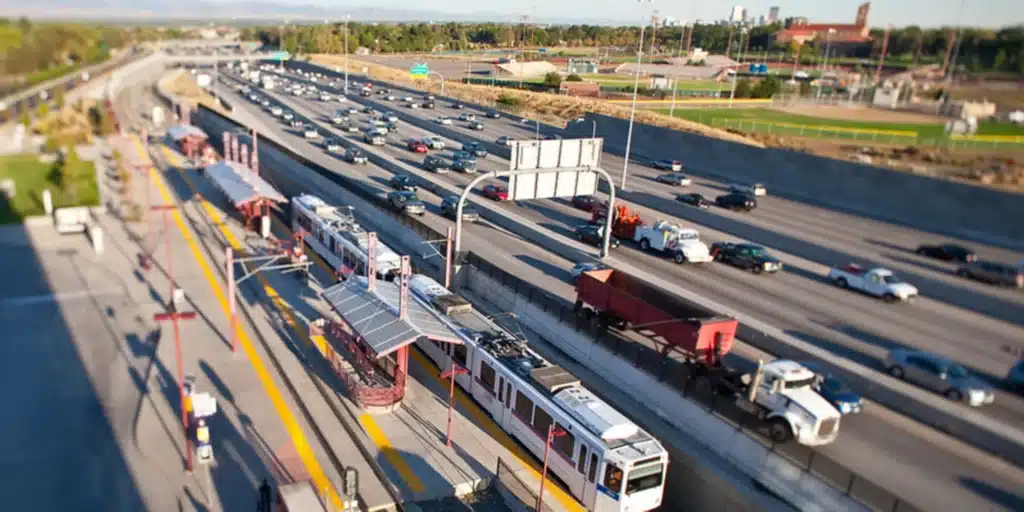
“Having asked our customers for patience and understanding while these critical light rail infrastructure projects were underway, it is incredibly gratifying to now see such a substantial improvement in on-time performance,” said Johnson. “RTD is committed to providing reliable service, and the schedule we keep amplifies that pledge to our customers. The team takes this charge seriously and approaches every aspect of our transit service delivery with this top of mind.”
On-time performance is a measurement of how frequently buses and trains arrive at stop or stations according to the posted schedule, with “on-time” being defined as a vehicle arriving no more than one minute early or five minutes late. On-time performance, RTD says, can be impacted by several factors, including maintenance work, inclement weather, mechanical issues, accidents, customer boarding times and traffic conditions relating to agency bus service. “The results of RTD’s 2025 Customer Excellence Survey reflect the agency’s commitment to reliability, with year-over-year improvements in customers noting that bus or train services usually run on time,” the agency noted.
In addition, light rail service availability averaged 96.8% through August 2025, reflecting the fact that RTD delivered 21,160 light rail trips out of the 21,848 scheduled. Year-to-date service availability for bus is 99.5% and nearly 99% across all commuter rail lines. Service availability is a measurement of the percentage of trips that operate as scheduled.
More information is available here.




