

In the previous article in this series, we took a close look at SEPTA’s through-running operation in and around Philadelphia, both its challenging start and its status today, as the only large and almost-entirely through-running “transit railroad” in North America. In this article, we will examine a smaller system, which began with a single through-running line and expanded from there. It is GO Transit, the only “transit railroad” in Canada with a line of that sort.

Toronto is renowned for the quality of its transit, mostly operated by the Toronto Transit Commission (TTC). The TTC operates subways, long five-section articulated streetcars (the largest streetcar system still operating in North America), and local buses. The TTC does not provide all the transit in the city, and it does not go far into suburban areas. The other rail operations are the Union-Pearson Express (UP Express, not to be confused with Union Pacific) line to Pearson Airport, and several GO Transit lines that radiate outward from Union Station in downtown Toronto (also used by VIA Rail and Amtrak’s Maple Leaf train to and from New York). GO Transit was named for the Government of Ontario, which started the service. Today its operating agency is Metrolinx, which was founded in 1986, but it has kept the GO Transit name. Metrolinx also operates UP Express and administers the Presto farecard that is used in Toronto and Ottawa, as well as a few bus agencies in the region.

Today, GO Transit operates seven lines, and limited service extends as far around the shore of Lake Ontario as Niagara Falls. Some of those lines run only during peak-commuting hours in the prevailing direction, while others also operate during off-peak hours on weekdays and on weekends. GO Transit also operates a major bus system from a terminal accessible from Union Station through a labyrinth of underground passageways. Some of the bus routes run beyond the outer terminals of GO Transit’s rail lines, others run “off-peak” schedules to places where trains only run at commuting times, and still others go where there are no trains. The trains run in push-pull configuration, using Bombardier bilevel (or multi-level, if you prefer) coaches (standard equipment in the United States outside Amtrak’s Northeast Corridor (NEC) and in Chicago), and in Vancouver. Power is provided by MPI MP40 locomotives.
According to Metrolinx, there were local trains in the region prior to GO Transit’s operation, but those trains were not like the service that CN ran in 1967 or runs today, according to Metrolinx: “CN and in some cases, VIA, operated limited commuter train service on the Lakeshore, Kitchener, Barrie, and Stouffville corridors. They used either small trains with older locomotives and coaches or RDCs (Rail Diesel Cars). Intercity services did make multiple local stops in other cases, such as the Milton corridor. As GO Transit services were introduced, the CN and VIA services were removed.”

Daniel Garcia and James Bow posted a comprehensive history and examination of GO Transit. They described the events that led up to the beginning of the service this way: “Ontario premier John Robarts announced plans to build a commuter railroad operating from Dunbarton (Pickering) to Hamilton in 1965. The Ontario government set to work purchasing rail equipment for the route, including locomotives from EMD and coaches from Hawker-Siddeley. The province decided against leasing equipment from the private railways as, at the time, such equipment was unavailable, Canadian National and Canadian Pacific had their own trains to run. However, GO Transit did pick out equipment that could be easily operated by the private railways. The provincial commuter service would lease equipment to the railways during weekends and, the plan was, the equipment could be easily sold to the railways should the trial of the commuter service prove unsuccessful.” Also, according to Garcia and Bow, the first schedule was limited, with trains running through between Dunbarton and Pickering with a 69-minute running time. At first there were only nine round trips per day. By September, GO Transit (run by the Government of Ontario at that time, hence the name) was running hourly service.
Trains started running along the Lakeshore Corridor on May 23, 1967, 16½ years before SEPTA began running through the Center City Commuter Connection tunnel that marked the start of through-running in Philadelphia. What made GO Transit a through-running operation is that its terminal, Union Station, is located near the middle of the line. Going east of there, the original line ran five stops to Pickering, along the route that VIA Rail uses to go to Montreal and Ottawa. Going west from there, it ran for six stops to Oakville. There was also limited service to downtown Hamilton for peak-hour commuters.
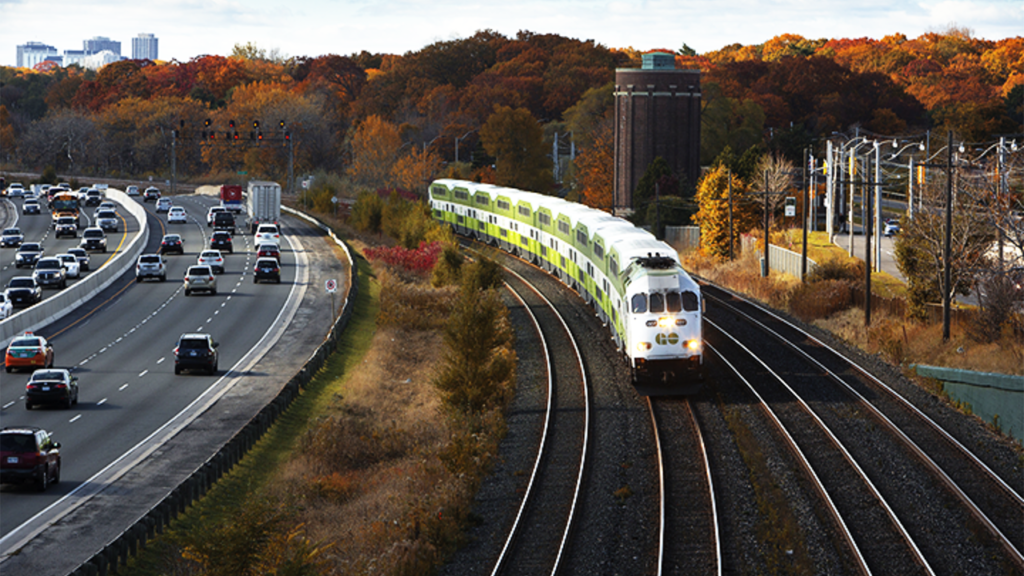
Since that time, the Lakeshore East line has been extended two more stops to Whitby, and then another stop to Oshawa, where riders can connect with VIA Rail. On the Lakeshore West line, about half of the “regular” service now turns at West Harbour in Hamilton. Service to downtown Hamilton is still limited to a few “commuter” trains, although three round trips per day now run part way around the lake to Niagara Falls, with an intermediate stop at St. Catherines (also served by Amtrak’s Maple Leaf).
The Lakeshore Corridor runs a densely packed schedule today, with a full span of service, seven days a week on both the Lakeshore East and Lakeshore West sides of Union Station. While trains had run once an hour in the past, the standard interval is now half-hourly, perhaps with some deviations of one or two minutes from precise 30-minute headways. There are three kinds of extra trains on top of the half-hourly service: trains run every 15 minutes during parts of peak-commuting periods, trains that go to downtown Hamilton, and trips to and from Niagara Falls, all in addition to the half-hourly schedule.
The line was always a through-running operation, at least primarily so. Andrea Ernesaks, Senior Manager for Media Relations and Issues at Metrolinx, explained it: “Most of our all-day service trains run east/west on Lakeshore West, continuing onto Lakeshore East. On the west end of the line, the terminus alternates between West Harbour and Aldershot, except in the case of Niagara off peak/weekend service trains. Through running was part of the original plan, with train numbering continuing from what is now known as Lakeshore West to Lakeshore East (originally Oakville to Pickering) for some services, with additional peak period services that may have terminated at Union Station with unique numbers (such as service from Hamilton, and later Whitby/Oshawa). Some trains ran in service to Union on one corridor and ran empty beyond Union to ‘bounce back’ as a peak period train on the other corridor. In later years, these services would be used in service in both directions as a ‘counter-peak’ service.”
On the Lakeshore East side, trains leave Oshawa at :10 and :40 after the hour. The trip to Union Station is scheduled to take 62 minutes, so trains arrive there at :12 and :42 after the hour. Trains leave Union Station at :20 and :50 past the hour and arrive at Oshawa at :22 and :52. That is the weekday schedule. The weekend schedule is similar, but the times are different. Trains leave Oshawa at :07 and :37 and arrive at Union Station at :09 and :39. They leave Union Station at :20 and :50, as on weekdays, but there is extra weekend service. Trains leave Union Station every 15 minutes during the late afternoon and much of the evening, both on Saturdays and Sundays. The extra trains leave Oshawa at :05 and :35 and Union Station at :05 and :35.
The schedule on the Lakeshore West side is slightly more complicated. During off-peak times, half the trains originate and terminate at Aldershot, while the other half run to or from West Harbor, 14 minutes to the west. Trains run essentially half-hourly between Aldershot and Union Station. Running times from Union Station to Aldershot are 1:09 and 1:23, respectively. During peak-commuting hours on weekdays, there is service every 15 minutes between Union Station and the original terminal at Oakville, with trains originating and terminating there, in addition to the half-hourly service to Aldershot or West Harbor. Weekend service in the late afternoon and much of the evening runs with that pattern, too. Buses cover early morning and late night hours with a few runs on each line.
Looking at the schedule as a through-running operation, we’ll look at a specimen schedule. On weekdays, Train 1710 leaves West Harbour at 0825 and arrives at Union Station at 0945. It continues as Train 9310, leaving at 0950 and arrives at Oshawa at 1052. Returning, it leaves Oshawa as Train 9017 at 1110 and arrives at Union Station at 1212. It then leaves for Aldershot as Train 1017 at 1217, arriving there at 1326.
Still, Metrolinx retains a degree of flexibility in scheduling, as Ernesaks told Railway Age: “The decision to operate through or terminate at Union Station on other lines varies depending on the trip and is dependent on several factors. As noted above, this includes ongoing infrastructure updates in the Union Station Rail Corridor, track conditions, train consist sizes and current ridership demands, and maintenance demands for example.”
GO Transit’s Lakeshore Corridor is similar to SEPTA’s through-running operations in the Philadelphia area, except that GO Transit runs longer trains. While Metrolinx did not furnish ridership numbers for the East and West sides of the Lakeshore Corridor, it seems reasonable to assume that, like most SEPTA riders go to Center City, most GO Transit riders go to Toronto’s Union Station, although some would go past Union Station to their destinations, and others would ride locally on one side of downtown Toronto.
GO Transit today has expanded north and west, away from the Lakeshore. Today the railroad operates five other lines, partially on infrastructure that it bought from other railroads, including the portion on the Lakeshore Corridor between Oshawa and Aldershot. Some trains run, at least in part, on track still owned by CN or CP, the latter now CPKC. The lines to Milton (west of the city but north of the lake) and Richmond Hill (north of the city, with the endpoint now located at Barrington, two stops north of Richmond Hill) operate during peak-commuting hours only, and in peak-commuting direction. There are buses at other times. The Kitchener Line (west of the city) and the Barrie and Stouffville Lines (north of the city) run to those endpoints only during commuting times. At other times, including on weekends, trains run to a short-turn point closer to Toronto, and buses run the rest of the way.
Metrolinx has plans to expand GO Transit, but their proposals either involve extending existing lines (like Lakeshore East to Bowmanville) or expanding service on an existing line (more service on the Barrie Line and the outer end of Lakeshore West, and a full span of service on the Milton Line). Overall, GO Transit appears to be successful in extending Toronto’s transit network beyond the numerous rail transit and local bus routes of the TTC, into a few towns in the Toronto region.
One place where rail transit has made a comeback and regional trains serve an even wider area than GO Transit serves is Los Angeles, where Metrolink runs some of the longest regional rail lines anywhere in North America. It has been so successful that, with the traffic that Metrolink and Amtrak’s corridors in Southern California generate, construction is under way to make Union Station a through-running facility. We will look at that project in the next article in this series.




