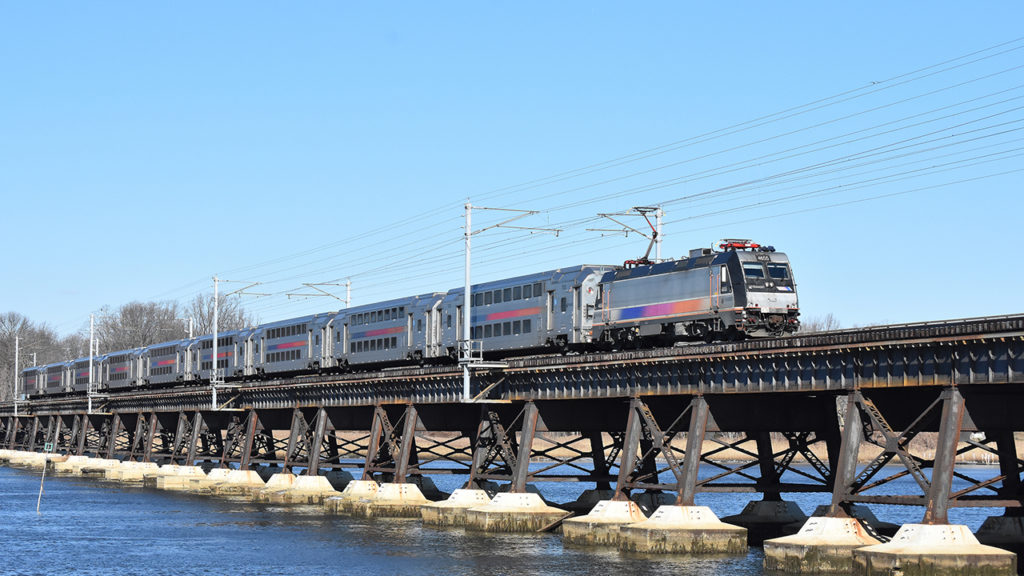
President Joseph R. Biden Jr. on July 24 appointed Presidential Emergency Board (PEB) No. 251 to investigate the collective bargaining dispute between New Jersey Transit (NJ Transit) and the Brotherhood of Locomotive Engineers and Trainmen (BLET). The PEB on Aug. 23 issued its recommendations, which are now under review by both parties.
Officials at NJ Transit, which runs the nation’s third-largest commuter railroad, requested the PEB’s establishment, according to a report by NJ Advance Media for NJ.com.
Elizabeth C. Wesman, a labor arbitrator and former President of the National Association of Railroad referees, has been named PEB Chair. Joining her on the Board are Barbara C. Deinhardt, a labor and employment arbitrator and mediator, who in 2022 was appointed by President Biden to serve on PEB 250, which was formed to resolve a dispute between most major freight railroads (and many smaller ones) and their 12 labor unions representing some 145,000 unionized rail workers; and Lisa Salkovitz Kohn, a labor and employment arbitrator and mediator and member of the Board of Governors for the National Academy of Arbitrators.
The NJ Transit-BLET contract dispute has been in National Mediation Board (NMB) sponsored mediation for nearly three years. According to BLET, its NJ Transit locomotive-engineer members have been seeking a new labor agreement since October 2019 and “are the lowest paid engineers working in commuter service in the nation.”
The PEB appointment came just prior to the expiration of a 30-day cooling-off period that began June 25. Under the Railway Labor Act (RLA), either party would have been able to exercise self-help—strike by the union or lockout by the management—had a PEB not been established.
Pursuant to the RLA, the PEB will have 30 days to convene, hear the railroad and union positions, and issue recommendations for settlement of the dispute. The report was due to President Biden on Aug. 23. From the time the PEB is granted, the parties have 120 days to reach an agreement. If no agreement is reached at the end of the 120 days, the sides (or governors in states that would be affected by a rail strike) can request a second PEB, which would give the parties another 120 days to come to an agreement. The union is prohibited by law from any strike or work stoppage while this process is under way. (For more details, download the timeline below, courtesy of BLET.)
“NJ Transit said it would be March 2025 before any strike could occur,” according to a July 24 Associated Press report.
In June, NJ Transit told Railway Age that it “has made a fair and pattern-based contract offer [to BLET] that has been accepted and ratified by 14 of our 15 rail unions covering 91% of our rail union employees.” The transit agency noted that it “has and will continue to engage in good faith negotiations that fairly and best represents the interests of NJ TRANSIT’s hundreds of thousands of customers, as well as New Jersey taxpayers, in light of our widely-known budgetary realities. Despite facing a $766 million dollar operating budget gap in FY26, we have not withdrawn the current offer consistent with the offer resoundingly accepted by all unions except the BLET. We remain fully committed to an amicable resolution to these contract talks.”
According to BLET, “such pattern-based contracts don’t account for two years of specialized training to become an engineer and the knowledge and expertise required to qualify to operate trains on different parts of the railroad.”
“This labor dispute has dragged on for far too long, but we will respect the process established by the Railway Labor Act,” BLET National President Eddie Hall said in a July 24 statement. “It’s time for NJ Transit to make a fair offer and settle this dispute voluntarily. Otherwise, our members will be walking picket lines rather than operating trains.”
PEB Recommendations
On Aug. 23, PEB 251 released its recommendations (download below courtesy of BLET).

“Our charge is to craft for the Parties a potential path toward a mutually acceptable resolution of this protracted and difficult dispute,” the Board wrote in its report. “The Parties have made our job both easier and more difficult with their excellent and comprehensive presentations.” Following PEB 251’s review of the submissions, exhibits, witness testimony, and arguments, it made these recommendations (also see summary, right):
- A 7-1/2 year contract, with an amendable date of July 1, 2027.

- The Board said that it has reviewed “the extensive PEB precedent discussing pattern bargaining in the railroad industry that has been submitted by both parties … Many, if not all, of the arguments raised here have been raised by carriers and organizations [a.k.a., unions] over the past 67 or more years. Almost without exception, the Boards have given great weight to the importance of the pattern principle as essential to labor peace. For example, PEB 169 recommended a wage increase consistent with the pattern because ‘a higher settlement would probably nurture employee dissatisfaction and catchup demands and hamper collective bargaining and the negotiation of future contracts’ … Almost without exception, once finding a pattern, prior Boards have recommended the pattern’s general wage and benefit agreements, or at least the fully monetized value thereof, to the organization(s) contesting the applicability of the pattern settlement, sometimes (but not always) after an independent analysis of common wage determinants, sometimes (but not always) also making recommendations on or remanding for further negotiation unique craft-specific concerns.” The Board recommended “the acceptance of the pattern agreement general wage increases in the Carrier’s [NJ Transit’s] July 25, 2023 proposal, but further suggest that the Parties agree now on a 6% increase to be effective after the amendable date of the 7½-year contract, an increase designed to partly ameliorate the 3.8% loss in wages in the previous years in addition to providing an increase to respond to ongoing inflation.” According to the Board, on July 24, 2023, “during mediation, the Carrier made a proposal for a 7½-year agreement, with 3% increases in each of the last three years, an additional holiday (Veterans Day) and an additional sick day, and an amendable date of July 1, 2027. (This was a proposal that had been presented to the other organizations [NJ Transit unions] soon after the ratifications of the 2020-2024 agreements and has now been accepted by 11 of those organizations.)”
- The Board also recommended “that the engineers receive a cents per hour increase over and above the pattern settlement, retroactive to the effective date of this contract, if necessary to maintain the 10.4% differential between the conductor and the engineer rates that has been agreed to by the Parties for over 40 years pursuant to the Letter of Agreement dated December 29, 1982 and modified June 18, 2018. In addition, we recommend that the wage proposal be applied with full retroactivity, calculated and paid in accordance with the usual practices of the Parties. In light of the length of time that has elapsed since the other organizations [NJ Transit unions] began to receive the general wage increases and the retroactivity payments and the corresponding period of time in which they, and NJTRO [New Jersey Transit Rail Operations], have had use of the money, we recommend that BLET members receive an additional $3000, payable in two lump sums. In making this recommendation, we have taken particular cognizance of the delays in the negotiation and mediation process and the number of times the Organization requested release from mediation, only to have the request objected to by the Carrier, even though the Carrier’s position on the main issue in dispute was unwavering.”
- “We also recommend that the Parties continue to meet to discuss whether any work rule concessions on the part of the Organization could be used to increase their base wages without breaking the pattern. In its Report, PEB 246 noted that SEPTA [Southeastern Pennsylvania Transportation Authority] acknowledged that a union might negotiate terms in addition to the pattern settlement if the union chose to make concessions or find ways to fund other contract terms that SEPTA and the union could agree upon … Here, too, we recommend that the Parties continue to seek to find such areas of agreement that could lead to wage increases not inconsistent with the pattern.”
Regarding BLET’s argument that pattern bargaining should not be imposed because the NJ Transit engineers “are paid significantly and increasingly less than their counterparts at the other major commuter railroads in the country,” the Board said it “is not disputed that unionized employees at NJTRO—engineers and the other crafts—are paid generally less than at many of the major commuter railroads, particularly Caltrain and Metrolink in California and MARC in Maryland. They are also paid generally more than employees at some other railroads, such as SEPTA in Philadelphia. As did PEB 248, we find that to the extent that any comparators outside of NJTRO are relevant, those in the Northeast close to New Jersey (PATH [Port Authority Trans Hudson rapid transit], LIRR [MTA Long Island Rail Road], Metro-North [MTA Metro-North commuter railroad], and SEPTA) are clearly the most relevant. Even among those properties, it is difficult to draw conclusions from the disparity in base wage rates. It is obvious that the value of a contract to its covered employees will vary according to the cost of living in the relevant area. The Carrier has submitted evidence that the cost of living in Long Island, for example, is much higher than that in New Jersey, particularly southern New Jersey. In view of the limited evidence in the record before us, we cannot reach any clear conclusions as to how the base wage of the engineers in New Jersey compares in its purchasing power with, for example, the base wage of engineers on LIRR, PATH, or Metro-North.”
“There is some record evidence that the wages and benefits for engineers at NJTRO are now sufficient to entice applicants for engineer positions, despite higher base wages being offered at other nearby properties,” the Board reported. Additionally, “[a]nother challenge we encountered in evaluating the Union’s disparity argument is that comparing only base wages does not give a full picture of the full value enjoyed by the workers under the collective bargaining agreements,” the Board said. “The value of pension benefits; health and welfare plans; holidays, vacation and other paid time off; and myriad work rules can obviously have a large impact on how much a contract is worth to its covered employees and how much a contract costs its carrier. Neither party here provided any analysis of the full cost and value of the agreement at NJTRO compared to those at the other commuter railroads. As a result, our ability to determine the extent to which NJTRO engineers may be undercompensated relative to their counterparts at other regional commuter railroads is limited. With those caveats, we have considered the evidence submitted by the Organization to show that the base wages for engineers at NJTRO have lagged behind those of engineers elsewhere and that this disparity has grown. According to the Organization, under NJTRO’s proposal, its engineers would fall short of the average base wage rates of eight other major rail commuter lines by $6.70 or 14.5% as of July 2024, and by July 2025, the gap would grow to more than 15.2% or $7.20 per hour. When comparing NJTRO engineer wages only with the average base wage rates of the four regional commuter railroads, however, it appears from the exhibits submitted by the Organization that the NJTRO engineers would fall short of the average by $3.78 per hour or 7.57% as of July 2024, and by July 2025, the gap would grow to 7.87% or $4.06 per hour. Thus, it appears that when compared within the region, the disparity, while present, may not as be large nor increasing as quickly as the Organization contends.”
The Board also reported that “[i]t is clear from the record that this disparity between NJTRO engineer wages and the wages at other regional commuter railroads is not new. The evidence submitted by the Organization reflects a disparity going back at least to 2003. Interestingly, the exhibits presented by the Organization seem to show that, over the past 20 years, the engineers at NJTRO have gained more in wages, as a percentage, than the engineers at PATH, LIRR, and MNCR. Engineer wages at NJTRO increased 85% from 2003 to 2025 (using the current management proposal) while engineer wages at PATH increased 76%, engineer wages at LIRR increased 83%, and engineer wages at MNCR increased 82%. (Engineer wages at SEPTA increased 95% over that same period, more than at NJTRO, but remain the lowest in the region.) In addition, the argument regarding the disparity between NJTRO wages and comparator wages also applies, and has applied at least since 2003, to some degree to all the other organizations on this property, even with the pattern increases. In 2022, for instance, SMART base wages were almost 10% lower than the average at the other major commuter rails (compared with BLET’s being almost 14% lower). There is no evidence in the record about the disparity between the SMART base wages at NJTRO and the four regional commuter railroads to compare with the 7.5% disparity in 2024 between the NJTRO engineer wages and those same regional railroads. Therefore, we do not conclude that the disparity argument is one that is unique to BLET such that it justifies a deviation from a pattern so clearly established.”
BLET, NJ Transit Respond
“The BLET National Division, along with legal counsel and the BLET NJ Transit General Committee of Adjustment, are continuing to analyze the report and meet with all involved parties prior to making any public comments,” BLET said in an Aug. 30 statement released on its website. It noted that “[u]nder the Railway Labor Act, if there is no settlement between the parties based on a PEB’s recommendations, then the next step under the law is a public hearing hosted by the National Mediation Board to be held on or before Friday, September 20. This flowchart (PDF) illustrates how rail labor and commuter/passenger rail management reach an agreement on rates of pay and work rules under the RLA. The NMB provided this timeline (PDF) for settlement of the BLET/NJT dispute.”
In a Sept. 3 statement to Railway Age, NJ Transit Chief Communications Officer Jim Smith said: “NJ TRANSIT appreciates the Presidential Emergency Board’s (PEB) thoughtful consideration and the recommendation provided. We are pleased that the PEB’s recommendation includes the acceptance of the pattern-based general wage increases in our original proposal. We have continued to assert that the pattern-based agreements accepted by 14 of our 15 rail unions are fair and reasonable. We will thoroughly evaluate all facets of the recommendation to ensure it aligns with our agency’s goals and addresses the concerns raised during the mediation process. We remain committed to arriving at a resolution that is both fair and sustainable for NJ TRANSIT, the hard-working members of the BLET, and New Jersey taxpayers.”
Background
Members of the BLET of the Teamsters Rail Conference on Aug. 31, 2023, voted to grant Eddie Hall the authority to call a strike at NJ Transit.
The union on Aug. 7, 2023, reported that it had begun mailing strike authorization ballots to NJ Transit locomotive engineers; ballots were due 12 p.m. EDT on Aug. 31, 2023. BLET reported results showing 81% of the eligible 494 union voters cast ballots, with 100% of them in support of strike authorization.
“The BLET wants a contract that gives its members wages more in line with what engineers at other commuter railroads make,” the union reported Aug. 7, 2023. “Except for one other transit agency, NJ Transit’s engineers are the lowest paid engineers working in commuter service in the nation.”
“I am confident that 100% of the ballots returned will be in favor of striking NJ Transit,” BLET’s Eddie Hall said Aug. 7, 2023. “We will be one step closer to ‘self-help’ once the ballots are counted later this month and just prior to the Labor Day weekend. I want to stress that BLET shall comply with the rules of the Railway Labor Act. However, once released by the National Mediation Board, we will be ready to act. What we really want is a fair contract for engineers and to ensure uninterrupted train services for passengers.”
On Aug. 31, 2023, Hall followed up, saying: “NJ Transit’s locomotive engineers have spoken loud and clear.” He noted that “NJ Transit’s managers wasted taxpayer dollars by going to court this month in a frivolous and failed attempt to block our vote count and strip us of our rights. They would rather litigate than negotiate. We would prefer to reach a voluntary settlement, but make no mistake, with this vote the clock is now ticking. The process to be granted release from the NMB has begun. As soon as it is lawful for us to act, we will.”
NJ Transit spokesperson Jim Smith on Aug. 31, 2023, told NJ Advance Media that “[w]e are still actively engaged in mediation with the union and a strike is not permissible while mediation is ongoing—that would be a violation of the Railway Labor Act.”
In court on Aug. 17, 2023, NJ Transit “contended the [union] vote and union statements violated a June 2022 court order against any wildcat job actions and sought a contempt of court ruling,” according to NJ Advance Media. “NJ Transit attorneys argued the union planned to strike on a day after the vote on Sept. 1 [2023]. The judge dismissed NJ Transit‘s motion but did issue an order that required the union to email members they were not to strike after the vote to comply with the June 2022 order, court documents said.”
The 2022 court order was issued after a job action on June 17, 2022, the Juneteenth holiday. NJ Transit engineers marked off as sick, resulting in hundreds of train cancellations and suspension of service. The sick-outs and cancellations continued into the weekend. NJ Transit went to court and obtained an order directing its engineers to return to work, as well as a permanent court order barring them from staging what the agency said would be another “illegal strike.”
On June 15, 2023, NJ Transit resolved a settlement with the National BLET in the amount of $50,000, which NJ Advance Media said was to “recover costs to cross-honor rail tickets, deploy and pay extra workers in 2022.”
NJ Transit President and CEO Kevin Corbett told NJ Advance Media in early August 2023 that the agency wanted to “reassure riders there is a federal court order against a strike and there is a long [mediation] process that goes well into 2024.” He added that the strike vote is “symbolic,” designed to pressure NJ Transit into a settlement favorable to the BLET.
Railway Labor Act mediation can last indefinitely, provided there is a reasonable chance of a settlement. If mediation fails to produce a settlement, the NMB can ask—not force—the parties to enter binding arbitration. If binding arbitration is rejected, a 30-day cooling off period is imposed to maintain the status quo: The union doesn’t strike and the railroad doesn’t lock out employees.
Of NJ Transit’s 15 rail unions, the BLET is the only one without a new contract. The agency “wants the union to accept a similar agreement and salary increases that other rail unions agreed to,” according to NJ Advance Media. The other unions agreed to “pattern-based bargaining,“ with wage increases starting at 2% and gradually rising to 3% on the fifth contract year. Corbett defended this practice, used nationally and which its other unions accepted, the media outlet reported in early August 2023. Corbett noted: “We’ve negotiated in good faith. We have respect for our unions; 14 of 15 signed contracts. The BLET feels they’re special. We believe in collective bargaining and pattern-based bargaining.”
The BLET maintains that locomotive engineers deserve a higher salary than other train crew members because they have more responsibility; qualifying to operate a train involves rigorous training to learn physical characteristics and safety rules. NJ Transit engineer salaries should not be lower than those at Amtrak and MTA Long Island Rail Road because the three carriers share operating territory (for example, the Northeast Corridor between Trenton, N.J. and Penn Station New York/Sunnyside Yard for NJT and Amtrak), the union reported.
NJT issued the following statement on Aug. 10, 2023:
“To begin, NJ Transit has great respect for the men and women who make up the locomotive engineer ranks. We also have the utmost respect for labor and the collective bargaining process—and no one has been a more ardent supporter of labor than [New Jersey Democrat] Governor [Phil] Murphy. We are committed to continuing to negotiate in good faith as we have since the start of this process.
“While we certainly appreciate the BLET’s frustration, we too are frustrated—and disappointed —by the misleading characterizations their leadership has made in recent statements. We believe it’s our obligation, in the interest of public trust, that we correct that record.
“Assertions that NJ TRANSIT is somehow responsible for the absence of a pay raise for four years and that BLET members are working for subpar wages is disingenuous. Wages are competitive with railroads in the region and, historically, it’s a matter of public record that locomotive engineers have been among the top earners of all NJ Transit employees—union and non-union. Further, the choice to continue to work without a pay raise is the BLET’s, alone. We agree that four years is too long, and we urge the BLET to join the other 14 unions who signed the contract and have been enjoying their generous annual increases. Let’s get this contract signed and get these employees paid.
“The BLET has also said NJ Transit is ‘unwilling to spend a dime on train crews.‘ In fact, we have 223 million dimes waiting for the BLET members when they sign the contract. That’s right, we have committed $22.3 million in salary increases for BLET members over the 4 years of the current contract. And, all of that is retroactive to the engineers as soon as they sign the contract. The average locomotive engineer earning $97,000 annually would be earning $109,212 at the end of the current four-year contract. It’s inexplicable why the BLET leadership would leave tens of millions of dollars in salary on the table that should be going to their members.
“The BLET’s recent press release authorizing a strike vote has also misled customers, members of the public, the media, and elected officials by making it appear that a strike could happen as early as Labor Day weekend—we heard from all of these constituencies with their concerns this week. Their release created unwarranted and unnecessary public alarm because the BLET is currently prohibited from striking while we are in active mediation. In addition to the provisions of the Railway Labor Act, which prohibit parties from engaging in ‘self-help’ measures while engaged in active mediation, there is also a federal court injunction in place that provides additional protections to NJ Transit from a threat of strike. The court order was entered immediately following the illegal job action orchestrated by the BLET local on June 17, 2022, that severely disrupted the lives of tens of thousands of NJ Transit customers who depend on rail service every day.
“There’s an old expression: ‘The whole army can’t be out of step.’ We have made a fair and pattern-based contract offer that has been accepted and ratified by 14 of our 15 rail unions covering 91% of our rail union employees. The BLET is the only union to not accept these terms. The BLET asking to be treated differently than 91% of NJ TRANSIT’s rail union employees, and 95% of all NJ Transit’s unionized employees combined, demanding to receive exceedingly more than every other union that signed the contract is simply out of step and not consistent with the rest of the state.
”We look forward to getting a signed contract that delivers the same benefits to our locomotive engineers that every other rail union member currently enjoys, and ensures that NJ Transit customers can continue to count on convenient, reliable and uninterrupted rail service.”