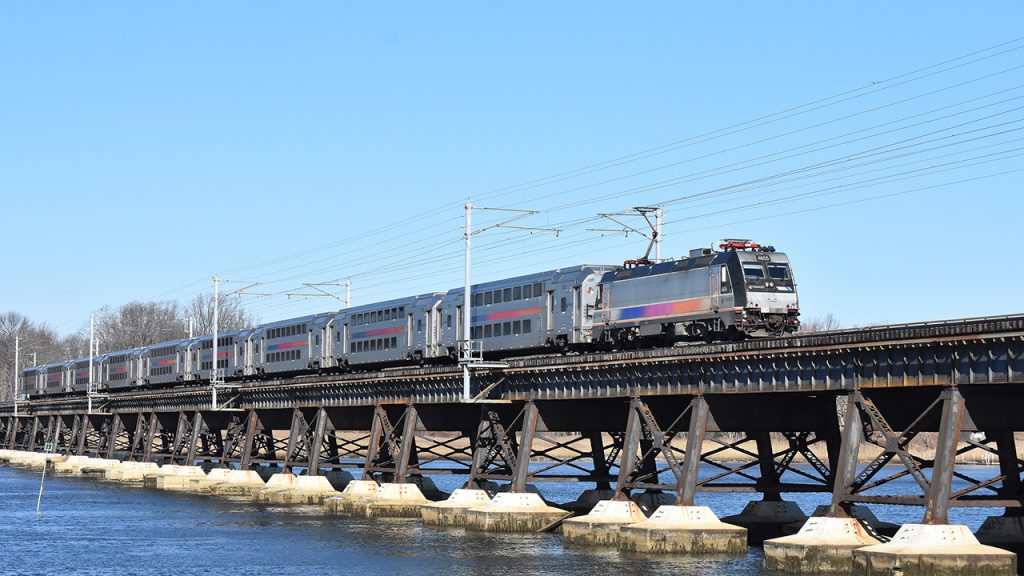
UPDATE: New Jersey Transit (NJT) locomotive engineers represented by the BLET (Brotherhood of Locomotive Engineers and Trainmen) have ratified a tentative contract agreement reached May 18 by management and union leadership. The rank-and-file had previously rejected agreements, and after contract talks broke down, went on strike at 12:01 a.m. on May 16, in accordance with the terms of the Railway Labor Act. Trains in the Garden State and parts of New York State shut down.
The strike lasted three days, and it took a fourth day to perform the required inspections and get the trains running again. There won’t be another strike anytime soon, though, as the engineers accepted the deal by an overwhelming 95% to 5%, or 398 votes to 21. It was a dramatic reversal, as the same employees had rejected a previous deal struck in March, with 87% voting against it, and had previously voted unanimously to strike.
NJT CEO Kris Kolluri announced the result on June 11, at the agency’s monthly Board meeting. Kolluri called the agreement “precedent-setting” and “net neutral” on revenue. He said it gives the engineers a fair wage without jeopardizing the agency’s financial situation. He added: “Our obligation is to the riders and the broad taxpayers.”
Word of the ratification came late on June 10, and the agency issued a statement from Kolluri: “I am pleased to announce the ratification of a new contract by the Brotherhood of Locomotive Engineers and Trainmen (BLET), representing a fair and fiscally responsible agreement for our locomotive engineers, NJ Transit, our customers, and the taxpayers of New Jersey. From the outset, Governor Murphy and I were clear that any agreement must balance fair compensation with budgetary discipline—and this contract delivers on both … I want to thank our customers for their patience and understanding during last month’s disruption to rail service as a result of the strike. I also extend my sincere appreciation to the thousands of NJT employees who rose to the occasion and supported our riders under some of the most difficult circumstances our agency has faced.”
The BLET reported the agreement on its website on June 10, after the votes were counted: “Voting concluded today for members of the BLET for a new collective bargaining agreement with NJ Transit, the nation’s third largest commuter railroad. BLET members at NJT voted to accept a tentative agreement reached with the commuter railroad’s management on May 18, ending a contract battle that stretched five years and included a three-day strike that shut down the railroad last month.” The union called the deal “fair and acceptable,” and its headline read in part: “Deal ends five-year contract battle.”
The BLET gave more details than NJ Transit: “The seven-year agreement, covering the years 2020-2027, addresses rates of pay and other issues for the 450 NJT locomotive engineers employed by the transit agency” and “Highlights of the new agreement include a significant pay raise for engineers who were, until now, the lowest paid engineers working for a major commuter railroad in the United States. NJ Transit’s engineers had not seen a raise in pay since 2020 despite a spike in inflation. In addition to a pay increase that will raise hourly wages to over $50 per hour, locomotive engineers will also receive retroactive wages and a signing bonus.”
Tom Haas, General Chairman of the NJT local, was quoted as saying: “All along we’ve said we didn’t want to be the highest paid engineers, we only wanted equal pay for equal work,” and “This agreement brings us close to what our peers make for doing the same type of work with the same levels of experience and training.” Haas added: “This agreement gives us the pay raises we needed, but also was done without a major hit to NJT’s budget and should not require a fare hike for passengers.” BLET National President Mark Wallace was quoted as saying: “Our members told us through an earlier vote that they wanted parity with engineers at Amtrak and other passenger railroads that share the same train platforms. Prior to that vote, engineers voted unanimously to strike when allowed under the rules of the Railway Labor Act, if a voluntary agreement couldn’t be reached. Now, through this vote, our members have told us that the terms agreed to are both fair and acceptable.” Before the strike, Kolluri had warned that meeting the engineers’ demand for a raise would require a 17% fare hike for that benefit alone.
Kolluri also said in his prepared statement: “We adhered to the established bargaining pattern and, through constructive negotiations, secured meaningful concessions that enabled us to fund the wage increases sought by BLET members without exceeding our current budget.” At a press conference after the meeting, he told reporters that the union had agreed to concessions over issues including health care and work rules concerning hours “and other things.” He declined to furnish any more details but said that they will be released after the agency’s Board ratifies the agreement at its next meeting on July 17.
BACKGROUND
The strike marked the first labor stoppage on NJ Transit Rail since it was founded in 1983. At that time, three new railroads were formed to take over the local service that Conrail had operated: NJ Transit Rail, Metro-North, and SEPTA Regional Rail. All three of the new railroads were hit by strikes as 1983 began, and the one in New Jersey lasted for 35 days.
Little had changed from the agency’s positions reported on May 15. In effect, NJ Transit was prepared to continue talks with the BLET, but both Gov. Phil Murphy and NJT President CEO Kris Kolluri expressed concern that the agency could not afford to meet the union’s demand for a wage increase while preserving its financial stability. The latest press release on the agency’s website, bearing a May 16 dateline, said, quoting Murphy: “Over the past several weeks and months, we have been working around the clock to avoid this strike and keep NJ Transit operating at full capacity. As always, our single-highest priority has always been to provide the best possible service to our state’s commuters and taxpayers. This strike will upend the lives of hundreds of thousands of New Jerseyans. My message tonight to our locomotive engineers is this: The path to a new contract will be paved at the negotiating table, not the picket line. Ultimately, it is the people of New Jersey who will suffer because of this strike. I am calling on our locomotive engineers to remain at the negotiating table to reach a fair and affordable deal so we can get the trains moving again as soon as possible and avoid raising costs on riders and taxpayers.”
The release also said this, quoting Kolluri: “I have always said that any deal we reach would have to be fair to our engineers and fiscally responsible without burdening our riders or the taxpayers of New Jersey. While we, unfortunately, were unable to finalize a deal Thursday night, I am committed, as I have been since my first day on the job in January, to remaining at the bargaining table for as long as it takes to get an agreement finalized. We have an obligation to the hundreds of thousands of NJT customers to work around-the-clock until a deal is reached and rail service can resume for all those who rely on it every day.”
Murphy and Kolluri held a press conference at 10:00 on May 16. The event took place at the Aberdeen-Matawan station on the North Jersey Coast Line, a station not served by any bus routes, so the location was not served by transit of any kind.
Murphy said that this is a terrible morning for riders and “it didn’t have to come to this.” Regarding the agency itself, he said: “They are continuing to work around the clock to rearrange the state’s transportation system” and are working toward a deal that would “give NJ Transit’s employees a fair deal without extra cost to riders and taxpayers.” He said that the workers who depend on NJT are the backbone of our entire economy and “they deserve a transit system that is reliable.” He added that the agency’s offer was 10¢ per hour less than LIRR engineers and would have “provided hard-earned wages without blowing up the agency’s budget.” He blamed “a small handful of engineers” and called the situation “a mess of their own making” and said that he is “ready to get NJ Transit back to full speed and give engineers their hard-earned raises.” Murphy also mentioned the fiscal cliff facing transit, including SEPTA’s plan to cut service 45% and raise fares by 20%, adding “That will never happen in New Jersey.” He called for compromises “from all of us” and mentioned “last year’s painful corporate transit fee.” He contrasted NJT’s financing with MTA’s congestion pricing solution, which he calimed is to “rip off New Jersey commuters going into Manhattan.” He said he will not raise taxes, but can deliver a solution “that sets the next Administration up for success.” He concluded by saying, “This is a bump in the road” and callied on the BLET to “come back to the negotiating table in good faith.”
Kolluri said, “This strike is not what any of us wanted to see, but that is where we find ourselves,” and “We worked very methodically to put the railroad to bed.” He said that the agency had people at train stations and made sure that bus lines were picking up riders, and that NJT will do that every day the union is on strike. He also mentioned the “financial death spiral” that every transit agency is facing and complained about “massive financial problems because of bad practices that, in some cases, go back decades.” He said that NJ Transit is now on “a stable financial footing” but is now confronted with “this existential financial problem.” He said that he does not want to “bankrupt New Jersey Transit” and “put it on a death spiral.” He concluded by saying that the engineers “were gracious to us” and that they said they want to get back to work. He noted that, when he became head of agency, his first call was to union General Chairman Tommy Haas, adding that they got a deal done, but union members voted it down. He said he wanted a deal that is “fair to them and fiscally responsible to us” and reported that the May 15 talks ended on a conciliatory note.
Murphy then mentioned other transit that is still running and said “secured traffic” leaving the concert last night went well. That was the concert at the Meadowlands Arena that was not served by NJ Transit’s Sports Line because of the strike threat. The Friday concert will not be served becuase the strike has already started. Kolluri also mentioned that talks will continue. The National Mediation Board asked the parties to come back on Sunday, and Kolluri said that he spoke to BLET National President Mark Wallace at Penn Station, and NJT is prepared to continue negotiating.
The latest statement from the BLET bore the headlines Trains Will Not Run Friday at NJ Transit and No Deal Reached on a Wage Increase; Management Walks Out of Contract Talks Forcingl; a Strike and was issued on May 15: “After 15 hours of non-stop contract talks today, no agreement on a wage increase was reached this evening between the Brotherhood of Locomotive Engineers and Trainmen (BLET) and NJ Transit managers. NJ Transit managers walked out of the talks shortly before 10 p.m. and through their actions have forced a strike despite the transit agency having the funds for a raise. Trains that usually run 365 days a year will come to a stop.. BLET members at NJ Transit have been seeking a new agreement since 2019. They have gone without a raise for five long years. In August 2023, the members of the local union voted unanimously to grant the BLET National President the authority to call a strike when it became lawful to do so and if a deal had not been reached.”
The union highlighted that money remains the sticking point, posting: “‘Our members at NJ Transit had the full support of our national union, as well as the Teamsters,’ said BLET National President Mark Wallace. ‘NJ Transit has a half-billion dollars for a swanky new headquarters and $53 million for decorating the interior of that unnecessary building. They gave away $20 million in revenue during a fare holiday last year. They have money for penthouse views and pet projects, just not for their front -line workers. Enough is enough. We will stay out until our members receive the fair pay that they deserve.’ NJT’s engineers make at least $10 less per hour than engineers who work for passenger railroads that share the same train platforms as NJ Transit.”
At the May 14 meeting of NJT’s Board of Directors, Kolluri acknowledged that time was growing short, saying that the parties “still have 29 hours left and will continue to negotiate.” He made that statement about 7:00, and the reality is setting in that there might be no more trains after the end of the service day on May 15.
The agency had reached agreements with all other railroad craft unions and touted a recent accord with the Amalgamated Transit Union (ATU), which represents workers on the agency’s bus side, including the drivers. Still, the recent history between the agency and the BLET has been stormy over the past few years. On June 16, 2023, Railway Age Editor-in-Chief William C. Vantuono reported that National BLET had agreed to pay NJT $50,000 for a “sickout” on “Juneteenth” of the previous year in a dispute about the status of that day as a holiday and the pay that was due to the engineers: “The BLET … has settled with New Jersey Transit for $50,000 over a June 19, 2022 ‘sickout’ the agency says was an ‘illegal job action.’ BLET National President Edward Hall said the union ‘does not condone unlawful strikes, slowdowns, or other such job actions by its affiliates.’”
More recently, there was hope that the parties had reached an accord. On March 10 of this year, Vantuono reported that the parties had a tentative agreement, quoting Kolluri as saying: “We are pleased to announce a fair and fiscally responsible contract settlement that ensures value for our taxpayers and customers, and provides a reasonable wage increase for BLET members. Apart from the contract settlement, we have resolved a long-standing grievance and settled another outstanding dispute between the parties in a manner that benefits both parties, paving the way for the introduction of new technology that enhances efficiencies at NJ Transit and supports our workforce. We believe this agreement not only reflects NJ Transit’s commitment to fairness, efficiency, innovation, and long-term financial sustainability—but it ensures uninterrupted rail service for the 100,000 people who depend on it.”
The engineers themselves didn’t see it that way. Instead, 87% of them voted against the proposed agreement in April, and it was back to the bargaining table for both sides. The BLET reported the rejection vote this way: “Locomotive engineers at NJ Transit, represented by the Brotherhood of Locomotive Engineers and Trainmen (BLET), have overwhelmingly rejected a tentative contract offer with the commuter railroad. The vote by NJ Transit’s engineers sets the clock ticking for ‘self-help’ where engineers are permitted under the rules of the Railway Labor Act to strike, or the commuter railroad’s management can lock out workers. Self-help can begin as soon as May 16. Turnout was high, 427 of the 460 engineers eligible to vote (93%) cast ballots, with 372 voting to reject the agreement (87∞ opposed ratification).”
On May 12, Railway Age Executive Editor Marybeth Luczak gave the latest update on the dispute. While the story concentrated on the recent settlement with the ATU, she also reported on the less-harmonious situation with the engineers: “The sticking point is wages, according to the union, which has been seeking a new agreement since October 2019, and has been through National Mediation Board-sponsored mediation, as well as two Presidential Emergency Boards (PEBs) with NJ Transit to resolve the dispute. BLET said its NJ Transit locomotive-engineer members ‘are the lowest paid engineers working in commuter service in the nation.’ According to NJ Transit, ‘BLET refused to accept the competitive wage and benefits package that all 14 other rail labor unions [at the agency] accepted in 2021.’” The dispute had gone through several steps, including two PEBs, efforts by federal mediators (which continue at this writing), and “cooling-off periods” that delay authority for the union to strike or the agency to lock out its employees.
Luczak’s report was comprehensive, and if anything has changed, it is that the passage of time has brought the looming threat of the loss of train service on NJT and the Metro-North “West of Hudson” service that NJT operates closer with every passing hour. Late on May 14, before and after the Board meeting, the agency announced that rail service on its “Sports Line” branch for concerts at the Meadowlands Arena will be canceled on May 15 and 16 because of the ongoing labor dispute.
At the Board meeting, BLET General Chairman Tom Haas called for “a fair and compatible wage” that would match what other passenger railroads in the region pay. Earlier, Luczak quoted Haas as saying: “The main issue that engineers face is the fact that not only do we have a significant gap in our wage between our wage and the average that every other passenger railroad engineer in the United States makes, but that gap is widening year by year, and … that wage gap is not nearly as large for the other crafts at NJ Transit. It’s the engineers who are falling further and further behind every year … The wage increase proposal that BLET gave NJ Transit is 2% more than what the agency had proposed. They proposed an average increase of just under 3%; our proposal is an average annual increase of just under 5%.”
Haas’s statement at the May 14 meeting appeared less strident than the previously quoted April 15 post on the union’s website, where he was quoted as saying: “Our members are angry. I, along with other NJ Transit engineers, have kept the trains moving, but we have gone without a raise since 2019, during a period of high inflation and throughout the pandemic that claimed some of our coworkers. We earn less than our peers at other commuter railroads that share the same platforms. For years, we have faced managers who prioritized spending on pet projects including a half-billion dollars for a corporate headquarters with penthouse views, but those same managers couldn’t find an extra dime for their train crews …” Since last year, the union has contrasted its members’ pay with the agency’s decision to give up its headquarters building in Newark and move to costly rented office space in the Gateway Center complex, which is connected to Newark Penn Station. Regarding the negotiations, Haas was also quoted as saying: “Management has moved in our direction since NJ Transit President and CEO Kris Kolluri took over in January, but this vote count makes it clear, more needs to be done.”
Kolluri said that the agency would continue the negotiations but called for “an affordable resolution” while expressing concern about the agency’s budget. At the Board meeting, he reported “a very constructive meeting with the National Mediation Board” but added that a deal “must be fair to the taxpayers and riders.” He reiterated that position at the post-meeting press conference. He called for “trust and confidence” and said that the process does not have to be acrimonious. While he did not say these things at the meeting or his press conference, Kolluri and other NJT managers have expressed concern at other times and in other places about the effects of meeting the union’s pay demands on the agency’s finances.
According to a report by Nikita Biryuikov posted on May 6 on the New Jersey Monitor website, Kolluri told New Jersey State Assembly lawmakers that “[the BLET’s] request for larger pay increases puts them at odds with economic realities.” Byriukov reported that the engineers were “seeking increases that would bring their average salary to $190,000, while the agency has pushed for a contract that would bring that wage up to $172,000” and quoted Kolluri as telling the Assembly Budget Committee: “If there’s any citizen, private or government, in this environment who’d get a $25,000 pay raise and say, ‘No, no, that’s not good enough,’ does that sound like a group of people who are grounded in reality, or more important, on what is actually happening in the world we live in?” He was also quoted as saying that meeting the union’s demands would require a 17% fare increase. As with all similar situations, the alternative to a fare increase is a round of service cuts, a scenario that also might soon play out in and near other cities.
NJ Transit also told its side of the story: “The Facts About NJ TRANSIT’s Negotiations with the BLET.” It lists “some common claims and the facts that provide necessary context” and gives the agency’s side of the story on each. It concludes with six “statements from a range of stakeholders sharing their perspectives on the potential impact of a strike and the path forward,” all of whom are business-oriented organizations, and none of whom are represent labor or transit riders as rail passengers.
Like other transit providers, NJ Transit is facing the fiscal cliff that has resulted from the impending loss of the COVID-19 relief money authorized by Congress during the pandemic, and with ridership remaining lower than pre-COVID levels. New Jersey increased business taxes on the state’s largest corporations last year to help keep the agency afloat. The additional tax will expire at the end of 2028.