It’s not an entirely new concept, but it has been gaining favor over the past three decades. It’s through-running: the concept of a regional railroad serving a metropolitan area routing trains into the city’s core on one line and out to the suburbs on another. It can include the additional feature of linking two different city terminals to enable trains from outlying areas to serve both of those endpoints.
Proponents of the concept say that it can add capacity and increase efficiency by reducing turnaround time at downtown terminals, while bringing the convenience of a one-seat ride to passengers who travel through the city’s downtown core on the two lines that happen to be paired with each other; in other words, the segment heading toward the downtown terminal and the segment heading away from it.
Major Legacy Rail Changes
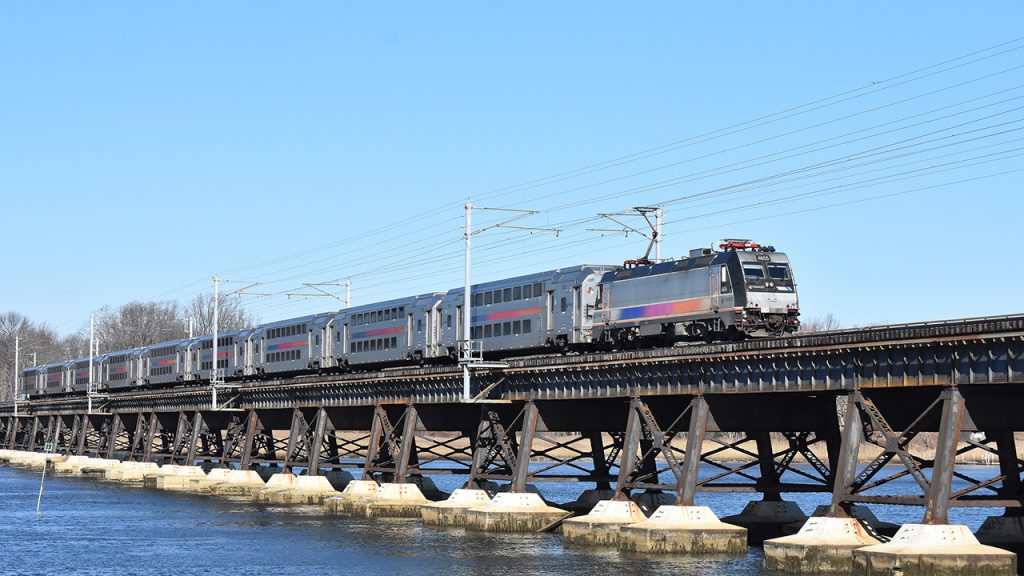
The concept of through-running, as I will examine it, is only relevant to a few multi-line systems that serve large cities in the United States and Canada, but they are places where an efficient operation can improve capacity with existing infrastructure, and maybe even render it unnecessary to spend the billions of dollars that large infrastructure projects can cost.
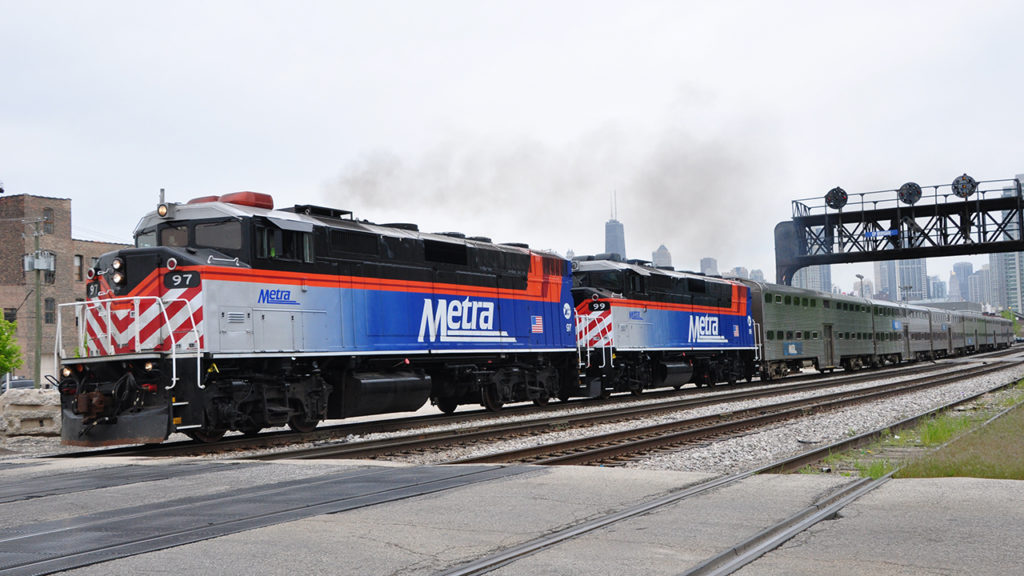
There are four major legacy rail systems in the United States, serving Boston, New York City (including from New Jersey), Philadelphia and Chicago. In each case, the lines of at least two once-separate and often competing railroad companies established local service into their downtown or waterfront terminals. That service was distinct from the long-distance trains they operated, whether they provided overnight journeys to faraway places or shorter routes that I would refer to as “corridor-length” today. These lines became “commuter railroads” over the past 150 years or so, although the trend now seems to be heading away from traditional five-day commuting and toward more-flexible approaches for riders scheduling their trips to the office or to other places, including on weekends. There is one new system that includes several lines, and that’s Metrolink. It has operated since 1992 and now serves Los Angeles with six lines radiating in several directions. In addition, there is one line that bypasses the city’s Union Station and another that serves as a shuttle, connecting with another line at its outer endpoint.
Canada does not have such legacy systems, even though there have been regional lines serving Toronto and Montreal for decades. Through-running is in operation on the Lakeshore Corridor of Toronto’s GO Transit system, operated by its agency Metrolinx. It is one of the systems I will examine later.
Private Railroads Leave; Public Agencies Arrive
Until the 1960s, regional lines serving the city center were operated by the private-sector railroads themselves. Some lines ran only during commuting hours, with or without a bit of “off-peak” service, while others offered a full span of service every day, with hourly or even half-hourly frequency. Still others featured “in-between” schedules that might have included midday service on weekdays or limited weekend service. There was no thought of through-running in those days, because the railroads competed. Some examples were the Boston & Maine on the north side and the New Haven and Boston & Albany (later part of the New York Central) on the south side of Boston, and the Pennsylvania Railroad and the Reading Railroad running competing services to Philadelphia, sometimes on lines located close together. Chicagoland was served by many different railroads, as was the New York area, where New Jersey had four and the New York State side had three. Today, Boston has only MBTA “Commuter” Rail, Chicago has only Metra, Philadelphia has only SEPTA, and New York has the Long Island Rail Road and Metro-North on the New York side and New Jersey Transit on the New Jersey side. The former private-sector competition was not sustainable or affordable, so now it’s gone. It has been replaced by public agencies whose mission of providing transportation in as cost-effective manner as possible requires making the most out of the infrastructure they own and operate.
The sort of infrastructure that can support a full span of service running frequently on local lines has changed, too. The first railroads either had an overland route to the city’s core, or they had to cross a river to get there. When a river was in the way, they built a waterfront terminal and run ferries to a point as close to the city’s core as they could get. A few such terminals survive, like Hoboken Terminal, which serves NJ Transit trains, local buses and light rail, with PATH trains and ferries to get to Manhattan. Hoboken remains a major transit center today, but it is no longer necessary for railroads to use that approach.
Why Through-Running?
All of us at Railway Age have written about the high cost of new railroad infrastructure. That includes the cost of new passenger rail projects, which seems to grow exponentially. Whether you call the landmark 2021 legislation the Infrastructure Investment & Jobs Act (IIJA) or the Bipartisan Infrastructure Law (BIL), the grants it authorized can support only a limited number of projects. There is also no guarantee that any similar legislation, especially a bill with the word “bipartisan” in its name, will become law in the foreseeable future. So, it is essential that the railroads involved use their infrastructure as efficiently as possible and keep spending on new infrastructure projects down to a manageable level. Through-running can help in that regard by reducing the amount of time any given train set stands at the downtown station after its inbound run and before its outbound run. After a train arrives, it must wait, usually for several minutes, for a track to become available for that train to make its outbound run at a stub-end terminal, whether or not through-running operation is feasible there. With a shorter turnaround time, equipment utilization improves, so it becomes possible to run more trips with the same equipment pool.
Probably the greatest benefit is the money that can be saved on infrastructure projects, because there will be less need to build tremendously expensive terminal capacity. The cost of building it crowds out smaller and less-costly projects that could deliver more mobility per dollar by opening new lines, rather than spending considerably more money expanding a terminal. The Gateway Program at New York’s Penn Station under the Hudson River and into nearby New Jersey provides an extreme example. I will have more to report about the situation on local railroads in the New York area later in this series.
Current Through-Running Examples
While through-running on local railroads has only been ongoing for a little more than 40 years (SEPTA in Philadelphia started it in 1984), a similar operation began on the Pennsylvania and New Haven Railroads more than 100 years ago, and the practice continues with many of Amtrak’s trains on the Northeast Corridor (NEC) today. It started when the Hell Gate Bridge was completed in 1917 and electrified in 1918, and trains between Washington, D.C. and Boston began stopping at the then-new Penn Station in New York City and proceeding toward Connecticut and beyond. Before then, passengers traveling on both sides of New York City made their way between Penn Station and Grand Central Terminal or took a train that bypassed New York on a route that went as far west as the Delaware River, using railroads like the Lehigh & New England, Lehigh & Hudson River, and PRR’s Belvidere Delaware (Bel-Del) line, which were used to create an overland route that was time-consuming, but provided a one-seat ride.
With Penn Station and the Hell Gate route in service, a few trains started running on the route that later became Amtrak’s NEC, as they do today. By about 1970, trains from Boston and Springfield no longer terminated at Grand Central Terminal but went to Penn Station instead. Most of them were routed south of Penn, and the practice continues today. Few of Amtrak’s NEC trains originate or terminate at Penn Station anymore.
There is also no reason why other Amtrak routes, like the Empire Service trains, need to terminate at New York. Some or all of them could be routed further south. Even the Adirondack train between New York and Montreal ran to and from Washington for a brief time in 1995 and 1996. Running some trains on Amtrak’s Empire Line in New York State and the NEC further south, Amtrak could serve the Empire State while reducing the number of moves to and from Sunnyside Yards in Queens. Amtrak discontinued the Silver Star between New York and Florida last November, claiming that it could reduce trips to and Sunnyside during an upcoming rehabilitation project by instituting that service reduction. Beyond the everyday through-running on Amtrak NJ Transit runs a few special trains between New Haven and Secaucus Junction Station in cooperation with Metro-North, with a connection on the “Sports Line” to the stadium in the Meadowlands for football games. While this routing is used only for special trains today, the precedent has been set, which has proven the concept for regional service. Metro-North is also preparing part of the Hell Gate Bridge route for local trains that would serve new stations in the Bronx, but there is no through-running contemplated for that line.
Looking Forward
The prospect of through-running as an everyday operation on NJ Transit and the railroads on the New York side of the river remains controversial today, as its proponents continue to argue that it would be useful, while the transportation “establishment” continues to object to it. I will examine that controversy later in this series. In the meantime, I will look at through-running in Toronto and possibilities for it in other places, such as Los Angeles. I will look at where it could be implemented and at efforts to get it started in some of those places, although those efforts have not yet been successful.
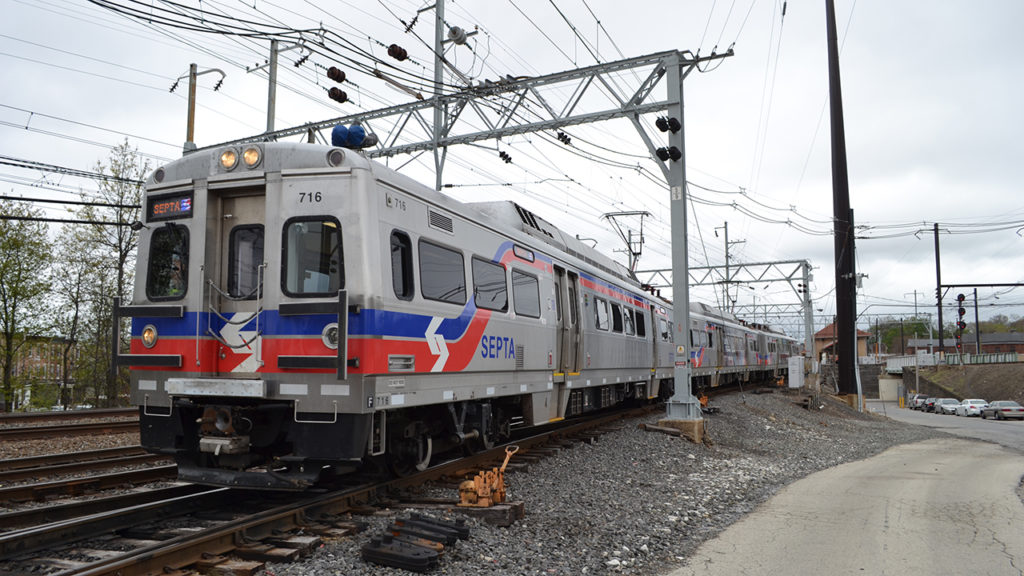
There is one place where through-running has been successful, and that’s at SEPTA in Philadelphia. A tunnel under Center City was built to join the incoming suburban lines of the Pennsylvania and Reading Railroads, and most trains now originate at one outlying point, run under Center City while stopping at three stations in that area, and terminate at a different outlying point. There is no other operation like it in the United States at the present time.
I will take a closer look at SEPTA’s operational model in the next article in this series.