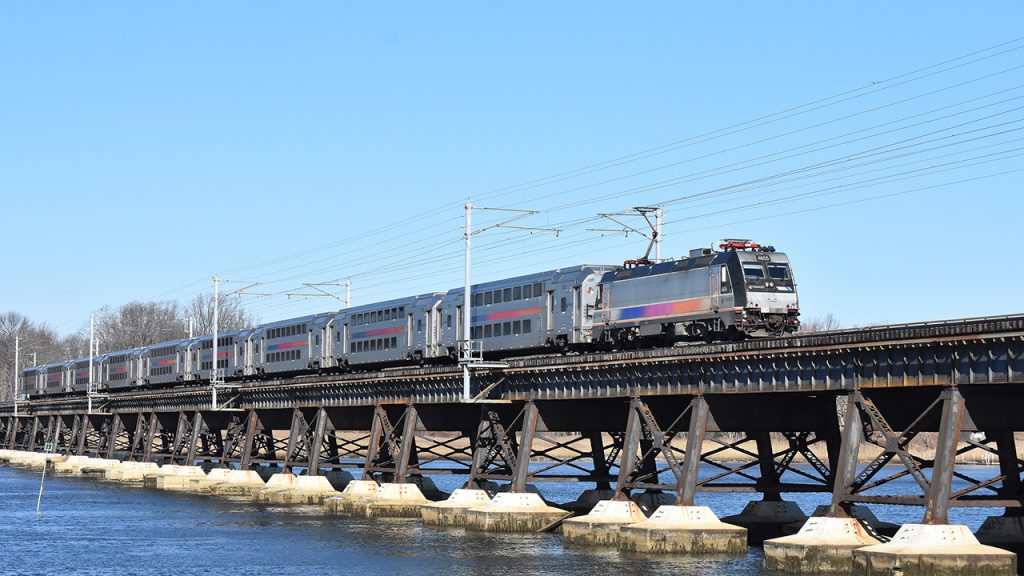
Riders on New Jersey Transit’s rail lines had to do without their trains for four days in the middle of May, due to a strike by engineers represented by the Brotherhood of Locomotive Engineers and Trainmen (BLET). It was only the second strike in the agency’s history; the first was in 1983, when NJT Rail was founded. That strike lasted 34 days. This time, the engineers received a raise in their base pay but had to make concessions to the agency to reach an agreement. Those givebacks were revealed at the agency’s Board of Directors meeting on Thursday, July 17, when the Board ratified the new contract.
The seven-year retroactive accord ends a five-year battle, mostly over money. The engineers said they were paid less than their counterparts on other local passenger railroads, and they wanted wage parity. Like essentially all other transit providers in the nation, the agency said that there was not enough money available to meet the engineers’ demands, so both sides would have to work out a deal within that constraint. Although a different deal reached last spring was rejected by 87% of union members who voted, the current accord received a “yes” vote from 95% of voting members (a vote of 398 to 21).
Statements from Both
NJ Transit did not issue a press release concerning the settlement; only one about approving the budget for the new fiscal year, which also took place at the Thursday evening meeting. Colleen Wilson reported in the Bergen Record: “Kris Kolluri, president and CEO of NJ Transit, provided details of the work rules that allowed the two sides to reach a compromise, which gave the locomotive engineers the higher hourly wage rate they wanted while giving up other items of value to make up the difference. ‘I give Tommy and his members a lot of credit, it was not an easy decision, I’m sure, for him to give up all these things,’ Kolluri said, referring to Thomas Haas, the BLET general chairman.”
Haas said: “We did have to make some pretty tough decisions about how we wanted to proceed but overall, I mean, it definitely is a win for engineers and it really made some strides for us in areas that we really felt were important,” according to Wilson, who also reported: “Haas said the agreement was a win for the engineers, who starting July 1, 2025 began earning a starting hourly rate of $53, up from the current $39.78 starting hourly pay. The engineers will receive a 3% raise July 1, 2026 and the contract ends Dec. 31, 2027.” Kolluri pointed out that Haas was present at the meeting, but he did not make a statement at that time.
Throughout the process and since he came on board to lead the agency, Kolluri stressed that he wanted a deal that was fair to the riders and the taxpayers, and that also was fair to the union and its members. He also made it clear that the agency had to be careful about the money it spends whena it negotiates labor agreements. The unions representing all other crafts had already settled with the agency.
Givebacks Revealed
To get the wage increase that came with the deal, the engineers had to give up money elsewhere. Kolluri revealed four such givebacks as part of his report at the meeting:
- They would make a 3% contribution toward health care, which Kolluri said no other union is doing.
- Overtime pay (at time and a half) no longer starts after eight hours of work, but after nine hours. In other words, the ninth hour of work during a workday is now compensated at the “straight time” rate.
- Deadhead pay allowances have been reduced by 10%.
- Engineers will now complete 16 hours of mandatory training at home, on their own time, rather than going to the workplace for it. Kolluri noted that the agency will no longer have to pay somebody else to fill in for the employee taking the training, sometimes at overtime pay rates.
NJ.com reporter Larry Higgs explained the pay rates: “The union got a desired hourly rate increase to $53 for engineers, which keeps NJ Transit competitive with the salaries of peers at other commuter and passenger railroads, such as Metro-North, Amtrak and the Long Island Rail Road. Assistant engineers get $43.48 per hour, and trainees receive $37.10 per hour … They also received a 3% annual increase, which was an issue that led to union members voting down the first tentative contract.” The 3% increase keeps pace, at least on a percentage basis, with automatic annual 3% fare increases; a policy that was approved last year.
Engineers would also receive retroactive raises that were implemented during the five-year period they worked without a contract. If they took their training at NJT and left the agency before three years’ service, they will be required to pay the agency back for up to $9,300 in costs, depending on when they quit. They will also get holiday pay for Veterans’ Day and Juneteenth. In 2022, some engineers walked off the job in a dispute over holiday pay for Juneteenth. NJ Transit sued, claiming that the job action was unlawful, and the union paid $50,000 in a settlement.
More Givebacks Elsewhere?
The newly approved pact at NJ Transit might signal a new model for collective bargaining between transit agencies and rail labor. Whether or not this model would affect private-sector railroads (Brightline is the only private-sector passenger operation except for tourist railroads; the rest carry freight as their primary business), transit agencies are in the public sector. Amtrak’s status is less clear, but it acts more like a public-sector entity than a private-sector one.
It is well-known, and we have reported on the situation extensively here at Railway Age, that transit agencies are in financial trouble. Some are facing imminent and massive service reductions, stemming from funding crises that have resulted from reductions in ridership and revenue that started with the COVID-19 pandemic. New federal policies are not friendly to transit, and massive cuts in federal programs will put more pressure on states and their political subdivisions to pay more for the programs and services that they continue to provide. That includes transit, which includes rail transit operations.
Lean times for rail management will also bring lean times for rail labor. After NJ Transit’s engineers rejected one proposed deal, a different deal proved much more popular, and they accepted it overwhelmingly. It included givebacks, but the engineers apparently decided that the givebacks were worth it to get a raise in their base pay, and management decided that the givebacks will save the agency enough money to justify the raises. Time will tell if this model of collective bargaining catches on in the industry generally. As the “Magic 8-Ball” said: “Signs point to Yes” because hard times that are now affecting both labor and management will probably dictate that they will have no other choice.