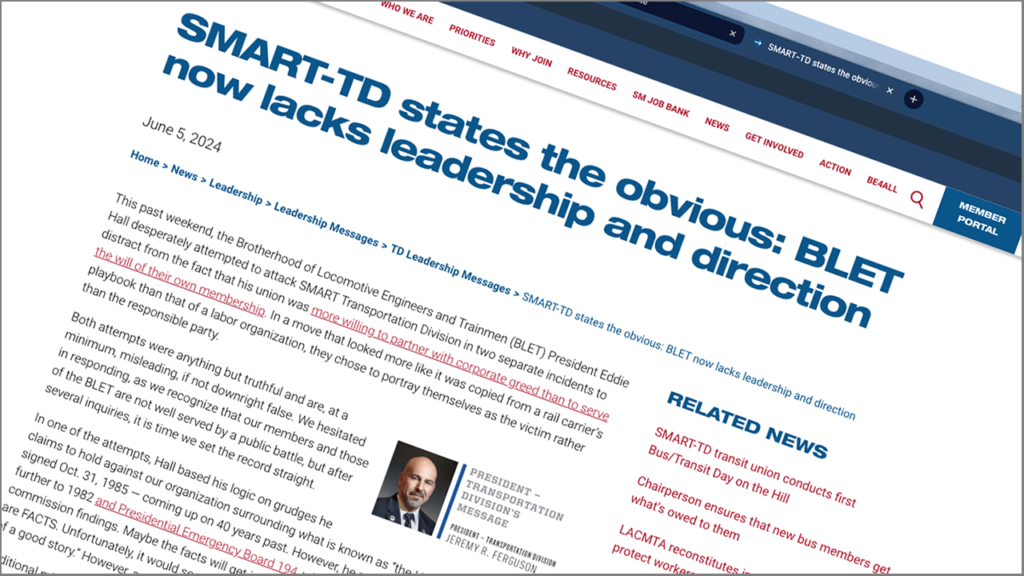
WATCHING WASHINGTON, RAILWAY AGE JULY 2024 ISSUE: Those scorpions in a bottle—the Brotherhood of Locomotive Engineers and Trainmen (BLET) and the Transportation Division of the International Association of Sheet Metal, Air, Rail and Transportation Workers (SMART-TD)—are locked for the umpteenth time in combat, alleging in website derisions a litany of grievances.
Alleged are dishonorable recruitment, selling out the other union’s jobs, being weaker on safety, and misfeasance in member representation. Precipitating the current rumble is strenuous competition to hold and attract members and an April 2024 BLET attempt at a sweetheart deal with private equity fund Ancora that SMART-TD alleges would have harmed its members’ job security on Norfolk Southern had Ancora succeeded in a proxy battle.
Troublingly, this is more than a cacophonous parade of publicly traded insults as the infighting menaces good faith bargaining in an approaching new round of contract negotiations amending wage rates, benefits and work rules. The fault lines run deep—the two having six times rejected marriage and serially initiated hostilities against the other.
The underlying cause for each to leap at the other’s jugulars are declining numbers of dues-paying conductors and engineers as new technology has allowed Class I railroads to improve productivity and efficiency while slashing total employment from 458,000 in 1980 to under 116,000 today.
Exacerbating tensions is a blurring of once bright craft demarcation lines that assured representation of conductors by SMART-TD predecessor United Transportation Union (UTU), and of engineers by BLET predecessor Brotherhood of Locomotive Engineers (BLE). Collective bargaining agreements now provide for an ebb-and-flow of train crews across craft lines, creating for both unions a temptation to poach the other’s members as either may represent those sharing the locomotive cab.
“Troublingly, this is more than a cacophonous parade of publicly traded insults as the infighting menaces good faith bargaining in an approaching new round of contract negotiations amending wage rates, benefits and work rules.”
Although the union for unions—the American Federation of Labor and the Congress of Industrial Organizations (AFL-CIO)—provides in its charter that affiliated unions not raid each other’s members, obedience has been spotty. UTU twice quit to escape sanctions, while BLET also has a dodgy in-and-out history.
Should contretemps turn vicious, BLET could abandon its support for a minimum of one conductor and one engineer on through freight trains and seek, as it did in 1985, higher engineer wages in exchange for reduced crew size. At BNSF today, BLET has such an agreement that could become operative in a few years when moratoriums on existing minimum crew size expire.
If this appears counter to the responsibility of labor unions to protect member jobs, consider that three parties sit at the negotiating table—rail management, and labor unions wearing two hats. Economic theory holds that self-interest is paramount when the choice is between a union’s financial security and its members’ job security.
Union cost cutting has not matched dues losses caused by carrier head-count reductions. Over the past few decades, SMART-TD membership has declined from 181,000 to under 70,000 as technology replaced jobs of brakemen, firemen, flagmen and switch tenders.
To Merge or Not?
As with railroads that unified in search of greater efficiency, rail labor organizations recognize their own mergers can be a financial lifeline. For BLET and SMART-TD, when marriage failed to occur, the fallback strategy was plunder.

SMART-TD predecessor UTU was formed in 1969 through the merger of four operating-craft unions themselves beset by declining dues revenue as technology advancements contributed to a 50% reduction in their memberships. The 2011 consolidation of UTU and Sheet Metal Workers International Association (SMWIA) into SMART was a similar effort at financial husbandry following a UTU membership decline from 181,000 in 1974 to some 68,000.
Before UTU consolidated with SMWIA, and BLE with the Teamsters, the two failed at six merger attempts that would have produced substantial cost savings and better situated the unified BLE and UTU to fend off a race-to-the bottom as railroads played one against the other.
Can’t We All Just Get Along?
Although an informal truce between BLET and SMART-TD existed for almost two decades before this latest outbreak of malevolence, their history is one of skirmishes and worse to the abiding detriment of members:
- In 1965, the AFL-CIO censured BLE for raiding a UTU-predecessor union.
- In 1969, BLE declined an invitation to join a merger of four operating crafts forming UTU.
- In 1985, BLE’s Lake Erie Plan supported crew-size reduction from five to two BLE-represented engineers in exchange for the engineers receiving higher pay. Jobs represented by UTU were to be phased out.
- In 1986 and 1988, BLE rejected merger. The 1988 attempt failed when UTU sought to recruit BLE-represented Norfolk Southern engineers.
- In 1993, BLE withdrew from merger talks, suggesting UTU first cease negotiating separately with rail management and work jointly with BLE to “begin building a history of trust.”
- In 1994, when UTU struck Soo Line Railroad, BLE authorized its engineer members to cross picket lines, saying UTU’s demands threatened BLE-represented jobs.
- In 1997, UTU, which had more members than BLE on most railroads, sought congressional legislation to combine the separate crafts of conductor and locomotive engineer as a prelude to winner-take-all elections. The language was surreptitiously attached to an unrelated funding bill for military aid to Bosnia, but stricken when BLE discovered its existence.
- Also in 1997, BLE, after gaining representation of UTU conductors on Canada’s VIA Rail, negotiated a combining of crafts, causing job eliminations of former UTU members. The Canada Industrial Relations Board found BLE liable for reparations.
- In 1999, BLE withdrew from UTU merger talks facilitated by the AFL-CIO after dissident BLE officers initiated a successful recall of merger proponent and BLE President Clarence Monin. In earlier supporting the merger, Monin said, “We’ve lived within a cocoon for too long.” Following the failed merger vote, the UTU commenced a raid of Union Pacific-employed BLE members. With significantly more members (22,000) than BLE (8,000), UTU sought a winner-take-all election to represent both crafts. BLE retaliated by enlisting its Conrail members to encourage UTU members to switch unions. The NMB denied UTU its UP-representation election, saying it would not “deviate” from precedent even though it earlier ruled that on three non-Class I railroads (Florida East Coast, Terminal Railroad of St. Louis and Texas-Mexican) “modern practices” had blurred craft lines.
- In June 2001, BLE and UTU jointly said a merger would “produce substantial financial savings” and end “hostilities that have distracted both of us from doing what we’re paid to do—represent our members’ interests.” During those merger talks, UTU signed a letter of intent with UP that UTU-represented conductors operate yard locomotives from the ground using remote control in place of engineers in the cab. UTU promised to share remote control jobs if BLE agreed to merge. While UTU members voted 6-to-1 for merger, BLE members voted “no” by a 5-2 margin.
- In 2002, the NMB again denied a UTU request for a winner-take-all representation election—this time on Kansas City Southern Railway.
- In 2003, UTU initiated a winner-take-all election on Canadian Pacific (CP) in Canada—and lost its CP members when BLE won the vote.
- In 2004, BLE accused UTU of a Bosnia-bill encore in seeking congressional sponsors for legislation mandating—based solely on which union had the higher headcount—a single bargaining representative for operating crafts on Class I railroads.
- Also in 2004, a merged-into-Teamsters BLET urged engineers nationally to “recruit” UTU members with whom they shared the locomotive cab. A “T” was added to BLE for “Trainmen,” generic for UTU crafts.
- In 2007, the AFL-CIO “condemned” non-member BLET for “an intensive campaign to raid the membership of the UTU” by offering “reduced, and in some instances, free dues with hopes of enticing UTU members to join the BLET.”
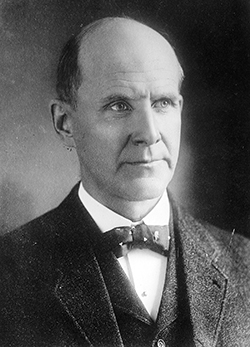
A succeeding era of good feelings just couldn’t last. Rather than collaborate to strengthen bargaining power for the benefit of members, BLET and SMART-TD again have chosen self-serving infighting. The greatest of rail labor leaders, Eugene V. Debs, wrote in 1893: “What can labor do for itself? The answer is not difficult. Labor can organize, it can unify, it can consolidate its forces. This done, it can demand and command.”

Railway Age Capitol Hill Contributing Editor Frank N. Wilner was for 12 years director of public relations for UTU and SMART-TD, having previously been a White House appointed chief of staff at the Surface Transportation Board and assistant vice president for policy at the Association of American Railroads. He is author of “Understanding the Railway Labor Act,” available from Simmons-Boardman Books at www.railwayeducationalbureau.com, 800-228-9670.