HISTORICAL PERSPECTIVE, RAILWAY AGE MARCH 2026 ISSUE: Railroad history tends to be reductive, or at the very least presented without a great deal of context. Why that is, and what to do about it, have not greatly troubled scholars and writers of popular histories for the past two centuries. There were many reasons.
By its nature, railroading is complex, multi-disciplinary, dispersed and sometimes devilishly hard to characterize. It was our first truly synthetic technology, in which the whole was vastly greater than the sum of its parts. The extent to which railroad mobility shaped almost every aspect of modern America has never been fully explored. It was merely assumed, or taken for granted.
Railroading was seductive in so many ways. The works themselves could be grand and reflect emerging American values. For many decades it was on the leading edge of what it was possible to do. It was what we might call an “enabling technology”—much like digital computing a century-and-a-half later. And it provided good livings for millions of people.
It also could be rewarding. Railroading made travel and business more accessible and less fraught. Many people found railroad work satisfying, and it was the answer to problems we had never even thought of before. What railroading provided was a lot like the idea of American-style democracy itself. It was a new form, turned old ways of thinking on their heads and opened possibilities that were unimaginable just a few decades earlier.
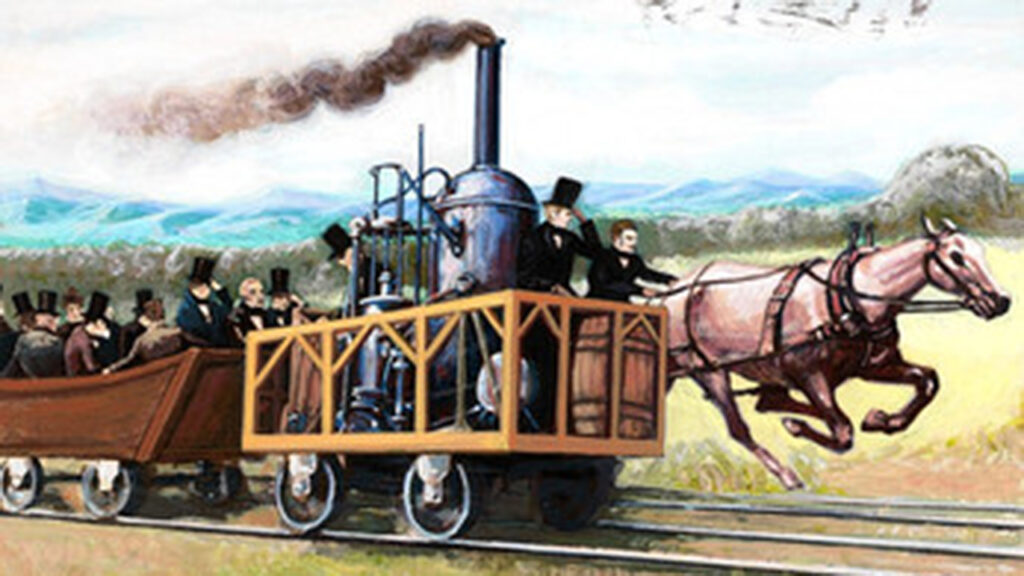
We too often accept conventional interpretations that railroading was either an import from Great Britain, or some “new” technology (like penicillin or the electric light bulb) that was suddenly “invented” and quickly made the world better. The standard narrative was that mobility in the U.S. was primitive before 1827, when the Baltimore & Ohio Railroad sprang into existence as the country’s first fully conceptualized, modern logistics enterprise. Afterward, everything changed. That is lazy thinking of the worst kind.
This year seems particularly apt to pause for some attitude adjustment. I suggest that the 1820s were not merely the dawn of the “Railway Age” (an older expression from which this storied publication takes its name), but the final act in the project to create effective American independence.
In its first half-century, neither the survival nor prosperity of the new “United States” was assured. At times, its prospects were downright precarious, and everyone involved knew it. The Founding Fathers (we have little idea what the Founding Mothers thought) had profound reservations: How, when everything moved at the speed of an animal, the wind or a current, would it even be feasible to govern a continental nation? Thomas Jefferson imagined it would take a thousand years or so to create a nation stretching from the Atlantic to the Pacific.
In fact, it took roughly 90 years—one long lifetime. Railroad mobility was the reason. There were men and women in 1893 whose lives overlapped the signing of the Treaty of Paris in 1784, which officially ended the War for Independence. That was the year railroads mounted massive and celebratory history exhibits at the World’s Columbian Exposition in Chicago.
America’s earliest railroads were a necessary, although not sufficient, element of the country’s successful independence. Early railroad promoters had a deep understanding of the struggle to create a new, and likewise synthetic, nation. One of the greatest challenges facing the U.S. in the Early National period was mobility. It took a few decades, but railroading answered the need.
It wasn’t coincidence (or a stunt) that Charles Carroll, the only surviving signer of the Declaration of Independence, turned the first spade of earth to mark the beginning of construction for the B&O on July 4, 1828.
The quote attributed to him—that he considered his involvement in early railroading second in importance only to signing the Declaration of Independence (if even to that)—was not mere politesse. He was a plantation owner, clear-eyed businessman and participant in a revolution that could have turned out very badly for him and his family. Carroll clearly understood that the mobility railroading promised would make the kind of America he (and his fellow patriots) imagined possible.
The great experiment we know as the United States was, and remains, a process and not a fait accompli. Miscalculations by the British, and the apparent freedom engendered by being an ocean away, gave rise to the notion of American independence. A brutal seven-year struggle offered a kind of nascent physical and political independence. But that was never sufficient to ensure its survival.
Railroad mobility provided what I call “independence of creation.” It isn’t the physical reality of the most comprehensive logistics network the world had seen that represents railroading’s accomplishment. Instead, it is the kind of freedom and independence that reliable, all-weather, effective, inexpensive, near-universal transportation confers on a population at continental scale.
That represents railroading’s contribution to American Independence. By removing barriers of time, distance, cost and effort, railroad mobility unleashed a century of individual and collective creativity never before imagined, much less attempted. The railroad boom of the 1820s and 1830s was, in my opinion, the final chapter in the half-century struggle to create a truly independent and sustainable U.S. It wasn’t merely an enabling technology. It was the technology we needed, at the right time and in the right places.
That is why the Bicentennial of American Railroading is important. It isn’t a single event or year we should be celebrating, but rather a kind of awakening. There is always a before and an after, and somewhere in the middle something changes. It is the same for the American political independence we celebrate this year.
There is much to be gained by nesting railroading’s 200 years deeply within America’s 250, if for no other reason than that the success of each depended on the other. The railroad industry looks forward—as it must.
But neither should it ignore, or worse yet, underestimate, the richness and importance of its past. It isn’t too late to more creatively recognize, and share, what railroading has meant in the creation of the modern U.S. The short-term benefits of the railroad industry embracing its history may seem elusive. Two centuries of experience suggest otherwise. It would be an astute investment in its future.

John Hankey is a curator and historian with more than 50 years of professional experience in railroad history and preservation. He holds a B.S. from the Johns Hopkins University, an M.A. as a Hagley Fellow at the University of Delaware and did further graduate work at the University of Chicago. His three primary research interests focus on how railroad mobility shaped America, aspects of railroad technology and culture, and addressing myths and misinterpretations of traditional railroad history. He is most proud, however, of the six years he spent in Engine Service on the Baltimore & Ohio Railroad, and his tenure at the B&O Railroad Museum in Baltimore, where he served as Chessie Systems Historian and Archivist, and later as the museum’s Chief Curator. Also invaluable was the time he spent doing real railroad work, providing the kinds of insights and experiences unavailable by any other means. As a consultant, he has worked with Class I railroads, major museums and historic preservation projects throughout the country, the Smithsonian, National Park Service, local governments and dozens of smaller railroad heritage projects. He is the fifth (and final) generation on his father’s side to have worked for the B&O.