KBS
KBS on March 31 reported launching a new stand-alone website, www.kb-signaling.com, “giving current and prospective customers, partners, and rail industry stakeholders across the globe a direct digital entry point to the company’s signaling products, project delivery capabilities, and technical resources.” KBS, which has been a member of Munich, Germany-based Knorr-Bremse Group since 2024, develops and supplies what is described as “end-to-end wayside and onboard conventional signaling, Control, Command, and Signaling (CCS) platforms and solutions.”
KBS said its “roots extend more than a century across North American rail signaling,” and the new website reflects its focus on “safety, reliability, system compatibility, and long-term performance across critical rail infrastructure.”
According to the company, the website presents its offerings “in a structure aligned with how customers evaluate signaling systems in practice”: from individual subsystems to fully integrated projects. For example, as transit agencies weigh the cost and complexity of implementing communications-based train control (CBTC), KBS noted, many are pursuing a staged conventional-signaling upgrade, and the company helps enable this approach by being CBTC vendor-agnostic. “This interoperability between CBTC hardware and digital conventional signaling enables flexible, phased deployment and smart reuse of assets,” it said.
The website:
- Covers products including the fifth-generation AFTC5 digital Audio Frequency Track Circuit and the integrated Vital Processing Interlocking (iVPI®) system.
- Highlights KBS’s role as a “project-focused partner, reflecting how the company supports customers from initial concept through commissioning and long-term operation.”
- Includes a centralized document library, as well as “enhanced search capability” to allow access to technical documentation, brochures, and supporting resources.
- Provides background on KBS’s history, leadership, locations, values, and certifications. There is also a careers section.
“In rail signaling, confidence comes from understanding the technology—and how it performs, integrates, and is supported over time,” said Craig Daniels, Head of commercial for KBS. “This website complements our technical expertise. It gives customers and partners a clear, practical way to understand our capabilities, explore our products and project experience, and engage directly with our teams as they plan and deliver complex, safety-critical programs.”
Further Reading:
- One Year of KB Signaling
- KB Signaling Showcases QuEST™ Rail Software-Based LCP at Railway Interchange 2025
- KB Signaling Expands WSDMM
- Knorr-Bremse, Nexxiot to Launch Suite of Smart Products for Improving Rail Connectivity
- Alstom Sells North American ‘Conventional Signaling’ Business to Knorr-Bremse AG
Actelis
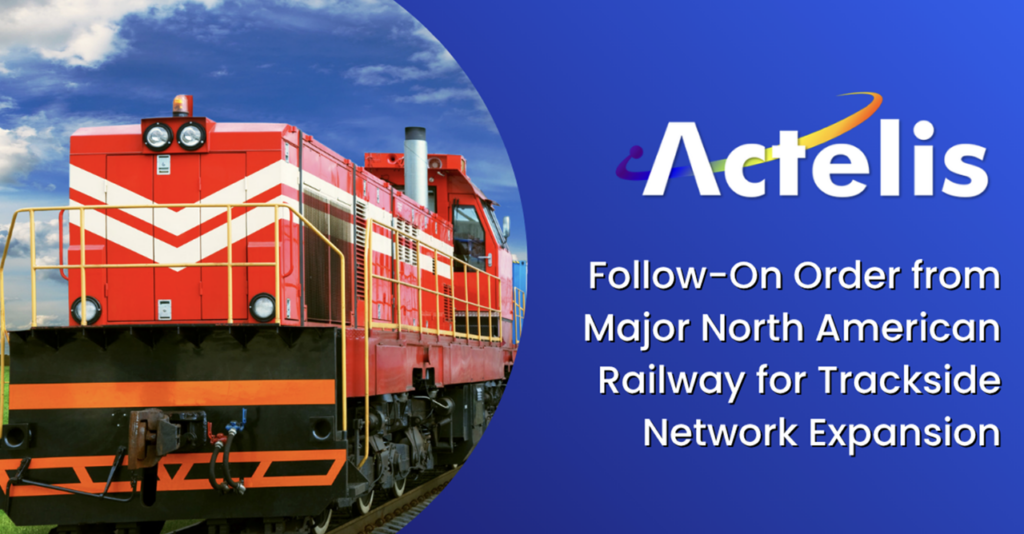
Actelis, a provider of networking solutions for IoT and broadband applications, recently reported receiving a follow-on order from a “major North American railway operator” to expand “trackside networking infrastructure supporting critical rail safety and control systems.”
The customer, which Actelis did not name, “has been deploying Actelis’ solutions across its network over several years and continues to expand its footprint, leveraging Actelis’ centralized management software to remotely monitor, manage, and troubleshoot its distributed trackside infrastructure,” according to the supplier.
The order will “support the continued rollout of networking solutions along challenging rail corridors, where reliable connectivity is essential for the operation of advanced safety and signaling systems, including centralized traffic control and other mission-critical applications,” Actelis said.

The company’s “hybrid fiber networking solution” was selected for its “ability to deliver fiber-grade performance over existing infrastructure while enabling rapid deployment across extended and remote track environment,” Actelis said. “By leveraging existing infrastructure and integrating fiber and wireless components, Actelis’ hybrid fiber-copper technology allows operators to extend high-bandwidth connectivity along rail lines without the need for costly and time-intensive new fiber installation, ensuring the redundancy and reliability required for safety-critical applications, while supporting both traditional and AI-driven monitoring and network operations.”
“Rail networks require highly resilient communications systems that can perform reliably across remote and environmentally demanding terrain,” Actelis Chairman and CEO Tuvia Barlev said. “This follow-on order reflects the customer’s continued confidence in our ability to deliver secure, high-performance connectivity for trackside infrastructure supporting critical safety systems.”