The Surface Transportation Board on March 13, 2026, responding to separate letters filed Sept. 30, 2025 by Norfolk Southern and Union Pacific about “specific concerns with respect to service commitments made by CPKC (Canadian Pacific Kansas City) regarding the 320-mile Meridian Speedway in the CP/KCS merger proceeding, decided “there is no need for it to intervene at this time.”
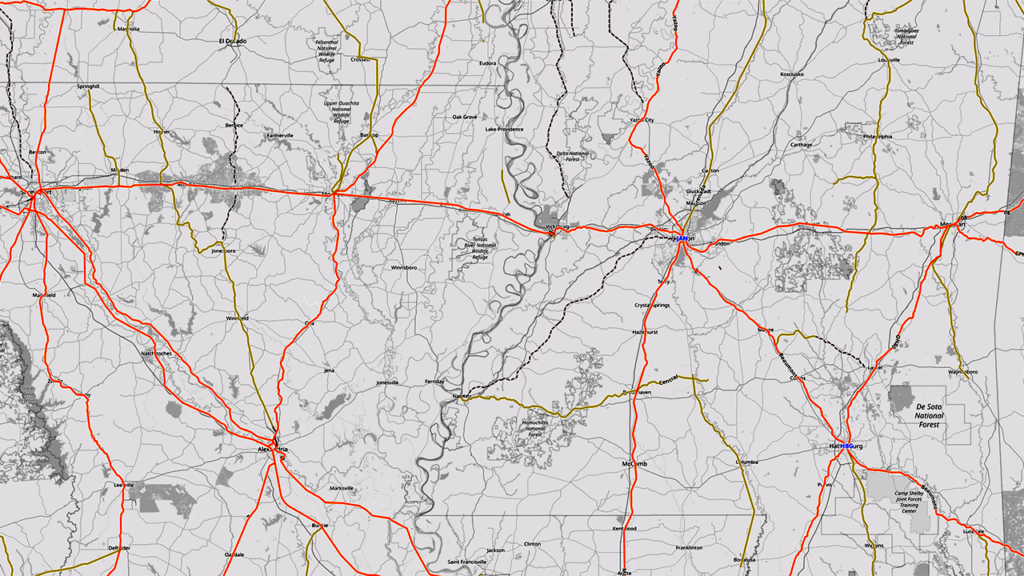
In STB Docket No. FD 36500 (Sub-No. 6), CANADIAN PACIFIC RAILWAY LIMITED; CANADIAN PACIFIC RAILWAY COMPANY; SOO LINE RAILROAD COMPANY; CENTRAL MAINE & QUEBEC RAILWAY US INC.; DAKOTA, MINNESOTA & EASTERN RAILROAD CORPORATION; AND DELAWARE & HUDSON RAILWAY COMPANY, INC. —CONTROL— KANSAS CITY SOUTHERN; THE KANSAS CITY SOUTHERN RAILWAY COMPANY; GATEWAY EASTERN RAILWAY COMPANY; AND THE TEXAS MEXICAN RAILWAY COMPANY (GENERAL OVERSIGHT) (download below), the Board denied requests from Norfolk Southern and Union Pacific “related to alleged service issues on the Meridian Speedway between Meridian, Miss., and Shreveport, La.”
“In its Sept.30, 2025 letter, NS requests that the Board direct CPKC to provide a Service Action Plan to detail its plan for restoring Meridian Speedway haulage service to acceptable levels,” STB summarized. “According to NS, since CP’s acquisition of KCS, there has been a substantial deterioration in intermodal train service provided by CPKC over the Meridian Speedway and at the Shreveport gateway, which has affected multiple intermodal customers, some of whom have diverted their traffic from rail service to trucks. NS contends that the service degradation is inconsistent with representations that CP and KCS made to the Board in the merger proceeding, and that it is within the Board’s authority to direct CPKC to take immediate action to restore service to acceptable levels and to provide a Service Action Plan. NS states that CP and KCS specifically represented in the merger docket that ‘[n]either NS nor the Board has any reason to be concerned that CPKC will be a good steward of service on this route’ and that CPKC would take steps ‘to increase train frequency and improve service, to the benefit of both NS and intermodal shippers’ over the Meridian Speedway, and that service in general would be ‘as good as or better’ than service pre-merger. NS argues that CPKC’s performance has not matched the promises it made in the CP/KCS merger approval proceeding. According to NS, over the [past]six months, transit times on Meridian Speedway haulage trains to and from Shreveport have ballooned and the Meridian Speedway has seen a marked decrease in traffic, which is attributable in large part to CPKC’s poor service.”
“In its letter, UP requests that the Board investigate the deterioration in CPKC’s service over the Meridian Speedway and hold CPKC to what UP argues are CPKC’s commitments it made in the CP/KCS merger proceeding,” STB said. “UP states that before the CP/KCS merger, it delivered intermodal trains of up to 11,000 feet in length to KCS at Shreveport, for movement to NS at Meridian via the Meridian Speedway. According to UP, shortly after the Board approved the merger, CPKC imposed an 8,500-foot length limit on trains it would accept at Shreveport for movement over the Meridian Speedway. UP states that it agreed to abide by the restriction with the understanding that CPKC would provide additional resources to move the larger number of trains required as a result of the length restriction. UP argues, however, that CPKC has failed to provide those additional resources, and, as a result, UP and its customers are experiencing unacceptable delays, and the delays are increasing.”
CPKC, STB said, submitted a letter on Nov. 13, 2025 “arguing that the issues raised by NS and UP are not matters that fall within the ambit of the Board’s oversight, and, in any event, lack merit as a matter of fact. CPKC contends that the gateway condition imposed in the CP/KCS approval decision does not apply because the traffic at issue is not ‘affected traffic.’ CPKC states that the NS haulage traffic at issue was not affected by the merger, as it is intermodal traffic which CP does not serve today and did not serve pre-merger.”
“CPKC also defends the 8,500-foot train length restriction, noting that this limit was chosen because only three sidings out of the 20 in the 300 miles between Shreveport and Meridian can accommodate trains longer than 8,500 feet,” STB noted. “Furthermore, CPKC argues that since instituting the train length restriction, transit times for all trains on the Meridian Speedway improved markedly as soon as over-length NS haulage trains were shortened to fit within available sidings. According to CPKC, the increased dwell time in UP’s Hollywood Yard at Shreveport is a consequence of UP’s decision to continue to push overlength trains toward the Speedway despite knowing that those trains will have to be shortened at Hollywood Yard before moving onto the Speedway.”
“Union Pacific is disappointed with the Meridian Speedway decision,” UP told Railway Age when asked for comment. “Canadian Pacific changed the way they operated and moved customer freight after they purchased Kansas City Southern. We’re disappointed but will live with the decision.”
Norfolk Southern, when contacted by Railway Age, declined to comment.
This case was part of STB’s efforts to clear a large backlog.
“This was a case of Union Pacific insisting that CPKC allow 11,000-foot trains on the Speedway in spite of what the long-standing agreement made between Kansas City Southern and UP in 2006 established,” an industry observer told Railway Age. “It angered UP that CPKC decided to eliminate over-siding trains to run an 8,500-foot maximum for all trains on the corridor. In the STB filing, UP misrepresented the delays and tried to paint CPKC as violating CPKC’s merger commitments on gateways and service. UP CEO Jim Vena more than once publicly criticized CPKC, stating CPKC would not allow them to run 11,000-foot trains ‘the way the railroad was supposed to be run.’ He also made attempts to use the dispute as evidence that partnerships don’t work. As a lead up to the STB dispute in Fall 2023 , in response to CPKC’s 8,500-foot restriction, UP retaliated and imposed an arbitrary 8,000-foot-train restriction on CPKC on the trackage rights it uses to get to Mexico south of Houston, Tex., despite that years before, KCS invested heavily to extend numerous sidings across a roughly 70-mile line segment to accommodate 10,000-foot trains—the details of which are in two CPKC STB filings. This can be inferred as anti-competitive behavior and gives the very strong impression that UP will not hesitate to waste the STB’s time creating a dispute when it doesn’t get its way—the type of behavior that will become a customer problem if UP does not live up to any of the conditions imposed to have its merger with NS approved.”