RAILWAY AGE, MARCH 2026 ISSUE: Now the No. 8 U.S. port by volume and still looking to grow, South Carolina Ports Authority boasts the deepest harbor on the East Coast and “can handle any ship, any tide, any time.”
The South Carolina Ports Authority (SCPA), with two rail-served intermodal inland ports with daily, overnight service, delivers the benefits of a coastal marine terminal many miles inland and allows shippers to reduce carbon emissions up to 80% vs. all-truck service. SCPA, served by Norfolk Southern (NS) and CSX, is investing $3 billion in capacity, trying to stay ahead of growing demand. Recently appointed SCPA President and CEO Micah Mallace late last year detailed a “pledge for aggressive growth” to 1,100 port customers and stakeholders during his first State of the Port address.
SCPA’s Port of Charleston “enjoys the deepest harbor on the U.S. East Coast, has secured a path to 10 million TEUs at its marine terminals, and has invested to ensure its rail capabilities match the growth occurring in South Carolina and throughout the Southeast,” the Authority noted. “Companies invested $8.19 billion in new and existing businesses in South Carolina over the past year. Of that, Port customers invested more than $786 million into new and expanding manufacturing facilities and distribution centers, adding 1,200 jobs and bringing new volume to the Port’s inland and ocean terminals.”
Ocean carriers also showed “a vote of confidence” in SC Ports’ capabilities within the U.S. Southeast market, SCPA said. The Port of Charleston grew its weekly services to 29 in 2025, including first-in-calls from key markets in Asia and Europe, and expanding coverage of the growing India market to six weekly services.
The Authority noted that, combined, its freight terminals—Inland Port Dillon, Inland Port Greer, Wando Welch, Leatherman and Columbus Street—“outpace the U.S. market and other South Atlantic ports for growth in the Northeast Asia-U.S. trade lane. Post-COVID, the Port of Charleston’s volume has increased by 9% in this trade lane, compared to a decline of 2% at other regional ports.” The inland ports handle rail cargo; Columbus Street is a roll on/roll off (“RORO” or “ro-ro”) facility*, and Wando, Leatherman and North Charleston handle containerized cargo.
“SC Ports was the fastest growing U.S. container port for nearly a decade,” Mallace said. “We have done this before, and we can achieve it again. Generating growth necessitates a momentum change, and momentum change requires bold initiatives. This is a region where one can engineer above-market growth, and that is exactly what we intend to do.” Mallace said a multi-year effort includes plans to use SCPA real estate to “facilitate growth projects for businesses, help support projects with partners who generate growth, focus on revenue-generating infrastructure, and offer creative solutions and white-glove service to BCOs (Beneficial Cargo Owners).”
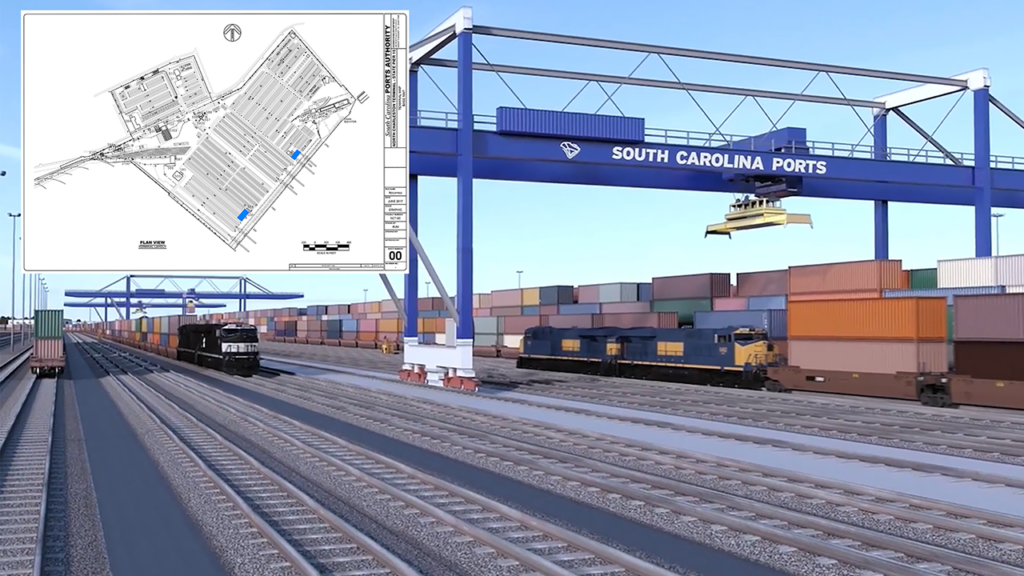
SCPA is looking to open Navy Base Intermodal Facility (NBIF), a near-dock, rail-served cargo yard located on a 118-acre site on the former North Charleston Navy Base. NBIF will allow import and export traffic to move between the Port of Charleston and Inland Ports Greer and Dillon, and on to inland markets throughout the Southeast and Midwest. NS and CSX will serve NBIF; SCPA is working with both railroads to finalize agreements.
NBIF, in which the State of South Carolina is investing $550 million, will feature 78,000 linear feet of railroad track that can handle 14,000-foot-plus trains, and six electric rail-mounted gantry cranes to transfer containers between CSX and NS trains and trucks. A one-mile dedicated drayage road will be used to truck cargo to and from Leatherman Terminal, and a planned barge service will transport containers between the Leatherman and Wando Welch terminals. Annual lift capacity will be one million containers.
SCPA has also expanded Inland Port Greer to enable it to handle longer trains and 50% more cargo.
SCPA’s shorter-term growth prospects are somewhat uncertain, though. Despite the strength of the U.S. Southeast market, “challenges persist,” and the Authority saw “tempered container volumes and stable growth in its 2025 fiscal year.”
“As the three-year freight recession persists, spot rates are down, and volatility has become the new normal. The port market will continue to have to operate in a challenging environment,” Mallace told State of the Port attendees. “We see the same challenges as our competitors, but we are not satisfied with 3% year-over-year growth in the container segment.”
*From Wikipedia: “Roll-on/roll-off (RORO or ro-ro) ships are cargo ships designed to carry wheeled cargo, such as cars, motorcycles, trucks, semi-trailer trucks, buses, trailers, and railroad cars, which are driven on and off the ship on their own wheels or using a platform vehicle, such as a self-propelled modular transporter. This is in contrast to lift-on/lift-off (LoLo) vessels, which use a crane to load and unload cargo. RORO vessels have either built-in or shore-based ramps or ferry slips that allow the cargo to be efficiently rolled on and off the vessel when in port. While smaller ferries that operate across rivers and other short distances often have built-in ramps, the term RORO is generally reserved for large seagoing vessels. The ramps and doors may be located in the stern, bow, or sides, or any combination thereof.” I thank SCPA Public Relations Manager Laura Clifton for educating me and correcting a few errors in this story. One is never too old to learn something new. – William C. Vantuono