
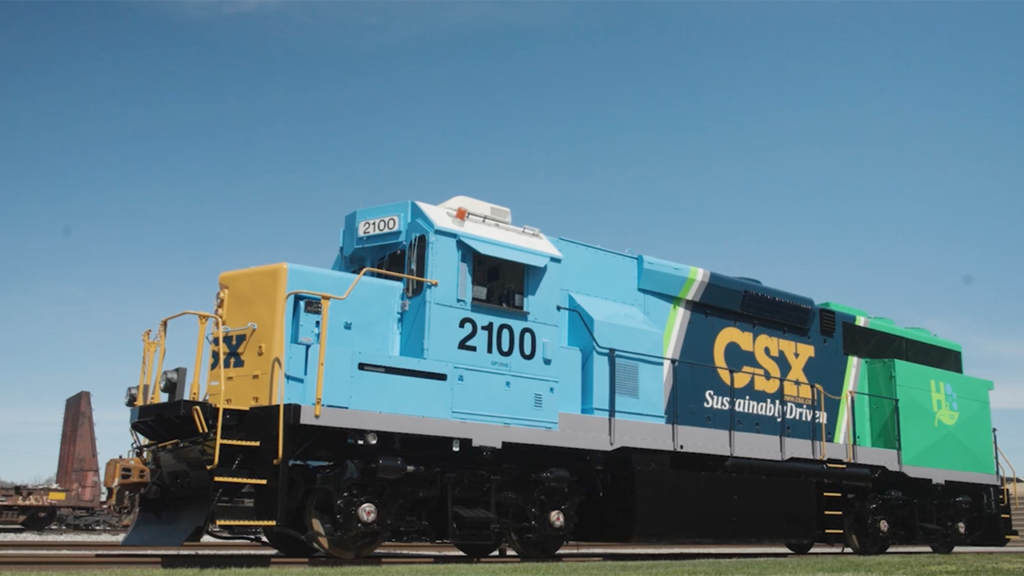
Our rapidly warming planet has been sending us all repeated signs that the unrelenting accumulation of greenhouse gasses (GHGs) surrounding the Earth must be reversed. The U.S. Department of Transportation (USDOT) is doing its share to fulfill the Biden Administration’s climate priorities, making Climate and Sustainability one of its Strategic Goals. And the Administration has made reducing carbon emissions a top priority in two signature pieces of legislation: the Infrastructure Investment and Jobs Act (IIJA; aka the Bipartisan Infrastructure Law) and the Inflation Reduction Act.
Coupled with the IIJA are USDOT’s Innovation Principles, designed to inform departmental decisions in implementing the law. Three of them directly relate to Federal Railroad Administration (FRA) decarbonization efforts:
- Allow for experimentation and learn from past experience.
- Provide opportunities to collaborate.
- Be flexible and adapt as technology changes.
FRA’s decarbonization efforts in improving current technologies, research and development into new technologies, and stakeholder outreach operate in the context of innovation.
Collaboration is the spark. In 2021 FRA initiated discussions with the Transport Canada (TC) Center for Innovation to discuss clean energy research projects funded and supported by both FRA and TC. The first objective of these discussions was to see how to exchange information and data and reduce duplicative research efforts in clean energy and decarbonization. But the partnership grew into something larger and more significant. It became clear that the problems at hand were global and there existed opportunities for world-wide cooperation in research and exchange of data on decarbonization policies and technologies.
An FRA virtual (due to the COVID-19 pandemic) workshop in 2021 was the result. Featured speakers from Europe, Mexico, and the U.S. shared information on the state-of-affairs of rail transportation in their respective regions and the actions needed for decarbonization in the context of U.S. policy guidelines and goals. FRA followed up on the first workshop with a half-day workshop in November 2022 that reviewed current research and safety considerations for hydrogen-fueled locomotives and battery-electric locomotives. Presenters came from FRA, the U.S. Department of Energy (DOE) and TC. The two virtual workshops set the stage for a third, in-person, FRA workshop held in Denver in May 2023.
The Denver conference was of a size and scale unlike anything FRA had ever organized. Rail: Getting On Track for Decarbonization drew well north of 150 experts in rolling stock design and manufacturing, clean energy, emissions reduction, rail operations, and regulators from around the world. They represented companies and organizations such as the International Union of Railways, Europe’s Rail Joint Undertaking, Deutsche Bahn, Stadler Rail, Alstom, TC, the Canadian Standards Association Group, the Association of American Railroads, American Public Transportation Association, the American Short Line & Regional Railroad Association, BNSF, CSX, CPKC, Wabtec, Progress Rail, and more. The federal and state agency participants were from the US DOE, the U.S. Environmental Protection Agency, the California Air Resources Board , and, of course, FRA. Four days of collaboration and insight ensued. Prior to the technical discussions, a group of participants toured the National Renewable Energy Laboratory in Golden, Colorado. The main event over the following 2 days featured discussions on clean energy technologies and associated issues, including advanced energy storage and rail propulsion systems, hydrogen fuel, and bioenergy technologies. Day 4 was reserved for FRA to take participants on a full-day tour of its Transportation Technology Center, with its 52 miles of test track, situated on 50 acres outside Pueblo, Colorado. Visitors saw various types of experimental and field test activities that are conducted at TTC (an example in Figure 1).

What was revealed in these three workshops? What did the attendees learn? These workshops highlighted that rail sectors across the globe are facing the same problems in their early attempts at decarbonization, energy efficiency, and GHG reduction in general. Specific problems include: the rapid timeline needed for decarbonization, infrastructure development for electric (battery) recharging, green energy generation and distribution, safety in use of new technologies in the rail sector, the limitations of new technologies to provide comparable performance to diesel fuel, understanding the reliability of new technology options, safety, and seamless interchange of equipment (specific to North American rail operations). Most of the international speakers stated that battery energy storage systems (BESS) and hydrogen fuel are the ways to achieve net-zero within the targeted timeline (generally assumed to be 2050). In the U.S., these technologies are being considered in the following configurations:
- Hydrogen as the fuel (as either fuel cells or as internal combustion engines) for motive power.
- High-energy-capacity (several MW-hours-size) primary batteries to power traction motors in rail vehicles and locomotives. However, FRA and the U.S. rail sector recognize the limitations of these technologies for long-distance movement of people and goods.
Simultaneous to this sharing of information on an international scale with both industry and government representatives, FRA has been on a relentless pursuit of decarbonization research, in keeping with USDOT’s Innovation Principles; “Allow for experimentation” is more than just a vague goal. New technology is crucial to help achieve net-zero emissions, but keep in mind that safety is paramount: FRA’s mission is to ensure safety to the public and the railroad workers from all rail operations, including under abnormal operating conditions of accidents and collisions. Safety is the primary consideration when FRA examines new technologies — decarbonization-related or otherwise. FRA acknowledges that BESS and hydrogen-fueled rolling stock could be the next frontier of rail propulsion. However, FRA must ensure that these technologies are safe for the U.S. rail sector under the rigors and conditions of normal and exceptional rail operations. Therefore, FRA will conduct several key tests to understand the safety issues that may arise from the use of newer technologies and develop possible mitigations to minimize or eliminate the hazards, if any, arising from rail accidents and new technologies.
The next step in turning ideas into reality comes in the form of the FRA Office of Research, Development, and Technology (RD&T) Broad Agency Announcement (BAA), where potential vendors from the private sector and academia compete for government contracts to conduct research on select rail topics. Each year RD&T receives upwards of 120 submissions related to its 5 Research Areas: Track and Structures, Rolling Stock, Train Control and Communication, Human Factors, and Railroad Systems Issues.
RD&T, in consultation with the FRA Office of Railroad Safety (RRS), initiates research in the Rolling Stock Research Area that evaluates the efficiency and safety of current and new decarbonization technologies. In 2022, the Energy and Emissions topic was crafted in collaboration with the RRS and integrated ideas gleaned from the first two FRA decarbonization workshops. The research topic was intentionally broad, soliciting submissions to “investigate the crashworthiness, safe operation protocols, fire safety, workforce development, and emissions reduction capabilities of these technologies. In addition, FRA will be evaluating the benefits of the new decarbonization technologies in promoting environmental justice and workforce development.” During the 2023 cycle, FRA received 11 Energy and Emissions concept papers, and 7 offerors were invited to submit full proposals (currently under review). RD&T has reissued the Energy and Emissions topic for 2024 and will expand it to include other relevant topics that will yield the answers needed for industry and governmental decision-making.
The Rolling Stock division also oversees a separate sub-division, the Rail Energy, Emissions and Engine (Rail E3) Technology Research program. The Rail E3 Program objectives are to: 1) promote and support the development of safe, efficient, and reliable alternative fuels and motive power for rail transportation, 2) develop and demonstrate safe and reliable technologies that reduce emissions of rail transportation, and 3) develop knowledge and tools to address climate change and rail infrastructure resiliency. Rail E3 is not new; launched unofficially in 2008, the program expanded its portfolio in 2022 to include the development of a dual-fuel, hydrogen, internal combustion engine. RD&T has been working on cleaner solutions for rail for some time, developing technology and tools advancing the efficiency and emissions of the rail sector.
RD&T is currently working with Argonne National Laboratory to enhance the GREET (Greenhouse gases, Regulated Emissions and Energy use in Technologies) model (see Figure 2) with a module focused on providing users with a tool to evaluate the lifecycle energy intensity and emissions of their rail operations. The Rail Module in GREET (it is applicable for other modes of transportation) can be used to compare the energy and emissions associated with extracting, refining, and distributing raw material for fuel/energy (oil, lithium, cobalt, hydrogen, biofuels, etc.) needed to make bio-, diesel or hydrogen fuels, batteries, etc., and their energy use for tractive effort at wheels to move goods and people. The Rail Module is only as good as the data it is built on, so R&DT is constantly looking for partners willing to share data on their rail operations to make the model robust and truly reflective of the realities of the rail industry. GREET can be used by practitioners to make decisions about how to decarbonize the rail sector based on best available resources.

The federal government always seeks to form partnerships and coalitions to achieve its ends. Such is the case for achieving the goal of net-zero emissions in rail. In April 2022, FRA issued its Climate Challenge to the rail industry, asking owners and operators along the national rail network, and manufacturers of rail equipment, to work with the U.S. Government to commit to reach net-zero greenhouse gas emissions by 2050. It is an acknowledgement that decarbonization requires an industry-wide and whole-of-government approach, and that collaboration is needed to meet those goals launched by the railroads through cooperative research, data sharing, and overall cooperation. This was also the message that rang throughout the 4 days of meeting during the decarbonization workshop in Denver: decarbonization requires commitment and collective efforts. RD&T has proven that it is a valuable partner for rail research. We have had solid research relationships with the rail industry in the past and hopes to build more in the future, working to reduce emissions in the rail sector. It is a testament to what is possible when a government and its people show an ongoing commitment to science and technology.

Melissa Shurland is a Program Manager in the Office of Research, Development, and Technology at the Federal Railroad Administration. Melissa is part of the Rolling Stock Research Division, where she manages the Rail Energy, Emissions, and Engine Technology Research portfolio. Her research focuses on alternative fuels and motive power technology development for improved efficiency and reduced emissions in rail transportation. Melissa also manages a portfolio of projects that focuses on issues related to train occupant protection, specifically fire safety, emergency preparedness, and accessibility in passenger trains. Melissa joined FRA in 2007 following a 6-year career as a Car Equipment Engineer at MTA New York City Transit Authority. She earned a Bachelor of Science degree in Mechanical Engineering from New York University Tandon School of Engineering (formerly Polytechnic Institute) in 2001.

Dr. Phani Raj, who will be a featured speaker at the Nov. 13-14 Railway Age/RT&S Light Rail Conference in San Diego, is currently serving as a Senior Advisor on Technology at the Office of Asst. Secretary for Research, Development and Technology (OST-R), USDOT. He also served as Senior Engineer in the Engineering, Technology & Automation Division and in the Hazardous Materials Division of the Office of Safety, Federal Railroad Administration (FRA). He has been at FRA for over 10 years. Before joining FRA, he headed a Technology & Management consulting company in the Boston area for more than 30 years.
Dr. Raj holds Ph.D. and S.M. degrees in Mechanical Engineering from Harvard University and MBA from Northeastern University. As a visiting professor, he taught graduate chemical engineering courses at MIT, Texas A&M University and Worcester Polytechnic Institute. He has authored more than 65 peer reviewed journal publications.
At OST-R he is involved in evaluating the RD&T work of all US DOT Operating Administrations with a view to facilitating the transfer to the commercial sector the relevant technologies developed in the research projects. At FRA, Dr. Raj was involved in implementing the use of alternate fuels and decarbonization technologies in all aspects of rail operations, including powering locomotives and passenger units. These included evaluating the safety, analyzing technical feasibilities, assessing infrastructure issues, and considerations of inter-operability in interchange, economics, public acceptance assessments and field tests development. Also, he formulated and participated in large field tests to evaluate the behavior of rail vehicles and hazmat carrying tank cars in rail accidents, and safety of new fuels for use in rail operations. He represented FRA in several interagency working groups that are studying, conducting research and developing decarbonization technologies, safe handling, transportation, and use of new forms of fuels and energy for rail motive power. Dr. Raj was recently awarded a U.S. Patent for an electronic rail braking system that can stop a train as a single unit and avoid accordion type derailments.




